Showing posts with label Title VII of the 1964 Civil Rights Act. Show all posts

Wednesday, June 17, 2020

With Luck, the Supreme Court’s Bostock Ruling May Destroy the GOP Coalition

With luck evangelicals will come to the realization that the current Republican Party has never cared for them or embraced their causes beyond lip service and the pandering of Donald Trump.  The GOP's real interest has always been focused on corporate America and what benefits corporate America.  In the amicus briefs filed in the combined cases under Bostock v. Clayton County, corporate America sought a ruling in support of LGBT Americans that would curb legalized religious based discrimination that interfered with both corporate America's recruiting/hiring efforts and  the sensibilities of wealthy, educated CEO's.  Justice Neil Gorsuch delivered for gays and for corporate America in his majority opinion and left evangelicals and the scamvangelists who routinely fleece them reeling and engaging in spittle flecked rants.  Gorsuch's ruling was right under the wording of Title VII, right under moral standards - no one is more immoral than evangelicals - and on the right side of history.  As we move into the 2020 elections, with luck evangelicals will defect from the GOP which has always viewed them as useful idiot. A piece in the Washington Post looks at this possibliity.  Here are highlights:
President Trump won the presidency in part because he rallied religious voters with his promise to fill the vacant Supreme Court seat following Justice Antonin Scalia’s death with someone who would protect their values. It is thus ironic that the opinion of Scalia’s replacement, Justice Neil M. Gorsuch, in Monday’s decision holding that the Civil Rights Act of 1964 forbids employment discrimination against LGBTQ Americans, may start the unraveling of the coalition behind Trump — and the Republican Party.
Strongly religious voters have gravitated toward the Republican Party for some time now, but it wasn’t always this way. . . . . Clinton won the white Catholic vote, and Reagan won it in his two races by roughly the same margins that he won overall. Catholics did not tilt Republican in the 1980s or 1990s, and the evangelical GOP tilt was significantly less than it is today.
Data from the Pew Research Center shows this started to change in 2000, as the culture war led religious voters to increasingly back Republicans. In 2000, Bush won white Catholics by seven points while losing the national vote by about half a point. That difference between the white Catholic vote and the national vote grew with each succeeding election, rising to 11 points in 2004, 12 points in 2008, and 23 points in 2012. Evangelical voters made a similar shift. . . . The inference is clear: The more that secular elements within the Democratic Party successfully pushed their cultural agenda, the more religious voters moved to Republicans.
Trump moved these figures to new, astronomical heights. He won 81 percent of the white evangelical vote and 60 percent of the white Catholic vote even while losing the national popular vote by 2 percentage points. White evangelicals voted 67 points more Republican than the nation as a whole, while white Catholics voted 25 points more Republican than the nation.
Concern about the Supreme Court’s role in the culture wars clearly impacted this dramatic shift. The 2016 exit poll found that 21 percent of all voters said Supreme Court appointments were the most important factor in their vote; Trump carried them by a 56 to 41 percent margin. It’s clear that fear of a culturally liberal court drove a crucial number of normally Democratic-supporting white voters to back Trump.
Gorsuch’s decision Monday could throw all of this into the political dustbin. Regardless of the decision’s legal merits, religious voters clearly expected Gorsuch and his fellow Trump appointee, Justice Brett M. Kavanaugh, to oppose progressive attempts to advance their cultural agenda through the courts. “But Gorsuch” was a common phrase used to justify continued support for Trump among religiously motivated voters throughout 2017 and 2018. Now that Gorsuch has proved himself untrustworthy in their eyes, they would be right to question whether Republican assurances meant anything at all. Indeed, Sen. Josh Hawley (R-Mo.), has already said as much on the Senate floor.
Even a small reduction in the Republican margin among the devout will destroy any hope Trump will be reelected. Evangelical voters made up between 21 and 38 percent of the vote in the key Southern states of Florida, Texas, Georgia and North Carolina in 2016.
If his margins among this demographic fell by only 10 points this year, he would lose Florida and North Carolina based on his 2016 result and would even lose Georgia and Texas if the 2018 election returns are a better measure of those states’ current partisan breakdowns.
Trump’s hold on the Midwestern “blue wall” is also imperiled by erosion in religious voters’ support.
Republicans and Trump will need to confront this challenge sooner rather than later. Trump will need to spend more time shoring up his support among religious voters than he might like, likely stressing religious liberty and pro-life measures. Congressional Republicans would also be well advised to demonstrate their support for measures important to these voters. None of this, however, can fully replace what these voters’ faith in Republicans ability to appoint the right people to the Supreme Court provided. For these voters, Trump and the GOP were tested and found wanting.
Let's hope evangelicals belatedly wake up to the fact that congressional Republicans never really cared about  evangelicals' litmus test issues.

Saturday, October 26, 2019

Neil Gorsuch Has Revealed Conservative Justices' Partisanship

Justices Gorsuch and Roberts.
Judges and Supreme Court Justices are supposed to base their rulings on the law, the Constitution and the facts yet increasingly we are witnessing the conservatives on the U.S.S Supreme Court and right wing Republican appointed judges - especially Trump appointees, a number of which have been rated as unfit by the American Bar Association - motivated by political ideology and partisan affiliation and even personal religious belief rather than basing rulings on the language of the Constitution, statutes and scientific and medical facts. In the recent oral arguments before the Supreme Court concerning whether LGBT Americans are protected by Title VII of the Civil Rights Act of 1964, Justice Gorsuch tipped his hand that he may be more worried by the reaction of the ugliest elements of the GOP base - think Christofascists and evangelicals - if the Court rules that it is illegal to discriminate against gays and transgender employees. Indeed, Gorsuch commented on potential "massive social upheaval" which suggests that had he been on the Court at the time of Brown v. Board of Education, we'd still have segregated schools.  A piece in The Advocate looks at Gorsuch's candid and dangerous agenda.  Here are excerpts:
As a frequent critic of the Supreme Court’s conservative majority and a long-standing activist for transgender rights, I am probably one of the few members of my community who feels grateful for Justice Neil Gorsuch’s acknowledgement that he fears extending employment non-discrimination protections to transgender Americans would unleash “massive social upheaval.” I found Justice Gorsuch’s remark — which many have interpreted as an indication that the Court may decline to protect transgender workers — to be refreshing for its honesty and transparency. If Gorsuch votes against extending protections, he acknowledged candidly, he would do so not on the basis of law, fairness, or judicial philosophy, but because of his assessment of public opinion, something Supreme Court justices rarely concede they take into consideration.
Integrity is obviously a crucial attribute of any judge, but has been sorely lacking in recent years among members of the Court’s conservative majority. To take an example I know well, earlier this year, a slim 5-4 majority accepted the Trump administration's false assertion that allowing transgender troops to serve posed a “risk to military effectiveness and lethality," thus allowing the president to reinstate the military’s transgender ban. But all service chiefs had testified that inclusive policy was a success, and the administration's claim about risk was based on medical arguments that the American Medical Association and former Military Surgeons General and U.S. Surgeons General had repudiated.
When a court’s rulings depend on the elision of fact, civil rights and even democracy itself can suffer, and the transgender military ruling, unfortunately, is far from exceptional. Critics have suggested that the Court’s most important decisions in recent years, including dismantling the Voting Rights Act and upholding the travel ban, have ignored key facts in service of partisan ends.
Given the conservative majority's arguably vexed relationship with evidence, Justice Gorsuch's integrity is admirable. But if his acknowledgment is refreshing for its candor, it is troubling at the same time, as the premise of his revelation — that a ruling extending protections would promote upheaval — has no basis in fact. Numerous polls confirm that the American public overwhelmingly supports extending non-discrimination protections to transgender employees. As a political science professor and LGBT advocate, I am unaware of any massive social upheaval in the 21 states whose laws explicitly protect transgender individuals . . . he is certainly entitled to his imagination. But his concerns have no basis in reality.
What likely worries Justice Gorsuch is that some conservatives believe that treating transgender employees equally violates their religious convictions. Setting aside that many evangelical Christians support employment non-discrimination for LGBT Americans, civil rights protected by laws and by the Constitution should not depend on the public’s comfort. Brown v. Board of Education, the 1954 ruling prohibiting states from establishing racial discrimination in public schools, led to social unrest. But it was unquestionably correctly decided. By revealing his concerns about social upheaval, Justice Gorsuch has given up the ghost on the conservative majority’s true partisan priority, whether the Court thinks the GOP’s base will like a decision. That is dangerous partisanship that has no place on the bench.
[I]t is ethically unacceptable to prioritize the religious injury that some employers might believe themselves to suffer if forced to treat transgender workers equally with the tangible injury that transgender employees suffer when they are denied employment on the basis of their gender identity. Some employers surely believe that they compromise their religious convictions when they are forced to treat women, racial minorities, and Muslims equally, but catering to such beliefs would be immoral. Whether one interprets religious objections to treating transgender employees equally as unreasonable animus or reasonable religious belief, there is no comparison between such objections and the consequences of being fired. That Gorsuch and his conservative colleagues on the bench would entertain the comparison is, at best, problematic.
Justice Gorsuch’s concern is even at odds with his judicial philosophy. Gorsuch professes a commitment to “textualism,” . . . . that explicitly disavows any concern for public opinion.
Eve Sedgwick, had an insightful reading of Justice Byron White's opinion in Bowers v. Hardwick—the now-overturned 1986 case that allowed states to criminalize same-sex sex: She demonstrated that White’s ruling against gays and lesbians depended on a refusal to recognize hard facts, a maneuver she labeled as "willful ignorance." According to Sedgwick, White's sidestepping of evidence he did not like was a “contemptuous demonstration that powerful people don't have to be acute or right."
Gorsuch’s stated concern about “massive social upheaval” smacks of the same conceit. As conservative jurists twist facts to sustain partisan rulings that injure everyday Americans, progressives are becoming increasingly vocal about the possible need for judicial reform. Hopefully, Justice Gorsuch and his colleagues will heed such warnings before driving the Court and the democracy itself off a cliff.

Sunday, October 13, 2019

Religion: The Elephant in the Room Behind Anti-Gay Discrimination’


The Founding Fathers had a very limited concept of freedom of religion.  It meant (i) being able to worship in the religion or denomination of one's choice, and (ii) not being forced to financially support an established church - - e.g., in colonial Virginia, all citizens paid taxes to support the Church of England churches whether they were members or not.  Religious belief did not exempt one from compliance with the the civil laws applicable to all citizens nor did it entitle religious institution to tax-exempt status.  

Beto O'Rourke is being pummeled for stating that  anti-gay churches should lose their tax exempt status, yet their tax -exempt status comes not from their religious nature but instead from the generally false assumption that they engage in charitable work and, because this status as a charity, deserve indirect public support via an exemption from paying taxes. If one looks at where the money of many religious institutions - churches in particular - often little or nothing goes to charitable works. Instead, moneys go to support facilities that are akin to a private club (often euphemistically called "fellowship halls") and activities that are in no wise involved in actual worship).  To the extent many of these churches engage in "education" it is actually indoctrination aimed at engendering hatred toward those who are not members of their "club" and/or who do not subscribe to their ignorance based beliefs.   

Turning back to the cases now before the U.S. Supreme Court that will decide whether or not the Title VII of the Civil Rights Act of 1964, the real issue - despite the supposed focus on the wording of that statute - ultimately comes down to evangelical Christians wanting to be above the law and entitled to use their real or feigned religious belief as a weapon against those they hate.  A piece in Religion Dispatches looks at this elephant in the room that opponents to LGBT rights are trying to make invisible.  Here are article highlights (note the disingenuous question by Chief Justice Roberts which ignores the reality that having gay or transgender employees in no way impinges on one's right to worship in the church or temple of their choice): 
“I think this whole category is the elephant in the room.”
That’s what Justice Stephen Breyer said, referring to religion and religious exemptions from laws that ban discrimination against LGBTQ people, during arguments Tuesday at the Supreme Court.
Breyer’s exchange with Solicitor General Noel Francisco came as battle between religious exemptions and LGBT rights returned to the Court in the form of three cases involving employees fired for being gay or transgender.
These disputes, . . . . turn on the interpretation of a provision of Title VII of the Civil Rights Act of 1964. The law provides that employers may not discriminate “because of” an employee’s or prospective employee’s “race, color, religion, sex, or national origin.” The fired employees are arguing that courts should interpret the word “sex” to include sexual orientation and gender identity, . . .
Both sides marshalled their favorite methods of statutory interpretation, disagreeing sharply on how courts might determine whether an employer had discriminated within the meaning of Title VII.
There’s much to say about these arguments, including the question of whether the employers were saying, in effect, that it is acceptable to discriminate against LGBTQ people so long as they discriminate against all LGBTQ people. But for those interested in the intersection of law and religion, one of the most curious features of Tuesday’s arguments was the way in which religion was rarely mentioned, yet somehow never quite out of the picture.
Chief Justice John Roberts raised the question of religious liberty in the first set of arguments the Court heard, concerning the gay employees who were fired on account of their sexual orientation. . . . How can the Court protect religious liberty in a nuanced way if its only choice is whether or not to read Title VII to encompass discrimination on the basis of sexual orientation?
Justice Breyer introduced hypotheticals about religion into both sets of arguments. Suppose that an employer objects neither to Catholics nor to Jews per se, he imagined, but is deeply opposed to interreligious marriage. If that employer fires a Catholic employee for marrying a Jew, how is that not discrimination on the basis of religion if the employer would not have fired the employee for marrying a Catholic? The same logic, Breyer suggested, applies here.
As Justice Breyer rightly observed, religion was lurking just under the surface of Tuesday’s arguments. Many disputes in recent years have involved claims that employers who hold certain religious beliefs deserve exemptions from generally applicable laws, including nondiscrimination laws designed to protect LGBTQ people.
But despite purporting not to be about religion, Tuesday’s cases attracted input from religious groups across the ideological spectrum. National evangelical associations and the U.S. Conference of Catholic Bishops filed amicus briefs on behalf of the employers, while progressive Muslim groups, Jewish groups, and liberal Protestant churches did so for the employees. As they did in Cakeshop and cases like it, the former trotted out visions of the coercion that they believe religious entities would be subject to if the Court were to read sexual orientation and gender identity into Title VII. The latter affirmed that their faith mandates that they recognize the inherent dignity of all people and seek to prohibit discrimination in a pluralistic public square.
Sometime in the first half of 2020, amidst a campaign that has already featured the country’s first out candidate for the presidency, the Court will hand down rulings that may well decline to expand LGBTQ rights in the context of private-sector employment.
It’s likely that the opinions will have little to say about religion, and Tuesday’s arguments only gingerly touched on a topic that evokes passion and pain on all sides. But whichever way the Court rules, it will not resolve the deep conflicts between conservative religious activism and LGBTQ rights that have divided the nation.

What we are seeing is an effort to far expand the freedom of religion envisioned by the Founders and turn it into a special right for certain religious groups that puts them above the law.  Sadly, it is more of the same horrible legacy that religion has visited on mankind through the centuries be it religious wars in the ancient world, the Spanish (and later American) massacres of Native Americans who were labeled "heathens", the Catholic massacres of Protestants in France during the 1600's, the 30's Years War in Europe, massacres between Hindus and Muslims, the religious wars in England and more recently in Northern Ireland, or the Buddhist massacres of Rohingya Muslims in Myanmar (formerly Burma)
.  Religion is too often a divider and a justification for visiting horrors on those of a different faith or no faith.

Wednesday, October 09, 2019

LGBT Americans Again Wait to See If They Are Equal Under the Law

In the eighteen years since I first admitted to myself and others that I am gay - have always been gay, despite decades of strenuous attempts to "pray away the gay" - I and others in the LGBT community have had to wait and worry for the courts and legislatures to rule or legislate that we are equal under the law and not condemned to an inferior status because of what ultimately is religious based discrimination nowadays principally championed by far right Christians at least in America.  First we watched and worried at how the Supreme Court would rule in Lawrence v. Texas in 2003 which ultimately struck down the sodomy laws in Texas, Virginia and eleven other states.  Until that ruling, gays faced possible felony convictions even for relations with those of the same gender even in the privacy of their own homes.  

Later, we watched to see if Congress would strike down Don't Ask, Don't Tell which made life a living hell for thousands of honorable and decent LGBT members in the nation's military.  I and many others in the LGBT community have friends who were forced out of the military because of this policy that, once again, had its basis in religious based bigotry that had nothing to do with one's ability to serve and lead.  Look no farther than Alexander the Great, the Sacred Band of Thebes, or America  Revolutionary War leader General Friedrich Wilhelm August Heinrich Ferdinand Steuben, also referred to as Baron von Steuben, to prove the lie of Christofascists arguments.

More recently, in 2014 and 2015, we watched and waited to see how the courts would rule on same sex marriage - the husband and I traveled to the District of Columbia to marry before the 4th Circuit struck down Virginia's ban - with the Supreme Court finally making same sex marriage a reality in the Obergefell ruling in June, 2015.  

Through out this slow process, here in Virginia and many other states (thanks to Republican legislators), LGBT citizens have been unprotected from being fired for being gay - something I know about first hand after being forced from a law firm for being gay.  I was told a gay partner would "offend the sensibilities of the firm's conservative clients."  I have never fully recovered from the financial ruin that firing triggered.  While I now work at a firm that cares nothing about me being gay, thousands of gays are not so lucky.  Now, we in the LGBT community again wait to see if the Supreme Court will grant us equality and equal protection under the nation's non-discrimination laws.  With that Court now in the grips of right wing justices, the verdict is anything but certain as a piece in The Atlantic notes.  Here are article highlights: 
A skydiving instructor in New York, a funeral-home director in Michigan, a child-welfare advocate in Georgia: Donald Zarda, Aimee Stephens, and Gerald Lynn Bostock are three people who seemingly have little in common, save for one extraordinary fact. Each claims to have been fired because they are gay or transgender, and all three will argue their cases before the U.S. Supreme Court this week.
The Court will decide whether existing federal civil-rights law protects millions of LGBTQ people from discrimination in the workplace, potentially clearing the way for new challenges across the legal system. But more important, the Court’s ruling will be a powerful symbol of the status of LGBTQ rights in America today. Faced with the legal mess America left behind when it moved on from its gay-rights moment following the legalization of same-sex marriage in Obergefell v. Hodges in 2015, the justices will decide whether the law actually reflects a culture that is radically more accepting than it was even a few years ago.
All three of the alleged wrongful-termination cases hinge on one word: sex. Under Title VII of the Civil Rights Act of 1964, employers cannot fire, refuse to hire, or otherwise penalize people because of their sex.
[T]he Court has long ruled that sex discrimination includes sex stereotyping, or generalizations about how a person should act or dress based on societal norms for men and women. In 1989, this was the basis of a major victory for a woman named Ann Hopkins, who sued her employer, the accounting firm then known as Price Waterhouse, for telling her she needed to wear makeup and otherwise play up her feminine charms to get promoted to partner. Over the past 30 years, LGBTQ advocates have argued that sex stereotyping is also what drives employers to discriminate against people who are lesbian, gay, bisexual, and transgender, believing LGBTQ people fail to meet society’s standards for how men and women should act.
But Katie Eyer, a law professor at Rutgers University, doesn’t think the Supreme Court’s decision in these cases will necessarily follow clear ideological lines. “I really do think this is a case in which people’s intuitions” about the justices’ ideology “are butting up against the methodological commitments of those same justices,” she told me.
The possibility for a surprise outcome, Eyer said, lies in the influence of textualism, the legal theory that guides certain conservative justices. While some scholars, such as Epstein, argue that Title VII should not cover LGBTQ people because Congress never meant for it to do so, “the basic premise of textualism is that we have to have our legal decisions controlled by the words that Congress used rather than any sort of subjective sense of what Congress intended,”
Eyer said. She believes the meaning of sex plainly includes expressions of gender and sexuality, and that at least one conservative justice might agree. As evidence, she cited the Court’s unanimous 1998 decision in Oncale v. Sundowner Offshore Services, Inc., in favor of a man, Joseph Oncale, who was sexually harassed by other men who worked with him on an oil rig in the Gulf of Mexico. The author of that decision was none other than the Court’s foremost champion of textualism, Antonin Scalia, who was replaced by an ardent admirer of his and who is also a committed textualist: Neil Gorsuch.
No matter what the Court decides, these cases will likely prompt a renewed push for federal legislation that clearly spells out Congress’s position on LGBTQ discrimination. Versions of this kind of bill have bounced around Congress for decades, but have always failed to pass, which Harper has called “shocking and appalling.” The latest iteration, called the Equality Act, easily passed in the House of Representatives this spring, but was essentially dead on arrival in the Senate. If the Supreme Court rules that Title VII does not currently bar employment discrimination based on sexual orientation and gender identity, Congress will be LGBTQ advocates’ last hope for protections.
On the other hand, if the Supreme Court rules in favor of the LGBTQ-rights argument, conservatives will likely race to protect religious institutions that fear they will be forced to comply with hiring standards that violate their teachings on gender and sexuality. Many LGBTQ advocates want to see their rights protected with explicit legislation, no matter what: It would send a “moral message,” Eyer said. “There is value to having Congress enact a law that says, explicitly, ‘This is a form of discrimination that we value—quite apart from sex discrimination—that we think should not exist in the workplace.’”
Ultimately, these cases are most significant because of their moral symbolism: While relatively few people end up suing their employers in federal court, laws help set norms about who is valued and protected in the United States. “Nobody wants the lawsuit,” Eyer said. “What they want is not to have experienced discrimination or harassment to begin with.”
Just a few years ago, a Supreme Court with a very different ideological makeup handed down a landmark ruling in Obergefell, establishing the right for all Americans to marry. That decision left many legal issues unresolved, however, including questions about LGBTQ discrimination. As it stands now, the Court may not be inclined to continue on its recent path of affirming LGBTQ rights.
Whatever it decides, however, America has fundamentally changed. The judgment of nine Supreme Court justices matters. But LGBTQ Americans are working toward something larger: acceptance.
I dream of a day when LGBT citizens are fully equal with everyone else under the law.  


Sunday, July 14, 2019

Doctors, Priests, Even Some Republicans Beg SCOTUS to Outlaw Discrimination


Out Magazine is reporting that a new study released by The Trevor Project – a suicide prevention organization - found that 39% of surveyed LGBT youth said they had “seriously considered” suicide in the past twelve month period. According to the report, 57% of youth who have undergone “conversion therapy” – a fraudulent practice much favored by Christofascists and Republican politicians like Mike Pence - reported a suicide attempt in the last twelve months. The study also found that more than half of the transgender youth surveyed “seriously considered” suicide.  Fueling these troubling statistics are the discrimination, bullying and often family rejection that so many LGBT youth experience. Yet what is the Trump/Pence regime doing?  Seeking to allow Christian extremists in the health care industry to refuse to treat LGBT individuals arguing that such treatment would offend the religious liberty of these modern day Pharisees and filing briefs with the U.S. Supreme Court ("SCOTUS") in support of employer’s right to fire employees based solely on their sexual orientation or gender identity.  To counter this malevolent effort, numerous groups, including doctors, priests, activists, major corporations  - even some Republicans - are filing briefs urging SCOTUS to rule that Title VII of the Civil Rights Act of 1964 bars anti-LGBT discrimination.  A piece in The Advocate looks at this effort.  Here are highlights:
As the Supreme Court prepares to take up LGBTQ employment discrimination, plenty of equality supporters have weighed in — in addition to the expected activist groups, they include doctors, religious leaders, major corporations, and even Republicans.
On October 8, the high court will consider the cases of two men (Donald Zarda, a skydiving instructor, and Gerald Bostock, a social worker) who say they were fired for being gay and a woman (Aimee Stephens, a funeral director) who was fired for being transgender. At issue is whether Title VII of the Civil Rights Act of 1964, which bans sex discrimination, also applies to discrimination based on sexual orientation and gender identity.
A brief led by the American Medical Association, in which it was joined by 15 other health care organizations, applies to all the cases but deals primarily with issues of gender identity. Citing more than four dozen health care studies and papers, it argues that protecting transgender people from employment discrimination is crucial to their physical and mental health. . . . it notes, “employment discrimination against transgender people frustrates the treatment of gender dysphoria by preventing transgender individuals from living openly in accordance with their true gender identity and impeding access to needed medical care.” Discrimination often results in loss of income and health insurance, the brief points out.
Religious bodies are represented in a brief filed by the Episcopal Church, the United Synagogue of Conservative Judaism, the United Church of Christ, the Central Conference of American Rabbis, and more than 700 individual faith leaders. They “unite in believing it is both morally wrong and not constitutionally required to permit blanket discrimination in employment against lesbian, gay, bisexual, and transgender people based upon the personal religious beliefs of their employers or customers,” their brief states.
They note that in the Harris Funeral Homes case, a brief taking an anti-transgender position argues that some customers, because of their religious beliefs, would suffer “trauma” by dealing with a transgender funeral director in a time of grief. But that brief does not cite any cases in which someone was traumatized in this way — or why a business should be allowed to discriminate because certain customers object . . . . sustaining LGBTQ employees’ right to be free of discrimination will not interfere with the fundamental right to religious belief and practice, they say.
Another brief filed by religious organizations in support of the employees comes from several Muslim groups, including the Muslim Bar Association of New York, Muslims for Progressive Values, the Muslim Caucus of America, and the Muslim Public Affairs Council.
On the business side, a supportive brief was filed by 206 companies, including such major names as Amazon, AT&T, Bank of America, Ben & Jerry’s, Coca-Cola, Disney, Facebook, Goldman Sachs, IKEA, Microsoft, Nike, Prudential, the San Francisco Giants baseball franchise, and Xerox.
“Laws forbidding sexual orientation or gender identity discrimination are not unreasonably costly or burdensome for business,” they state. “To the contrary, recognizing that Title VII prohibits these forms of sex discrimination would strengthen and expand benefits to businesses, such as the ability to recruit and retain top talent; to generate innovative ideas by drawing on a greater breadth of perspectives, characteristics, and experiences; to attract and better serve a diverse customer base; and to increase productivity among employees who experience their workplace as a place where they are valued and respected.”
Organized labor is represented in briefs from the National Education Association and the AFL-CIO, and lawyers in one from the American Bar Association.
No currently serving Republican members of Congress were represented in the brief, but many currently serving Democrats — more than 150 — filed their own. “Title VII prohibits sex-based discrimination, and it is impossible to divorce an employee’s sexual orientation or gender identity from their sex,” their brief says. “Thus, discrimination on all bases that are related to a person’s sex, including sexual orientation, gender identity and nonconformance with sex stereotypes, is prohibited.” There’s also a brief from numerous former executive branch officials, from both Republican and Democratic administrations.
No one knows how the court will rule, and it will be considering oral arguments by the parties’ lawyers, precedent, and other factors along with the amicus briefs. And there have been briefs filed supporting the right to discriminate. But the many supportive briefs before the court present a host of powerful arguments against discrimination.

Sunday, July 07, 2019

Some Republicans Urge SCOTUS To Protect LGBT Employees

LGBT friendly Republicans are about as plentiful as unicorns (especially in the Virginia GOP), but believe it or not a group of Republicans - most former office holders since being gay friendly would guarantee a primary challenge for an incumbent - have filed an amicus brief with the Supreme Court of the United States ("SCOTUS") arguing for the Court to rule that Title VII of the Civil Rights Act of 1964 bans employment discrimination against LGBT employees. Their argument is that the plain language of the statute encompasses sexual orientation not just biological sex.  Two the United States Courts of Appeal have agreed with them while the 11th Circuit based in Atlanta unsurprisingly did not, reflecting the overall social and educational backwardness of the states within the 11th Circuit. A piece in The Advocate looks at this unlikely brief.  Here are article excerpts:
Donald Trump and his Justice Department may argue that current federal law doesn’t ban anti-LGBTQ discrimination, but many members of Trump’s party disagree.
More than 30 well-known current and former Republicans have filed a friend-of-the-court brief in the employment discrimination cases the U.S. Supreme Court will hear October 8, The New York Times reports. The court will consider the cases of two men who say they were fired for being gay and a woman who was fired for being transgender, and the signatories to the brief contend that those actions are illegal.
Lower courts have found that such discrimination violates the Civil Rights Act of 1964, holding that the act’s Title VII, banning sex discrimination, applies to discrimination based on sexual orientation and gender identity. The lawyers representing the employers have contested that interpretation and appealed the rulings to the Supreme Court.
The Republicans signing on to the brief, to be filed with the court this week, are led by Ken Mehlman, former chairman of the Republican National Committee and George W. Bush’s 2004 campaign manager. Mehlman came out as gay in 2010 and became an activist for marriage equality.
Other signatories include several former members of the U.S. House of Representatives, such as Ileana Ros-Lehtinen, Tom Campbell, Ryan Costello, and Christopher Shays; former U.S. Sen. Alan Simpson; Meg Whitman, the president and CEO of eBay and 2010 California gubernatorial nominee; 2012 presidential candidate Fred Karger; and staffers from the George W. Bush administration.
Numerous other friend-of-the-court briefs regarding these cases are expected to be filed this week; the deadline is Wednesday. More than 150 Democrats in Congress, led by Rep. David Cicilline and Sen. Jeff Merkley, are also filing a brief supporting this interpretation of Title VII. But the Republican brief, which is not endorsed by any current members of Congress, is more surprising.
The Republicans’ document calls for for an expansive reading of the civil rights law but does so using a conservative legal argument — one derived in part from the writings of the late Supreme Court Justice Antonin Scalia, certainly no supporter of LGBTQ equality. It quotes from a book by Scalia and Bryan Garner, saying, “The text [of a law] plainly applies or does not apply by its very words,” even if the legislators who crafted the law did not foresee a “particular circumstance” in which it would apply.
The text of Title VII, the brief says, makes clear that “it is unlawful for an employee’s sex to contribute to an employer’s decision to discharge or otherwise discriminate against the employee. Yet that is exactly what happened in all three cases on review. Two men were discharged because they were gay, which necessarily means that they lost their jobs because they were men who were attracted to men. Had they been similarly situated women — that is, women who were attracted to men — their employers would not have discharged them for such attraction.
“The other plaintiff is a transgender woman whose employer discharged her for representing herself as the woman she understood herself to be. The employer so acted because the employee declined to accede to the demand that employees who had been assigned ‘male’ at birth (or whom the employer otherwise believed to be male in essence) refrain from representing themselves as women. Had the plaintiff been assigned female at birth (or had the employer otherwise believed her to be female in essence), she would not have been discharged for representing herself as a woman. Thus, in all three cases, an employee was fired for attractions or actions that his or her employer would have tolerated for members of another sex.
The brief acknowledges that in 1964, Congress and the American public may not have envisioned the term “sex” applying to sexual orientation or gender identity, but argues that this is not relevant. “As this Court has repeatedly recognized, in Title VII cases as well as cases in other areas of the law, statutes often apply more broadly than their drafters anticipated, and extrinsic evidence of statutory ‘intent’ is irrelevant when the statute’s words are clear,” it states.
The Trump administration, through the Department of Justice, has argued that Title VII does not apply to sexual orientation or gender identity.  . . . .The Equality Act, pending in Congress, would amend the Civil Rights Act and several other federal laws to ban discrimination based on sexual orientation and gender identity, so the matter would no longer depend on courts’ interpretation. The House approved the Equality Act in May, with support mostly from Democrats. Whether it will even come to a vote in the Republican-controlled Senate is doubtful. Trump is on record as opposing the bill.
Mehlman also had an op-ed published in today’s Times arguing that these people suffered unlawful discrimination. “Such treatment is unethical and un-American, and the Supreme Court has the opportunity to read the clear language of Title VII and affirm that it is illegal,” he wrote. “No matter whether the justices take a textualist or practical interpretation, the answer is the same. …

Mehlman obviously doesn't speak for the Christofascists and professional Christians Trump panders to for whom mistreating others is a hallmark and raison d'etre.  For these self-centered hypocrites, it is ALWAYS about discriminating against and harming others.

Tuesday, July 02, 2019

200+ Major Companies Submit Supreme Court Brief in Favor of LGBT Employees

click image to enlarge.

On October 8, 2019, the U.S. Supreme Court will hear oral arguments in the cases Altitude Express v. Zarda and R.G. & G.R. Harris Funeral Homes v. EEOC and Aimee Stephens that will determine whether Title VII of the Civil Rights Act of 1964, which prohibits employment discrimination based on sex, prohibits discrimination against LGBT employees.  206 major companies have filed amicus briefs with the Court arguing that LGBT employees should not be subject to firing or other employment discrimination.  Opposed to this argument is the always vile and always disingenuous Alliance Defending Freedom - but only for Christofascists, of course - which continues the quest of evangelical extremists and far right Catholics to be placed above the laws that govern the rest of us. Selfishness and greed - as the prior post on taxpayer funding of religious schools notes - are the main attributes of these people.  NBC News looks at the companies opposing discrimination.  Here are excerpts: 
More than 200 major U.S. and international corporations signed an amicus brief submitted to the Supreme Court on Tuesday arguing that excluding sexual orientation and gender identity from federal civil rights law “would undermine the nation’s business interests.”
“The 206 businesses that join this brief as amici collectively employ over 7 million employees, and comprise over $5 trillion in revenue,” the brief states. “These businesses — which range across a wide variety of industries (and some of which are even competitors) — share a common interest in equality because they know that ending discrimination in the workplace is good for business, employees, and the U.S. economy as a whole.”
The signatories include Airbnb, Amazon, American Airlines, Apple, Bayer, Bank of America, Best Buy, Domino’s, Facebook, GM, Google, Hilton, IBM, JP Morgan Chase, Marriott, Macy’s, Morgan Stanley, Nike and Comcast-NBCUniversal, the parent company of NBC News.
The brief comes before the high court hears arguments Oct. 8 in three cases involving LGBTQ workplace discrimination. In Altitude Express v. Zarda, a skydiving instructor was fired after a customer complained that the instructor disclosed that he is gay. In R.G. & G.R. Harris Funeral Homes v. EEOC and Aimee Stephens, a trans woman was fired from her long-time job at a funeral home after she announced her gender transition. And in Bostock v. Clayton County, a man was fired from his job as a county child welfare services coordinator after his employer learned he is gay.
While lower courts ruled in favor of the employees in the first two cases, the 11th U.S. Circuit Court of Appeals ruled in favor of the employer in the Bostock case, setting up incongruity between the lower courts, and thus, a Supreme Court review. The high court justices are expected to rule on whether workplace discrimination based on one’s sexual orientation or gender identity violates Title VII of the Civil Rights Act of 1964, which “prohibits employment discrimination based on race, color, religion, sex and national origin.”
The Alliance Defending Freedom, a conservative [certified hate group] Christian legal group known for advocating against LGBTQ rights, is arguing for the court to reverse lower courts’ expanding definition of sex discrimination.
Without a federal law explicitly banning workplace discrimination based on sexual orientation and gender identity, a number of states across the United States have passed their own measures to outlaw such discrimination. However, it is currently legal in 26 states [including Virginia, thanks to Republicans in the General Assembly] to fire someone solely due to their sexual orientation or gender identity, according to the Movement Advancement Project, an LGBTQ think tank.
Should the Supreme Court side with the LGBTQ employees in the three cases at hand, discriminating against an employee due to their sexual orientation or gender identity would become illegal under federal civil rights law.
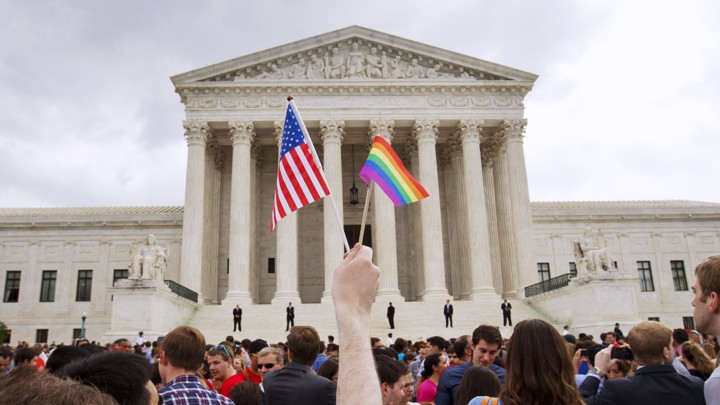
If one reads the wording atop the Supreme Court building, it says "equal justice under the law" - something that LGBT Americans in 26 states still do not enjoy.  I was forced from a law firm for being gay a decade and a half ago. It destroyed me financially and, while I am doing well financially again, I will never be in the financial position I would have enjoyed but for that bigotry based firing.  No one should have their life and their family harmed because of bigotry that clings to a selective parsing of Bronze Age myths and legends. 

And yes, I will continue to tell the truth about groups like Alliance Defending Freedom - and The Family Foundation - as long as they continue to disseminate lies about LGBT individuals and seek special rights for their knuckle dragging followers. . 

Monday, April 22, 2019

Supreme Court to Take Up Cases on LGBT Workplace Rights


Currently there are no express federal non-discrimination protections for LGBT employees in the workplace.  Similarly, over two dozen states - including Virginia - have no state law employment non-discrimination protections for LGBT citizens.  Given this void, some federal agencies and two of the U,S. Circuit Courts of Appeal have held that Title VII of the Civil Rights Act of 1964, in banning sex discrimination, also bans sexual orientation discrimination.  Yet another court held that the Act did not afford such expansive protections.  Now, the U.S. Supreme Court -stacked with Trump appointed anti-gay justices - will take up the question.  It is an issue that I am passionate about given my own experience more than a decade ago of being forced from a Virginia Beach law firm for being gay. That event, combined with an anti-gay divorce court judge forced me into bankruptcy. After being force to maintaining my own firm for eight years due to the homophobia in the local legal community, for the last five years I have been with gay accepting firms and have largely recovered financially.  I know first hand what religious based bigotry and hatred can do to harm lives.  A piece in  Politico looks at the appeals:
The Supreme Court has agreed to take up a set of high-profile cases involving gay rights and the rights of transgender people in the workplace.
The justices announced Monday that they will consider whether existing federal law banning employment-related sex discrimination also prohibits discriminating against individuals on the basis of sexual orientation or because they are transgender.
The Supreme Court said it will hear a pair of cases in which federal appeals courts split over whether LBGTQ employees are protected by the Civil Rights Act of 1964.
The justices also accepted a case involving a transgender funeral home employee, saying they will consider whether being transgender is protected in itself or whether it falls within existing law against “sex stereotyping.”
The cases are expected to be argued in the fall.
A piece in The Advocate gives more details on the posture of the three cases to be heard by the U.S. Supreme Court and the impact the ultimate decision will have on millions of LGBT Americans:
The Supreme Court has agreed to take up a set of high-profile cases involving gay rights and the rights of transgender people in the workplace.
The justices announced Monday that they will consider whether existing federal law banning employment-related sex discrimination also prohibits discriminating against individuals on the basis of sexual orientation or because they are transgender.
The Supreme Court said it will hear a pair of cases in which federal appeals courts split over whether LBGTQ employees are protected by the Civil Rights Act of 1964.
The justices also accepted a case involving a transgender funeral home employee, saying they will consider whether being transgender is protected in itself or whether it falls within existing law against “sex stereotyping.”
The cases are expected to be argued in the fall.
One involves Donald Zarda, a skydiving instructor who was fired from his job in 2010 after telling a client he was gay. His employer, New York-based Altitude Express, contended he was fired for touching the client inappropriately. The U.S. Court of Appeals for the Second Circuit, while not ruling on the merits of the case, did rule last year that Title VII of the Civil Rights Act of 1964, in banning sex discrimination, also bans sexual orientation discrimination. Altitude Express appealed to the Supreme Court, saying that the scope of the law should be decided by legislators, not the courts.
In the other sexual orientation case, Gerald Bostick, a social worker employed by Clayton County, Ga., said he was fired for being gay. County officials said his firing was for other reasons. In his case, the Eleventh Circuit Court of Appeals said Title VII did not apply because it did not explicitly address sexual orientation. The Supreme Court often agrees to hear cases where there is disagreement between circuits, known as a "circuit split."
In the gender identity case, funeral director Aimee Stephens was fired from a Michigan funeral home company in 2013 after she began presenting as a woman at work. The company, R.G. & G.R. Harris Funeral Homes, said she violated its dress code by wearing women’s clothing; her boss, Thomas Rost, also said she violated his religious beliefs about gender being God-given and immutable. The Seventh Circuit Court of Appeals ruled that companies cannot arbitrarily fire trans people and that discrimination based on gender identity is inseparable from discrimination based on sex. The funeral home operator, represented by the anti-LGBTQ Alliance Defending Freedom, appealed to the Supreme Court, objecting to that expansive interpretation of sex discrimination law.
In hearing these cases, the high court, which now has a conservative majority, could have a huge effect on LGBTQ rights. Civil rights groups said the matter underscores the need for the Equality Act, recently introduced in Congress, which would amend existing law to explicitly ban discrimination based on sexual orientation and gender identity, in employment and other facets of life.
Greg Nevins, senior counsel and workplace fairness program strategist for Lambda Legal, noted, “Title VII obviously requires equal treatment of men and women, so it was wrong to treat Donald Zarda (or Gerald Bostock) differently because of his attraction to men, when a Donna Zarda or Geraldine Bostock would not have endured discrimination for liking men. And when Aimee Stephens’ employer fired her after learning that she was undertaking a gender transition, her employer discriminated against her because of sex. These arguments couldn’t be more straightforward, and we are hopeful that the court will confirm that they are correct.”

Saturday, August 25, 2018

16 States Want Gays to Be Exempt from Civil Rights Protections


Anti-LGBT animus is alive and well 16 states - most in the South/Bible Belt - except for Utah, Wyoming, Nebraska and Maine (thanks to its lunatic GOP governor) - where the attorneys general have filed briefs urging the U.S. Supreme Court to rule that companies can fire workers based on their sexual orientation and gender identity without violating federal workplace discrimination laws.  The goal is the reversal of the EEOC position that firing gays or transgender is all about sex and sexuality and, therefore, Title VII of the 1964 Civil Rights Act is applicable.  The filing is motivated by Jeff Session's Justice Department position that ‘sex’ under the terms of Title VII does not mean anything other than biological status as determined at birth which is in direct opposition to the EEOC position.  As Joe Jervis notes, the brief was co-authored by Nebraska Deputy Attorney General David Bydalek, formerly policy director of the vociferously anti-gay Nebraska affiliate of Focus On The Family.  One can only hope that progressive corporations and businesses take not and avoid these states.  Here are highlights from Bloomberg:
A group of 16 states urged the U.S. Supreme Court Aug. 23 to rule that companies can fire workers based on their sexual orientation and gender identity without violating federal workplace discrimination law.
The states, led by Nebraska Attorney General David Bydalek, asked the justices to overturn an appeals court decision against a Michigan funeral home that fired a transgender worker. They said Congress didn’t intend the ban on sex discrimination in Title VII of the 1964 Civil Rights Act to cover bias against lesbian, gay, bisexual, or transgender employees.
“The States’ purpose is to note that ‘sex’ under the plain terms of Title VII does not mean anything other than biological status,” Bydalek wrote.
The friend-of-the-court brief is the latest development in a legal debate that has divided courts and exposed a rift within the Trump administration. The Equal Employment Opportunity Commission says LGBT bias already is banned, but the Justice Department disagrees.
The EEOC successfully sued on behalf of Aimee Stephens, who was fired from her job at R.G. & G.R. Harris Funeral Homes after telling a supervisor she was transitioning to a woman. But the agency must get the Justice Department’s approval if it wants to participate in the case at the Supreme Court level.
A total of 13 Republican attorneys general, including those representing Texas, Alabama, Kansas, and Utah, signed on to the brief. Three GOP governors— Matthew Bevin (Kentucky), Paul LePage (Maine), and Phil Bryant (Mississippi)—also joined in the court filing.
The Supreme Court is expected to decide in the coming months whether to take up the case. It’s also been asked to consider two other cases testing whether sexual orientation bias is a form of sex discrimination banned under the existing law.
Laws in 20 states and Washington, D.C., directly ban employment discrimination based on sexual orientation and gender identity. That includes bans in Utah and Maine.
The U.S. Court of Appeals for the Sixth Circuit in 2017 became the first federal appeals court in the country to conclude that transgender bias is a form of sex discrimination under Title VII when it said Harris Funeral Homes violated the law by firing Stephens.