Showing posts with label Fidel Castro. Show all posts

Thursday, February 27, 2020

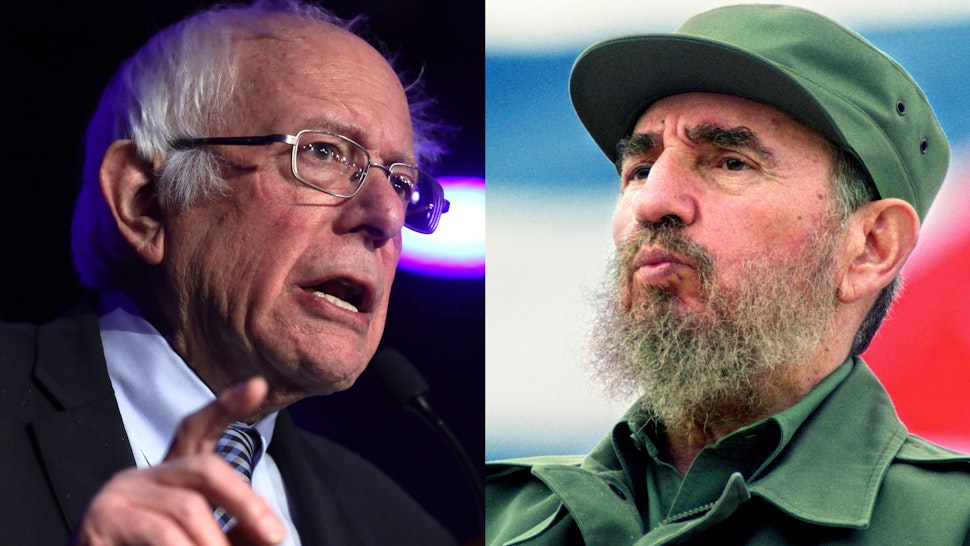
Sanders Reaffirmed His Admiration for the Castro Regime’s Social Policies

Bernie Sanders remains unrepentant for his praise of brutal totalitarian regimes, especially that of Fidel Castro.  Given Sanders' "my way or the highway" mindset, one cannot help but wonder if Sanders doesn't admire forcing change even when the populace doesn't want, particularly if it promotes his left wing ideology.  A piece in the Miami Herald from 2016 looks at the number of Cubans murdered by Castro's brutal regime:
The late and widely respected University of Hawaii historian R. J. Rummel, who made a career out of studying what he termed “democide,” the killing of people by their own government, reported in 1987 that credible estimates of the Castro regime’s death toll ran from 35,000 to 141,000, with a median of 73,000.


This is the regime Sanders has lauded. A column in the Washington Post looks at the myth that Castro's regime greatly reduce illiteracy.  Tell the families of those murdered or forced into exile that a meager increase in literacy was worth the blood bath.  If Sanders is so wrong about the Castro regime - and the Soviet and Sandinista regimes - what else is he wrong about? Democrats are insane if they give Sanders their party nomination.  The only one who benefits is Donald Trump and his horrible regime.  Here are Post column excerpts:
Unfazed by the howls of indignation — honest or feigned — over his recent praise of communist Cuba, Sen. Bernie Sanders (I-Vt.) has reaffirmed his admiration for the Castro regime’s social policies over the past few days. He has done so while simultaneously insisting that he’s “very opposed to the authoritarian nature of Cuba.”
But can the achievements of any monstrous regime ever be praised? Is it really possible to separate the cruelty of any dictatorship from any of its policies? In the case of communist Cuba, a further question arises: Is it possible to believe any of the claims it makes for its own achievements, given that it generates its own statistics and promotes its own version of history?
And anyone who would care to do some fact-checking, as did The Post’s Glenn Kessler a few years ago, will quickly discover that the Sanders version of Cuban history is far from accurate.
First, consider the issue of literacy in Cuba before Castro came along. Was pre-Castro Cuba a nation of illiterates, and Castro’s literacy campaign as great an accomplishment as Sanders avers? Not at all. A Cuban census from 1953 found that 77.9 percent of the island’s total population was already literate, and that in urban areas the literacy rate was 88.9 percent: among the highest in Latin America and higher than in some benighted rural counties in the United States. Seven years later, in 1960, according to data compiled at Oxford University, the literacy rate for the entire island was 79 percent.
So the scope of Castro’s 1961 literacy campaign, much admired by Sanders, is more myth than reality. Moreover, the image of pre-Castro Cuba as a primitive society rescued from poverty and illiteracy by a so-called revolution is a deceitful caricature, one brilliantly conceived by the Castro regime to make its brutality seem less offensive — merely “authoritarian” rather than monstrous.
Second, consider the real purpose of Cuba’s literacy campaign. Can it be totally disassociated from the repression that accompanied it, as Sanders would like you to think? Far from it. At the very same time that it was teaching illiterate Cubans to read, the Castro regime was busy stifling all freedom of expression. It banned any books that displeased it, shut down all newspapers and magazines, and flooded schools with texts that were pure propaganda. It turned each and every school on the island into an indoctrination camp in which no deviation from Marxist orthodoxy was ever allowed.
In other words, the literacy campaign was designed to enhance a totalitarian state’s control of its people. The fact that it lent a falsely benevolent sheen to Castro was an added bonus, but there is no denying that the Maximum Leader taught Cubans to read so that their thinking could be more carefully controlled by his propaganda machine.
Try to imagine Sanders or any other leftist ever insisting that it is “unfair” to deny the Third Reich praise for some of its accomplishments, such as the building of the Autobahn.
The “good” things Sanders finds in communist Cuba should seem immensely disturbing to Americans, even frightening. His vehemence in defending these “good” things, which in truth are hollow victories stained with blood, should also set off alarms, for this peculiar obsession reveals more than some character flaw.
Sanders’s insistence on finding positive things to say about Fidel Castro might be the clearest indication he has yet given American voters of his own sources of inspiration, and of his vision for the future of the United States.


#NeverSanders

Thursday, September 29, 2016

How Donald Trump Violated the U.S. Embargo Against Cuba


Donald Trump likes to talk about "crooked Hillary," but given the Trump University scam, Trump's use of his foundation as a personal piggy bank, and Trump's six bankruptcies and screwing over of contractors, Trump is the one who looks crooked.  Now, on top of all of this, Newsweek is reporting that Trump violated the U.S. trade embargo against Cuba.  Admittedly, the dollar amounts are not huger - at least for someone like Trump.  But what I find so disturbing is Trump's attitude.  Like his Christofascist supporters, Trump obviously thinks that he is above the laws that apply to the rest of America.  Here are excerpts from the Newsweek piece:
A company controlled by Donald Trump, the Republican nominee for president, secretly conducted business in Communist Cuba during Fidel Castro’s presidency despite strict American trade bans that made such undertakings illegal, according to interviews with former Trump executives, internal company records and court filings.

Documents show that the Trump company spent a minimum of $68,000 for its 1998 foray into Cuba at a time when the corporate expenditure of even a penny in the Caribbean country was prohibited without U.S. government approval. But the company did not spend the money directly. Instead, with Trump’s knowledge, executives funneled the cash for the Cuba trip through an American consulting firm called Seven Arrows Investment and Development Corp. Once the business consultants traveled to the island and incurred the expenses for the venture, Seven Arrows instructed senior officers with Trump’s company—then called Trump Hotels & Casino Resorts—how to make it appear legal by linking it after the fact to a charitable effort.
The payment by Trump Hotels came just before the New York business mogul launched his first bid for the White House, seeking the nomination of the Reform Party. On his first day of the campaign, he traveled to Miami, where he spoke to a group of Cuban-Americans, a critical voting bloc in the swing state. Trump vowed to maintain the embargo and never spend his or his companies’ money in Cuba until Fidel Castro was removed from power.

He did not disclose that, seven months earlier, Trump Hotels already had reimbursed its consultants for the money they spent on their secret business trip to Havana.
 Without obtaining a license from the federal Office of Foreign Assets Control (OFAC) before the consultants went to Cuba, the undertaking by Trump Hotels would have been in violation of federal law, trade experts say.

Officials with the Trump campaign and the Trump Organization did not respond to emails seeking comment on the Cuba trip, further documentation about the endeavor or an interview with Trump. Richard Fields, who was then the principal in charge of Seven Arrows, did not return calls seeking comment.

In that statement, Conway has acknowledged that Trump broke the law. Paying the money for the business trip and meetings in Cuba – regardless of whether it resulted in an additional investment or casino deal – would directly violate the law. 
[O]ne OFAC official, who agreed to discuss approval procedures if granted anonymity, says the probability that the office would grant a license for work on behalf of an American casino is “essentially zero.”


The goal of the Cuba trip, the former Trump executive says, was to give Trump’s company a foothold should Washington loosen or lift the trade restrictions. While in Cuba, the Trump representatives met with government officials, bankers and other business leaders to explore possible opportunities for the casino company. The former executive says Trump had participated in discussions about the Cuba trip and knew it had taken place. 
The fact that Seven Arrows spent the money and then received reimbursement from Trump Hotels does not mitigate any potential corporate liability for violating the Cuban embargo. . . . If OFAC discovered this and found there was evidence of willful misconduct, they could have made a referral to the Department of Justice.” 
Like the Communist regime, the company was struggling, having piled up losses for years. In 1998 alone, Trump Hotels lost $39.7 million, according to the company’s financial filings with the Securities and Exchange Commission. Its stock price had collapsed, falling almost 80 percent from a high that year of $12 a share to a low of just $2.75.

Though it has long been illegal for corporations to spend money in Cuba without proper authorization, there is no chance that Trump, the company or any of its executives will be prosecuted for wrongdoing. The statute of limitations ran out long ago, and legal analysts say OFAC’s enforcement division is understaffed, so the chances for an investigation were slim even at the time.

And perhaps that was the calculation behind the company’s decision to flout the law: the low risk of getting caught versus the high reward of lining up Cuban allies if the U.S. loosened or dropped the embargo. The only catch: What would happen if Trump’s Cuban-American supporters ever found out?

Wednesday, January 06, 2016

Rafel Cruz - The GOP's Mythical Hero


If one wants to find where Ted Cruz gets is craziness from and how he has become so challenged when it comes to telling the truth, look no farther than his nut case father, Rafel Cruz, who has artfully re-written his personal history and happily allowed his son's lunatic and religious extremist followers to transform Rafel Cruz into an almost mythical figure.  While the Cruz campaign doesn't actively promote the myth, it does nothing to set the record straight, including making it clear that Cruz senior fought - if one can use the word - on the side of Castro and not against him.  The story line of Rafel Cruz is, in short, a lie.  A piece in The Daily Beast looks at the myth making effort.  Here are highlights:


Rafael Cruz has biography that seems made of Red-State American dreams: fleeing Cuba, coming to the United States, becoming a born-again Christian, falling hard for Reagan, and now trying to help his son, Ted, inspire an Evangelical resurgence in American politics.

It’s a compelling narrative, and it makes for a great Tea Party rally speech. Cruz was his son’s most beloved surrogate during the 2012 Texas Senate race, and the admiration he found from Tea Party crowds only grew.

But as Rafael Cruz’s star has risen, so have a multitude of myths about his life that Team Cruz doesn’t exactly discourage

[W]hile Rafael himself and the Cruz campaign haven’t (to our knowledge) publicly said anything inaccurate about his personal history, they have left uncorrected some tales that members of the media and prominent conservative activists have woven about Cruz the Elder -- including tales that are totally divorced from reality (and in some cases easily found on the Internet).

It’s unclear where the Rafael Cruz mythologies came from and how much they benefit his standing in the Evangelical community. But it’s clear that the myths are pernicious, and that they’re impactful.
One of the first and most galling falsehoods about Rafael Cruz’s past is the notion that he fought communism. He didn’t, but that hasn’t stopped some of his most vocal backers from repeating, in contravention of all fact, that he suffered under communism and took on Fidel Castro.

Cuba may have been a hellhole when Rafael Cruz was growing up there.  But there’s one thing it wasn’t: communist.

As Andy Kroll detailed in his National Journal profile of Rafael Cruz, the future senator’s father fought against the island nation’s dictator, General Fulgencio Batista. 

In reality, the Batista regime gave Rafael Cruz a student visa in 1957, which he used to travel to the U.S. Two years later, in 1959, Castro became prime minister of Cuba and the island nation became a communist country.

And when it comes to literal fighting in armed conflict, Rafael Cruz fought on only one side: Fidel’s. But this false implication that he was on the other side of history still finds its way into the first pages of his very own book. This isn’t the only instance of Cruz World overlooking misperceptions about Cruz the Elder’s Cuban background.

But that’s not the only persistent rumor. Multiple major publications have reported Rafael Cruz: that he pastors a church in the suburbs of Dallas. Except that he hasn’t. Ever.   

Rick Tyler, a spokesman for Cruz’s campaign, told the Daily Beast that these reports are all wrong, and that Rafael Cruz has never pastored any churches.  He is an ordained minister, Tyler said, but has never led a congregation.

Any relation to “Purifying Fire Ministries,” by the way, is another Cruz mythology. Tyler said Cruz initially branded his work preaching to pastors’ groups with that moniker, but ditched it when he realized that Suzanne Hinn -- wife of famous and sketchy televangelist Benny Hinn -- had a ministry with almost the identical name.

It’s an odd situation. And if his son’s rise continues at the rate it’s going, it could generate no dearth of confusion for people looking for the truth about the dad of the maybe-president.

Monday, November 09, 2015

Another Campaign Untruth: Ted Cruz’s Father’s Story of Fighting for Castro

Ted Cruz and Rafael Cruz- two consummate liars and nutcases
It increasing seems that being a shameless liar is a prerequisite to being a Republican presidential nominee contestant.  Either the candidates themselves are telling the lies or close family members are providing the false story lines.  Candidly, as the Christofascists have risen in power within the GOP, the level of lying and demagoguery has directly increased.  Now, Ted Cruz finds himself under fire for his father's fraudulent lies that have been woven into Cruz's own fairy tale narrative.  The older Cruz - who in my opinion belongs in an insane asylum - has made claims of "fighting for freedom" in Cuba as a young man.  The trouble is that many of the details he used to embellish his story simply are not true.  The New York Times looks at the truth about the elder Cruz's made up narrative.  Here are excerpts:
Since he was a boy, Senator Ted Cruz has said, all he wanted to do was “fight for liberty” — a yearning that he says was first kindled when he heard his father’s tales of fighting as a rebel leader in Cuba in the 1950s, throwing firebombs, running guns and surviving torture.
Those stories, retold by Mr. Cruz and by his father, Rafael, have hooked Republican audiences and given emotional power to the message that the Texas senator is pushing as a contender for the party’s presidential nomination. 

But the family narrative that has provided such inspirational fire to Mr. Cruz’s speeches, debate performances and a recently published memoir is, his father’s Cuban contemporaries say, an embroidered one.

The elder Mr. Cruz, 76, recalls a vivid moment at a watershed 1956 battle in Santiago de Cuba, when he was with a hero of the revolution, Frank País, just hours before he was killed in combat.  In fact, Mr. País was killed seven months later and in a different place and manner.

In interviews, Rafael Cruz’s former comrades and friends disputed his description of his role in the Cuban resistance. He was a teenager who wrote on walls and marched in the streets, they said — not a rebel leader running guns or blowing up buildings.

Leonor Arestuche, 79, a student leader in the ’50s whom the Castro government later hired to verify the supposed exploits of revolutionary veterans, said a term existed for people like Mr. Cruz — “ojalateros,” or wishful thinkers.   “People wishing and praying that Batista would fall,” she said, “but not doing much to act on it.”

There is no question that Rafael Cruz, who is now a pastor and his son’s most effective and popular campaign surrogate, was beaten in 1957 at the hands of agents for Fulgencio Batista, the Cuban dictator.

The reason Mr. Cruz was arrested, however, is less clear, and he has offered different explanations. In an interview alongside his son in March, Mr. Cruz said he had sought to recruit to the revolutionary cause someone who turned out to be an informant working for Batista’s regime. The 1959 account, though, did not mention any informant . . . . 

Mario Martínez, who Mr. Cruz confirmed was part of his small revolutionary cell, said he did not recall Mr. Cruz’s being apprehended for trying to recruit someone and said he believed that the cause of his old comrade’s detainment was possession of a revolver — one that Mr. Cruz had never used. 

[N]one of the Cuban historians, former comrades of Mr. Cruz in his hometown or veterans of the Santiago battle reached by The Times could corroborate his story. 

[V]eterans of the operation questioned Rafael Cruz’s account of his involvement.  Luís Clergé, who prides himself on knowing the names of the commandos he served with in the Nov. 30 operation, had no memory of Mr. Cruz.   Mr. Cruz’s name also drew blanks from Luís Solá Vila, a leader of the Federación Estudiantil Universitaria, a campus-based activist group in Santiago, and Luís Gálvez Taupier, a university leader who worked closely with the movement’s youth brigades, among others.

In his book “A Time for Truth,” published in June, Ted Cruz writes that the rebels who attacked the Santiago Police Headquarters met devastating resistance, and “All of the students were killed, as was their leader, Frank País.”

But of the scores of rebels who participated in the attack, only a few were killed, according to eyewitness accounts and historical documents.

It looks like Ben Carson is not the only GOP candidate challenged by truth and veracity.  Both Carson and Cruz are pushing narratives that play well with the idiots and Christofascists of the GOP regardless of whether or not they bear any semblance to reality.  Among most normal and honest people, this amounts to lying.  Deliberately lying.

Sunday, December 21, 2014

Cuba's Evolution on Gay Rights

Mariela Castro
With the United States finally beginning to change its failed policies against Cuba - despite the protests of many older Cubans who fled Castro's regime - some believe the evolution Cuba has made on gay rights could be a blue print for easing restrictions on other personal freedoms in the island nation.  One would think that 50 years of a failed policy that has not yielded desired results ought to send a message that remaining on the same course is an exercise in futility.  Of course, don't tell that to the today's GOP which cares little about objective reality and increasingly looks like a large insane asylum.  Personally, I'd like to see travel to Cuban opened up because over time open access to the rest of the world and an influx of capital and ideas is the quickest way to transform Cuba despite the efforts of the Castro regime.  But I digress.  Here are highlights from a New York Times piece on Cuba's evolution on gay rights:
In Cuba, street marches have historically been government-orchestrated events or dissident protests that are swiftly crushed by the authorities. So it was downright startling when, in May 2007, Fidel Castro’s niece sauntered down the street with a small army of drag queens waving gay pride flags.

Long before the Obama administration announced a dramatic shift in Cuba policy on Wednesday, asserting that isolating the island had failed, a couple of Western governments with close ties to the United States saw the potential to help gay Cubans, even though it meant working with a prominent member of the Castro family. Havana’s first observance of the International Day Against Homophobia and Transphobia marked the beginning of a remarkable evolution of gay rights in the most populous island in the Caribbean, a region where hostile attitudes toward sexual minorities remain the norm.

Mariela Castro, the daughter of the current president, Raúl Castro, has led the charge on legislative and societal changes that have given rise to an increasingly visible and empowered community. In the process, she has carved out a rare space for civil society in an authoritarian country where grass-roots movements rarely succeed. Some Western diplomats in Havana have seen the progress on gay rights as a potential blueprint for expansion of other personal freedoms in one of the most oppressed societies on earth.

Norway and Belgium have financially supported Ms. Castro’s organization, the National Center for Sexual Education, offering a test of the merits of supporting certain policies of a government that the United States and European capitals have largely shunned because of its bleak human rights record. As the Obama administration begins carrying out its new Cuba policy, it should draw lessons from the impact others have had by engaging.

“It’s fine to criticize, but you also have to acknowledge that they’ve done good,” said John Petter Opdahl, Norway’s ambassador to Cuba, in a recent interview. Mr. Opdahl, who is gay, said his government gave Ms. Castro’s organization $230,000 over the last two years. “She has taken off a lot of the stigma for most people in the country, and she has made life so much better for so many gay people, not only in Havana but in the provinces.”

After the 2007 march, Ms. Castro, who is straight, began a public campaign to promote tolerance. She persuaded the government in recent years to offer state-paid gender reassignment surgery and hormone treatment for transgender people. Last year, when the Assembly passed a labor code that protected gays and lesbians — but not transgender people — from discrimination in the workplace, Ms. Castro became the first lawmaker in Cuban history to cast a dissenting vote in protest. Her ultimate goal, she said, was codifying full equality under the law.

Gay Cubans say that discrimination remains a problem, particularly outside big cities. Still, last year, a woman in Caribién, a municipality east of Havana, became the country’s first transgender elected official. At the urging of Ms. Castro and gay bloggers, in 2010 Cuba began voting in favor of resolutions supporting gay rights at the United Nations, breaking ranks with allies in Africa and the Caribbean.

The Obama administration has spent millions of dollars promoting gay rights around the world and has made the issue a diplomatic priority. In the Dominican Republic, Washington took a bold stance last year when officials appeared unwilling to accept Wally Brewster, the openly gay entrepreneur President Obama nominated as ambassador. The State Department warned Santo Domingo that if it turned Mr. Brewster down, the country would find itself without an American envoy for a long time.

When Dominican officials acquiesced, they asked that Mr. Brewster be discreet about his sexual orientation. American officials responded that he, like all ambassadors in the region, would be expected to champion gay rights. To make the point, the State Department released a video of Mr. Brewster and his partner expressing their enthusiasm for the new job.

Ms. Machado said most gay rights activists on the island have not accepted support from Washington because its policy toward Cuba was predicated on regime change. “While the United States is the enemy of our state, we can’t work with them,” she said recently in an interview in Havana. “Any support you receive makes you a traitor.”

That entrenched view has stymied American efforts to promote things such as freedom of assembly and freedom of the press. President Obama’s changed policy will make engagement with Americans more palatable.

The far right claims to care about human rights even though its actions tell a very different story as the GOP continues to embrace and and support homophobes, white supremacists and those who seek to keep women subservient to men.