Showing posts with label race relations. Show all posts

Tuesday, July 14, 2020

Is Donald Trump Beginning to Implode?


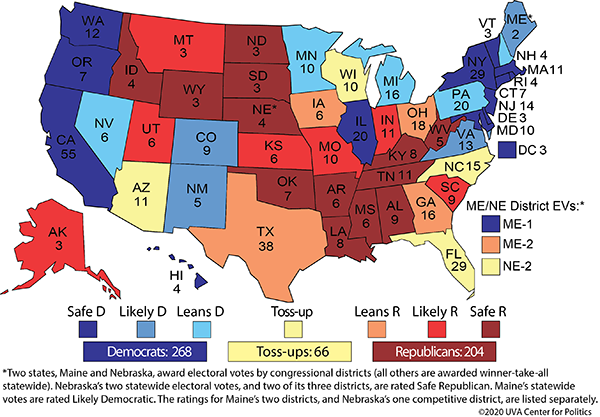
As Donald Trump continues to double down on rhetoric that thrills his core base of racists and Christian extremists in the hope of turning out his base in November, the opposite effect is happening with the rest of the population.  Indeed, the more ugly Trump's rhetoric becomes, the more voters he appears to be driving away.  A piece in Larry Sabato's Crystal Ball even shows Trump's lead in reliably red states dwindling and has caused GOP stalwart states like Alaska, Indiana, Kansas, Missouri, Montana, South Carolina, and Utah from "safe Republican" to "likely Republican."  One can only hope that Trump's hemorrhaging of support continues and that the presidential election becomes a rout with Biden winning by a landslide.  Personally, I want this to happen because it would restore some shred of faith in the American public as a whole and because it would devastate Trump's ego - Trump's pain is my pleasure, if you will.  Here are highlights from the Crystal Ball:

We are now about six weeks into a downturn in Donald Trump’s polling numbers. It’s worth thinking about the ramifications of this change if it endures.
In the RealClearPolitics average of national approval polling, Trump went from about early December to late May without ever dipping below -10 in net approval (approval minus disapproval). He has spent every day since June 1 at or below -10 net approval, and he’s currently at about -15.
Joe Biden’s national polling lead over Trump through May was in the four-to-six-point range. That is a decent lead, but not one that suggested Biden was a towering favorite . . . . But since early June, Biden’s lead has ballooned to the eight-to-10-point range. He has also enjoyed healthy leads in many polls of the most important swing states, like Florida, Michigan, Pennsylvania, and Wisconsin.
The bottom line here is that the nation is in a state of terrible crisis, and the public has, at least for now, judged the president’s responses to both coronavirus and protests of racial inequalities in policing to be lacking.
In an ABC News/Ipsos poll released Friday, 67% of respondents disapproved of Trump’s handling of coronavirus and of race relations. . . . . It is not the kind of year when one wants to be an incumbent running for reelection, and a majority of the public appears to believe that this president is not meeting the moment.
A few weeks into the public health crisis, we explored the possibility of Trump being the second iteration of Jimmy Carter, whose reelection bid fell apart among myriad crises in 1980. Since then, the Trump-as-Carter scenario has grown even more plausible.
There is time for the situation to change — as we wrote a few weeks ago, we want to see where things stand after the conventions, around Labor Day. But Trump is extremely unlikely to win if the polls continue to look the way they do now. And if these numbers represent a new normal, we need to account for the possibility that this election won’t be particularly close, and that new states may come into play. In other words, if the national picture remains bleak for Trump, then the slippage he’s seen from earlier this year wouldn’t just be limited to a handful of swing states.
The very well-sourced New York Times trio of Maggie Haberman, Jonathan Martin, and Alexander Burns recently reported that internal Republican data showed Trump with only a small lead in Montana and trailing in Kansas, two states that Trump carried by about 20 points apiece in 2016 (both have competitive Senate races, too).
Trump’s position is weak enough in mid-July that we have to concede there are some signs of competitiveness in states that were not competitive in 2016. This sort of thing can happen when the overall election is tilted toward one side over the other, which is the state of play at the moment and the advantage Biden currently holds.
[W]e continue to rate states like Colorado, New Mexico, and Virginia as Likely, not Safe, Democratic. That’s despite it being hard to imagine Trump carrying any of them, even if his position dramatically improves.
So we’re moving seven Safe Republican states to Likely Republican: Alaska, Indiana, Kansas, Missouri, Montana, South Carolina, and Utah. . . . In all likelihood, these red states are going to vote for Trump, and not just by a few points.
But could one or more flip if Biden wins decisively in November? Possibly. Let’s remember: A “Likely” rating still means we see one side — in this case, the Republicans — clearly favored in a state. We just don’t feel 100% certain about these states in the event of a lopsided election.
We think we’ll get more clarity about which scenario is more likely following the conventions — whatever the conventions actually look like. Even with 2020’s scaled down, undramatic, and overshadowed conventions, voters and media see them as departure points into the general election. Casting a ballot is no longer just on the distant horizon. It’s a reality that will firm up people’s choices — and our ratings.

Sunday, February 17, 2008

The Grand Old White Party

In today’s New York Times, Frank Rich looks at the Republican Party’s continued drift away from the mainstream in this country. In addition to being largely controlled by the Christianist elements of the Party – who hate everyone who isn’t just like them, with gays and immigrants (translation, non-whites) being the favorite whipping boys – the Party is becoming more and more lily white. Having once worked in Richmond, Virginia, Rich also has some interesting reflections on Virginia’s sometimes agonizingly slow movement towards the 21st century, particularly in terms of race relations. Amazingly, for all its procrastination, lapses and delays, Virginia is moving faster toward embracing the future than the Republican Party. Then too, Rich takes a few shots at my former law school classmate, former Senator George Allen. Here are some highlights (http://www.nytimes.com/2008/02/17/opinion/17rich.html?em&ex=1203397200&en=2427f7c3cc6ed0d0&ei=5087%0A):

Senator Obama’s televised victory oration celebrating his Chesapeake primary trifecta on Tuesday night was a mechanical rehash. No matter. When the networks cut from the 17,000-plus Obama fans cheering at a Wisconsin arena to John McCain’s victory tableau before a few hundred spectators in the Old Town district of Alexandria, Virginia, . . . What distinguished his posse from Mr. Obama’s throng was not just its age but its demographic monotony: all white and nearly all male. Such has been the inescapable Republican brand throughout this campaign, ever since David Letterman memorably pegged its lineup of presidential contenders last spring as “guys waiting to tee off at a restricted country club.” Trapped in an archaic black-and-white newsreel, the G.O.P. looks more like a nostalgic relic than a national political party in contemporary America. A cultural sea change has passed it by.

Given that the American story has been so inextricable from the struggle over race, the Obama triumph has been the bigger surprise to many. Perhaps because I came of age in the racially divided Washington public schools of the 1960s and had one of my first newspaper jobs in Richmond in the early 1970s, I almost had to pinch myself when Mr. Obama took
52 percent of Virginia’s white vote last week. The Old Dominion continues to astonish those who remember it when.

Here’s one of my memories. In 1970, Linwood Holton, the state’s first Republican governor since Reconstruction and a Richard Nixon supporter,
responded to court-ordered busing by voluntarily placing his own children in largely black Richmond public schools. For this symbolic gesture, he was marginalized by his own party. Today Anne Holton, the young daughter sent by her father to a black school in Richmond, is the first lady of Virginia, the wife of the Democratic governor, Tim Kaine.

For all the changes in Virginia and elsewhere, vestiges of the Southern strategy persist in some Republican quarters. Mr. McCain, however, has been a
victim, rather than a practitioner, of the old racial gamesmanship. He is still paying for correctly describing Jerry Falwell, once an ardent segregationist, and Pat Robertson, a longtime defender of South African apartheid, as “agents of intolerance.” And of course Mr. McCain remains public enemy No. 1 to some in his party for resisting nativist overkill on illegal immigration.

Whatever the potency of his political skills and message, Mr. Obama is also riding a demographic wave. The authors of the new book “Millennial Makeover,” Morley Winograd and Michael D. Hais,
point out that the so-called millennial generation (dating from 1982) is the largest in American history, boomers included, and that roughly 40 percent of it is African-American, Latino, Asian or racially mixed. One in five millennials has an immigrant parent. It’s this generation that is fueling the excitement and some of the record turnout of the Democratic primary campaign, and not just for Mr. Obama.

Mr. McCain could get lucky, especially if Mrs. Clinton gets the Democratic nomination and unites the G.O.P., and definitely if she tosses her party into civil war by grabbing ghost delegates from Michigan and Florida. But those odds are dwindling. I was startled to hear last week from a friend in California, a staunch anti-Clinton Republican businessman, that he was wavering. Though he regards Mr. McCain as a hero, he wrote me: “I am tired of fighting the Vietnam war. I have drifted toward Obama.”

Among the white guys flanking Mr. McCain at his victory celebration on Tuesday, revealingly enough, was the once-golden George Allen, the Virginia Republican who lost his Senate seat and presidential hopes in 2006 after being
caught on YouTube calling a young Indian-American Democratic campaign worker “macaca.” In that incident, Mr. Allen added insult to injury by also telling the young man, “Welcome to America and the real world of Virginia.” As election results confirmed both in 2006 and last week, it is Mr. Allen who is the foreigner in 21st century America, Mr. Allen who is in the minority in the real world of Virginia. A national rout in 2008 just may be that Republican Party’s last stand.