Showing posts with label anti-science regimes. Show all posts

Friday, May 01, 2020

How Trump Gutted Obama’s Pandemic-Preparedness Systems

The Trump/Pence regime continues to try to re-write the regime's bungled response to the coronavirus pandemic, that has ranged from (i) the dissolution of the Obama pandemic directorate within the National Security Council, (ii) a willful blindness to anything that doesn't conform to a right wing ideology, to (ii) Trump's rejection of science and objective facts while pandering to his knuckle dragging base (today he called armed protesters who stormed thew Michigan legislature "very good people"). It is critical in the lead up to 2020 election that voters understand the Trump regime's ineptitude and role in making the pandemic even worse. A piece in Vanity Fair reviews the bungling that is the hallmark of the Trump/Pence regime.  Here are article excerpts:

When the first reported cases of Ebola in Guinea came to light in March 2014, it set off a mad scramble inside the Obama White House to track and contain the spread of the virus, which killed around 50% of the people it infected. Though not nearly as contagious as the current coronavirus, an epidemic, or even a pandemic, seemed possible if the disease weren’t confined to its West African redoubts. The Obama White House had clear protocols and chains of command for these kinds of threats. “The way to stop the forest fire is to isolate the embers,” Beth Cameron, a former civil servant who ran the White House’s National Security Council Directorate for Global Health Security and Biodefense, told me.
In the summer of 2018, on John Bolton’s watch, the team Cameron once ran was one of three directorates merged into one amid an overhaul and streamlining of Donald Trump’s National Security Council. And the position Monaco previously held, homeland-security adviser, was downgraded, stripped of its authority to convene the cabinet.
Obama’s team never faced a crisis as serious as the novel coronavirus, a truly unprecedented challenge. But officials who worked on past crises and experts on pandemic response believe that Trump’s dismissal—and in some aspects, wholesale discarding—of the Obama administration’s preparedness structures and principles, and the current administration’s ideas about government. . . . have left them dangerously unprepared.
“What the administration lacked in February, and still lacks today is articulating an overall strategy for managing this crisis,” a former administration official told me.
Trump has yet to do this. “President Trump has, throughout this, seemed a little schizophrenic about his role, . . . . “On the one hand, he clearly wants all the credit for it when things go right. On the other hand, he has furiously attempted to avoid having to take ownership for the success of the effort…he wants the credit without the accountability.”
The biggest difference between Obama’s approach and Trump has to do with science. “Traditionally, we have had a situation where the response is always scientifically, technically proven,” says a former government official. “Of course there are political considerations. But the options that are presented are fundamentally sound from a scientific perspective.”
In the current situation, the president decides which scientists and governmental organizations are listened to. “We’re seeing that institutions like the FDA and the CDC have been curtailed; their ability to do the right thing has been curtailed,”  . . .
Trump critics are quick to draw contrast between the COVID-19 and Ebola crises. Obama, they assert, was guided by objective facts. “One of the principles [that] President Obama was very clear on when it came to public health crises is you have to be guided by science and facts and speak clearly and consistently and credibly on those issues,” . . . . “President Obama’s view was, we’re not going to be buffeted by the political winds here. We’re going to go with what the scientists and the public health experts tell us is in our best interest,” she said.
The U.S. crisis response structure has not been equipped to span all 50 states. “The system...is very heavily designed around a relatively short duration, very geographically specific incidents, things like hurricanes and earthquakes and tornadoes and tsunamis,” the former administration official told me. The refrain is, “locally executed, state managed, and federally supported.” And the thinking goes, when a locality gets overwhelmed—say a hurricane or a tornado hits—it goes to its state; if that state gets overwhelmed it will go to neighboring states for assistance, mutual aid; and when that system is exhausted, the federal government steps in with additional resources.
It is this federal-support piece that has been missing, sources I spoke with say.
The reorganization and streamlining of the National Security Council in the Trump era, specifically whether Bolton dismantled an office focused on pandemics, has emerged as a point of discussion and competing narratives. At the start of the Trump administration, Tom Bossert held the position and, as an assistant to the president, had the highest rank of commissioned officers in the White House. Cameron recalled that during the presidential transition, Rice pushed for pandemics to be one of the three topics covered in an exercise with the incoming administration.
But when Bolton was tapped to replace H.R. McMaster, Bossert was shown the door and the position was downgraded to a deputy assistant to the president, no longer able to convene the cabinet. . . . Today, the position of homeland-security adviser is vacant.
The role of the homeland-security adviser was created after the 9/11 attacks, the premise being that one person in the West Wing, steps away from the Oval Office, was focused solely on immediate domestic threats. “The idea is you want somebody in the White House who is directly and immediately responsible to the president on these issues,” explained Monaco, who earned the nickname “Dr. Doom” from Obama in the role. . . . you need to have that direction and an ability to quickly break through bureaucratic impediments and move quickly...pursuant to an overall strategy.”
The novel coronavirus is exposing the inadequacies of a cornerstone of Trump’s (and Kushner’s) governing philosophy. “The entire argument behind electing Donald Trump is that business can handle anything better than the government, right? So the entire philosophy, the entire ideology of every senior leader in the White House and that they’ve installed across the federal government is, ‘Get the private sector to do it.
But the problem is, there are some things only the federal government can do, after all. “This is the crisis for this administration, just as every administration faces, that challenges its ideology and worldview to its core and cannot be effectively addressed with that worldview.”
With no sign that Trump is poised to fill the leadership vacuum, sources I spoke with fear the devastation is only beginning. “I think that we will eventually come out the other side, but it’s going to be one where it would take longer and they would lead to more loss of life,” the former government official told me.
Juliette Kayyem, a former homeland-security official in the Obama administration who played a critical role in the H1N1 crisis and the vaccination rollout, was blunt in her assessment. President Trump does not have the capacity to govern a mass vaccine-distribution program because that’s going to be some really hard decisions,” she told me. For instance, who gets it first? . . . . The biggest problem she sees today is, “This president doesn’t make decisions based on objective criteria.”

Friday, April 24, 2020

The Pandemic Should be a Call to Action on Climate Change

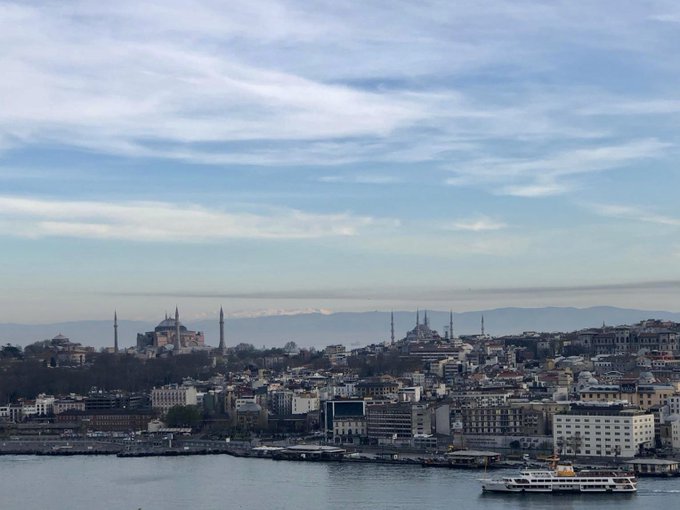
Clear skies over Istanbul with mountains visible.
The Covid-19 pandemic should be a wake up call that some things know no national borders, including climate change.  In addition, travel bans, economic slowdown and greatly reduced use of automobiles has made the impact of human activity on climate obvious as smog and air pollution and water pollution has been reduce to yield clear skies and clear water not seen in some areas in years.  Yet while this stark reminder is before us, the Trump/Pence regime - which so bungled the pandemic response - continues to wage war against clean air and clean water regulations and is loosening offshore oil drilling regulations, refusing to believe in science and pandering to special interest political donors. It's an insane strategy, but then so is the occupant of the White House who unbelievably suggested that humans be injected with (or ingest) lethal disinfectants  to fight the Covid-19 pandemic.  Adding to reasons to fear climate change is the potential release of pathogens long frozen in permafrost and warmer temperatures that will allow some diseases to spread to regions where they have heretofore not been a problem.  A piece in the Washington Post looks at what should be a wake up call but which is being ignored by the Trump regime and many on the lunatic far right.  Here are excerpts:
Travel bans and lockdowns have cleaned the globe, flushing the murk from Venice’s canals, clearing Delhi’s polluted smog, making distant snowy peaks visible for the first time in years from the shores of the Bosporus.

U.S. scientists still predict 2020 will be the hottest year on record, even as experts forecast the largest annual drop in carbon emissions in modern history — a direct consequence of the pandemic’s freeze on human activity, trade and travel. The crisis isn’t uniformly good news for the planet: For example, satellite data shows that deforestation in the Brazilian Amazon is at its fastest pace in years, with environmental officials otherwise sidelined or preoccupied by the outbreak.
The pandemic is not just a reminder of the human impact on the environment, including the significance of man-made emissions on global warming and air pollution. It’s also similar: an imperceptible menace that knows no borders, overwhelms aging infrastructure and bedevils policymakers and politicians who struggle to grapple with the scale of the threat.

“A good way to think about the coronavirus pandemic is that it is like climate change at warp speed. What takes decades and centuries for the climate takes days or weeks for a contagious disease,” New York University climate economist Gernot Wagner wrote last month. “That speed focuses the mind and offers lessons in how to think about risk in an interconnected world.”
In the Boston Globe, former U.S. secretary of state John F. Kerry pointed to evidence suggesting climate change could be a “threat multiplier” for zoonotic and pandemic diseases. He also took aim at President Trump and other politicians who cling to positions outside the scientific consensus and impede collective action.
“Just as in today’s pandemic, progress has been halted by finger-pointing, denial, replacing real science with junk science, misinformation, and flat-out lies, elevating political hacks instead of scientists and experts, refusal to work with allies and even adversaries, and leaving states and cities to fend for themselves,” wrote Kerry.
“The coronavirus pandemic has delivered sharp and painful reminders of our collective vulnerability and the value of paying very close attention to reality,” wrote physicist Mark Buchanan. “If there’s any good to come out of the current tragedy, it may be in helping to persuade a few people to help tip the scales and get our leaders to take the next looming issue much more seriously.” The Trump administration isn’t quite set on tipping the scales. Stimulus money the White House has been empowered to spend in the pandemic’s aftermath may go to U.S. fossil fuel companies that were already in financial trouble before the crisis.
 But away from the White House, others are seeking to take the lead. Under the aegis of the World Economic Forum, major financial firms — including some that may help manage elements of the federal response to the pandemic — have pledged to divest from fossil fuels. Campaigners are calling for government stimulus to fund sustainable development projects that could build the green economy. The World Bank is proposing linking governments’ post-pandemic spending to greener infrastructure projects and future disaster-proofing. “We all breathe the same air and we’re all going to live with the same rising seas,” Michael Chertoff, a former head of the Department of Homeland Security in the George W. Bush administration, told Today’s WorldView during a webinar this week. “And whatever we may disagree about some things, we’re going to need to sit down with them and our like-minded allies and everybody else and figure out what can we do collectively to protect the global commons against either pandemic diseases or disastrous climate change.” But, as Slate’s Joshua Keating noted, the opposite may well be true . . . . some right-wing parties elsewhere in the West have already seized on the threat of climate change not as a call for collective action, but as a justification for limiting migration and unraveling globalization. “It’s not hard to imagine a future U.S. administration, rather than denying the increasingly obvious reality of climate change, using it to argue that the country needs tougher immigration controls and fewer refugees,” wrote Keating. “The alternative, they will argue, is to be overwhelmed by the human invaders and see our own natural resources depleted in the way other countries already have.”


Insanely, limiting immigration will not halt warming temperatures and rising sea levels.  All it does is play to the hate and bigotry that are hallmarks of the political right in today's America.

Tuesday, February 04, 2020

Coronavirus Shows the Vulnerability of the "Chinese Model"

America's would be dictator and China's dictator.
As Donald Trump - an admirer of autocratic regimes and head of an administration that is forcing out scientists and experts who do not support his climate change denying, anti-safety regulation agenda - delivers his State of the Union speech (I'm not watching because (i) I loath the sound of his voice, (ii) his remarks will be filled with lies, and (iii) there will be countless reports on what he said),  the health emergency in instructive as to the dangers of silencing those who seek to publicize inconvenient information and truths. By all accounts other than those of the Chinese government, the coronavirus outbreak was horribly mismanaged by the Chinese government and those who early on sought to warn of the danger were harassed and punished.    Indeed, the Chinese attempt to downplay the health emergency parallel's Trump's claim that Iranian rockets had not harmed any members of the U.S. military when, in fact numerous service members had suffered traumatic brain injuries.  A piece in the Washington Post looks who the Chinese government failed its own people and have put the world potentially at risk.  Here are highlights:

The “Chinese model,” as enthusiasts sometimes describe Beijing’s autocratic system for dictating policy, can look eerily successful — until you consider catastrophic events such as the recent coronavirus outbreak.
China’s response to the epidemic that began in Wuhan nearly two months ago shows some advantages of its police-state approach, and some severe disadvantages: Chinese authorities can commandeer resources to build a hospital in 10 days. But by stifling bad news and even arresting vigilant doctors, they create deep distrust at home and abroad, risking their ability to be effective.
Chinese people simply don’t believe their government. They know that government health data is suspect, just like China’s official economic numbers.
The public’s distrust of the government emerged in interviews conducted this week by an American business executive who worked in Shanghai for three years and who shared with me conversations with former colleagues there. These Shanghai residents expressed deep skepticism about official data, which as of Tuesday showed more than 23,000 cases and 490 deaths.
“I personally doubt the numbers are accurate. I believe there are lots of missing cases, especially in rural area,” said one of the Chinese residents. “I think there are definitely miscounted numbers as some people died before there were cases diagnosed,” said a second. “Don’t trust the official numbers,” bluntly cautioned a third.
This third Shanghai resident expressed a widely shared fear that the authorities didn’t learn from the SARS outbreak in 2003: “Seventeen years after SARS, they are still making the same mistakes, nightmare mistakes, that’s my deepest despair. From holding back the truth, to [inadequate] preparations for disaster, to [slow] speed of reaction. 
A dramatic example of how China’s police-state tactics backfired is the case of Dr. Li Wenliang, an ophthalmologist at Wuhan Central Hospital. In late December, Li noticed cases of a virus that resembled SARS. He posted a warning to other doctors on Dec. 30, advising them to wear protective clothing. On Jan. 1, the Wuhan Public Security Bureau, the local equivalent of the FBI, summoned Li to sign a statement that he had made “false comments” that “severely disturbed the social order.”
Xinhua News Agency joined the public shaming of Li and other doctors who had posted warnings. . . . . Three weeks after Li had tried to sound the alarm, China declared the virus outbreak a national emergency. The Supreme People’s Court later denounced the arrests of Li and others and said: “Rumors end when there is openness.”
Xu Zhiyuan, a Chinese journalist who decried Beijing’s actions in suppressing the SARS outbreak, wrote later about the costs of such censorship. The Times article quoted his social media post: “The system is successful in that it destroyed the people with integrity, the institutions with credibility and a society capable of narrating its own stories.”
The financial cost of suppressing information and letting coronavirus spread in its early weeks could run to hundreds of billions of dollars. Goldman Sachs estimated in a forecast for clients Tuesday that a severe outbreak could reduce China’s gross domestic product growth in 2020 by more than a full percentage point. Already, Chinese financial markets have taken a huge hit.
China’s command economy, managed by a one-party dictatorship, has achieved miracles in recent decades. In comparison, an open and contentious democracy like the United States can sometimes seem like a losing proposition. But we’re now witnessing a striking reminder of the need for open sources of information and public officials who aren’t cowed by political pressure.
Xi thundered on Monday that Chinese officials who “lack boldness” in responding to coronavirus will be punished. Perhaps he will dictate that patients who don’t get well quickly will be jailed, too.