Showing posts with label sexual abuse by priests. Show all posts

Monday, February 17, 2020

Catholic Hierarchy Continues to Abuse Clergy Abuse Victims

Cardinal Valasio De Paolis
Despite Pope Francis' conflicting efforts to move the Catholic Church out of the 12th century and to impose some minimal level of accountability for the global clergy sex abuse scandal, many in the Church hierarchy - the princes of the church, if you will - remain utterly oblivious to reality and the sensibilities of every day Catholics (my family has now fully left the Church largely in disgust over the sex abuse scandal plus the continuing anti-gay jihad).  Another prime example of this obtuseness and separation from everyday morality has come to light in the context of efforts to settle the lawsuits against the Legion of Christ whose founder was a sexual predator of the highest order who was protected by the late and less than saintly John Paul II.   In speaking to the mother of one of the sex abuse victims, Pope Benedict XVI's personal representative at the time conditioned a relatively meager settlement payment on the victim recanting his allegations - or, stated more bluntly, lying about what happened to him.  Thankfully, the conversation was wiretapped and the Vatican will not be able to claim the conversation never happened as the matter goes to court shortly.  Here are highlights from coverage of this incredibly foul action which was but a part of an elaborate, systematic effort to cover up abuse and crimes against children and youths:
The cardinal’s response was not what Yolanda Martínez had expected — or could abide. Her son had been sexually abused by a priest of the Legion of Christ, a disgraced religious order. And now she was calling Cardinal Valasio De Paolis -- the Vatican official appointed by the pope to lead the Legion and to clean it up -- to report the settlement the group was offering, and to express her outrage.
The terms: Martínez’s family would receive 15,000 euros ($16,300) from the order. But in return, her son would have to recant the testimony he gave to Milan prosecutors that the priest had repeatedly assaulted him when he was a 12-year-old student at the order’s youth seminary in northern Italy. He would have to lie.
The cardinal did not seem shocked. He did not share her indignation.
Instead, he chuckled. He said she shouldn’t sign the deal, but should try to work out another agreement without attorneys: “Lawyers complicate things. Even Scripture says that among Christians we should find agreement.”
The conversation between the aggrieved mother and Pope Benedict XVI’s personal envoy was wiretapped. The tape — as well as the six-page settlement proposal — are key pieces of evidence in a criminal trial opening next month in Milan. Prosecutors allege that Legion lawyers and priests tried to obstruct justice, and extort Martínez’s family by offering them money to recant testimony to prosecutors in hopes of quashing a criminal investigation into the abusive priest, Vladimir Reséndiz Gutiérrez.
Lawyers for the five suspects declined to comment.
Benedict had entrusted De Paolis, one of the Vatican’s most respected canon lawyers, to turn the Legion around in 2010, after revelations that its founder, the late Rev. Marcial Maciel, had raped his seminarians, fathered three children and built a cult-like order to hide his crimes.
There had been calls for the Vatican to suppress the Legion. But Benedict decided against it, apparently determining in part that the order was too big and too rich to fail. Instead, he opted for a process of reform, giving De Paolis the broadest possible powers to rebuild the Legion from the ground up and saying it must undergo a profound process of “purification” and “renewal.”
But De Paolis refused from the start to remove any of Maciel’s old guard, who remain in power today. He refused to investigate the cover-up of Maciel’s crimes. He refused to reopen old allegations of abuse by other priests, even when serial rapists remained in the Legion’s ranks, unpunished.
More generally, he did not come to grips with the order’s deep-seated culture of sexual abuse, cover-up and secrecy — and its long record of avoiding law enforcement and dismissing, discrediting and silencing victims. As a result, even onetime Legion supporters now openly question his reform, which was dismissed as ineffective by the Legion’s longtime critics.
Now, victims of these other Legion priests are coming forward in droves with stories of sexual, psychological and spiritual abuse, and how the Legion’s culture of secrecy and cover-up has remained intact.
Martínez, a 54-year-old mother of three, chokes up when she recalls the day she received the phone call from her son’s psychologist. It was March of 2013, and her eldest son had been receiving therapy on the advice of his high school girlfriend. Martínez thought she was about to learn that she would be a grandmother; she thought her boy had gotten the girl pregnant.
Instead, Dr. Gian Piero Guidetti told Martínez and her husband that during therapy, their son had revealed that he had been repeatedly sexually molested by Reséndiz starting in 2008, when he was a middle schooler at the Legion’s youth seminary in Gozzano, near Italy’s border with Switzerland. Guidetti, himself a priest, told them he was required by his medical profession to report the crime to prosecutors.
His complaint, and the testimony of Martínez’s son, sparked a criminal investigation that resulted in Reséndiz’s 2019 conviction, which was upheld on appeal in January.
The investigation, however, netted evidence that went far beyond Reséndiz’s own wrongdoing. Documents seized by police and seen by AP in the court file showed a pattern of cover-up by the Legion and the pope’s envoy that stretched from Milan to Mexico, the Vatican to Venezuela and points in between.
Personnel files, for example, made clear Resendiz was known to the Legion as a risk even when he was a teenage seminarian in the 1990s, yet he was ordained a priest anyway in 2006 and immediately sent to oversee young boys at the Gozzano youth seminary.
When police finally did get wind of the case in March 2013, they uncovered elaborate efforts to keep Reséndiz’s crimes quiet. According to one email seized by Italian police — written March 16, 2011, or 10 days after the Austrian claim was first received by the order — a Legion lawyer recommended to one of the Legion’s senior behind-the-scenes bureaucrats, the Rev. Gabriel Sotres, that a Legion priest visit with the victim in Austria.
The aim of the visit, prosecutors wrote in summarizing the email exchanges, “was to speak to the (victim’s) older brother and convince him to not tell their parents and not go to police because this could cause serious problems not only for the Legion but also Father Vladimir, all the other priests involved and the victim and his family.”
The document the Legion wanted Martínez’s family to sign states that her son ruled out having been sexually abused by Reséndiz and regardless didn’t remember. It said he denied having any phone or text message contact with him, and that his ensuing problems were due to the fact that he left the seminary and was having trouble integrating socially into his new public high school.
The document set out payments for the son’s continuing education and therapy and required “absolute” secrecy. If the family were called to testify, they were to make the same declarations as contained in the settlement -- denying the abuse.
A few months later, the Legion realized it had erred in leaving the proposal with Martínez and proposed a revised settlement acknowledging the abuse occurred. Now, though, it required the family to pay back double the 15,000 euro ($16,300) settlement offer if they violated the confidentiality agreement.
The mother would have none of it. “It’s not a very nice agreement, signing a lie,” Martínez told the cardinal. “Aside from the fact that I don’t want any money, I’m not signing the letter.”

Multiply this outrage by the number of dioceses and Catholic orders around the world and one begins to get an inkling of just what a cesspool the Church hierarchy continues to be.  Indeed, thoughts of a crime syndicate spring to mind when one reads through the efforts to threaten and intimidate victims and their families. Thank god I and my children are no longer Catholics and that my grandchildren will not be at risk of sexual abuse by Catholic clergy. 

Wednesday, December 04, 2019

Sex Abuse Scandal Claims Another U.S. Bishop

St. Joseph Cathedral in Buffalo, N.Y. (David Duprey).
It is almost 18 years since the Catholic Church sex abuse scandal was blown wide open by the Boston Globe in 2002, yet the leadership of the Church has still not come to grips with ending the causes that gave rise to the scandal in the first place: (i) the requirement that priests - at least in western rite churches - be celibate, (ii) a mindset where cover ups to supposedly protect the image of the Church outweigh protecting children and youths, and (iii) the Church's 12th century dogma concerning sexuality and a near obsession with all things sexual. Meanwhile, little has been done to weed out bishops and cardinals who were either sexual predators themselves or who willingly participated in cover ups of abuse and protected predator priests. In Buffalo, New York, public pressure and media exposure have seemingly forced the Vatican's hand in the removal of Buffalo bishop Richard J. Malone.  Too many bishops and cardinals like Malone remain in their bishoprics and the Church continues its anti-LGBT jihad and refusal to accept normal human sexuality. Locally, it was only this year that Virginia Beach's Catholic High School had the name of former Richmond bishop Walter Sullivan removed from its name due to Sullivan's protection of predatory priests. A piece in the Washington Post looks at the forces and ugly cover ups that led to Malone's removal.  Here are highlights:
The Vatican on Wednesday announced the resignation of Bishop Richard J. Malone, who stoked fury in his Buffalo diocese for the alleged mishandling of sexual abuse claims, and whose tenure became emblematic of the Catholic Church’s struggle to overcome its central crisis.
Under Malone’s watch, Buffalo had become perhaps the U.S. Church’s most scandal-tainted diocese. It faces an FBI probe and more than 200 lawsuits. Malone pledged to institute reforms, but he was instead battered by accusations of coverup and by embarrassing leaks. One whistleblower said she found a 300-page dossier on accused priests hidden away in a supply closet near a vacuum cleaner.
Malone, 73, is departing two years before the mandatory age at which bishops must offer their retirements to Pope Francis — though many prelates stay on the job beyond the 75-year mark. The Vatican did not explain the reasons for Malone’s resignation.
Malone’s case offers mixed signals about how the Vatican is dealing with bishops accused of negligence or coverup and whether changes drawn up by Francis will help the institution police its upper ranks.
The Vatican did not use a system, put in place by the pontiff earlier this year, that would have allowed the region’s top bishop — in this case, Cardinal Timothy Dolan of New York — to open an investigation. Instead, in something of an ad hoc measure, the Vatican dispatched a different prelate, Bishop Nicholas DiMarzio, on a “nonjudicial” fact-finding mission to Buffalo.
The Associated Press reported last month that DiMarzio himself is facing accusations of sexually abusing a child. DiMarzio denies the allegations.
In September, a Buffalo television station broadcast audio, secretly recorded by the bishop’s priest-secretary, in which the bishop worried about what might happen if the sexual harassment accusations that a seminarian had leveled against a priest became public.
“This could be the end for me as bishop,” Malone said in the leaked recording.
But the situation was even more convoluted. The seminarian, Matthew Bojanowski, accused Malone of failing to take actions against the parish priest. Meantime, news outlets obtained a letter from the bishop’s priest-secretary to Bojanowski that suggested the two had a romantic relationship.
The local congressman called on Malone to resign. So too did a council of prominent Catholics. A petition calling for Malone’s departure gathered more than 12,000 signatures, accusing him of deceit and for being a “silent accomplice” to the crimes of priests. A Buffalo News poll in September said that 86 percent of Catholics wanted him to resign. Picketers had followed the bishop to recent events, and the newspaper reported that the diocese had ceased publishing the bishop’s event calendar.
The problems for Malone escalated early in 2018 when an initial accuser came forward, describing molestation as a teenager at the hands of a priest. A wellspring of abuse complaints followed, and in March 2018, Malone released a list of 42 priests who had been credibly accused of abuse, mostly from earlier decades. But it was anything but full transparency: Malone’s former administrative assistant had seen an earlier draft of the list. It contained more than 100 names.
Going public to “60 Minutes” last year, the former administrative assistant, Siobhan O’Connor, accused Malone of wiping some of the most problematic names from the public record. One of the missing names was that of a priest who had been accused of inappropriately touching two boys. According to the “60 Minutes” report, Malone endorsed that priest for a job as a cruise ship chaplain.

To be clear, the Catholic Church does not have a monopoly on sex abuse by clergy.  The Southern Baptist Convention - another stridently anti-LGBT denomination - has a huge problem with abusive pastors which the denomination continually tries to sweep under the rug.  Meanwhile, Patheos reports this:

Popular Alabama televangelist Acton Bowen pleads guilty to 28 charges of raping and sexually assaulting multiple children between the ages of 12 and 16.  Before his arrest in 2018, Bowen was the host of xlroads TV, a global broadcast reaching millions every week.

Sunday, October 27, 2019

51% of Millennials Do Not Consider Themselves Christian

For roughly two decades I have argued that right wing evangelical Christians - particularly the hate mongers and scamvangelists they continue to support such as Pat Robertson, Jerry Falwell, Jr., Franklin Graham, Tony Perkins, James Dobson, et. al. - and the Catholic Church hierarchy would be the death of the Christian brand. Under the helm of these factions, a religion that is supposed to be focused on love, good works, and caring for and about others has become synonymous with hatred of others and staggering hypocrisy not to mention indifference about the sexual abuse of children and youths.  A new Pew Research report suggests that my prediction is perhaps close to coming true as a only 49% of Millennials identify as Christian, with survey respondents finding themselves repulsed by all the hatred, the embrace of ignorance, and the lock step with the Republican Party and Donald Trump who pursue an agenda that is the antithesis of the Christian social gospel. While the right wingers blame the plummeting data on "war on Christianity," for the real cause it would seem they need only look in the mirror.   A  column in the New York Times looks at these new report findings:

Perhaps for the first time since the United States was established, a majority of young adults here do not identify as Christian.
Only 49 percent of millennials consider themselves Christian, compared with 84 percent of Americans in their mid-70s or older, according to a new report from the Pew Research Center.
[S]something significant seems to be happening. The share of American adults who regard themselves as Christian has fallen by 12 percentage points in just the last decade.
“The U.S. is steadily becoming less Christian and less religiously observant,” the Pew study concluded.
Some on the religious right will thunder that this as a result of a secular “war on Christianity.” . . . . But a far bigger threat to the “brand” of Christianity comes, I think, from religious blowhards who have entangled faith with bigotry, sexism, homophobia and xenophobia. For some young people, Christianity is associated less with love than with hate.
“Pompous right-wing political chest-thumping, and an unwillingness to listen on matters like climate change or racism, has contributed to a perception by millions that Christianity is irrelevant, or worse yet, a threat to progress,” the Rev. Richard Cizik, the leader of a group of self-described “new evangelicals” with moderate views, told me.
Christianity’s reputation suffers from backward views on women’s issues and from the unwavering support among evangelical hard-liners for President Trump.
It would be difficult to imagine a president more at odds with Jesus’ message than Trump, a serial philanderer and liar who has persecuted refugees, divided families, exploited the poor and allegedly committed sexual assaults.
That is the opposite of the Christianity whose heroic side I’ve often praised: A Catholic doctor in Sudan’s Nuba mountains … a missionary doctor in Angola … nuns everywhere. If they were the face of Christianity, its reputation would be golden.
Pew’s latest report found that nonbelievers are gaining ground fast. “Nones” — those with no particular religion — now account for more than one-quarter of the American population. There are substantially more nones than Catholics.
The decline in religion is particularly evident among young people. Those born between 1928 and 1945 are only two percentage points less likely to identify as Christian than they were a decade ago, while millennials are 16 percentage points less likely to call themselves Christians.
[T]he data seem consistent with the argument made by leading scholars that young adults have turned away from organized religion because they are repulsed by its entanglements with conservative politics. “Nones,” for example, are solidly Democratic.
The central issue is that faith is supposed to provide moral guidance — and many moralizing figures on the evangelical right don’t impress young people as moral at all. Senator Jesse Helms said in 1995 that AIDS funding should be cut because gay men get the disease. The Rev. Jerry Falwell and the Rev. Pat Robertson initially suggested that God organized the 9/11 terror attacks to punish feminists, gays and lesbians.
God should have sued Falwell and Robertson for defamation. But, in some sign of karma, a survey found that gays and lesbians have higher public approval than evangelicals do.
 I love the last part: gays and lesbians have higher public approval than evangelicals do.

Monday, September 30, 2019

Trump DOJ Backs Indianapolis Archdiocese in Firing of Gay Employees

Modern Day Pharisee - Archbishop of Indianapolis.
If one wants a case study in hypocrisy, look no farther than the Archdiocese of Indianapolis and the Trump Justice Department.  In the case of the archdiocese, it wants the right to fire a gay high school faculty who has no direct contract with the archdiocese to protect its "religious liberty" and easily influenced students yet - like virtually all Catholic dioceses around the globe - has covered up sexual abuse of children and youths and has fought tooth and claw to avoid payment of reasonable compensation to the victims of clerical sexual abuse. Then there is the Trump DOJ which has sought to protect an occupant of the White House who is devoid of any shred of morality and decency, much less living a life reflective of the pillars of Catholic dogma who is pretending to back the "religious freedom" of a diocese guilty of sexual abuse of children and minors. The true agenda of both institutions: (i) to pander to the most reactionary elements of their respective bases, and (ii) distract from the ugliness of their science denying, homophobic animus towards LGBT individuals. A piece linked via The Advocate looks at the situation.  Here are excerpts:
The U.S. Department of Justice on Friday issued a Statement of Interest in support of the Archdiocese of Indianapolis in its ongoing dispute with a former Catholic school teacher who alleges he was wrongfully terminated because he was in a same-sex marriage.
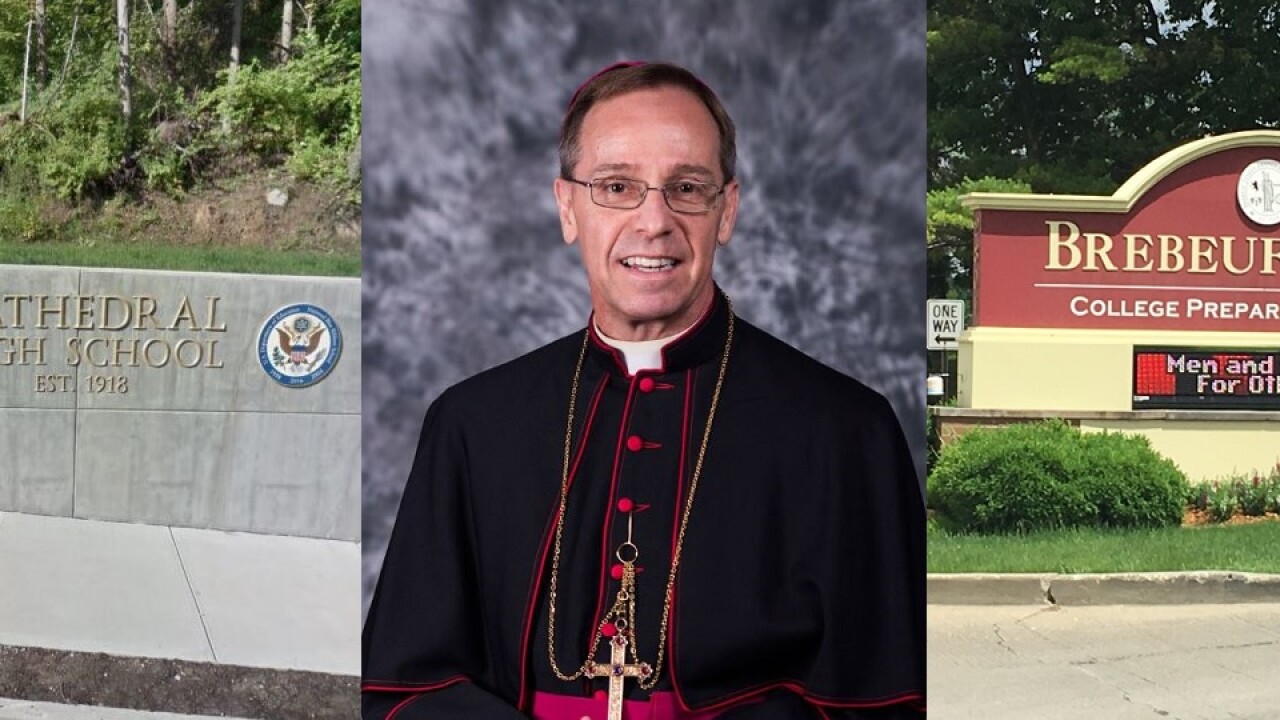
Joshua Payne-Elliott is currently suing the archdiocese, alleging it illegally interfered with his contractual and employment relationship with Cathedral High School, causing Cathedral to terminate him. 
In it's statement, the DOJ said that the First Amendment protects the right of the  Archdiocese to interpret and apply Catholic doctrine. 
It's not clear what the DOJ's statement means for Payne-Elliott's suit, if anything. But his lawyer, Kathleen DeLaney, said it was "highly unusual" for the Justice Department to insert itself into a local employment issue.
What I take away from this is that the Trump administration is politicizing a legal dispute about an Indiana business tort." DeLaney said.
Steve Sanders, a constitutional law expert, said it's not that uncommon for presidential administrations of both parties to file statements in “important civil rights cases.”
"I fear that this statement from the Trump administration's Justice Department appears to be more calculated to win favor with the president's base of religious conservatives than it does to seriously assist the court's adjudication of this case,” Sanders said. . . . . He added: “The Archdiocese may or may not prevail in the end, but the issue is not as one-sided, and the outcome is not nearly as clear, as the Justice Department statement portrays them to be." 
DeLaney said the case isn't about religious liberty, but instead centers on an employment dispute. 
"Josh Payne-Elliot was employed by Cathedral High School," she said. "Cathedral High School fired my client because the archdiocese told them to and threatened to take various actions against Cathedral if they refused to fire my client.
"That is textbook intentional interference in an employment relationship. He was not employed by the archdiocese but the archdiocese had him fired."
When Payne-Elliott filed his suit, he said in a news release that he hoped the case would "put a stop to the targeting of LGBTQ employees and their families."
He is one of the three gay, married Catholic school employees fired in the last year at the direction of the archdiocese, who said they were in violation of church doctrine by being in same-sex marriages.
The employees worked at multiple schools under the purview of the Church. Aside from Payne-Elliott, two guidance counselors were fired from Roncalli High School earlier this year.
In addition, Payne-Elliott's husband, Layton Payne-Elliott, is a teacher at Brebeuf Jesuit Preparatory School. The archdiocese stripped Brebeuf of its Catholic identity after it refused to fire Layton Payne-Elliott. The Vatican recently suspended that ruling, pending an appeal from the school. 
The bottom line is you have a diocese that has covered up sexual abuse teamed up with the Justice Department under an occupant of the White House who is the antithesis of what Christian values should be.  It'a match made in Heaven, or perhaps more appropriately, in Hell.

Thursday, April 18, 2019

Benedict XVI Ignores the Facts of the Catholic Sex Abuse Crisis

In a prior post I vented on former Pope Benedict XVI's misguided and factually out of touch missive condemning the sexual revolution of the 1960's - and of course gays - for all of the sexual abuse by clergy in the Catholic Church.  Indeed, Benedict's version of the history of sex abuse within the Church is about as fact free as Fox News coverage of Donald Trump.  Facts and the truth simply do not matter with Benedict's main agenda being an attack of modernity and any theologians who do not embrace the Church's 12th century, ignorance based dogma on sex and human sexuality.  A piece in Religion News Service likewise focuses on Benedict's refusal to face factual reality.  Here are excerpts:

The recent essay on clergy sexual abuse by Benedict XVI shows why it was such a good idea for him to resign as pope. In the letter released last week, he shows how out of touch he is with the causes of the abuse crisis.
Fundamentally, Benedict lives in a Platonic world of ideas where facts don’t matter. . . . . sexual abuse was occurring prior to the 1960s [and Vatican II]. The church and America were just better at covering it up.
But Benedict also wants to blame sex abuse on contemporary moral theologians who challenged the church’s traditional, natural law ethics, especially as it applied to sexual ethics. Contemporary moral theology is less rule-based and, rather, takes a more personalistic and relational approach. Challenging the church’s opposition to birth control, as did most theologians, opened the floodgates to all sorts of sexual sins, including child abuse, in his view.
While he was prefect of the Congregation for Doctrine of the Faith from 1981 to 2005, scores of Catholic theologians were fired from seminaries, reprimanded or silenced. Others practiced self-censorship in order to avoid the wrath of Rome.
It is flabbergasting to hear him in his letter complain that respect for due process kept him from dealing with this infestation. Too many scholars bear the scars of his inquisitional approach to dissent in the church. CDF’s procedures — where it acted as accuser, judge and jury — had no concept of contemporary ideas of due process.
It does not matter that no moral theologian can be found who condoned the sexual assault and rape of children. Facts don’t matter.
It does not matter that abusers came not just from the ranks of liberals like Theodore McCarrick but also from conservatives like Marcial Maciel, the founder of the Legion of Christ.
It does not matter that most of the priests who abused in the 1970s were products of an old seminary system that existed before Vatican II, which isolated seminarians from the very men and women with whom they would work and serve. Benedict still considers this the ideal way of preparing priests. Alas, he still wants to blame post-Vatican II theology for all the ills of the contemporary church.
Most importantly, he passes over in silence the truly scandalous failure of the hierarchy to remove abusive priests from ministry where they could abuse again and again. The crisis is not just about the abuse; it is also about the coverup.
Benedict would have done well to keep silent or to have shared his views only with Pope Francis. His message is being used by those who oppose Francis to show what a real pope thinks about sex abuse.
First, you cannot muzzle former popes any more than you can muzzle theologians. All one can do is urge them to exercise prudence in what they say and then let the debate begin.
Second, the church needs to make clear that there is only one pope. A resigned pope should revert to his baptismal name and put aside the white cassock for a black one. He should not be called pope or pope emeritus. Ratzinger has a right to express his opinions, but they have no more magisterial weight than those of any other retired bishop.
Finally, since even dead popes are becoming rallying points for different factions in the church, we should stop canonizing popes so soon after their deaths, lest the canonization be politicized. Perhaps a good rule would be to delay consideration of canonization of a pope until after all the cardinals and bishops he appointed are dead.
John Paul II was hurriedly canonized despite his horrific record in dealing with sexual predators.  Indeed, he protected Marcial Maciel for many years despite volumes of reports on his sexual abuse of both males and females.  John Paul II was hardly saintly. 

Thursday, April 11, 2019

Former Pope Benedict XVI's Anti-Gay Lies Continue

Picture of then Pope Benedict XVI with his "personal secretary".
Former Pope Benedict XVI - thought by many to be a self-loathing closeted gay with a long time male lover - has again launched a major attack on gays and also the 1960's sexual revolution and Vatican II for the rampant and global sexual abuse of children and youths by Catholic clergy.  He conveniently ignores the reality that in the 1950's and likely long, long before then, sexual abuse was rampant within the priesthood, so blaming the 1960's sexual revolution for something that long proceeded it is specious at best.  He also side steps his own role in cover ups as head of the Congregation for the Doctrine of the Faith - historical also known as the Inquisition - while serving under John Paul II who protected some of the worse predator clergy.  Moreover, it was Benedict who enforced the Church's warped 12th century dogma on human sexuality that many experts credit with the psycho-sexual maladjustment of predator priests that along with unquestioned power set the stage for abuse.  The take away about Benedict's creed is to believe none of it.  Here are highlights from the Washington Post on Benedict's attempt to avoid his own responsibility in the abuse scandal and the corrupt nature of the Church hierarchy:

Breaking years of silence on major church affairs, Pope Benedict XVI has written a lengthy letter devoted to clerical sex abuse in which he attributes the crisis to a breakdown of church and societal moral teaching and says he felt compelled to assist “in this difficult hour.”
The 6,000-word letter, published in tandem Thursday by a Catholic outlet and an Italian newspaper, decries the 1960s sexual revolution, laments the secularization of the West and describes seminaries filled with “homosexual cliques.”
Benedict’s personal secretary, Archbishop Georg Gänswein [thought by many to be Benedict’s gay lover], confirmed the authenticity of the letter in an email.
Since abdicating the papacy six years ago, Benedict — living in a monastery inside the Vatican City walls — had remained nearly silent on issues facing the Roman Catholic Church, in part to yield full authority to his successor, Pope Francis. The new letter, then, marks an unprecedented moment in the modern church: a significant pronouncement from an ex-pope on the most central problem facing the church.
 Benedict wrote that he contacted both Francis and the Vatican’s secretary of state before proceeding. And the pope emeritus finished his essay by thanking Francis for his work to show “the light of God.” But Benedict’s remarks on the topic differ sharply from those of Francis, who has emphasized the corrupted power of clergy and has acknowledged systemic problems that result in coverup. Those themes also prevailed during a February sexual abuse summit at the Vatican that involved leading bishops from around the world.
 Benedict devoted the first third of his letter to changes in society and inside the church beginning in the 1960s that gave rise to an “all-out sexual freedom.” He wrote that Catholic moral theology “suffered a collapse” of its own during a period of major reforms.  One outcome of the sexual revolution, Benedict wrote, is that “pedophilia was then also diagnosed as allowed and appropriate.”
David Gibson, the director of Fordham University’s Center on Religion and Culture, said it was a “major problem” that Benedict was “blaming the abuse crisis on liberal mores and gays and secularization.”
 In the letter, Benedict did not describe his own role in dealing with the crisis, nor did he discuss particular cases. Benedict, before becoming pope, was the head of the Congregation for the Doctrine of the Faith. As pope, he sometimes defrocked hundreds of priests per year, and the Vatican was more forthcoming than it is now about releasing data on abuse.
But analysts say Benedict also had significant shortcomings and was slow to acknowledge the institutional problems that have enabled abuse to persist — including the role of bishops and cardinals in protecting accused priests.
Benedict remains a sick and twisted individual.

Saturday, March 16, 2019

End Private Catholic Priest Access to Minors

As I often note, I was raised Roman Catholic and went all in on being Catholic, not the least because I was desperately trying to "pray away the gay" given the psychological damage the Church's 12th century dogma on sexuality and homophobia had done to me. I first became an altar boy at age 8 and prior to Vatican II.  I remained one until I graduated from high school,becoming one of the :senior" altar boys along the way.  While I was never sexually molested, I understand why and how easy it would be for a predator priest to prey on altar boys in particular and also children in Catholic schools. The priest of that time - and perhaps still so - were treated as demigods and never questioned or challenged.  And making matters worse, women were NEVER allowed in the church sacristy - where priest and altar boys donned their grab for mass - other than to drop off laundered altar linens. If one were going to molest an altar boy, the church sacristy was the perfect venue, especially at an early mass with perhaps a single altar boy attending at mass. This ease and unquestioned private access to children and youth combined with the Church's sick dogma on sexuality, is, in my view, why the sex abuse problem in the Church has been so rampant and why boys were disproportionately targeted.  Without such private access, the abuse would been far less.  A piece in The Advocate argues that this private, unquestioned access to would be victims must end.  Here are excerpts:
Cardinal Walter Kasper, a liberal reformer in the Catholic Church, recently spilled the beans about the state of Pope Francis's shaky papacy, telling a German interviewer that, "There are people who simply don't like this pontificate. They want it to end as soon as possible to then have, so to say, a new conclave."
While Pope Francis is on thin ice with conservative Catholics, for a host of reasons, he is arguably one of the most politically shrewd men on the planet. The 82-year-old is showing signs he's aware that if his papacy comes undone it will be because of movements from the Catholic right, the faction of the Church that insists homosexual men in the priesthood are the root cause of the clerical sex abuse crisis.
 As one of the most powerful religious figures on the world stage continues to makes his clever, byzantine moves to slander all homosexual men as mentally deranged and in need of psychiatric intervention — via bullhorn, dog whistle or that Bergoglian amalgam of both — and all to save his own hide, it's time for lay Catholics, at least those who aren't stakeholders in global slander, to step up to the plate and nip the clerical sex abuse of minors in the bud. Namely, to help end all private priestly access to minors, including child and adolescent participation in the sacrament of confession.
Readily available statistics show that the vast majority of Roman Catholic priests are not child molesters and in and of themselves present no danger to children and teens. But the church structures that enable grown men's private access to minors are demonstrably a danger to the young, and for continuing that reality, priests can be held to moral account.  Ultimately, it is ordinary Catholic parents, not the bishops, priests, and assorted lay Catholic power brokers/hangers-on who have the power to end private priestly access to minors, not merely by ending their children's participation in the sacrament of confession, but by putting that decision in writing to their parish priests, copied to their local bishops.
Biases, positive or negative, are a far cry from peer-reviewed social scientific data. With attorneys general in various states investigating Catholic dioceses, and with more clerical sex abuse scandals propping up in every corner of the globe — Australia, Chile, Germany — is it asking too much of the U.S. Conference of Catholic Bishops to, at minimum, provide the American public with some hard social scientific data, from objective non-Catholic sources, on child conscience formation to justify ongoing private access to minors by Catholic priests? Or will Catholics, indeed the American public at large, content themselves with yet another "oversight board" or "safe practices model" every time another clerical sex abuse scandal hits the news cycle, especially in light of the recent admission by German Cardinal Reinhard Marx that Catholic Church officials simply destroyed documents on child sexual abuse to cover-up for the crimes of priests?
Of course, there is a rather simple alternative that all Catholic parents can take who wish to instill gospel values into their children and teenagers, and to ensure their kids can look to the saints of history, official and unofficial, as role models. Be they parents in same-sex or opposite-sex relationships, single, liberal, conservative, or what have you, the safe alternative for Catholic parents is this: reading, praying and talking together as a family about life, about the virtues, and about the importance of examining conscience on a daily basis. Absolutely none of that requires a level of personal intimacy with strangers, and most certainly not the kind of intimacy that attends, especially for impressionable minors, calling a grown man outside of the family "Father."
If we can confront the degrees to which those of us who identify as Catholic sustain, by active commission or unexamined patterns, the ecclesial structures that are still, at present, endangering children and teens while serving as a springboard for the slander of innocent adults, we can ensure that future generations will look back on this one and feel what should come naturally — a sense of total mystification that we ever tolerated this trash heap of sexual abusers, enablers, and assorted slanderers for one second. 

Wednesday, March 13, 2019

More and More U.S. Catholics Question Their Church Membership


As long time readers know, I left Catholicism even before I came out publicly.  One of the catalysts for me was the sex abuse scandal that exploded on Boston in 2002, which was the focus of the Academy Award winning movie, Spotlight.  That was 17 years ago and in the intervening years no part of the globe has been spared from Catholic clergy sex abuse scandals which as of this week culminated in the 6 year sentence handed down against Cardinal George Pell, the senior cleric in Australia and by some accounts the number three man at the Vatican until now.  Meanwhile, even as my other family members have abandoned the Catholic Church, countless American Catholics have kept their heads in the sand, refusing to admit that the institution they are supporting financially and attending is morally bankrupt and perhaps more akin to a criminal enterprise than a institution dedicated to God.   Now, a new Gallup survey suggest that 37% of American Catholics are belatedly questioning whether or not to remain members of the Catholic Church.  Here are highlight from from Gallup:
As the Catholic church responds to more allegations of sexual abuse of young people by priests, an increasing percentage of Catholics are re-examining their commitment to the religion. Thirty-seven percent of U.S. Catholics, up from 22% in 2002, say news of the abuse has led them to question whether they would remain in the church.
While the polling was being conducted, Pope Francis met with Catholic leaders from around the world at the Vatican to respond to a new wave of sex abuse allegations in numerous countries. The church dealt with a similar crisis in the U.S. in 2002, the last time Gallup polled about this. That polling came after The Boston Globe reported on widespread abuse by Catholic priests in the Boston area and church leaders' efforts to prevent the abuse from becoming public knowledge.
Gallup's latest findings show that the current scandal is affecting U.S. Catholics more than the one in 2002 did, in terms of their feelings about the church.
Substantial minorities of both practicing and nonpracticing Catholics say they are questioning their commitment to the church -- but, as might be expected, those less committed to their religion are more likely to be questioning it. Whereas 46% of Catholics who seldom or never attend church say they have questioned whether they would remain in the faith, 37% of those who attend church on a monthly basis and 22% who attend weekly say the same.
The same pattern existed in 2002, although both practicing and nonpracticing Catholics are more likely now than in 2002 to be questioning their place in the church. Seventeen years ago, only one in eight weekly churchgoers were re-examining their membership, as were 24% of semi-regular churchgoers and 29% of infrequent ones.
Catholics are less confident in priests in the U.S. more generally, and in U.S. bishops and other Catholic leaders. About one in four U.S. Catholics say they have very little or no confidence in those two groups. One in eight have little or no confidence in Pope Francis or their own priests.
While it is uncertain how many of the 37% of U.S. Catholics who say they're questioning remaining in the church will actually leave in response to the latest sex abuse scandal, any loss of adherents is certainly not welcome news -- especially when the church is dealing with larger societal trends moving away from formal religion. A decline in the number of Catholics would seem especially problematic if it were driven by practical matters such as how church leaders responded to a scandal rather than fundamental spiritual matters such as disagreement with church teachings or church members finding their faith to be unfulfilling.
Catholics shaken by the latest scandal could be affected in other ways besides leaving the church, including less frequent church attendance and being less willing to listen to church leaders' teachings on matters of faith.

In my view, the Catholic Church needs a major reformation that includes (i) removal of god knows how many bishops and cardinals involved in sex abuse themselves or in deliberate cover ups, and (ii) a rejection of the Church's idiotic 12th century views on sex and human sexuality and the role of women. If this doesn't happen, expect to see Church membership plummet in developed countries with the Church being destined to be an Africa based church relying on ignorant and uneducated populations to maintain its falling membership. 

Tuesday, March 12, 2019

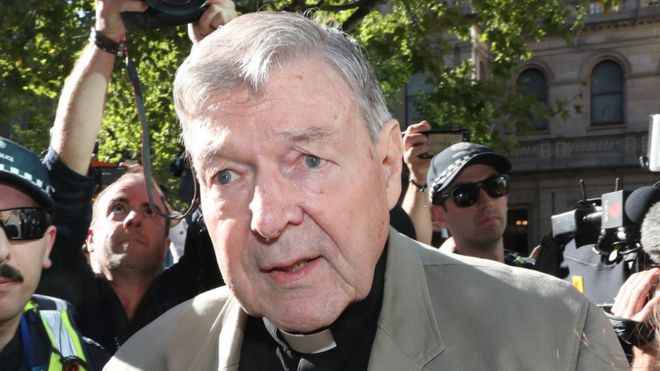
Cardinal George Pell of Australia Sentenced to 6 Years in Prison

George Pell attends a sentence hearing at a Melbourne court on 27 February 2019

In other positive news, Cardinal George Pell of Australia has been sentenced to six years in prison for his sexual abuse of minors.  There are likely many more senior prelates who need to be jailed either for their own abuse of minors or their participation in the Catholic Church's worldwide conspiracy to protect predator priest and other clergy.  The New York Times looks at Pell's sentencing.  Note the judge's use of the word arrogance, which applies broadly across the ranks of the Catholic bishops and cardinals. They view themselves as princes while the rest of us are little better than serfs.  Here are article highlights:
MELBOURNE, Australia — George Pell, an Australian cardinal who was the Vatican’s chief financial officer and an adviser to Pope Francis, was sentenced to six years in prison on Wednesday, for molesting two boys after Sunday Mass in 1996.
The cardinal was convicted on five counts in December, making him the most senior Catholic official — and the first bishop — to be found guilty in a criminal court for sexually abusing minors, according to BishopAccountability.org, which tracks cases of sexual abuse by Catholic clergy.
Cardinal Pell, who stood stone-faced with lips pursed when his sentence was read aloud, will not be eligible for parole for three years and eight months.
“I would characterize these breaches and abuses as grave,” the chief judge in the case, Peter Kidd, said during the sentencing. Speaking directly to Cardinal Pell, he added: “Your conduct was permeated by staggering arrogance.”
The sentence, falling far short of the 50-year maximum, will be closely scrutinized around the world. The sentencing was broadcast live from the courtroom in Melbourne, Australia’s second-largest city, where Cardinal Pell first rose to prominence as an archbishop.
It brings to a close two years of legal jockeying over evidence and accusations of sexual abuse, most of which were kept from public view by Australia’s legal system until recently. And for Catholics all over the world, it amounts to the toppling of a Vatican giant, a cleric of enormous power who will now reside behind bars.
“The importance of this case cannot be overstated,” said Anne Barrett Doyle, co-director of BishopAccountability.org. “It will set a precedent.” . . . . Some called it a welcome if small dose of justice, while others said the sentence was far too lenient.
“Why should we take into account his age?” said Phil Nagle, an advocate for abuse victims from Ballarat, Cardinal Pell’s hometown. “He’s ruined lives.”
[H]e [Pell] is well known, in part, for protecting church finances from large payouts to abuse victims — and a culture warrior. He could frequently be found raising money for conservative causes in Australia, publicly condemning homosexuality and stepping into policy debates as well, opposing, for example, legislation to allow adoption by gay parents.
Note too Pell's breathtaking hypocrisy: sentenced for raping two 13 year old boys, yet railing against gays and gay parenting.   The Vatican is full of Cardinal Pell's.

Wednesday, February 27, 2019

Pope Francis’s Disgraceful Sex Abuse Excuses


In general I do not often agree with Washington Post columnist Marc Thiessen who I view as too right wing on any number of topics and issues.  Yet, in a new column, he sums up my views of Pope Francis' sharp failure to firmly address the need for a thorough house cleaning of the ranks of the Vatican and Church hierarchy without which the Catholic Church will remain a moral embarrassment and will lack any shred of moral authority to lecture others on anything. The column lays out why the continued evasive excuses, cover ups and refusals to hold individuals accountable must end.  Don't hold your breath for this to happen.  Only a massive exodus of parishioners and huge drops in financial supprt will force need to change to happen.  Until, then, expect more of the same failure to act in any meaningful way.  Here are column highlights:
Pope Francis’s closing address to the Vatican Summit on Child Protection was a disgraceful display of excuses and evasions. He began with extended meditation on how a “great number of” abuse cases are “committed within families.” He urged the assembled bishops to focus on “other forms of abuse” experienced by “child soldiers,” “starving children,” “child victims of war” and “refugee children.” He laid out an agenda that, bizarrely, focused on matters have nothing to do with clerical abuse (such as combating “sexual tourism”). And, most shamefully of all, he lashed out at those demanding that bishops who covered up abuse and silenced victims be held to account, declaring that the church must “rise above” those who “exploit, for various interests, the very tragedy experienced by the little ones.”
While Francis did declare that “no abuse should ever be covered up (as was often the case in the past),” he still refuses to tell us which bishops and cardinals did the covering up. It’s true that, just days before the summit, he removed disgraced former archbishop Theodore McCarrick from the priesthood. But Francis still refuses to explain: What took so long? Who knew about McCarrick’s alleged serial predations and did nothing? When did Francis know? And why did he not punish McCarrick until his crimes — which were repeatedly reported to the Vatican — were publicly exposed by the media?
Francis’s decision to focus the summit exclusively on “the protection of minors” was a cynical ploy to avoid addressing questions of accountability, or the rampant sexual abuse of vulnerable adults by their religious superiors. The accusations against McCarrick were not limited to his horrific abuse of children. He allegedly forced countless young priests and seminarians, whose careers he could make or break, to have sex with him. Last week, The Post reported on the Rev. Lauro Sedlmayer, who says he was sexually abused as a young priest by McCarrick during the 1990s. The priest says he told three bishops and that nothing was done.
It is not enough for Pope Francis to remove McCarrick from the priesthood. The patronage network that enabled him must be rooted out as well.
There are documents in the Vatican archives that would definitively show who knew what, and when they knew it. But Francis has refused to release them, much less hold McCarrick’s many enablers to account.
[T]he pope has squelched efforts to expose and punish those responsible for covering up abuses by McCarrick and others. The Wall Street Journal reports that in 2015, Boston Cardinal Sean O’Malley — whom Francis put in charge of handling the abuse crisis — recommended the creation of a special tribunal to try bishops who ignore or cover up abuse. The pope rejected his proposal. Last year, O’Malley met with Francis in Rome where, the Journal reports, the pope “made it clear he would not authorize a full-fledged investigation into the McCarrick affair.”
Until Francis addresses the corruption of the episcopacy, he has zero credibility to lead a fight against sex tourism. No one wants to hear lectures on morality from bishops who refuse to rid their ranks of those who enable sex predators. They seem to be more concerned with preserving their worldly privilege and power than restoring the church’s moral integrity. How many souls have been lost, how many have left the sacraments, because of their scandalous inaction? We will never know in this world. But they will certainly learn the answer in the next.
Francis called the summit an “opportunity for purification.” It was a missed opportunity. Purification requires two things: confession and penance. Until the bishops repent of their sins, and accept the temporal consequences of their actions, there will be no forgiveness from the laity.

Wednesday, February 13, 2019

Virginia’s Catholic Bishops Release Names of 58 Sexual Predator Priests

Virginia's Southern Baptists are still reeling from the sex abuse scandal in their denomination exposed by two Texas newspapers over last weekend.  Now Virginia's two Catholic bishops - Bishop Barry Knestout of Richmond and Bishop Michael F. Burbidge of Arlington - have released the names of 58 clergy credibly accused of sexual molestation of children and youths, thereby bring home to Catholic Virginians the reality of the abuse scandal is not off in far away cities. 42 of those named were in or had been in the Diocese of Richmond.  The remainder were in the Diocese of Arlington.  Both the Virginian Pilot and the Washington Post look at the releases which may have been spurred in part by the ongoing investigation of the Virginia Attorney General's office which is asking victims of clergy abuse to contact its hotline found here. First excerpts from the Pilot piece:

The Catholic Diocese of Richmond released a list Wednesday of 42 clergy members who "have a credible and substantiated allegation of sexual abuse against a minor."
It follows the conclusion of an independent investigation completed by a third party. Citing the "highly sensitive nature of the information reviewed," diocese spokeswoman Deborah Cox declined to name the independent examiners.
None of the named clergy are listed as active members. Thirteen are deceased. Most are classified as suspended or removed; five were "laicized," meaning they have been removed from ministry.  Past news reports and information on the diocese website show at least six have ties to Hampton Roads.
"To the victims and to all affected by the pain of sexual abuse, our response will always be about what we are doing, not simply what we have done," Bishop Barry Knestout wrote in a letter published along with the list.
A diocese spokeswoman did not respond to a reporter's requests for comment.
Attorney General Mark Herring announced in October the state would investigate the diocese. A spokesperson for the office said Wednesday the investigation is ongoing. Survivors are encouraged to reach out through their clergy hotline.  
[O]n the list is John E. Leonard, who served as principal of Norfolk Catholic High School from 1987 to 1992. According to an Associated Press story from 2004, he had been on the faculty at St. John Vianney Seminary in Goochland in the early 1970s, when he was convicted of assaulting two teenage boys. He was sentenced to two consecutive 12-month jail terms, which were suspended. Leonard was instead placed on lifelong probation.  The diocese website says Leonard was removed from the diocese in 2004 before his death in 2015.
Another local pastor was Eugene John Teslovic, who, according to a 2002 story published by The Pilot, was expelled from active ministry while serving at St. Luke Catholic Church in Virginia Beach, where he had become pastor in 1991. He previously served at the Church of Resurrection in Portsmouth. Teslovic is listed as removed on the diocese website.
The piece in the Washington Post looks at both dioceses and adds details on the Diocese of Arlington action and notes the larger scandal in the United States that intensified again last summer.  Here are excerpts:
Virginia’s two Catholic dioceses Wednesday released lists of clergy whom officials say were deemed “credibly accused” of sexually abusing youth, the latest in a slew of U.S. dioceses to make public such names amid a national crisis over clerical abuse and coverups.
The diocese of Arlington, which covers the northeastern corner of Virginia, released a list of 16 names. It said the list was the product of two former FBI agents contracted by the diocese and given access to clergy files and information dating to its founding in 1974. It wasn’t immediately clear if any of the names were completely new to Catholics of the diocese.
The diocese of Richmond, which covers the rest of the state, released 42 names.
A local survivor-advocate on Wednesday criticized the Virginia lists, noting that they don’t include the names of the parishes where the men served nor when they were removed.
“The church has been in crisis . . . and this is something they think will make them look good? To me this is reactive, not proactive,” said Becky Ianni, who said she was abused beginning at age 8 in 1965 by Alexandria priest Rev. William Reinecke, whose name appears on the Arlington list.
The Catholic Church has been under the gun since last summer, when a top D.C.-based cardinal — Theodore McCarrick — was suspended amid charges of abuse and extensive coverup. He later resigned as cardinal and a decision is awaited any day from Rome about his fate within the church. A grand jury report out of Pennsylvania about dioceses there led to the early resignation of D.C. Archbishop Donald Wuerl as well as additional civil investigations, bills calling for expanded statutes of limitations so clergy victims could sue, and more lists like the ones Wednesday out of Virginia.
Virginia’s attorney general, Mark Herring, is among the state prosecutors who recently opened an investigation into Catholic dioceses and whether there have been abuse and coverup.
Arlington includes 458,000 Catholics and 70 parishes. Richmond includes 222,000 Catholics and 142 parishes. The reason for the apparently lopsided numbers wasn’t immediately clear but the Richmond diocese covers a far larger, spread-out territory. Richmond was established in the early 1800s while Arlington was formed out of that in the 1970s.


The sex abuse scandal in the Catholic Church is a topic this blog has covered for many years.  With the Diocese of Richmond belatedly revealing at least a portion of its dirty linen (there could well be more names not released), I  am reprinting a portion of my February, 2002, guest editorial piece in the Virginian Pilot:
Bigotry Claim Is Disingenuous
As a life long Catholic, former altar boy, and a 4th Degree Knight of Columbus, I was dismayed by Bishop Walter F. Sullivan’s letter to the editor (Virginian Pilot, January 30, 2002) decrying the editorial cartoon carried by the Virginian Pilot on January 21, 2002, focusing on the Catholic Church’s track record in respect to pedophile clergy. Bishop Sullivan would have readers believe the cartoon is “pure bigotry” against the Catholic Church. The reality is that the Catholic Church hierarchy is most vigorous in instilling guilt and a sense of sinfulness in its members on a host of topics ranging from birth control, divorce (on January 28, 2002, Pope John Paul II directed all Catholic lawyers and judges to refrain from taking divorce cases, Associated Press), remarriage by divorced Catholics, and in-vitro fertilization, to attendance at non-Catholic church services. Yet, the Catholic Church hierarchy has shown little vigor in weeding out pedophile priests or disciplining high Church officials who knew of sexual abuse problems but did not act to stop it.
The editorial cartoon carried by the Virginian Pilot surely arose from the on-going scandal in the Archdiocese of Boston where, due to unrelenting reporting by the Boston Globe on the lawsuits against former priest, John J. Geoghan, it has been disclosed that over the last 10 years, the Archdiocese has quietly settled child molestation claims against at least 70 priests. Church records turned over under court order, document that five (5) bishops and two (2) cardinals knew of Geoghan’s child molestation, yet he was repeatedly reassigned to new, unsuspecting parishes (Boston Globe, January 31, 2002). Unfortunately, the situation in Boston is not an isolated incident as shown by a very brief search on the Internet . . . 


Sadly, my words back then understated the huge global scale of the problem and the culpability of high Church officials. 

Tuesday, January 22, 2019

The Vatican’s Self-Created Crisis for Catholicism.


Having been raised Roman Catholic, been an altar boy for a decade from age 8 to 18, and risen to the 4th Degree in the Knights of Columbus, I am all too aware of the Medieval dogma of the Church and its desperate clinging to a 12th century understanding of human sexuality.  And yes, during those years I was desperately trying to "pray away the gay". something that is both ludicrous and futile with the benefit of hindsight.  Nowhere is this embrace of 12th century ignorance more true than in the context of the Church's war against homosexuality which at times has included torturing gays and burning them at the stake, a mindset and practice which Catholic missionaries spread like a cancer across the globe.  Meanwhile, the Church has found the ranks of its clergy - probably for centuries - increasingly filled with gays with stunted psycho-sexual development given the Church's bizarre system of all boys schools and high school seminary schools since there was nowhere better to hide one's "secret" than with in the ranks of the celibate priesthood. Something similar also plagues anti-gay Protestant denominations where we see closeted evangelicals flocking to the pulpit where they vent homophobic vitriol only to be caught in gay sex scandals down the road.  In an extremely long piece in New York Magazine, Andrew Sullivan lays the current sex abuse scandal firmly at the feet of the Vatican.  In reading the piece (which I recommend reading the entire piece), do not forget that celibacy requirement in the Roman Catholic Church derived from the Church's lust for money as the costs of married priest with children mounted. Simply put, celibate priests did not dissipate Church assets in the support of wives and families.  Here are column highlights: 
We have no reliable figures on just how many priests in the Catholic Church are gay. The Vatican has conducted many studies on its own clergy but never on this subject. In the United States, however, where there are 37,000 priests, no independent study has found fewer than 15 percent to be gay, and some have found as many as 60 percent. The consensus in my own research over the past few months converged on around 30 to 40 percent among parish priests and considerably more than that — as many as 60 percent or higher — among religious orders like the Franciscans or the Jesuits.
This fact hangs in the air as a giant, unsustainable paradox. A church that, since 2005, bans priests with “deep-seated homosexual tendencies” and officially teaches that gay men are “objectively disordered” and inherently disposed toward “intrinsic moral evil” is actually composed, in ways very few other institutions are, of gay men.
The massive cognitive dissonance this requires is becoming harder to sustain. The collapse of the closet in public and private life in the past three decades has made the disproportionate homosexuality of the Catholic priesthood much less easy to hide, ignore, or deny. This cultural and moral shift has not only changed the consciousness of most American Catholics (67 percent of whom support civil marriage for gay couples) and gay priests (many of whom are close to quitting) but also broken the silence that long shrouded the subject.
Five years ago, Pope Francis made his watershed “Who am I to judge?” remark after being asked about a flawed gay priest. “A person once asked me, in a provocative manner, if I approved of homosexuality,” Francis went on. “I replied with another question: ‘Tell me, when God looks at a gay person, does he endorse the existence of this person with love or reject and condemn this person?’ We must always consider the person. . . . . These sentiments won 62 percent of the votes of the synod bishops — just shy of what was necessary to pass, but still evidence of a sharp shift in tone in official Catholic teaching.
They also triggered near panic on the Catholic right. Alarmed by the possibility that divorced and remarried people might be welcomed as well as gays, traditionalists launched a fierce rearguard campaign against the new papacy, with a focus on what some called a “Lavender Mafia” running the church, and broke new ground in connecting this directly to the horrifying revelations of sex abuse that came to light in 2002. In increasingly direct ways, they have argued that the root of the scandal was not abuse of power, or pedophilia, or clericalism, or the distortive psychological effects of celibacy and institutional homophobia, but gayness itself.
The unseemly fall this past summer of Cardinal Theodore McCarrick, one of the most powerful American cardinals of his time, provided a cause célèbre for this faction. It emerged that McCarrick had abused at least two children and then sexually harassed generations of adult seminarians with impunity.
McCarrick gave the right an opening. New online media organizations — led by Breitbart-style websites such as LifeSite News and Church Militant — now routinely pounce on any incidents involving gay priests and have an influential audience in the Vatican. A wealthy group of conservative Catholics, the Better Church Governance, has even launched an investigation into the orthodoxy, conduct, and, it’s clear, sexual orientation of each of the 124 cardinals who will elect the next pope.
At the center of this struggle, of course, are gay priests, bishops, and cardinals themselves. They are caught in a whiplash of relative toleration embodied by Francis and hostility exemplified by his conservative predecessor, Pope Benedict XVI. . . . . “They are equating all gay priests with sexual abuse. There’s a witch hunt.”
Sullivan then jumps and looks at good, decent gay priests and what the Vatican is doing to them and ultimately to the institution itself,  He also looks at an accurate history of gays in the Church:
Most of the gay priests I spoke with have never experienced abuse in the church. Many had already come to terms with their sexual orientation before they entered the priesthood, but some wrestled with it in the seminary, and others later in life. “There is no typical experience,” Father Joe, as I’ll call him, told me. “At first I wondered if I were a fraud, because I thought, Well, am I just trying to escape into a life in which I don’t have to deal with my sexuality? But I had people in charge of me who challenged me to ask myself if this were authentic, and I felt that this was the life and work that God was calling me to. It’s an ongoing discernment.” Then there was a moment of grace. “I was working in a hospital at the height of the AIDS crisis. A nun said to me, ‘What do you want to tell these people? They’re active homosexuals, drug users.’ I said, ‘I would talk about God’s mercy and be with them as they are.’ It helped me understand how God could use me even though the church didn’t accept me.”
Another, call him Father Andrew, described his choice of vocation as “convenient and existential”: “I was 18 and sexually aware but extremely depressed, and my father cornered me one day in the kitchen and made me come out. I went to a psychologist, who told me, ‘You’re not going to change. You need to accept yourself.’ ” Andrew’s father was not happy about this recommendation and ended the therapy. In college, Andrew sought out more treatment, and then, suddenly, his father died. It threw him. “I kept thinking about life and death. I had started praying again and attending Mass. I was driving in the desert from Phoenix to Tucson and saw these dust devils, and I suddenly heard in my head, ‘Oh, be a priest. You won’t need to deal with sex; you can be respected.’ And then my brother died — a car crash.” By his junior year, Andrew was in the seminary.
The scapegoating has wounded many of the priests I spoke with. It has become a double stigma: targeted by the hierarchy for being gay and by the general public for being pedophiles. Many of the people I spoke to, Catholics and non-Catholics, about the subject of gay priests rolled their eyes and asked about the abuse of children. The news environment is saturated with stories about sex abuse — and rightly so — yet there are hardly any public examples of the overwhelming number of gay priests who would never dream of preying upon the powerless.
These men are still sexual beings, flesh and blood. In these crises, they tend to do one of two things: either fall so deeply in love that they cannot sustain a life without physical intimacy and so leave the church or, more often, recalibrate, confess, and recommit to the celibate life.
How do you live a healthy sexuality in a context where your sexuality is stigmatized?” After the 2005 ban on gay priests, Father Mike became attracted to conversion therapy and underwent a year and a half of trying to be cured of being gay. It was only later that he came to see how “none of it was true; it was all a lie.”
The preponderance of gay men in the priesthood is, in fact, nothing new in the history of the church. For well over a millennium, it was commonplace, and though there were occasional denunciations of it, these were usually followed by papal inaction or indifference.
Even Saint Augustine had one particularly intense love affair with another young man. “For I felt that my soul and his were one soul in two bodies,” he wrote, “and therefore life was a horror to me, since I did not want to live as a half; and yet I was also afraid to die lest he, whom I had loved so much, would completely die.” This was not merely a spiritual friendship, Augustine confessed. . . . Some have speculated that Augustine’s starkly Manichaean divide between the spirit and the body is rooted in his disgust at his own homosexual tendencies. The historical record, however, reveals that for all Augustine’s influence, the practice of intense homoerotic friendship among the clergy was common over the following centuries, especially in monasteries.
The masterpiece on the subject of “spiritual friendship” was, in fact, written by a gay man, Saint Aelred, the abbot of the Cistercian monastery of Rievaulx in England in the mid-1160s. He had had sexual relationships with men in his younger years, but, vowing chastity as a monk, he sublimated these desires into an idea of intense celibate love for another man. He took as a model the relationship between Jesus and the “disciple whom Jesus loved,” John, describing it at one point even as a “marriage.”
By the 12th century, priests and monks were writing love poems to one another in what Boswell describes as an “outburst of Christian gay literature still without parallel in the Western world.” But perhaps in response to this broad acceptance of gay spirituality, some began to campaign for a crackdown. Around 1051, Saint Peter Damian published a treatise, The Book of Gomorrah, whose rhetoric is strikingly similar to the online denunciations of our time: “absolutely no other vice can be reasonably compared with this one … [it] is in fact the death of the body, the destruction of the soul … it removes truth utterly from the mind.” He accused the church of being run by a gay cabal who covered for each other and gave one another absolution for their sins. The pope at the time, Leo IX, nonetheless refused to ban gay clergy and argued that the problem w as those who had sex “as a long-standing practice or with many men.”
In 1102, in a similar moment, the Council of London decided to promulgate a decree against the newly defined sin of “sodomy” — only to have the publication stopped by the archbishop of Canterbury, who remarked that “this sin has hitherto been so public that hardly anyone is embarrassed by it.”
The tide turned decisively in the 13th century with the theological genius Thomas Aquinas denouncing homosexual acts as “against nature.” All sex — heterosexual and homosexual — was to be reserved only for married couples open to procreation, and any other sexual activity was a grave sin. Homosexuals, in the new theology, were part of nature — many had noticed homosexual behavior in the animal kingdom, particularly among hares and hyenas — but they were also somehow contrary to nature. Aquinas never resolved this paradox. Neither has the church.
As the taboo deepened in the succeeding centuries, there is little reason to believe that gay priests disappeared, but most went more fully underground. Still, same-sex love remained a profound part of Catholic Christianity. The friendship that grew between Saint Ignatius of Loyola and Saint Francis Xavier, for example, created the Society of Jesus, or the Jesuits, in the 16th century.
The greatest Catholic theologian of the 19th century, Cardinal John Henry Newman, devoted his personal life to another man, Ambrose St. John. This does not mean the two had a sexual relationship (although they might have), but it does suggest that deep same-sex love was still alive in the highest echelons of the Catholic priesthood, even at the apex of Victorian repression and even in someone about to be celebrated as a saint. When St. John died, Newman wrote, “I have ever thought no bereavement was equal to that of a husband’s or a wife’s, but I feel it difficult to believe that any can be greater, or anyone’s sorrow greater, than mine.”
But why is the priesthood so gay? It is worth noting that the connection between homosexuality and spirituality is by no means restricted to Catholicism. Some evolutionary psychologists have found an ancient link between gay men and tribal shamanism. Carl Jung identified the archetypal gifts of the homosexual: “a great capacity for friendship, which often creates ties of astonishing tenderness between men”; a talent for teaching, aesthetics, and tradition (“to be conservative in the best sense and cherish the values of the past”); “a wealth of religious feelings, which help to bring the ecclesia spiritualis into reality; and a spiritual receptivity which makes him responsive to revelation.”
Among gay priests themselves, I heard a variety of explanations. Some described to me how their sense of displacement as boys and teens made them more sensitive to the needs of other marginalized people: “You were an outsider, and you can help other outsiders and welcome them in.” Another simply said, “We understand suffering.”
Then there is the common experience of a gay boy or teen, brought up in the church, who turns to God in struggling with the question of his difference and displacement from the normal. He is forced to ponder deeper questions than most of his peers, acquires powerful skills of observation, and develops a precocious spirituality that never fully leaves him. This resonates for myself as a Catholic boy and teen. The first person I ever came out to was God, in a silent prayer on my way to Communion. I was an altar boy, knew well how to swing a brass thurible full of incense, could debate the nuances of transubstantiation by the age of 11, and considered the priesthood as a vocation (I concluded I wasn’t good enough a person).
But there are other reasons for gay men to seek the priesthood that are far from healthy. The first is celibacy. If you were a young gay Catholic in centuries past, one way to avoid social ostracism, or constant questions about why you lacked an interest in girls or women, was to become a priest. . . . . This pattern, though much less severe than in the past, endures. A profound lack of self-esteem, fueled in part by the church’s homophobia, also led to some seeking the priesthood as a means to repress or somehow cure themselves.
Other gay priests, more self-aware and cynical, find there is a career to be made in all of this falseness. From the 13th century onward, it’s easy to see how secretly gay men found in the church, and the church alone, a source of status and power. Marginalized outside, within they could become advisers to monarchs, forgive others’ sins, earn a stable living, enjoy huge privileges, and be treated instantly with respect. Everything was suppressed, no questions were asked in seminaries, and psychological counseling was absent (and even now is rare). Scarred, scared men became priests, and certain distinct patterns emerged.
One, as we have come to learn, was sexual acting out and abuse. To conflate sexual abuse with the gay priesthood, as many now reflexively do, is a grotesque libel on the vast majority who have never contemplated such crimes and are indeed appalled by them. It is classic scapegoating.
But some abuse of male teens and young adults, as well as abuse of other priests, is clearly related to homosexuality gone horribly astray — and around a quarter of the reported cases involve 15- to 17-year-old victims.
The scale of it in the late 20th century was extraordinary — but, in retrospect, predictable. If you do not deal honestly with your sexuality, it will deal with you. If you construct an institution staffed by repressed and self-hating men and build it on secrecy and complete obedience to superiors, you have practically created a machine for dysfunction and predation. And the hideous truth is we will never know the extent of the abuse in centuries past or what is still going on, especially throughout places in the world (like Africa and Latin America) where robust scrutiny of the church is still sometimes taboo.
Another pattern was externalized homophobia: What you hate in yourself but cannot face, you police and punish in others. It remains a fact that many of the most homophobic bishops and cardinals have been — and are — gay. Take the most powerful American cardinal of the 20th century, Cardinal Francis Spellman of New York, who died in 1967. He had an active gay sex life for years while being one of the most rigid upholders of orthodoxy.
Anti-gay archconservative Cardinal George Pell was recently found guilty of sexual abuse of boys in Australia. The founder of the once hugely influential hard-right, anti-gay cult the Legion of Christ, Marcial Maciel, was found to have sexually abused countless men, women, and children. The leader of Church Militant, which is obsessed with gay priests, is a self-described “ex-gay.” This is a good rule: Those in the hierarchy obsessed with the homosexual question often turn out to be gay; those who are calmer tend to be straight.
But this is because so many in the hierarchy still cannot see homosexuality as being about love and identity rather than acts and lust. As we uncover layer upon layer of dysfunction at the very top of the church, it may be time to point out how naked these bejeweled emperors can appear.
And this, of course, has added another layer of complexity to the story of gay priests: Generations matter. Those in their 70s and 80s grew up in a different universe, where the closet was automatic and the notion of even discussing gay priests was scandalous. One priest described that generation to me as “so closeted they might as well be in Narnia.” They may not even be aware they’re gay. But their reaction to the modern reexamination of homosexual love, and the consideration of sex as distinct from procreation, was panicked retrenchment.
This dynamic has made the clerical closet — not the fact of gay priests but the way that fact has been hidden — a core mechanism for tolerating and enabling abuse. On top of all this, the vow of obedience to superiors gives gay bishops and cardinals huge sway over their priestly flock. Some, of course, realized this power could be leveraged for sex and abused it.
The only obstacle standing in the way of this path is the homophobia formally embedded into church doctrine in 1986 by the future Benedict XVI. The church now explicitly teaches that gay people are “objectively disordered” because their very being leads them to an intrinsic moral evil. This “evil” is the orientation to have sex that cannot lead to procreation — the same reason the church opposes birth control for straight couples. The difference, of course, is that birth control is a choice, while gayness isn’t.
At some point you realize that this is, in the end, the bottom line. There is a deep and un-Christian cruelty at the heart of the church’s teaching, a bigotry profoundly at odds with the church’s own commitment to seeing every person as worthy of respect, deserving of protection, and made in the image of God. It’s based on a lie — a lie that the hierarchy knows is untrue, and a lie proven untrue by science and history and the church’s own experience. “The hierarchy is tying itself in knots in public over something it has already conceded in private,” Father Leo explained to me.
The task, it seems to me, is not to rid the church of homosexuality, which is an integral part of the human mystery, but of hypocrisy, dishonesty, and dysfunction.