Showing posts with label cover ups. Show all posts

Tuesday, February 18, 2020

Boy Scouts of America Files for Bankruptcy

There are stark parallels between the Boy Scouts of America and the Roman Catholic Church hierarchy.  The leadership of both organizations put protecting their reputations over the safety of children and youths and both maintained extensive records of abuse cases that remained hidden from the public.  Meanwhile, little was done to make sure pedophiles - which is something markedly different from being gay despite Christofascist and Catholic Church efforts to conflate the two even though the vast majority of pedophiles are heterosexual - did not find positions within the organization.  In the end, it was the deliberate cover ups and lies to the public and police authorities that have lead to the disgrace of the institutions and now a bankruptcy filing by the Boy Scouts much like numerous Catholic Church dioceses. The New York Times looks at this development.  Here are highlights:
The Boy Scouts of America, an iconic presence in the nation’s experience for more than a century, filed for bankruptcy protection early Tuesday, succumbing to financial pressures that included a surge in legal costs over its handling of sexual abuse allegations.
Founded in 1910, the Boy Scouts have long maintained internal files at their headquarters in Texas detailing decades of allegations involving nearly 8,000 “perpetrators, according to an expert hired by the organization. Lawyers have said in recent months that former scouts have come forward to identify hundreds of other abusers not included in those files.
The bankruptcy filing, in Delaware, is expected to disrupt continuing litigation and establish a deadline for when former scouts can pursue claims.
Jim Turley, the national chair of Boy Scouts of America, said in an open letter that the organization was entering bankruptcy in order to equitably compensate all victims of abuse through a trust.
It is unclear how much of an overhaul the bankruptcy process will bring to the Boy Scouts, which reports having 2.4 million youth participants, but Mr. Kosnoff said the filing seemed necessary given the totality of the claims that have emerged. At a minimum, Mr. Kosnoff said he would like to see the organization clean out its management and end lucrative salaries for leaders, some of whom earn more than half a million dollars annually.
Even then, Mr. Kosnoff said that he finds it “difficult to impossible” for him to envision a new structure that would give him confidence that the nonprofit has sufficiently changed. He said the organization, which has operated under a congressional charter since 1916, may need to liquidate and allow some new organization with better controls come in to fill the void.
Other organizations, including Catholic dioceses and U.S.A. Gymnastics, have also sought bankruptcy protection in recent years as they have faced sexual-abuse lawsuits.
The Boy Scouts’ troubles have lingered for decades. In a 1935 article in The New York Times, the organization described having files on hundreds of people who had been leaders in the scouts but had been labeled “degenerates.”
While their records date back a century, the Boy Scouts fought the release of some of the files in an Oregon case in the early 2000s — a case that led a jury to hold the Scouts liable in 2010 for $18.5 million in punitive damages. The records in that case stayed private until a ruling from the Oregon Supreme Court in 2012 made them public.
Paul Mones, a lawyer in that case, said he recalled musing with his co-counsel at the time that the files may just be the tip of the iceberg that could ultimately send the Boy Scouts toward bankruptcy. But instead of trying to establish a compensation fund for victims over the years, he said, the organization continued trying to protect its reputation.
Mr. Mones said that the bankruptcy filing will deny other victims an opportunity to hold the scouts accountable in court.
Victims and their lawyers have argued that the files hid the problem and left scouts at risk. Mr. Pierce said he did not know until much later that there was a systemic problem in the Boy Scouts. He said that while the organization helped shape him and gave him many positive experiences, he now believes it must be abolished or radically changed.
“It provides pedophiles with access to boys,” Mr. Pierce said. “That has to stop. I don’t know if that means getting rid of the Boy Scouts or some new oversight.”
Once again, its a case of those irresponsibly seeking to protect an organization being the ones to destroy it. Yet, over and over again we see the same pattern. especially in religious organizations. 

Monday, September 30, 2019

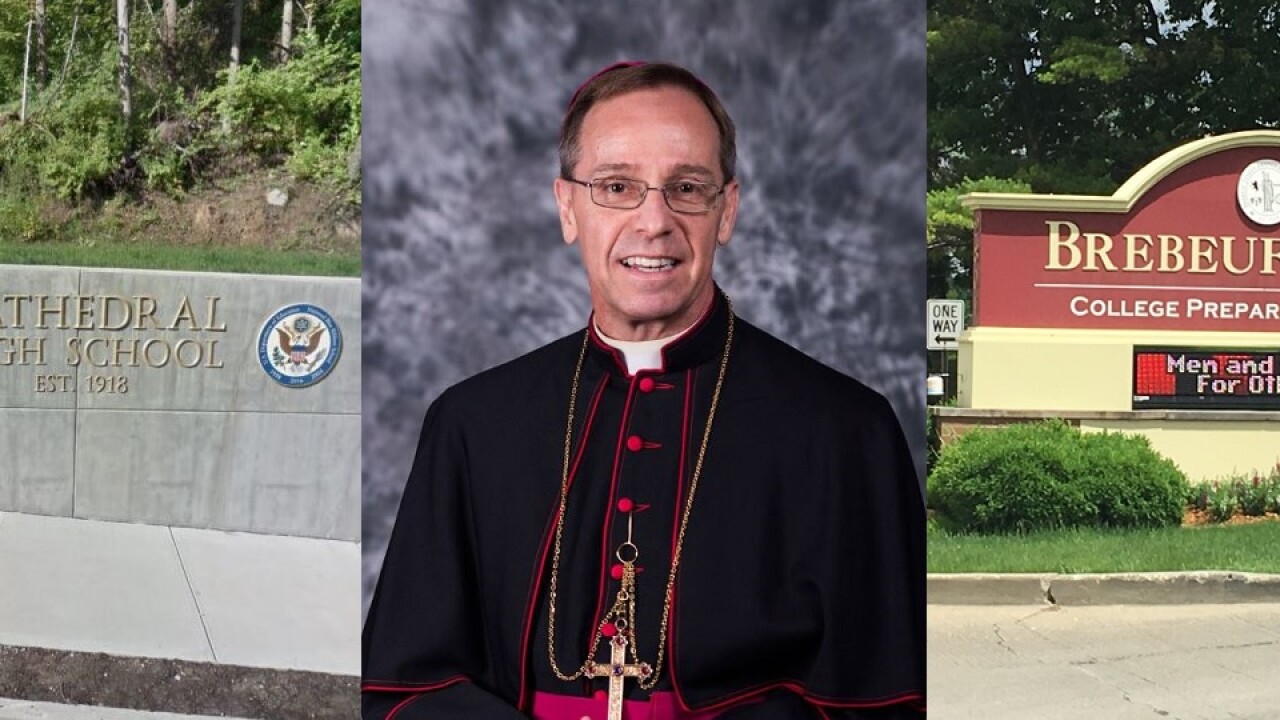
Trump DOJ Backs Indianapolis Archdiocese in Firing of Gay Employees

Modern Day Pharisee - Archbishop of Indianapolis.
If one wants a case study in hypocrisy, look no farther than the Archdiocese of Indianapolis and the Trump Justice Department.  In the case of the archdiocese, it wants the right to fire a gay high school faculty who has no direct contract with the archdiocese to protect its "religious liberty" and easily influenced students yet - like virtually all Catholic dioceses around the globe - has covered up sexual abuse of children and youths and has fought tooth and claw to avoid payment of reasonable compensation to the victims of clerical sexual abuse. Then there is the Trump DOJ which has sought to protect an occupant of the White House who is devoid of any shred of morality and decency, much less living a life reflective of the pillars of Catholic dogma who is pretending to back the "religious freedom" of a diocese guilty of sexual abuse of children and minors. The true agenda of both institutions: (i) to pander to the most reactionary elements of their respective bases, and (ii) distract from the ugliness of their science denying, homophobic animus towards LGBT individuals. A piece linked via The Advocate looks at the situation.  Here are excerpts:
The U.S. Department of Justice on Friday issued a Statement of Interest in support of the Archdiocese of Indianapolis in its ongoing dispute with a former Catholic school teacher who alleges he was wrongfully terminated because he was in a same-sex marriage.
Joshua Payne-Elliott is currently suing the archdiocese, alleging it illegally interfered with his contractual and employment relationship with Cathedral High School, causing Cathedral to terminate him. 
In it's statement, the DOJ said that the First Amendment protects the right of the  Archdiocese to interpret and apply Catholic doctrine. 
It's not clear what the DOJ's statement means for Payne-Elliott's suit, if anything. But his lawyer, Kathleen DeLaney, said it was "highly unusual" for the Justice Department to insert itself into a local employment issue.
What I take away from this is that the Trump administration is politicizing a legal dispute about an Indiana business tort." DeLaney said.
Steve Sanders, a constitutional law expert, said it's not that uncommon for presidential administrations of both parties to file statements in “important civil rights cases.”
"I fear that this statement from the Trump administration's Justice Department appears to be more calculated to win favor with the president's base of religious conservatives than it does to seriously assist the court's adjudication of this case,” Sanders said. . . . . He added: “The Archdiocese may or may not prevail in the end, but the issue is not as one-sided, and the outcome is not nearly as clear, as the Justice Department statement portrays them to be." 
DeLaney said the case isn't about religious liberty, but instead centers on an employment dispute. 
"Josh Payne-Elliot was employed by Cathedral High School," she said. "Cathedral High School fired my client because the archdiocese told them to and threatened to take various actions against Cathedral if they refused to fire my client.
"That is textbook intentional interference in an employment relationship. He was not employed by the archdiocese but the archdiocese had him fired."
When Payne-Elliott filed his suit, he said in a news release that he hoped the case would "put a stop to the targeting of LGBTQ employees and their families."
He is one of the three gay, married Catholic school employees fired in the last year at the direction of the archdiocese, who said they were in violation of church doctrine by being in same-sex marriages.
The employees worked at multiple schools under the purview of the Church. Aside from Payne-Elliott, two guidance counselors were fired from Roncalli High School earlier this year.
In addition, Payne-Elliott's husband, Layton Payne-Elliott, is a teacher at Brebeuf Jesuit Preparatory School. The archdiocese stripped Brebeuf of its Catholic identity after it refused to fire Layton Payne-Elliott. The Vatican recently suspended that ruling, pending an appeal from the school. 
The bottom line is you have a diocese that has covered up sexual abuse teamed up with the Justice Department under an occupant of the White House who is the antithesis of what Christian values should be.  It'a match made in Heaven, or perhaps more appropriately, in Hell.

Monday, June 10, 2019

Evangelical Churches' Reckoning May Be At Hand


Evangelical churches have long denied that they suffer from a sexual abuse crisis similar to that which has consumed the Catholic Church all across the globe.  That's not to say there isn't a rampant sexual abuse problem in evangelical churches.  Rather due to the decentralized structure of these churches - the Southern Baptist Convention is a prime example - central accountability is harder to establish and and many leaders disingenuously plead ignorance.  Then too, there is the repeated problem of church leaders rallying members to support the abuser and condemn the victim.  Indeed, demanding accountability becomes labeled as an attack on god and the church.  Often, the victims and their families become outcasts.  In my view, the problem is three fold: (i) an abuse of power by pastors and other church leaders, (ii) an absurd 12th century dogma on sexuality (that is stridently homophobic) inherited from the Catholic Church, and (iii) churches offering a haven where the sexually maladjusted can hide.  The end result is institutions that put their own prosperity and reputations over the lives of their members.  A lengthy piece in the New York Times looks at one abuse case - at least 700 victims were identified in an a recent investigation by The Houston Chronicle and The San Antonio Express-News - that demonstrates that the Catholic hierarchy is not alone in caring nothing for victims of abuse.  Here are article highlights: 


HURST, Tex. — Christi Bragg listened in disbelief. It was a Sunday in February, and her popular evangelical pastor, Matt Chandler, was preaching on the evil of leaders who sexually abuse those they are called to protect. But at the Village Church, he assured his listeners, victims of assault would be heard, and healed: “We see you.” Ms. Bragg nearly vomited. She stood up and walked out.
Exactly one year before that day, on Feb. 17, 2018, Ms. Bragg and her husband, Matt, reported to the Village that their daughter, at about age 11, had been sexually abused at the church’s summer camp for children. Since then, Matthew Tonne, who was the church’s associate children’s minister, had been investigated by the police, indicted and arrested on charges of sexually molesting Ms. Bragg’s daughter.
Ms. Bragg waited for church leaders to explain what had happened and thoroughly inform other families in the congregation. She waited for the Village to take responsibility and apologize. She waited to have even one conversation with Mr. Chandler, a leader she had long admired. Evangelical churches have long distanced themselves from the sexual abuse crisis that has consumed the Catholic Church. Many Southern Baptists have dismissed sexual abuse as a problem caused by “corrupt Hollywood” or “liberal theology.” But a reckoning has arrived.
Nearly 400 Southern Baptist leaders, from youth pastors to top ministers, have pleaded guilty or were convicted of sex crimes against more than 700 victims since 1998, according to a recent investigation by The Houston Chronicle and The San Antonio Express-News. Superstar pastors like Bill Hybels and Andy Savage have been forced to resign over allegations of misconduct.
After years of resisting reform, the Southern Baptist Convention, the largest Protestant denomination in the United States, promised that it would address the problem this week at its annual gathering of thousands of pastors. At the Village, one of the most prominent Southern Baptist churches in the country and a bedrock of Texas evangelical culture, Ms. Bragg said leaders offered prayer. . . .  But as months passed, she came to believe their instinct to protect the institution outweighed their care for her daughter or their interest in investigating the truth.
For years she trusted that her church’s top leaders had acted in the best interest of the congregation, and that if she disagreed, the problem was hers. She had a spiritual reason: to doubt them was to doubt God.
The Village, like many other evangelical churches, uses a written membership agreement containing legal clauses that protect the institution. The Village’s agreement forbids members from suing the church, and instead requires mediation and then binding arbitration, legal processes that often happen in secret.
The Village also uses an abuse prevention firm called MinistrySafe, which many evangelical churches cite as an accountability safeguard. Ms. Bragg assumed MinistrySafe would advocate for her daughter, but then she learned that the group’s leaders were the church’s legal advisers.
The Village permanently removed Mr. Tonne from the staff within weeks of learning his name from the Braggs. To this day, the Village denies he was fired because of a sexual abuse allegation.
The Village declined to answer a list of detailed questions about the matter from The New York Times, and Mr. Chandler declined multiple requests to be interviewed. The Village said that the church “promptly” met with the Braggs, provided outside professional counselors and received the Braggs’ signoff on all of their public communications “in an effort for honesty, transparency and to avoid any embarrassment or concern.”
But the Braggs, along with several of their friends, see things differently. They have now left the Village, worried that raising their children in an environment where her family was not supported was, in Ms. Bragg’s words, “spiritually abusive.” “No one was looking out for our daughter’s best interest,” she said, speaking publicly for the first time. “She matters. Jesus says she matters. We say she matters.”
They signed the church’s Membership Covenant, an agreement stating they would submit to the Bible and to the authority and spiritual discipline of church leaders. Members promise to “practice complete chastity” unless in a heterosexual marriage, to “refrain from illegal drug use, drunkenness, gossip,” and to “diligently strive for unity and peace within the church.” Leaders promise “to lovingly exercise discipline when necessary.”
Mr. Chandler has become a brand name in American evangelicalism, with a large national following. Many young people see his faith as authentic, even cool.
With more than 10,000 weekly attendees, the Village now has five campuses across the Dallas area. Mr. Chandler is raising money to build a new campus that is likely to cost more than $70 million. The Village has entered “kind of a golden era,” he said recently.
A sexual abuse survivor herself, Ms. Bragg realized her worst nightmare had come true. Suddenly so many troubles in her daughter’s life made sense. The recurring nightmares. The night she decided not to kill herself so her sisters wouldn’t find her dead. The hours of counseling and medical treatments. Unable to wait any longer to hear from church leaders, Ms. Bragg asked for a meeting with them. The first opportunity, the church said, would be several weeks away, three months after the family reported the incident.
At the meeting, none of the church’s top three pastors were present. Ms. Bragg and her husband brought a list of 15 questions, asking about church policies and the camp. They received no clear answers.
Ms. Bragg raised the possibility that the perpetrator could have been someone from the Village. That was impossible, she recalled being told by Doug Stanley, a senior director at the church, because leaders followed the church’s moral code, enshrined in the membership covenant.
She turned to her husband as they walked out. “Thank God” for the police detective assigned to the case, she said. “If we were relying on our church to give us information, we’d be leaving empty-handed.”
On its website, the Village currently cites its work with MinistrySafe as evidence that the church is “a safe place for children and victims.” . . . . Unknown to Ms. Bragg, Ms. Norris and her husband are attorneys, and they have an associated legal practice to manage crises and minimize risk for clients. MinistrySafe’s website offers legal consultation, and those services are provided through Ms. Norris’ law firm, Love & Norris.
MinistrySafe may address legal risks for churches, but it does not help promote greater transparency as part of its response to abuse, said David Pittman, a survivor.  “Christians want to believe that everything the church does for them is for their safety and salvation,” he said. “That simply isn’t true, not right now.”
“What we encountered Wednesday was a church that has made a conscious choice to protect itself rather than reflect the Jesus it claims to follow,” she wrote to the pastor of her church campus in Southlake.  “It’s a terribly sad joke,” she went on. “We followed the rules. We followed the bylaws.
The Southern Baptist Convention has no explicit procedure or enforcement mechanism to respond to an abuse allegation when it arises in one of the denomination’s churches, each of which is autonomous. The S.B.C. has resisted calls for reforms for years, but addressing the issue of sexual abuse will be a major focus this week at the convention’s annual meeting in Birmingham, Ala. All Ms. Bragg said she wanted was a church home that will care for her family. Evangelicals in Dallas are enamored with the Village, with Mr. Chandler, and all the church represents, she said recently. She started to cry.
“It is your word against these people,” she said. “Where could we come in and say, ‘This is what we have experienced,’ and have them actually honor that?”
Sadly, churches and church institutions are often NOT safe places for children and youths.

Wednesday, February 27, 2019

Pope Francis’s Disgraceful Sex Abuse Excuses


In general I do not often agree with Washington Post columnist Marc Thiessen who I view as too right wing on any number of topics and issues.  Yet, in a new column, he sums up my views of Pope Francis' sharp failure to firmly address the need for a thorough house cleaning of the ranks of the Vatican and Church hierarchy without which the Catholic Church will remain a moral embarrassment and will lack any shred of moral authority to lecture others on anything. The column lays out why the continued evasive excuses, cover ups and refusals to hold individuals accountable must end.  Don't hold your breath for this to happen.  Only a massive exodus of parishioners and huge drops in financial supprt will force need to change to happen.  Until, then, expect more of the same failure to act in any meaningful way.  Here are column highlights:
Pope Francis’s closing address to the Vatican Summit on Child Protection was a disgraceful display of excuses and evasions. He began with extended meditation on how a “great number of” abuse cases are “committed within families.” He urged the assembled bishops to focus on “other forms of abuse” experienced by “child soldiers,” “starving children,” “child victims of war” and “refugee children.” He laid out an agenda that, bizarrely, focused on matters have nothing to do with clerical abuse (such as combating “sexual tourism”). And, most shamefully of all, he lashed out at those demanding that bishops who covered up abuse and silenced victims be held to account, declaring that the church must “rise above” those who “exploit, for various interests, the very tragedy experienced by the little ones.”
While Francis did declare that “no abuse should ever be covered up (as was often the case in the past),” he still refuses to tell us which bishops and cardinals did the covering up. It’s true that, just days before the summit, he removed disgraced former archbishop Theodore McCarrick from the priesthood. But Francis still refuses to explain: What took so long? Who knew about McCarrick’s alleged serial predations and did nothing? When did Francis know? And why did he not punish McCarrick until his crimes — which were repeatedly reported to the Vatican — were publicly exposed by the media?
Francis’s decision to focus the summit exclusively on “the protection of minors” was a cynical ploy to avoid addressing questions of accountability, or the rampant sexual abuse of vulnerable adults by their religious superiors. The accusations against McCarrick were not limited to his horrific abuse of children. He allegedly forced countless young priests and seminarians, whose careers he could make or break, to have sex with him. Last week, The Post reported on the Rev. Lauro Sedlmayer, who says he was sexually abused as a young priest by McCarrick during the 1990s. The priest says he told three bishops and that nothing was done.
It is not enough for Pope Francis to remove McCarrick from the priesthood. The patronage network that enabled him must be rooted out as well.
There are documents in the Vatican archives that would definitively show who knew what, and when they knew it. But Francis has refused to release them, much less hold McCarrick’s many enablers to account.
[T]he pope has squelched efforts to expose and punish those responsible for covering up abuses by McCarrick and others. The Wall Street Journal reports that in 2015, Boston Cardinal Sean O’Malley — whom Francis put in charge of handling the abuse crisis — recommended the creation of a special tribunal to try bishops who ignore or cover up abuse. The pope rejected his proposal. Last year, O’Malley met with Francis in Rome where, the Journal reports, the pope “made it clear he would not authorize a full-fledged investigation into the McCarrick affair.”
Until Francis addresses the corruption of the episcopacy, he has zero credibility to lead a fight against sex tourism. No one wants to hear lectures on morality from bishops who refuse to rid their ranks of those who enable sex predators. They seem to be more concerned with preserving their worldly privilege and power than restoring the church’s moral integrity. How many souls have been lost, how many have left the sacraments, because of their scandalous inaction? We will never know in this world. But they will certainly learn the answer in the next.
Francis called the summit an “opportunity for purification.” It was a missed opportunity. Purification requires two things: confession and penance. Until the bishops repent of their sins, and accept the temporal consequences of their actions, there will be no forgiveness from the laity.

Sunday, January 20, 2019

Why Pope Francis' Sex Abuse Summit in Rome Will Fail

The Roman Catholic Church is in crisis in the western world, especially in the United States,  as the never ending lawsuits by victims of clerical sex abuse goes on, dioceses continue to file for bankruptcy protection, parishioners are walking away, and criminal investigations are expanding. Indeed, several high clerics have been convicted in criminal prosecutions.  Only in the undeveloped world where uneducated populations abound is the Church growing.  Hence, Pope Francis' calling of a gathering in Rome next month.  Many expect the summit to fail for various reasons, not the least of which in my view is Francis' refusal to (i) undertake a thorough house cleaning of the Vatican hierarchy and removal of numerous bishops and cardinals, and (ii) discard the Church's 12th century dogma on human sexuality.  A piece in the National Catholic Reporter (which is not controlled by the Vatican) by a long time Vatican observer lays out why the summit will fail.  Here are excerpts:
Next month's meeting in Rome, called by Pope Francis to deal with the sex abuse crisis in the Catholic Church, may well be a failure before it even starts.
The stakes for the meeting have been ratcheted up, at least for the American church, as the Pennsylvania grand jury report on clergy sex abuse has summoned up new scrutiny of the church's response, from the pews and from government officials; then, in November, the Vatican squelched a vote at the U.S. bishops' fall meeting on measures designed to hold the hierarchy accountable for not dealing with abuse. . . . According to the Vatican, the meeting will focus on three main themes: responsibility, accountability and transparency.
There are five reasons this meeting will fail.
First, four days is much too short a time to deal with such an important and complicated issue. The Vatican says the meeting will include "plenary sessions, working groups, moments of common prayer and listening to testimonies, a penitential liturgy and a final Eucharistic celebration." . . . To think that the February meeting can accomplish anything in such a short time is not supported by experience.
Second, the expectations for this meeting are so high that it will be impossible to measure up. . . . In addition, having sidelined the efforts of U.S. bishops in November, the meeting must come up with a way to hold bishops accountable, or it will make the excuse look unwarranted and phony.
Third, a strength of this meeting is that it will include presidents of episcopal conferences from all over the world. These are some of the most important bishops from their countries. But the cultures and legal systems of the participants vary tremendously, which will make agreement on policies and procedures difficult.
Many bishops in the Global South do not believe that sex abuse of minors is a problem in their countries. . . . This is in part because many Global South bishops have no idea how bad the problem is. In their traditional cultures, victims of abuse are very reluctant to come forward to report the abuse to the church or civil authorities.  As a result, too many bishops around the world are making the same mistakes that the U.S. bishops made.
Fourth, as far as can be seen at present, the meeting is not well-prepared. . . . This meeting, on the other hand, was only announced by the pope in September, and the committee created to organize it was not appointed until the end of November. The committee's first communication with the meeting's participants was in the middle of December, which gave the bishops until Jan. 15 to send in their response to a questionnaire enclosed with the letter.
Nonetheless, the meeting will also fail because, in order to succeed, Francis will have to lay down the law and simply tell the bishops what to do, rather than consulting with them. He'll have to present a solution to the crisis and tell them to go home and implement it.  Francis will not do that. He does not see himself as the CEO of the Catholic Church.
Francis appears to believe that the current laws are sufficient but need to be enforced. His goal, then, will be to get the bishops on board, not come up with new solutions. This is important, but it will not satisfy those wanting accountability structures to punish bishops who do not do their jobs. . . . Francis may pull it off, but I fear that when the meeting is over, it will only be seen as a small step forward in an effort that is going to take years.
Expect the exodus from the Church in the developed world to continue, especially among the younger generations, and be prepared for more horrific bombshells like the Pennsylvania grand jury report that came out last year. 

Thursday, January 10, 2019

There's No Making the Catholic Church "Great Again"


The Roman Catholic Church is facing perhaps its greatest crisis since the Reformation in the wake of a never ending cascade of sexual abuse by clergy and cover ups by high ranking Church officials, some of whom engaged in abuse themselves. Recently, it was disclosed that Opus Dei, an extreme far right element in the Church, had paid a $1 million settlement in respect to one of its most visible priest in response to abuse allegations. Over a dozen state attorneys general are investigating clerical sexual abuse and Church cover ups in their states and bomb shell stories hit the press nearly daily (my Google search agent delivers numerous stories every day).  The response of the far right elements in the Church such as "Church Militant" - which would bring back the Spanish Inquisition if it could - is to call for a return to the the Latin mass and blaming gays for all of the sins of the Church.  They want to make the Church "great again" in the same blind and fraudulent way that Trump has convinced his white supremacist followers that he can take them back to a better time that never really existed. A piece in the National Catholic Reporter looks at the foolishness and dishonesty of this approach.  Here are highlights:

Despite political slogans to the contrary, there has never been a time when America was "great." The same thing could be said about the Roman Catholic Church.
There has never been a "great" time, a "golden age," a context in which the church was actually a "perfect society" or anything apart from what it always has been and remains: a pilgrim community of the baptized. It has always been simultaneously holy and sinful (a theme theologian Brian Flanagan takes up in his recent book Stumbling in Holiness: Sin and Sanctity in the Church) because it is composed of imperfect, weak and ordinary human beings like you and me and everybody else.
While many Catholics, especially those in ecclesiastical leadership, have focused a lot of attention on the sanctity of the church over the centuries, the real sinfulness of the church can no longer be merely brushed off or avoided altogether. 
In the wake of the crises of faith and trust renewed by the revelations of the abuse and assault allegations against former-Cardinal Theodore McCarrick and witnessed in the Pennsylvania grand jury report, women and men of faith have had to grapple with why they continue to identify as Catholic and what that identity means to them. And the responses have varied.
A lot of attention has been paid to those who have opted out of Catholicism entirely. . . . . I understand this decision and the feelings that precipitate such a serious choice. I, too, have had my own struggles with how to square my faith in the God of Jesus Christ and the church with the darkest and most-disturbing criminality of some of its leaders.
[S]ome Catholics have proposed constructive pathways and calls for change. Among these, I think increased lay leadership and ministerial oversight in numerous forms makes tremendous sense and its implementation is long overdue.
Others have suggested dramatic and, at times, unrealistic responses. While well-intentioned, calls for widespread episcopal resignations or even just that of Pope Francis alone do not adequately address the structural issues that were the conditions that make possible such egregious abuse, assault and cover-up. 
And still others have taken a different approach entirely. Which brings me to what we might call the ecclesial equivalent of the Trumpian rally cry to "Make America Great Again."
While not an overwhelming number, there is a small but vocal group of Catholics who have taken the latest revelations as an opportunity to suggest the source of the crises in the church are the theological and liturgical reforms of the Second Vatican Council. This sort of conjecture is as incredible as those who claim gay clergy are the problem (a preposterous assertion that has been incontrovertibly disproven by scientific research).
What I find extremely disturbing with this sort of logic — and it is not limited to Roman Catholics, as one recent piece in The Times of London showed — are the ahistorical and untenable theological foundations it presupposes.
Change can be a terrifying prospect. So too is the realization that what so many of us generally presumed about the goodness, virtue and moral standing of our religious leaders might not be as accurate as we rightly hoped. But change in itself is not the problem and reactionary attitudes of yearning for a greater time that never was is also not the answer. The desire to return to what some see as past liturgical perfection, for example, reflects the fear of change in unfamiliar times seen today in broader society. It is a symptom of something more troubling: a desire for control presented as authentic reform.
There's no going back to this reverie of some past great church, because the only church that exists is the pilgrim one composed of all the baptized on a journey forward. The question for us this year is how exactly do we let the Holy Spirit lead us forward?


Rigid doctrine that ignores modern science and knowledge and condemnation of anyone who disagrees is not going to solve the current Church crisis.  Just as Trump's chanting MAGA is not going to sweep the nation back to the segregated and often brutal 1950's. 

Thursday, October 25, 2018

Virginia AG Launches Investigation of Sexual Abuse by Catholic Clergy


As long time readers know, I was raised Roman Catholic and once was a member of the Knights of Columbus and achieved the 4th Degree.  After the Boston Globe blew open the systemic, worldwide sex abuse scandal in 2002, I decided that I could be longer in good conscience be a part of such a corrupt and morally bankrupt institution.  In February 2002 I did a guest editorial in the Virginian Pilot in response a letter to the editor by then Bishop Richmond, Walter Sullivan's January 30, 2002, decrying a January 21 2002, editorial cartoon and claiming that the stories about the Church were "pure bigotry against the Catholic Church.''  The cartoon in question focused on the Catholic Church's track record in respect to pedophile clergy. 

Subsequently, I was attacked in letters to the editor, including a letter from a subordinate of Bishop Sullivan.  Time has proven the accuracy of the Globe story and sex abuse cover ups have been exposed virtually worldwide as numerous blog posts have reported.  Moreover, the cynical and dishonest hypocrisy of Bishop Sullivan was made clear when  Sullivan himself was implicated in the cover up of sexual abuse by a diocesan priest in the Diocese of Richmond that was among Sullivan's favorites.   The tenaciousness of a personal friend of mine and other victims of the priest in question finally resulted in a criminal prosecution against the priest and a plea deal.  

It would be nice to believe that this one priest was an anomaly, but given what has been seen in dioceses literally across the globe, such is likely wishful thinking.  Thus, in the wake of the Pennsylvania grand jury report and the launching of investigations of the Catholic Church by the U.S. Attorney in Philadelphia and the Attorney General of the District of Columbia, Virginia Attorney General Mark Herring has launched an investigation of the Catholic dioceses in Virginia.  The Virginian Pilot looks at this development.  Here are article highlights:
Attorney General Mark Herring announced Wednesday he is launching a hotline dedicated to "rooting out" possible clergy abuse in the commonwealth.
It's "part of an ongoing investigation into whether criminal sexual abuse of children may have occurred in Virginia’s Catholic dioceses, and whether leadership in the dioceses may have covered up or abetted any such crimes," according to a news release
The announcement comes a day after the District of Columbia's attorney general said his office will open an investigation into sexual abuse by Catholic clergy in the local archdiocese. 
Virginia is now one of at least 13 states that launched investigations after a shocking grand jury report out of Pennsylvania this summer. That report identified thousands of victims and their abusers following a two-year investigation of Catholic dioceses in that state. It also revealed that leaders of the Catholic Church in Pennsylvania helped cover up the child sexual abuse going back several decades.
Herring said at a press conference Wednesday that his office started the probe a few days after the Pennsylvania report came out.
"Like so many Americans, I read the grand jury report on clergy abuse in the Catholic dioceses in Pennsylvania, and I felt sick," Herring said in a statement. "It made me sick to see the extent of the damage done, the efforts to cover it up, and the complicity and enabling that went on by powerful people who should have known better and should have done more to protect vulnerable children."
"It's certainly an unusual step (in law enforcement) to announce an ongoing investigation," he said, "but in this instance ... we need the public's help to get to the truth."
People can report incidents of clergy or faith leader abuse anonymously through the new Virginia Clergy Abuse Hotline at 1-833-454-9064 and www.VirginiaClergyHotline.com at any hour of the day. It will be staffed by Virginia State Police investigators during business hours, according to the release.
Virginia is home to two Catholic dioceses: Richmond, which includes 153 parishes statewide, and Arlington, which includes 69 in Northern Virginia. Hampton Roads is part of the Richmond diocese.
Herring said the dioceses have been "cooperative at this point" and the investigation will "take as long as it needs to ... no matter how long it takes."


I will not be surprised to learn that Virginia's dioceses were no different that others around the world where crimes against children and youths were routinely covered up and predator priests protected.  We know for certain that Sullivan protected at least one predator priest.  I suspect many more may be revealed.  Kudos to Herring.

Saturday, October 06, 2018

Philadelphia Archbishop: LGBT People Don't Exist


With all of its problems and its legitimacy among educated portions of the world plummeting, one would think that the leadership of the Roman Catholic Church would focus on putting its own foul and morally bankrupt house in order.  Yet, instead, these same leaders who turned a blind eye to abuse and helped in massive cover ups to protect their own power and status continue to wage a war against LGBT individuals and basically modernity itself.  A case in point is Philadelphia Archbishop Charles Chaput who railed against even using the term "LGBT" and claimed that LGBT individuals do not exist and parroting the Christofascist lie that sexual orientation is a choice.  A piece in The Advocate looks at this batshitery.  Here are excerpts (Note that this raging homophobe was selected by the U.S. Conference of Catholic Bishops to be its representative):

Philadelphia Roman Catholic Archbishop Charles Chaput, one of the more anti-LGBTQ voices in American Catholicism, says the church should avoid using term “LGBTQ” in official documents — and he blames liberal beliefs about sexuality for the church’s abuse crisis.
“There is no such thing as an ‘LGBTQ Catholic’ or a ‘transgender Catholic’ or a ‘heterosexual Catholic,’ as if our sexual appetites defined who we are; as if these designations described discrete communities of differing but equal integrity within the real ecclesial community . . .
Chaput objected to the fact that the working document for the synod said, “Some LGBT youths, through various contributions that were received by the General Secretariat of the Synod, wish to ‘benefit from greater closeness’ and experience greater care by the Church.”
“‘LGBTQ’ and similar language should not be used in church documents, because using it suggests that these are real, autonomous groups, and the church simply doesn’t categorize people that way,” he said.
Chaput said young people are being shaped “by a culture that is both deeply appealing and essentially atheist.” He went on to blame contemporary culture for the church’s sexual abuse crisis.  “The clergy sexual abuse crisis is precisely a result of the self-indulgence and confusion introduced into the church in my lifetime, even among those tasked with teaching and leading,” he said. “And minors — our young people — have paid the price for it.” His admonition to avoid using “LGBTQ” and similar language came after that, so it wasn’t clear if he was specifically blaming gay people for the crisis or sexual liberalism in general.
Chaput was chosen by the U.S. Conference of Catholic Bishops to represent the group at the synod. He is a member of the synod’s permanent council as well.
Francis DeBernardo, executive director of New Ways Ministry, which advocates for LGBTQ equality within the church, denounced Chaput’s message. It “is a perfect example of how some church leaders have been so blinded by ideological homophobia and transphobia that they cannot perceive plain human facts accurately,” he wrote in an online essay published Friday. “His comments reflect the dangerous avoidance mentality that is the cause of the clergy sexual abuse scandal and so many of the ills which plague the Catholic Church today.”
“There are LGBTQ Catholics and transgender Catholics and heterosexual Catholics, just as there are Italian Catholics, elderly Catholics, disabled Catholics, Latin American Catholics, traditionalist Catholics, poor Catholics, educated Catholics, and so many other distinct groups within our big tent church,” DeBernardo wrote. It appears that Chaput “is trying to make LGBTQ people invisible in the church by pretending that they don’t exist,” he continued.
Chaput, who has a long history of anti-LGBTQ stances, was named archbishop of Philadelphia in 2011, having previously led the archdiocese of Denver. In Colorado, he supported the decision by a Catholic school in Boulder not to reenroll a lesbian couple’s child, and he used his regular column in Denver’s Catholic newspaper to celebrate the defeat of legislation that would have established civil unions for same-sex couples in the state. He further called same-sex marriage “the issue of our time.”
In 2016, with same-sex marriage legalized nationwide by the Supreme Court the previous year, he announced that people in “irregular” relationships, including same-sex ones, must refrain from sex if they are to receive communion or participate in certain other church activities.
Chaput is guaranteeing that more young Catholics will rightfully walk away from the Church.

Sunday, September 09, 2018

States Belatedly Take On Catholic Church


While there is plenty of blame to go around within the Catholic Church hierarchy for allowing the rampant, world wide rape of children and youths to go on for decades, if not centuries, civil authorities share much blame as well.  For many, many decades the Catholic Church and other denominations have been afforded undeserved deference due in part to the myth that churches do charitable works.  Secondly, rather than upset reactionary constituents, police officials and politicians turned a blind eye toward misdeeds within churches.  If any good comes out of the Pennsylvania grand jury report containing damning details on predators and their enablers within the hierarchy, it will because some state attorney generals are finally willing to take on the Church rather than turning a blind eye and pretending all church actions are for the good. I suspect that a detailed review of Catholic parishes - and other denomination operations as well - would show meager pennies on the dollar going to charitable works while the remainder goes to maintaining parasitic priests/pastors and spreading religious propaganda.  A piece in the New York Times looks at this welcome development.  Here are excerpts (note how some Republicans remain reluctant to investigae and potentially alienate right wing "Christian" voters):
Attorneys general across the United States are taking a newly aggressive stance in investigating sexual abuse by Roman Catholic clergy, opening investigations into malfeasance and issuing subpoenas for documents.
On Thursday alone, the New York State attorney general issued subpoenas to all eight Catholic dioceses in the state as part of a sweeping civil investigation into whether institutions covered up allegations of sexual abuse of children, officials said. The attorney general in New Jersey announced a criminal investigation.
The new inquiries come several weeks after an explosive Pennsylvania grand jury report detailed the abuse of more than 1,000 children by hundreds of priests over decades. With Catholics clamoring for more transparency from their church, demanding that bishops release the names of accused priests, civil authorities are beginning to step up to force disclosure.
In the three weeks since the release of the Pennsylvania report, the attorneys general of Illinois, Missouri, Nebraska and New Mexico have also said they will investigate sex abuse by Catholic priests in their states and have asked local dioceses for records. Most bishops have been saying they will cooperate. 
Attorneys general in some states said in statements Thursday that they were inspired to take action by the scathing Pennsylvania report, and said they were seeking to bring similar transparency to constituents in their states.
“The Pennsylvania grand jury report shined a light on incredibly disturbing and depraved acts by Catholic clergy, assisted by a culture of secrecy and cover-ups in the dioceses,” the attorney general of New York, Barbara Underwood, said. “Victims in New York deserve to be heard as well — and we are going to do everything in our power to bring them the justice they deserve.”
New Jersey’s attorney general, Gurbir S. Grewal, announced Thursday that he had appointed Robert D. Laurino, the former acting prosecutor of Essex County, to lead a task force that will investigate clergy sex abuse and any effort to cover up claims of assault. The task force will have subpoena power through a grand jury in order to compel testimony and demand the production of documents.
“I was deeply troubled to read the allegations contained in last month’s Pennsylvania grand jury report,” Mr. Grewal said in a statement. “We owe it to the people of New Jersey to find out whether the same thing happened here. If it did, we will take action against those responsible.”
But the probes announced in various states were not equally independent or combative. In Missouri, [Republican] Attorney General Joshua D. Hawley said last month that he will conduct an “independent review” of files that the archbishop of St. Louis, Robert J. Carlson, had just volunteered to make available to review. The two men each released letters about the arrangement on the same day, after survivors of sexual abuse by priests had organized protests calling for an investigation.
Mr. Hawley, a Republican running for the United States Senate, said in a telephone news conference that his power is limited because under Missouri law, he cannot convene a grand jury or issue subpoenas for documents.  But a lawyer for abuse victims called his claim a “half truth.” . . . . “He’s allowing the perpetrator to run the investigation,” Ms. Gorovsky said in an interview. “It’s exactly backwards.”
The potential scope of the investigations is huge. In the Archdiocese of New York alone, 315 victims of sex abuse by clergy have recently received compensation through an independent program sponsored by the church. In the Diocese of Brooklyn, some 250 victims have filed claims through a similar program. These programs did not offer compensation to victims abused by priests working for religious orders, so many more victims may reach out to report abuse through the hotline.
The Diocese of Buffalo has been swamped with abuse revelations in recent months. In February, a retired priest admitted to The Buffalo News that he had molested probably dozens of boys at multiple parishes from the late 1960s until the 1980s. Since then, abuse by other priests has also come to light, raising questions of why it was kept secret for so long.
“Little is known about clergy abuse of children in New York, because of the state’s antiquated and predator-friendly statute of limitations, and because the church has kept the evidence secret all these years,” Terence McKiernan, president of BishopAccountability.org, said Thursday in a statement.
“Finally we will learn the truth in New York.”

Tuesday, August 21, 2018

Pope Francis Could Save the Church. Will He?


I gave up on Catholicism back around 2000, even before I ultimately came out of the closet.  I was sickened by the homophobia of the institutional Catholic Church and its desperate clinging to 12th century knowledge.  So I became an Episcopalian.  Ultimately, through a fluke, I ended up switching to the Evangelical Lutheran Church in America ("ELCA"), the liberal version of Lutheranism.   When the sex abuse scandal exploded in Boston in 2002, I felt my decision to leave Catholicism was the correct move given the moral bankruptcy of the Church leadership all the way up to John Paul II.  For a time, some family members remained in the Church, but now, most have left as well, some moving to the ELCA, many of the younger ones simply walking away from religion as has been the case with so many Millennials.   With the damning revelations of the Pennsylvania grand jury report - I suspect a similar investigation in other states would reveal similar findings - many Catholics are likely pondering whether it isn't finally time for them to walk away in a realization that reform of the Church from within is most unlikely.  Only one man could change that equation if he wanted to do so.  As a column in the New York Times ponders, will Pope Francis defy the fossilized and utterly corrupt curia and hierarchy and make radical changes to save the institution.  Here are column highlights:
The Roman Catholic Church’s clergy sex abuse crisis has come roaring back to life as if it were the worst days of 2002, when the scandal tsunami out of Boston seemed to inundate the entire church.
The shock waves this time came from substantiated allegations that a well-known cardinal, Theodore McCarrick, a retired archbishop of Washington, had molested boys; he was forced to resign last month from the College of Cardinals. Then came the grand jury report out of Pennsylvania detailing 70 years of horrific abuse by some 300 priests, too much of it facilitated by bishops.
It has all landed on the desk of the current pope, and the scandals have the potential to undermine the Francis pontificate.
It shouldn’t. Indeed, if Pope Francis lives up to his own words and actions, this could be a chance for him to advance his vision of church reform and turn a long-running crisis into an opportunity for long-term renewal.
This eruption was inevitable. At a historic meeting in Dallas in June 2002, American bishops agreed to a comprehensive set of policies designed to protect children and punish offending priests. . . . as the bishops effectively exempted themselves from genuine oversight or discipline for failing in their jobs, the sin that truly scandalized the faithful.
Only Rome could investigate bishops, they said, and only the pope could punish them. That wasn’t likely. The Vatican under John Paul II was not very keen on the United States hierarchy’s new policy against priests, and the pontiff certainly didn’t want to throw his own bishops under the bus.
Now the scandal has even some of John Paul’s staunchest fans questioning the wisdom of his canonization in 2014, and it bedeviled Pope Benedict up to his stunning 2013 resignation.
[I]n March 2013, Pope Francis — then Cardinal Jorge Mario Bergoglio of Buenos Aires — gave a brief, powerful address in which he said the church needed to open up or risk becoming “self-referential” and “sick” with “theological narcissism” that leads to the worst evil, the “spiritual worldliness” of an institution that is “living in itself, of itself, for itself.”
As pope, he has saved his harshest rhetoric for his fellow clerics, especially the cardinals and bishops, criticizing them as “careerists” and “airport bishops” who spend more time flying around the world than tending their flock.
“Clericalism is a perversion of the church,” Pope Francis told 70,000 young Italian Catholics at a rally this month. “The church without testimony is only smoke.”
Pope Francis’ vision of the church is clearly more radical than the defensive posture of John Paul or the nostalgic traditionalism of Benedict. But is he willing and able to implement it?
The pope has had spotty record on disciplining bishops and on the sex abuse issues as a whole, but a promising trajectory. For example, in 2015 he investigated and dismissed two American prelates, Bishop Robert Finn and Archbishop John Nienstedt, who had been accused of covering up for abusive priests. (Both men were favorites of conservative Catholics and found sanctuary elsewhere.) In 2014, Francis removed a conservative Paraguayan bishop who had sheltered an Argentine priest who had left the diocese of Scranton — yes, a diocese cited in last week’s grand jury report — under suspicion of sexual abuse.
Yet earlier this year, Pope Francis faced what had been the greatest crisis of his papacy when he firmly defended a Chilean bishop accused of covering for a notorious and influential priest who led a scandalous double life. Then in April, faced with evidence that the bishop, Juan Barros, and many other in that country’s hierarchy had in fact been complicit in the scandal, the pope suddenly reversed course, . . .
When Archbishop McCarrick was found to have molested minors as well as young men, the pope not only ordered the retired 88-year-old churchman confined to virtual house arrest but also accepted his resignation as a cardinal.
These are encouraging steps, but much more is needed: not only the kind of spiritual renewal that Pope Francis demands but also the kind of systematic change that can safeguard children and vulnerable adults, restore some credibility to the institutional church and begin to dismantle the culture of clericalism — the spiritual elitism of holier-than-thou cliques who cover for one another as they try to run the church.
Pope Francis has frequently been excoriated by church conservatives . . . . But on the issue of abuse, the Catholic right is often proving to be the pope’s unlikely ally, with many calling for a top-to-bottom overhaul.
It’s not like the church has to rewrite the creed. Instead, Catholicism can start by creating a human resources department to ensure that any person who is sexually harassed or assaulted — especially by a bishop or cardinal — can report it in confidentiality and safety.
It’s a simple first step, but even that would have been unthinkable under the ecclesiology of previous pontificates. Now such changes are both unavoidable and integral to the kind of humble, open church that Pope Francis desires. They also work. . . . and they will work for addressing the church’s two outstanding problems: protecting adults as well as minors, and holding accountable bishops who cover up for abuse as well as those who commit abuse.
“Test everything; retain what is good,” Saint Paul wrote to the Thessalonians nearly 2,000 years ago. It was good advice for the church back then, and it is even more relevant today.
I am not optimistic and continue to believe than only plunging membership figures and plunging revenues - America remains one of the largest financiers of the Vatican - will ultimately force change.   If you want the Church to change, the first step is to walk away.
  

Monday, August 13, 2018

The Vatican's Continued Refusal to Address Sex Abuse


I was beginning my "coming out" saga in 2002 when the Catholic Church sex abuse exploded in Boston.  The expose on the moral bankruptcy of the Church leadership - which traced all the way to the Vatican - made it much easier to (i) walk away from Catholicism, and (ii) rejecting all of the Church's anti-gay brainwashing that I had experienced growing up Catholic.  Sixteen years later, I have come to terms with my sexual orientation and now count as friends many members of the LGBT community who are more moral and decent than the bitter old men at the Vatican.  Meanwhile, the Catholic Church remains embroiled in one new sex abuse scandal after another.  More importantly, no thorough house cleaning of bishops and cardinals who aided, abetted, or participated in sexual abuse has occurred.  Worse yet, there are no signs that this will occur any time soon. Continued cover-ups and obfuscation remain the norm as entrenched Vatican bureaucracies resist any meaningful change and the Church clings to its 12th century dogma on human sexuality and priestly celibacy that, in my view, play a causative role in the rampant clerical sex abuse. A piece in the Washington Post looks at the Church's continued failure to :clean house" and end the cycle of abuse.  Here are highlights:

With revelation after revelation, a new wave of sexual abuse scandals is rocking the Roman Catholic Church and presenting Pope Francis with the greatest crisis of his papacy.
In Chile, prosecutors have raided church offices, seized documents and accused leaders of a coverup. In Australia, top church figures are facing detention and trials. And in the United States, after the resignation of a cardinal, questions are swirling about a hierarchy that looked the other way and protected him for years.
The church has had more than three decades — since notable abuse cases first became public — to safeguard victims, and itself, against such system failures. And, in the past five years, many Catholics have looked to Francis as a figure who could modernize the church and help it regain its credibility.
But Francis’s track record in handling abuse is mixed, . . . . Analysts who have studied the church’s response to sexual abuse, and several people who have advised the pope, say the Vatican has been unable to take the dramatic steps that can help an organization get out from under scandals — and avoid their repetition.
 
Francis is credited with some meaningful moves. Last month, he accepted the highest-level resignation to date when Theodore McCarrick stepped down from the College of Cardinals. . . . But the pope has also had notable missteps. During a January trip to South America, he drew widespread criticism by saying he was convinced of the innocence of Bishop Juan Barros , accused of covering up the acts of a notorious abuser.
 
Francis sought to recover from that episode by sending two investigators to Chile, apologizing for his “serious errors” in handling the crisis . . . . He also called Chile’s 34 bishops to Rome, where, according to a letter that was leaked to the Chilean media, he accused them of failing to investigate possible crimes and destroying evidence. The bishops offered to step down en masse. So far, Francis has accepted five of those resignations.
 
Yet the church has struggled with a more comprehensive effort to close the chapter on sexual abuse.  Whereas transparency is typically advised, the church remains quiet about its investigations and disciplinary procedures. It does not release any data on the inquiries it has carried out. A proposed tribunal for judging bishops accused of negligence or coverup was quashed by the Vatican department that was supposed to help implement it. And, rather than being fired and publicly admonished, offending church leaders are typically allowed to resign without explanation.
Even when the Vatican does take action, resolution comes “at a very glacial pace,” said Juan Carlos Cruz, who was among the Chilean abuse victims who met for several days with Francis this past spring.
Cruz said he tried to tell the pope bluntly that a deeper shake-up was still needed. He specifically mentioned Francisco Javier ­Errázuriz, a member of the pope’s powerful nine-member advisory Council of Cardinals, who victims have long said ignored their abuse accusations and tried to discredit them. Errázuriz has denied wrongdoing.
Meanwhile, in the wider world, the cultural ground is shifting, and other forces are taking the lead on accountability.
 
At the same time, law enforcement agencies have been pursuing abuse cases in countries that once treated the church with deference. In Australia, some state and territory governments are even going after one of the church’s most sacred tenets and are on the verge of enforcing new laws requiring priests to report child abuse that they learn of during confessions. In the United States, the Catholic Church is bracing for the release of a 900-page grand jury report into sex crimes across six dioceses in Pennsylvania.
 
“I think we have reached a point where bishops alone investigating bishops is not the answer,” said Bishop Edward Scharfenberger, of the Roman Catholic Diocese of Albany. “We bishops want to rise to this challenge, which may well be our last opportunity considering all that has happened.”
 
A similar conversation, about how to strengthen the response to abuse, has played out for several years in the Vatican — particularly within the Pontifical Commission for the Protection of Minors, which Francis created a year after he became pope. But little has come of the commission’s ideas.
In 2015, Francis approved its proposal of a tribunal, placed within the Vatican’s powerful doctrine office, that would assess cases of bishops accused of concealing or neglecting abuse. The tribunal, though, was never created. Four former members of the commission, as well as outside analysts, say the idea was thwarted by the Congregation for the Doctrine of the Faith. . . .  congregation members and others in the Vatican hierarchy were also concerned about opening a “Pandora’s box.”
 
“This would mean hundreds of cases that would then bounce back to Rome with a huge media impact,” said Politi, author “Pope Francis Among the Wolves,” a papal biography. “It would signify the beginning of hunting season on culprits.”
 
The stalled effort to launch the tribunal prompted the resignation from the commission of Marie Collins, an Irish abuse survivor. Current and former members of the commission said that they are not given data and information on abuse-related cases being handled by the Vatican. Krysten Winter-Green, a former commission member who was a longtime counselor for abuse victims, said they were up against a “domain of secrecy.”
“The crime in the Catholic Church remains causing scandal, not covering up,” said Anne Barrett Doyle, co-director of the site BishopAccountability.org, which tracks sexual abuse cases. “Bishops all over the world are not being forthcoming.”
Sadly, a worldwide conspiracy continues aimed at covering up crimes and protecting those who aided and abetted the predators who raped children and youths. It's little wonder that Church membership is falling in educated areas of the world.