Showing posts with label Reformation. Show all posts

Sunday, December 15, 2019

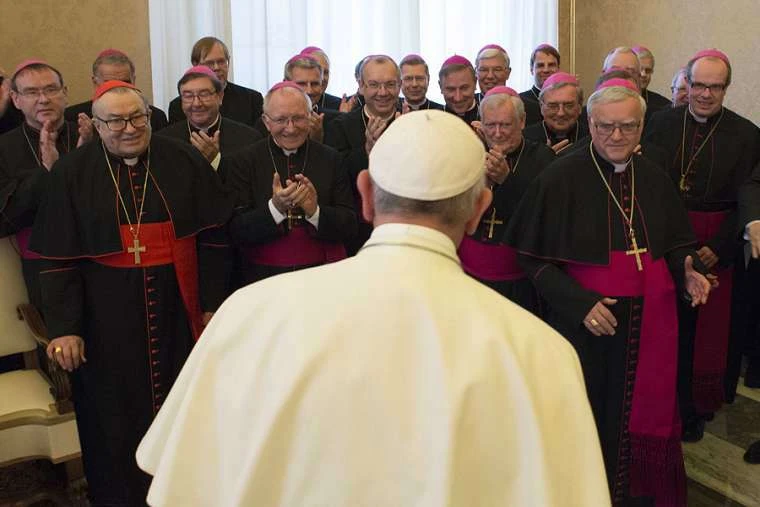
German Catholic Bishops Declare Homosexuality to be "Normal"

The Reformation began in Germany in reaction to the corruption and lunacy of the Roman Catholic Church.  It ultimately forced the Church to change its ways in a number of ways. One thing that did not change was the Church's dogma on human sexuality which remained firmly back in the 12th century - where it has remained to the current day despite advances in medical and mental healthy knowledge.  As a result, gays have been persecuted and sex has remained for procreation only and should never be enjoyed. Now, a synod of German bishops is committed to “newly assessing” the universal Church’s teaching on homosexuality, sexual morality in general, and seemingly at long last bring the Church out of the 12th century. As one might expect, the shrieks and screams from right wing Catholic extremists who live to condemn others and preach a message of division is off the charts. A piece in the Catholic News Agency looks at the ongoing development.  Here are excerpts:
Munich, Germany, Dec 12, 2019 / 02:10 pm (CNA).- The German bishops’ conference has committed to “newly assessing” the universal Church’s teaching on homosexuality, sexual morality in general, as well as the sacraments of ordination and marriage. The commitment comes at the beginning of a controversial two-year “Synodal Process” by the German hierarchy.
Following consultations in Berlin last week, the chairman of the Marriage and Family Commission of the German bishops’ conference declared that the bishops agreed that homosexuality is a “normal form” of human sexual identity.
“Both belong to the normal forms of sexual predisposition, which cannot or should be be changed with the help of a specific socialization”.
Koch went on to say that “developments” made possible by Amoris laetitia, Pope Francis’ exhortation of marriage and the family, the Church must consider the latest scientific and theological insights on human sexuality.
Archbishop Koch, together with diocesan bishops Franz-Josef Bode of Osnabrück, Bishop Wolfgang Ipolt of Görlitz, Bishop Peter Kohlgraf of Mainz, as well as several auxiliary bishops from the Faith and Family Commission of the bishops' conference consulted with a number of invited medical specialists, theologians and canon lawyers during the event.
Calling for a "solid discussion supported by human sciences and theology" Koch and Bode said that Amoris Laetitia already provides for noticeable "developments" of both Church doctrine and practice, adding that a sexual relationship for divorced and remarried couples after Amoris laetitia "was no longer always to be qualified as grave sin," and that wholesale “exclusion from the reception of the Eucharist" of such couples could no longer be justified.
Koch said that the "Synodal Process" should must begin from an "unbiased" position on the Church’s teaching and without fixed points of view, but rather an openness to taking into account “latest scientific insights”.
According to a press release issued by the bishops, there was also discussion on whether the prohibition of homosexual acts by the Church’s magisterium was "still up-to-date" – and whether artificial contraception should still be condemend by the Chuch for “both married and unmarried” couples.
The results of the “expert consultation” in Berlin will be fed in to the “Synodal Process” through the synodal forum on "Life in Successful Relationships - Living Love in Sexuality and Partnership", will begin its work in February 2020.
Coinciding with the opening of the Synodal Process, several diocesan and national Catholic associations funded by the German Church tax, or Kirchensteuer, have made public demands for changes to the Church’s teaching and practice on similar issues.
Calls for “reform” range from the blessing of homosexual unions to the priestly ordination of women, . . .

Thursday, January 10, 2019

There's No Making the Catholic Church "Great Again"


The Roman Catholic Church is facing perhaps its greatest crisis since the Reformation in the wake of a never ending cascade of sexual abuse by clergy and cover ups by high ranking Church officials, some of whom engaged in abuse themselves. Recently, it was disclosed that Opus Dei, an extreme far right element in the Church, had paid a $1 million settlement in respect to one of its most visible priest in response to abuse allegations. Over a dozen state attorneys general are investigating clerical sexual abuse and Church cover ups in their states and bomb shell stories hit the press nearly daily (my Google search agent delivers numerous stories every day).  The response of the far right elements in the Church such as "Church Militant" - which would bring back the Spanish Inquisition if it could - is to call for a return to the the Latin mass and blaming gays for all of the sins of the Church.  They want to make the Church "great again" in the same blind and fraudulent way that Trump has convinced his white supremacist followers that he can take them back to a better time that never really existed. A piece in the National Catholic Reporter looks at the foolishness and dishonesty of this approach.  Here are highlights:

Despite political slogans to the contrary, there has never been a time when America was "great." The same thing could be said about the Roman Catholic Church.
There has never been a "great" time, a "golden age," a context in which the church was actually a "perfect society" or anything apart from what it always has been and remains: a pilgrim community of the baptized. It has always been simultaneously holy and sinful (a theme theologian Brian Flanagan takes up in his recent book Stumbling in Holiness: Sin and Sanctity in the Church) because it is composed of imperfect, weak and ordinary human beings like you and me and everybody else.
While many Catholics, especially those in ecclesiastical leadership, have focused a lot of attention on the sanctity of the church over the centuries, the real sinfulness of the church can no longer be merely brushed off or avoided altogether. 
In the wake of the crises of faith and trust renewed by the revelations of the abuse and assault allegations against former-Cardinal Theodore McCarrick and witnessed in the Pennsylvania grand jury report, women and men of faith have had to grapple with why they continue to identify as Catholic and what that identity means to them. And the responses have varied.
A lot of attention has been paid to those who have opted out of Catholicism entirely. . . . . I understand this decision and the feelings that precipitate such a serious choice. I, too, have had my own struggles with how to square my faith in the God of Jesus Christ and the church with the darkest and most-disturbing criminality of some of its leaders.
[S]ome Catholics have proposed constructive pathways and calls for change. Among these, I think increased lay leadership and ministerial oversight in numerous forms makes tremendous sense and its implementation is long overdue.
Others have suggested dramatic and, at times, unrealistic responses. While well-intentioned, calls for widespread episcopal resignations or even just that of Pope Francis alone do not adequately address the structural issues that were the conditions that make possible such egregious abuse, assault and cover-up. 
And still others have taken a different approach entirely. Which brings me to what we might call the ecclesial equivalent of the Trumpian rally cry to "Make America Great Again."
While not an overwhelming number, there is a small but vocal group of Catholics who have taken the latest revelations as an opportunity to suggest the source of the crises in the church are the theological and liturgical reforms of the Second Vatican Council. This sort of conjecture is as incredible as those who claim gay clergy are the problem (a preposterous assertion that has been incontrovertibly disproven by scientific research).
What I find extremely disturbing with this sort of logic — and it is not limited to Roman Catholics, as one recent piece in The Times of London showed — are the ahistorical and untenable theological foundations it presupposes.
Change can be a terrifying prospect. So too is the realization that what so many of us generally presumed about the goodness, virtue and moral standing of our religious leaders might not be as accurate as we rightly hoped. But change in itself is not the problem and reactionary attitudes of yearning for a greater time that never was is also not the answer. The desire to return to what some see as past liturgical perfection, for example, reflects the fear of change in unfamiliar times seen today in broader society. It is a symptom of something more troubling: a desire for control presented as authentic reform.
There's no going back to this reverie of some past great church, because the only church that exists is the pilgrim one composed of all the baptized on a journey forward. The question for us this year is how exactly do we let the Holy Spirit lead us forward?


Rigid doctrine that ignores modern science and knowledge and condemnation of anyone who disagrees is not going to solve the current Church crisis.  Just as Trump's chanting MAGA is not going to sweep the nation back to the segregated and often brutal 1950's.