Showing posts with label nones. Show all posts

Friday, July 03, 2020

82% of Evangelicals Continue to Embrace Immorality


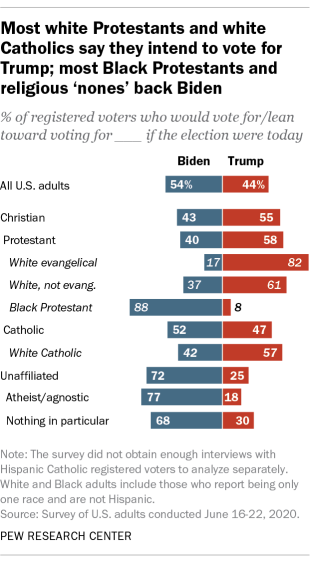
The results of a new Pew Research Center survey has been released and they again confirm that white evangelicals are the worse hypocrites and modern day Pharisees of any religious group as they continue to support the most immoral individual to ever occupy the White House.  Eighty two percent say they will vote for Trump in November.  The survey take away is that decent, moral people should not be fooled by the false piety and claims of religiosity from evangelicals given that Trump is the antithesis of Christian conduct and Christ's social gospel message. White evangelicals are not the only ones whose claims of being "Christian" should be questioned.  Majorities of white "Christians' also support Trump although not at the levels of evangelicals who, in my view, lead the nation in moral bankruptcy and hypocrisy.   One cannot be a moral person if they support a man who is the embodiment of immorality.   Here are highlights from the survey:
Amid rising coronavirus cases and widespread protests over racial injustice, President Donald Trump’s approval rating has dropped among a wide range of religious groups, including white evangelical Protestants – though they remain strongly supportive.
The same survey finds that if the 2020 presidential election were held today, 82% of white evangelical Protestant registered voters would vote for Trump or lean toward voting for him, while 17% say they would back the Democratic Party’s presumptive nominee, Joe Biden. By comparison, a Pew Research Center survey that was conducted just after the 2016 presidential election among those who were identified as having voted found that 77% of white evangelical Protestant voters backed Trump, while 16% voted for Hillary Clinton.
The June survey was conducted after Trump’s controversial visit to St. John’s Episcopal Church on June 1, and in the immediate wake of the Supreme Court’s landmark LGBTQ ruling on June 15.
Trump’s continued support among white evangelical Protestants – a group that is highly religious and overwhelmingly Republican – is matched by their dislike of Biden.
While no other religious group is as supportive of Trump as white evangelical Protestants – and his rating has slipped among most Christian groups in this analysis in recent months – [Trump] the president continues to garner support from half or more of other white Christians. More than half of white Protestants who do not identify as evangelical (56%) say they approve of the job Trump is doing, as do 54% of white Catholics – and roughly six-in-ten voters in these groups say they would vote for him if the election were held today.
On the other hand, large majorities of Black Protestants (83%), Hispanic Catholics (74%) and religiously unaffiliated Americans (74%) say they disapprove of Trump. Among Black Protestants, levels of disapproval have increased to 83% from 74% in April, but are roughly similar to where they stood in January, when 10% approved of Trump and 87% disapproved. And among Black Protestant voters, just 8% say they would vote for Trump if the election were held today, while 88% would vote for Biden.
Black Protestants, who overwhelmingly identify as Democrats or as Democratic-leaning independents, are the religious group with by far the most positive views toward Biden.
Among religiously unaffiliated Americans, another strongly Democratic constituency, opinions on a possible Biden presidency are more tepid. (The religiously unaffiliated, also known as “nones,” are those who describe their religion as atheist, agnostic or “nothing in particular.”) Fewer than a third of “nones” (27%) say Biden would be a good or great president, while 39% say he would be average and 33% say he would do a poor or terrible job. Nevertheless, this group’s views toward Biden are much more positive than toward Trump: Seven-in-ten “nones” say Trump has been a poor (13%) or terrible (56%) president, and a similar share of unaffiliated voters (72%) say they would vote for Biden if the election was today.
It's telling that the so-called "Nones" are more moral than evangelicals as evidenced by their stron rejection of Trump.

Saturday, August 31, 2019

Why People Hate Religion

Some of the faces of "Christian" hypocrisy. 

I am often accused of hating religion.   That accusation is true when it comes to the "professional Christians" like Jerry Falwell, Jr., Franklin Graham, and Tony Perkins who spread a constant message of hate, as well as the scamvangelists (a term a blogger friend coined some years back) who use religion to line their own pockets and live lives of the tremendously wealthy - Joel Osteen and Pat Robertson among others springs to mind. Then, of course, there are the evangelicals who support the Trump/Pence regime.  And one certainly cannot exclude the Catholic Church hierarchy that has protected sexual predators for decades, if not centuries. The common theme among all of these individuals is rank hypocrisy along with a heavy dose of greed.  Nowhere do you see these individuals practicing Christ's gospel message of feeding the hungry, clothing the naked, giving shelter to the homeless, or welcoming refugees. Other than their loud protestations of their religiosity, one would never know these people are Christian.  Meanwhile, those who actually practice Christ's ideals tend to be invisible and most certainly fail to loudly and publicly challenge those giving religion a bad name.  The result is 40% of the under 30 generations leaving organized religion and others "hating" religion.  A column in the New York Times looks at the phenomenon.  Here are excerpts:
You don’t hear much about Sister Norma Pimentel in the secular press. She’s not a wacko, a hypocrite, a sexual predator or a political operative. Her life’s work, she says, is guided by seeing “the presence of God” in migrant children in the shelter she oversees in the Rio Grande Valley — vulnerable souls that her president would otherwise put in cages.
What you hear about is the phonies, the charlatans who wave Bibles, the theatrically pious, and they are legion. Vice President Mike Pence wears his faith like a fluorescent orange vest. But when he visited the border this summer and saw human beings crammed like cordwood in the Texas heat, that faith was invisible.
Pence is the chief bootlicker to a president who now sees himself in messianic terms, a president who tweets a description of himself as “the second coming of God.” As hard as it is to see God Part II boasting about grabbing a woman’s genitals, paying hush money to a porn actress, or calling neo-Nazis “very fine people,” millions of overtly religious Americans believe in some version of Jesus Trump, Superstar.
In Indiana this summer, Archbishop Charles C. Thompson stripped a Jesuit prep school of its Catholic identity for refusing to fire a gay, married teacher. The same threat loomed over another Indianapolis school, until it ousted a beloved teacher with 13 years of service. He was fired for getting married to another man — a legal, civil action.
The archbishop claimed he was upholding Catholic teaching, an example of the kind of selective moral policing that infuriates good people of faith.
Catholic teaching also frowns on divorce. But when a divorced teacher, at the same school where the gay teacher was fired, remarried without a church-sanctioned annulment and posted her status on Facebook as a dare, the archbishop did nothing. For this is a road that leads to thrice-married, politically connected Catholics like Newt Gingrich, whose wife Callista (with whom Gingrich carried on an adulterous affair before getting married) is now Donald Trump’s ambassador to the Vatican.
Archbishop Thompson says he tries to be “Christ-centered” in his decisions. If so, he should cite words from Christ condemning homosexuality, any words; there are none.
Religious hypocrites are an easy and eternal mark. The French Revolution was driven in part by the revulsion of starving peasants toward the overfed clerics who had taken vows of poverty. The Protestant Reformation took flight on disgust at a church in Rome that sold passages to heaven, enriching men who had multiple mistresses after taking vows of chastity. White evangelical Christians, the rotting core of Trump’s base, profess to be guided by biblical imperatives. They’re not. Their religion is Play-Doh. They have become more like Trump, not the other way around. It’s a devil’s pact, to use words they would understand. 
In one of the most explicit passages of the New Testament, Christ says people will be judged by how they treat the hungry, the poor, the least among us. And yet, only 25 percent of white evangelicals say their country has some responsibility to take in refugees.
[W]hat really thrills them is when Trump bullies and belittles their opponents, as counterintuitive as that may seem. Evangelicals “love the meanest parts” of Trump, the Christian writer Ben Howe argues in his new book, “The Immoral Majority.” Older white Christians rouse to Trump’s toxicity because he’s taking their side. It’s tribal, primal and vindictive.
So, yes, people hate religion when the loudest proponents of religion are shown to be mercenaries for a leader who debases everything he touches. And yes, young people are leaving the pews in droves because too often the person facing them in those pews is a fraud.
They hate religion because, at a moment to stand up and be counted on the right side of history, religion is used as moral cover for despicable behavior. This is not new to our age. Hitler got a pass from the Vatican until very late in the war.
And if you’re looking for hope in the midnight of the American soul, look no further than Sister Pimentel’s shelter for hundreds of desperate children in McAllen, Texas.  Growing up, Sister Pimentel was going to be an artist, she says, until she felt a strong tug on her soul; it compelled her to a lifetime of selfless service. Faith is not that complicated. Religion always is.

Saturday, August 10, 2019

“Immoral Majority: Why Evangelicals Chose Political Power Over Christian Values.”


A new book by a writer and filmmaker with the title used for the heading of this post looks at the growing moral bankruptcy of evangelical Christians in the age of Trump.  The author argues that as long as evangelicals prioritize political power over true Christian behavior and persuasion by charitable actions, their pews will be continue to lose occupants and their national influence will dwindle in the long term. The author perhaps unrealistically argues given the lust for power of those like Franklin Graham, Jerry Falwell, Jr., and Tony Perkins, that if evangelicals hope to avoid cultural irrelevance in the years to come, they will have to value humility over ego, and resist the seduction of political power, no matter the cost. Nowhere does the hypocrisy and moral bankruptcy of evangelicals reveal itself more than in their cheering support of the Trump/Pence regime's brutality towards children of undocumented immigrants.  

Frighteningly, I suspect that many evangelicals would look at the image of the crying child above and not feel any remorse for the simple reason that the child is not white. The further irony, of course, is that while these evangelicals want to "take back their country," those against whom they target their hate are the descendants of the the original indigenous populations of the Americas  and who had their lands stolen from them by white European conquest.  Here are highlights from a column in the Washington Post by the author of “Immoral Majority: Why Evangelicals Chose Political Power Over Christian Values”:
As the debate about how to handle applicants for refugee status at the U.S. southern border gained urgency in recent months, Pew Research Religion waded into the social-media fray on July 7 with a tweet about the results of a poll the organization conducted last year. Pew reported, and online commentators quickly noted, that white evangelical Protestants were the least likely group — amid results sorted by age, race, education and religion — to say that the United States “has a responsibility to accept refugees into the country.” 
Sixty-eight percent of white evangelical Protestants said the country has no responsibility for refugees. No other demographic group came within 10 points of that result.
[S]ome evangelical leaders had been taken aback when the Pew results were originally released in May 2018, and urged their flocks toward change. But back then, the main question about refugees concerned those fleeing the brutal civil war in Syria. “When faced with a potential conflict between prominent evangelicals’ biblical pro-refugee arguments and [President] Trump’s opposition,” Brian Newman of Pepperdine University noted in The Post, “the vast majority of white evangelicals choose Trump.”
A year later, with the focal point on refugees from Central America, in much greater numbers and more likely to be vilified by the president, evangelical leaders are largely as one with their congregations.
Russell Moore, president of the Ethics and Religious Liberty Commission, the public-policy arm of the Southern Baptist Convention, ventured this observation on Twitter: “The reports of the conditions for migrant children at the border should shock all of our consciences. Those created in the image of God should be treated with dignity and compassion, especially those seeking refuge from violence back home. We can do better than this.”
Moore’s comments didn’t sit well with Jerry Falwell Jr., inheritor of his father’s Christian empire, president of Liberty University and a prominent evangelical figure.
Some were dismayed by Falwell’s response, but you’d be hard-pressed to find anyone paying attention the past few years who was surprised by it. 
Falwell is one of several leaders in the modern evangelical movement who have helped solidify Christian principles as synonymous with the Republican agenda, and specifically with the [Trump’s] president’s agenda.  Trump, of course, welcomes this way of thinking.
Yet the idea that without Republicans, Christianity is lost, is not unique to the Trump era. The merging of evangelicalism and Republicanism has been underway for decades. It is simply more visible and pronounced under this president — primarily because evangelical support for Trump requires a much higher degree of cognitive dissonance.
That is, fighting for conservative Christian values by unquestioningly supporting someone who not only doesn’t share them but has lived most of his life actively, and unapologetically, in opposition to them. 
Stomaching Trump’s behavior and rhetoric — which could generously be described as not characteristic of a Christian — has been rewarded with much-improved prospects for stricter abortion laws and achieving other long-sought goals in what conservative Christians regard as a desperate and escalating culture war.
The evangelical embrace of Trump has been an electoral positive for the Republican Party, but for those who would evangelize, the new reality is tragic.
[True Christians are] meant to speak the truth in a way that invites strangers in, welcomes them, makes them feel loved.  To care for the least of these is a Christian value. Expressing and demonstrating it is spreading the Word.
That’s called evangelizing. A movement that based itself on the term but now embraces its antithesis is becoming difficult to recognize.
Yes, there are good Christians, but until they loudly and continually condemn evangelicals on a daily basis, they are allowing evangelicals to be the face of Christianity and the result is the exodus of people, especially among younger generations, from religion entirely.  Meanwhile, being a Trump supporter and a true Christian are mutually exclusive.

Friday, May 03, 2019

Buttigieg's Rise Exposes a Deepening Rift in the "Christian Right"

Buttigieg and Christofascist extraordinaire, Mike Pence.
I have long argued that the Republican Party has no long term plan for survival short of a coup that would overthrow the U.S. Constitution and end popular elections with independent political parties.  For years now, the GOP has based its future on aging white voters - who are literally dying off - and far right Christians extremists (I call them the Christofascists), groups that basically hate everyone who is not just like them. Meanwhile, the rest of the population is becoming increasingly diverse and whites are headed towards a minority status within a few decades.  Now, compounding the numerical decline of aging white bigots is a growing rift in the so-called Christian Right (it is neither Christian nor right on the issues) that centers on LGBT rights and acceptance that is best personified by the rise of Pete Buttigieg.  Younger generations even among evangelicals are supportive of gay rights and same-sex marriage while their elders are not. The growing rifts within evangelicals in many ways mirror the fissures developing in the United Methodist Church over LGBT rights which many view as on the cusp of a major schism. Younger evangelicals increasingly reject the anti-gay vitriol of their denominations and demand that 12th century understandings of sexuality be abandoned.  A piece in The Week looks at the growing rift over LGBT rights which ultimately could endanger the GOP as it remains committed to anti-gym extremism. Here are excerpts:
Pete Buttigieg is having a moment in the national spotlight. Buttigieg, as most of America now knows, is the mayor of South Bend, Indiana, and a Democratic candidate for the 2020 presidential nomination. He's also gay, married to a man, and a regular churchgoer. And his meteoric rise has brought the debate over faith and sexual ethics clearly into focus.
This debate over same-sex relationships has been tearing apart American churches for years. Sometimes it presents itself as a dividing line between denominations. For example, Episcopalians, of which Buttigieg counts himself, have largely embraced gay rights. Evangelicals mostly have not. Last month, conservative commentator Erick Erickson said that "if Buttigieg thinks evangelicals should be supporting him instead of Trump, he fundamentally does not understand the roots of Christianity. But then he is an Episcopalian, so he might not actually understand Christianity more than superficially."
The debate is also alive and well within denominations themselves. For example, the United Methodist Church — the largest in U.S. mainline Protestantism — recently strengthened its prohibitions of same-sex wedding ceremonies and gay clergy, even while many similar churches have been liberalizing their teachings on homosexuality.
This aligns the United Methodists with the Catholic Church, the Southern Baptist Convention, and a growing number of Christians in the Global South. Indeed, it was African delegates, working with U.S. evangelicals, who supplied the margin of victory for the Methodist Church's recent interpretation of Scripture and tradition.
But no doubt many in the church were outraged by the decision. Methodist pastors in the Washington, D.C., area took out an ad in The Washington Post decrying the vote and calling for a more inclusive church. The chaplain at the Methodist college I attended, a longtime ordained minister within the denomination, has even signed on to work for Buttigieg's presidential campaign. Another nearby school ended its affiliation with the Methodist Church over the LGBT vote.
The people on both sides of the religious debate over homosexuality aren't merely talking past each other. Their views on the issue are fundamentally very different from one another.
Buttigieg summed up his view well when addressing his ongoing dispute with Vice President Mike Pence, an evangelical Christian with traditional views on sexual mores. He said that "the Mike Pences of the world" should understand "that if you got a problem with who I am, your problem is not with me — your quarrel, sir, is with my creator."Buttigieg would shift the focus toward gay rights, where social conservatives are losing ground as more people support gay marriage.
A Buttigieg nomination would also put evangelicals on the defensive over their support for President Trump. After all, how can you say you stand for the sanctity of marriage but still vote for the twice-divorced, thrice-married, locker room-talking, frequently incendiary president?
This debate is no longer just between Episcopalians and evangelicals. It's raging between Christians on the left and the right side of the political spectrum. Conservatives have long struggled to grapple with committed same-sex relationships, as well as the increasing number of otherwise theologically orthodox people who disagree with them about sexual ethics.
Such weighty theological questions aren't likely to be solved in the rough and tumble of a presidential campaign. But the right 2020 developments could get voters — and people in the pews — talking about them.

As conservative denominations - including the Catholic Church - hemorrhage  members and younger individuals are eschewing religion entirely, the rift over gays and gay rights and Christian hypocrisy will likely intensify.  Among the big losers will likely be the GOP which has placed all of its eggs in one basket. Frankly, the demise of the GOP cannot come soon enough in my opinion.

Friday, April 19, 2019

U.S. Church Membership Plummets Over Past 20 Years

(AP Photo/Charlie Riedel)
On the good news front - at least in my opinion - a new Gallup survey indicates that church membership in the USA has plummeted since 1999 from 70% of Americans belonging to a church to only 50%.  Meanwhile, the percentage of U.S. adults with no religious affiliation has jumped from 8% to 19%.  Only 24% of Millennials have any church affiliation which portends a huge problem for churches as older generations die off.  I continue to credit much of the exodus from Christianity in particular to evangelicals and other "conservative" denominations - think Southern Baptists - who have repeatedly demonstrated that hatred of others and rank hypocrisy are synonymous with religion.  With Republicans fully self-prostituting themselves to the Christofascists and pushing to grant them special rights, with luck the exodus will accelerate.  Here are highlights from the Gallup findings:
As Christian and Jewish Americans prepare to celebrate Easter and Passover, respectively, Gallup finds the percentage of Americans who report belonging to a church, synagogue or mosque at an all-time low, averaging 50% in 2018.
U.S. church membership was 70% or higher from 1937 through 1976, falling modestly to an average of 68% in the 1970s through the 1990s. The past 20 years have seen an acceleration in the drop-off, with a 20-percentage-point decline since 1999 and more than half of that change occurring since the start of the current decade.
The decline in church membership mostly reflects the fact that fewer Americans than in the past now have any religious affiliation. However, even those who do identify with a particular religion are less likely to belong to a church or other place of worship than in the past.
Religiosity is strongly related to age, with older Americans far more likely than younger adults to be members of churches. However, church membership has dropped among all generational groups over the past two decades, with declines of roughly 10 percentage points among traditionalists, baby boomers and Generation X.
Most millennials were too young to be polled in 1998-2000. Now that they have reached adulthood, their church membership rates are exceedingly low and appear to be a major factor in the drop in overall U.S. church membership. Just 42% of millennials are members of churches, on average.
The low rates of church membership among millennials conform with the generation's weaker attachment to religion in general. On average, 68% of millennials identify with a religion in the 2016-2018 church membership surveys, while 29% do not. In all other generations, at least 79% have a religious affiliation, with correspondingly lower percentages expressing no faith preference. Not only are millennials less likely than older Americans to identify with a religion, but millennials who are religious are significantly less likely to belong to a church. Fifty-seven percent of religious millennials belong to a church, compared with 65% or more in older generations. [T]he emergence of an increasingly secular generation to replace far more religious older generations suggests the decline in U.S. church membership overall will continue.
[C]hurch attendance has dropped more among Catholics than among Protestants. Consistent with this, the decline in church membership has been greater among Catholics. Twenty years ago, 76% of Catholics belonged to a church; now, 63% do.
Meanwhile, 67% of Protestants, down from 73% in 1998-2000, are members of a church. Much of the decline in Protestant membership is attributable to the increasing percentage of Americans who simply identify their religion as "Christian" rather than as a specific Protestant denomination such as Baptist, Lutheran or Methodist.
Republicans show a relatively modest decline in church membership of eight points since 1998-2000 (from 77% to 69%). In contrast, Democrats show one of the largest subgroup declines, of 23 points, from 71% to 48%. A sharp increase in the proportion of the population with no religious affiliation, a decline in church membership among those who do have a religious preference, and low levels of church membership among millennials are all contributing to the accelerating trend.
The challenge is clear for churches, which depend on loyal and active members to keep them open and thriving. . . . . Church leaders must also grapple with the generational slide away from religion. Millennials are much less likely than their elders to indicate a religious preference, and presumably the nearly one-third of millennials without a religious preference are unlikely to ever join a church.
Another obstacle churches face is Americans' eroding confidence in the institution of organized religion. While organized religion is not the only U.S. institution suffering a loss of confidence, Americans have lost more confidence in it than in most other institutions.
These trends are not just numbers, but play out in the reality that thousands of U.S. churches are closing each year. Religious Americans in the future will likely be faced with fewer options for places of worship, and likely less convenient ones, which could accelerate the decline in membership even more.
Again, in my view, all encouraging news. 

Saturday, April 13, 2019

"Nones" Now More Numerous than Catholics or Evangelicals

click image to enlarge
One thing the wrongly named "Christian Right" - they are neither Christian nor right - is doing most effectively is poisoning the Christian brand and driving people from religion, especially younger Americans.  As noted in the prior post, evangelical support for Donald Trump - likely the most morally bankrupt individual to ever occupy the White House - illustrates just how false and toxic religion can be (and that's without adding the horrors religion has caused over the centuries).   Adding to the exodus no doubt is the Catholic Church's never ending sex abuse scandal and the Church's refusal to hold bishops and cardinals truly accountable for their malfeasance if not active cover up of abuse. Now, for the first time, the so-called "Nones" are the largest "religious" group in the USA.  Given the current trends, their numbers will likely continue to soar (and yes, I see this as welcome news).  Politically, this new reality has not yet translated into representation in elected office, but that time is likely coming.  Here are highlights from CNN:
For the first time "No Religion" has topped a survey of Americans' religious identity, according to a new analysis by a political scientist. The non-religious edged out Catholics and evangelicals in the long-running General Social Survey.
Ryan Burge, a political scientist at Eastern Illinois University and a Baptist pastor, found that 23.1% of Americans now claim no religion. Catholics came in at 23.0%, and evangelicals were at 22.5%.  The three groups remain within the margin of error of each other though, making it a statistical tie. Over 2,000 people were interviewed in person for the survey. "Religious nones," as they are called by researchers, are a diverse group made up of atheists, agnostics, the spiritual, and those who are no specific organized religion in particular. A rejection of organized religion is the common thread they share.
 "It is the first time we have seen this. The same questions have been asked for 44 years," Burge told CNN.  The meteoric rise of religious nones began in the early 1990s and has grown 266% since 1991, he said.  Burge estimates that 'No Religion' will be the largest group outright in four to six years.
 Robyn Blumner, executive director of the Richard Dawkins Foundation for Reason & Science, sees the change as a generational trend driven by millennials.  "We are seeing the rise of a generation of Americans who are hungry for facts and curious about the world," she says.
 Whatever the causes, the non-religious represent a growing constituency. Yet this demographic is greatly underrepresented in Washington's halls of power. There is not a single open atheist amid the most diverse Congress in history, according to a Pew study.
 The Congressional Freethought Caucus's 10 members try to represent non-theist interests while protecting the secular character of government.  "This growing group of Americans can feel like there is at least some people in Congress who believe they matter." says the co-chair and founder, Rep. Jared Huffman of California.


A piece in The Daily Mail also reports as follows:
Shifting political ideologies about social issues has also played a role, with fewer Americans comfortable with the rhetoric of their religious leaders.
'Another (theory) is that the religious right kind of cleaved moderate Christianity and a lot of moderate Christians who were moderately attached said they didn't want to defend Jerry Falwell … and all the anti-gay and anti- abortion religious rights leaders,' Burge said. 'So they said, 'You know what? I'm out.'
As the 'nones' have ascended, the number of mainline Protestant Christians has fallen 62.5 percent since 1982, to now account for just 10.8 percent of the U.S. population, according to the survey.
Again, I hope the trend continues and that politicians are forced to stop prostituting themselves to the shrinking "religious right."

Saturday, January 19, 2019

Karen and Mike Pence's Anti-Gay Animus Puts Them Far Outside the Mainstream

Click image to read sign in background.
Mike Pence has delusions of being president, yet the anti-gay views of he and his wife place them far outside the main stream of American opinion.  Indeed, the only evangelical Christians - who have demonstrated to the rest of the country their complete moral bankruptcy by steadfastly supporting Donald Trump - seemingly share their anti-gay animus.  As CNN notes in referencing a Pew Research survey, two-thirds of Americans said gay or lesbian relationships are morally acceptable.  The third of the population who share anti-gay beliefs equates to almost the same percentage of the population that supports Trump.  If Pence dreams of the White House, he needs to stop clinging to and loudly supporting views rejected by a strong majority of Americans.   Here are highlights from CNN:  

Second lady Karen Pence has taken a job as an art teacher at a Christian school in Northern Virginia that bans gay students, parents, and employees.
The policy places the school on the other side of US public opinion; recent polling on the issue suggests most people don't see the homosexuality as immoral or even as an issue of morality.
According to a Pew poll from May 2018, two-thirds of Americans said gay or lesbian relationships are morally acceptable and only 30% said they are morally wrong. This was the highest number to say gay or lesbian relationships are morally acceptable since Gallup began tracking the question in 2001.
 Pew's findings that homosexuality isn't controversial are backed up by a Gallup poll from December 2017. While fewer overall said homosexuality was either morally acceptable (22%) or morally wrong (34%), that's because they offered a third option: not a moral issue. When offered the third option, 44% said that homosexual behavior wasn't a moral issue.
 And most people don't want religion to dictate government policies on LGBT issues, from an AP-NORC survey in August, 2018. Almost half of all respondents said they thought religion should have no influence at all on government policies. A third said it should have a lot or some influence and 16% said it should have "not much."
 In a May, 2018 Gallup poll, 67% of Americans said that marriages between same-sex couples should be recognized by the law as valid and have the same rights as other marriages.


Note: half of Americans want religion to have no influence on government policies.  As Millennials become more politically engaged, expect Mike Pence's anti-gay bigotry to become even a bigger political liability.  

Sunday, December 16, 2018

The Coming Demise of Evangelicals as a Political Force

One of the continuing toxic poisons in American politics is, in my view, white evangelicals who seek to impose their reactionary and exclusionary views on all citizens.  Over the last decades, this toxic mindset has taken over the Republican Party and, when looks at the history of the evangelical movement, has made white supremacy a pillar of today's GOP.  The good news is that the political power of the white evangelicals may be about to plummet as younger evangelicals are walking away from what has become a partisan religious movement defined by hatred of others.  A piece in Newsweek looks at what is hopefully the beginning of the end of white evangelical political power, an end hastened in part by evangelicals' embrace of Donald Trump, a man who is the embodiment of everything a true Christian should oppose and find abhorrent. Here are article highlights:

Alex Camire left the church a few months before his pastor announced from the pulpit that the election of Donald Trump was “a miracle of the Lord.”
The 29-year-old Connecticut social worker had been raised in the evangelical tradition; his parents were married in it. But Camire’s faith had started to fail a decade earlier when his church deemed his mother’s alcoholism—and his parents’ subsequent divorce—a sin. Later, a secular college education taught him that “the world”—the community outside the church—wasn’t going to drag him into a cesspool of sex and drugs, as he’d been taught from childhood. His pastor’s outspoken support of Trump convinced him he’d made the right decision.
Californian Jason Desautels similarly began to doubt his faith as a teen. In the week after the Oklahoma City bombing, his church’s minister railed against “sand people” and Muslims. “When it came out that the bomber was a white nationalist, he didn’t apologize or even say anything,” Desautels recalls. “And the adults seemed to be all fine with it. That planted the seed.”
Later, as an Army infantryman in Iraq, Desautels, now 39, moved further from the church. “I was in the land of Father Abraham,” he says. “I had this weird spiritual moment when I realized that these families had lived in this neighborhood for longer than America had been a nation, and here we were telling them what to do.” He cut ties completely with his church after his sister came out as gay and felt she had to apologize to their parents.
Blake Chastain, 35, entered Indiana Wesleyan University the week of 9/11, with hopes of graduating from the seminary. Instead, he began to fall away from the church when he couldn’t reconcile what he was learning in Bible study with his professor’s support for the Iraq War. “Conservative Christianity,” he says, “was at odds with the teachings in the Bible.”
All three men are on the front lines of a growing movement among millennials that is reshaping the evangelical church and the nation’s political landscape. Since the 1970s, white evangelicals have formed the backbone of the Republican base. But as younger members reject the vitriolic partisanship of the Trump era and leave the church, that base is getting smaller and older. The numbers are stark: Twenty years ago, just 46 percent of white evangelical Protestants were older than 50; now, 62 percent are above 50. The median age of white evangelicals is 55. Only 10 percent of Americans under 30 identify as white evangelicals. The exodus of youth is so swift that demographers now predict that evangelicals will likely cease being a major political force in presidential elections by 2024.
To be sure, evangelical Christians have been rewarded for their support of Trump after enduring eight years wandering in Barack Obama’s political desert. They have two new conservative Supreme Court justices, and there have been nine self-professed evangelical Cabinet members, plus a flurry of laws and executive orders clamping down on gender roles, abortion and LGBTQ rights. But experts say this may represent the last bounty for a waning political power. Unlike their parents, the younger generation is not animated by the culture wars; many are pushing for social justice for migrants and LGBTQ people and campaigning against mass incarceration—positions more in line with the Democratic Party. 
The result is a shrinking conservative bloc, something that could weaken white Christian political power—and, consequently, a Republican Party that has staked its future on its alliance with the religious right. It’s a conundrum that the father of modern GOP conservatism, Barry Goldwater, predicted in 1994: “Mark my word, if and when these preachers get control of the party, and they’re sure trying to do so, it’s going to be a terrible damn problem.”
The association of the religious right and the Republican Party has its roots in the 1954 Supreme Court ruling Brown vs. the Board of Education of Topeka, after which white Southerners began to flee public schools following forced desegregation. They opened so-called segregation academies: religious schools that were tax-exempt. When the IRS came after evangelical colleges like Bob Jones University, which officially prohibited interracial dating, the schools were faced with losing their tax-exempt status.
That would have meant financial doom. But a Republican activist named Paul Weyrich—with patronage from Western segregationist beer billionaire Joseph Coors—forged alliances with Southern religious leaders like Jerry Falwell and successfully lobbied to soften IRS enforcement. . . . Republican strategists used the issues of abortion and gay marriage to cement the union and drive right-leaning Christians into the voting booth.
But demographic trends are steadily diluting their outsize clout. Researcher Robert Jones, author of The End of White Christian America, has tracked what he calls a “stair-steps downward trajectory of white Christian presence in the electorate.” In 1992, when Bill Clinton was elected, 73 percent of the electorate was white and Christian. By 2012, that number was 53 percent. “If current trends hold steady, 2024 will be a watershed year—the first American election in which white Christian voters do not constitute a majority of voters,” Jones, who heads the Public Religion Research Institute (PRRI), tells Newsweek.
[T]heir ranks are now dwindling, driven largely by the youth exodus. According to Jones, white evangelicals constituted 21 percent of the U.S. population when Obama was elected in 2008. Eight years later, in 2016, that number dropped to 17 percent. Today, they make up 15 percent of Americans.
For an analogy, he uses Elisabeth Kübler-Ross’s landmark “stages of grief” experienced by the dying and their loved ones to describe what’s happening to evangelicals and American politics. First comes denial, then anger, followed by bargaining, depression and acceptance.
“We are past denial. People see the writing on the wall in terms of demographic change. And that is also why we see immigration taking over and becoming the flagship issue. That and a wall symbolize the resistance to this demographic change,” Jones says. “I think we are somewhere between anger and bargaining. And in many ways, this shotgun marriage between Trump and white evangelicals happened under some duress and is a desperate bargain that you make at the end of life. That is what we’re really seeing here.”
To understand what’s happening among evangelicals, researchers study the results of PRRI’s annual, wide-ranging, 80,000-interview American Values Atlas poll. In the most recent survey, from 2017, 40 percent of individuals under 30 claim “no religious affiliation” (sometimes called “the nones”). “White evangelicals are a big part of that decline,” Jones says. . . . “They cite partisanship,” Jones says. “That’s a big turnoff for young Americans. And so is negative treatment of gay and lesbian people.”
Polls find that upward of 80 percent of young people now support same-sex marriage. That number includes young Republicans and evangelicals under 30. . . . Some major evangelical leaders and thinkers, not surprisingly, reject this assessment.
Christopher Maloney, 32, was raised evangelical, stepped away from his faith and has released a documentary film on the exvangelical movement called In God We Trump. He disagrees with Moore that young evangelicals like him will come back to the fold.
“People around my age and younger were already deconstructing their evangelical faith in large numbers before Trump came along,” he says. “What the 2016 election did was accelerate what was already happening. We had begun edging toward the doors, and when evangelicals embraced Trump we bolted outside. To be honest, I don’t see a return of younger generations to the church as we know it.”
They aren’t interested, he says, in going to a central place to worship anymore, particularly when those fellow churchgoers are Trump supporters. “Millennials largely live by Christian ethics without any formal doctrine or dogma,” he says. “We just don’t need a religious structure to tell us how to be kind to one another.”
The disaffected ranks include women like Dawne Marx, a 53-year-old Texas mother of five, who walked away from her church community in 2016 after decades of voting with the evangelical fold. “I was a single-issue voter, a pro-life voter,” she tells Newsweek. “It was so nice and tidy. I didn’t have to think about anything else.”
Then she saw the images of family separations at the Mexican border and listened as the president casually dismissed the Saudi killing of journalist Jamal Khashoggi:
“All of a sudden there is Trump. And children wrapped up in aluminum blankets in cages and this crass, crude man, on a daily basis, saying things like, ‘OK, so a journalist got chopped up.’ And he’s saying, ‘We have a $100 billion contract, and there are a lot of jobs on the line.’ It’s like: They chopped somebody up!”

As one of the individuals in the article correctly noted, conservative Christianity is at odds with the teachings in the Bible.  It has become the home of modern day Pharisees who are the antithesis of what Christians should be. It deserves to die. 

Thursday, May 17, 2018

Trump on Immigrants: These are Animals


During a rant yesterday, Donald Trump finally gave voice to the real animus of his supporters towards undocumented immigrants - and I would argue by extension gays, non-whites, non-Christians on the part of evangelicals - when he described them as animals.  Not fellow human, but animals, the implication being that they are deserving of mistreatment and even death.  When America comes to the point where it deliberately and willingly separates children and warehouses them like animals on military bases, we have reached the point of utter moral bankruptcy.  Yet John Kelly and Trump, and Jeff Sessions - a longtime racist - seemingly fully support such cruelty.  And the evangelicals continue to rally to Trump's standard.  Is it any wonder a third of Millennials want nothing to do with religion?  A piece in USA Today looks at Trump's attack on immigrants who, in his mind, all have brown skin, and other Trump lies and untruths.  Here are excerpts:
President Trump used extraordinarily harsh rhetoric to renew his call for stronger immigration laws Wednesday, calling undocumented immigrants "animals" and venting frustration at Mexican officials who he said "do nothing" to help the United States.
“We have people coming into the country or trying to come in, we're stopping a lot of them, but we're taking people out of the country. You wouldn't believe how bad these people are," Trump said. 
"These aren't people. These are animals."
Trump's comments came in a freewheeling, hour-long White House meeting with local California leaders opposed to so-called "sanctuary city" policies.
Trump's remarks were reminiscent of his first press conference as a presidential candidate in 2015, when he said the United States had become a "dumping ground" for people other countries didn't want.
"When Mexico sends its people, they're not sending their best," he said then. "They're bringing drugs. They're bringing crime. They're rapists. And some, I assume, are good people."
In other comments, Trump:
► Called for Attorney General Jeff Sessions to investigate Oakland Mayor Libby Schaaf for warning undocumented immigrants of an upcoming sweep by immigration agents. "You talk about obstruction of justice, I would recommend that you look at obstruction of justice for the mayor, Jeff," the president said.
► Expressed frustration at his southern neighbor for not doing more to stop the flow of refugees and immigrants into the United States. "Mexico does nothing for us, they do nothing for us. Mexico talks, but they do nothing for us, especially at the border," he said. "Certainly don’t help us much on trade."
► Blamed Democrats for a policy of separating children from their parents when undocumented families enter the United States. 
"I know what you're going through with families is very tough," he told Homeland Security Secretary Kirstjen Nielsen. "But those are the bad laws the Democrats gave us. We have to break up families. The Democrats gave us that law. It's a horrible thing we have to break up families."
The attempt to blame Democrats was a huge lie - what else is new with Trump - given that the policy of separating children from parents only began after Trump took office.  As for the "devout Christians" supporting Trump, they should cease the hypocrisy of going to church and feigning piety.  I suspect Christ would find them repulsive and rightly so.

Monday, May 07, 2018

No Wonder There’s An Exodus from Religion


I often believe that if Christianity ends up largely dying in America as has happened in parts of Europe and some other developed nations, one of the leading causes will be the hypocrisy and general unloving behavior of Christ's purported most outspoken adherents.  What is an interesting correlation is that between the increased involvement of the so-called Christian Right - I call them Christofascists - in the Republican Party and the acceleration of the numbers of Americans identifying themselves as "None" - those who have forsworn religious affiliation.  With the Trump/Pence regime, the hypocrisy has gone off the charts as a column in the Washington Post notes.  Meanwhile, the exodus from religion continues.  Here are column excerpts:

Do you wonder why the proportion of Americans declaring themselves unaffiliated with organized religion has skyrocketed in recent decades?
This trend is especially pronounced among adults under 30, roughly 40 percent of whom claim no connection to a religious congregation or tradition and have joined the ranks of those the pollsters call the “nones.”
To understand how so many now prefer nothing to something when it comes to religion, ponder the news over the past few days.
The same newspapers and broadcasts that were reporting on how President Trump finally admitted that he had indirectly paid a porn star to keep quiet about an alleged affair also offered accounts of what we’ll call Jesuitgate, the controversy over who should be the chaplain of the House of Representatives.
 
Ryan had said he asked the cleric to quit because he had provided inadequate “pastoral services,” but denied that Conroy was ousted because of a mild prayer for justice he delivered during the debate over the GOP tax cut.
That phrase “pastoral services” must inspire a chuckle from your typical millennial agnostic. . . . Conroy also quoted Ryan’s chief of staff, Jonathan Burks, as telling him “something like ‘maybe it’s time we had a chaplain that wasn’t a Catholic.’ ” Ryan’s office vehemently denied this (the Catholic vote is substantial), but the speaker announced he didn’t want to have a “protracted fight” and that Conroy could stay.
But think about it: The House Republican leadership was more inclined to push out a chaplain than to impose accountability on a president who is a proven liar and trashes the rule of law for his own selfish purposes day after day.
This degree of partisan irresponsibility only aggravates the already powerful skepticism among the young about what it means to be religious. In their landmark 2010 book, “American Grace,” the scholars Robert Putnam and David Campbell found that the rise of the nones was driven by the increasing association of organized religion with conservative politics and a lean toward the right in the culture wars.
Revealingly, Putnam and Campbell found that millennials with tolerant and open views on homosexuality were more than twice as likely to be religious nones as their statistically similar peers with conservative or traditionalist views on homosexuality. Many young people came to regard religion, in Putnam and Campbell’s words, as “judgmental, homophobic, hypocritical and too political.”
If you want a particularly exquisite hypocritical moment, consider that on Thursday, the very day when Trump had to admit his lies on the Stormy Daniels payoff, the president held a White House commemoration of the National Day of Prayer
Conroy was getting at this in the most uncontroversial way possible when he spoke in his now-contested prayer of how “our great nation” has created “opportunities that have allowed some to achieve great success, while others continue to struggle.” If a chaplain could be rebuked for voicing that simple and undeniable truth, what’s the point of the “religious liberty” that Trump and his GOP allies celebrate?
And when will those who advertise themselves as religion’s friends realize they can do far more damage to faith than all the atheists and agnostics put together?
Yes, the image above was just too good to pass up.

Tuesday, March 27, 2018

The Rising Numbers of Those With No Religious Affiliation

The face of Christianity provided by today's GOP supporting evangelical Christians
If one listens to the bloviation of the professional Christian crowd, one hears much about keeping America a "Christian nation" even though such was never the case and the Founding Fathers went to great lengths to avoid any type of state religion.  What one will also hear is a great many lies and witness hypocrisy of epic proportions, especially in the era of Trump/Pence when evangelical Christians demonstrate their moral bankruptcy as they remain loyal supporters of a man devoid of morals and decency.  One of the results, in my view, is the accelerating rate at which Americans are leaving organized religion and Christianity in particular.  Why would anyone truly moral want to be associated with the likes of Franklin Graham, Jerry Falwell, Jr., Tony Perkins or the Catholic Church hierarchy which puts protecting predators and Church wealth ahead of the welfare of children and youths.  A piece in Scientific American looks at the continued increase in the "Nones."  Here are excerpts:

In recent years much has been written about the rise of the “nones”— people who check the box for “none” on surveys of religious affiliation. A 2013 Harris Poll of 2,250 American adults, for example, found that 23 percent of all Americans have forsaken religion altogether. A 2015 Pew Research Center poll reported that 34 to 36 percent of millennials (those born after 1980) are nones and corroborated the 23 percent figure, adding that this was a dramatic increase from 2007, when only 16 percent of Americans said they were affiliated with no religion. In raw numbers, this translates to an increase from 36.6 million to 55.8 million nones.
[T]hey are . . . . a significant voting block, far larger than Jews (4.7 million), Muslims (2.2 million) and Buddhists (1.7 million) combined (8.6 million) and comparable to politically powerful Christian sects such as Evangelical (25.4 percent) and Catholic (20.8 percent).
This shift away from the dominance of any one religion is good for a secular society whose government is structured to discourage catch basins of power from building up and spilling over into people's private lives.
[T]hese nones are not necessarily atheists. Many have moved from mainstream religions into New Age spiritual movements . . .  What's going on here? . . . . In a paper in the January 2018 issue of the journal Social Psychological and Personality Science entitled “How Many Atheists Are There?”, Will M. Gervais and Maxine B. Najle, both psychologists at the University of Kentucky, contend that there may be far more atheists than pollsters report because “social pressures favoring religiosity, coupled with stigma against religious disbelief..., might cause people who privately disbelieve in God to nonetheless self-present as believers, even in anonymous questionnaires.
From this analysis, they estimated, with 93 percent certainty, that somewhere between 17 and 35 percent of Americans are atheists, with a “most credible indirect estimate” of 26 percent.
If true, this means that there are more than 64 million American atheists, a staggering number that no politician can afford to ignore. Moreover, if these trends continue, we should be thinking about the deeper implications for how people will find meaning as the traditional source of it wanes in influence. And we should continue working on grounding our morals and values on viable secular sources such as reason and science.


As I have noted before, I believe that it will be the evangelical Christians and the Christofascists, not liberals, who will kill Christianity in America.

Saturday, March 10, 2018

Question of the Day: Why Do Bad Things Happen to the Good While the Horrible Live On

Trump surrounded by evangelical "Christian" leaders
The past seven days have been emotional and bring to mind the perennial question of why, if the Christian god exists, do bad things befall good people while foul and reprehensible people  (yes, I am talking about the current occupant of the White House) seemingly live on unscathed. A week ago, our nephew was badly injured in a freak accident that took the live of one of his employees who we knew from when our nephew's company did tile work in our master bathroom - they had also done the marble floors throughout the entire first floor of our home after it flooded in the 2009 Nor'Ida storm. Tuesday, one of my sons-in-law lost his father unexpectedly at a far too early an age.  All three of these men are/were devoted family men, honest in their dealings with others.  My son-in-law's father made a career out of protecting and helping others. All three are honest, decent men.  The contrast with Der Trumpenführer could not be more stark.  

Adding to the quandary of the question posed above is the reality that those who most loudly claim to represent and revere the message of Christ are the ones most supportive of the most foul and toxic individual to ever occupy the White House.  Endless lies, serial adultery, the rescission of regulations that protect citizens from rapacious and greed driven corporations, corruption on an unprecedented scale are all either cheered on or dismissed as unimportant even as these same "Christians" judge and condemn others who overall lead far more exemplary lives than they themselves. Worse yet, they reject knowledge and bear hatred towards the majority of the world's population.  If they represent the Christian god, who would want to be a follower?  Indeed, 1/3 of Millennials have demonstrated that they want no part of it at all and have walked away from religion.  

But evangelicals do not have a monopoly on hypocrisy and ugliness.  The Roman Catholic Church remains racked with sex abuse scandals literally around the globe yet no bishops and cardinals who allowed these horror to happen - and continue to happen - have been punished.  Indeed Pope Francis attended the funeral of one of the most reprehensible protectors of child rapist, Cardinal Bernard Law. Meanwhile the Catholic Church demeans women, condemns gays, and puts protecting its wealth ahead of all else.  Again, if these are what it means to be "Christian," why should anyone decent want any part of it?

I ceased calling myself a Catholic close to two decades ago.  Several years back, I joined author Anne Rice in ceasing to call myself a Christian because I wanted no association with those horrible, hate and bigotry-filled individuals who claim that moniker.  Like Jefferson, by default I am a deist.  I believe there is a creator, just not the one depicted in the Bible - or the Koran for that matter.  I will never know the answer to my question, but I do know that the answer is not found in Christianity as practiced by far too many of its adherents. 

PS.  Yes, I am in a negative mood.  As icing on the cake for a horrible week, we lost one of our dogs yesterday. It's 7:05 am and I feel like I could use a drink!