Showing posts with label exodus from churches. Show all posts

Friday, December 20, 2019

Christianity Today: Trump Must Be Removed from Office

Christianity Today is a magazine founded by the late Rev. Billy Graham, that has broad readership among evangelical Christians.  It is not the in the same league as the crazed publications of hate groups such as Family Research Council or American Family Association.  In fact, as noted, it was founded by Billy Graham and has not fallen under the influence of Graham's grifter children who use their family name and religion for self-enrichment and self-promotion. Thus, it is notable that in a main editorial, the editor-in-chief of Christianity Today has laid out the case of why Donald Trump must be removed from office, both for the good of the country and for the term legitimacy of evangelical Christianity, Axios notes why this editorial is ground shaking: 


An editorial published Thursday by Christianity Today, a magazine founded by the late Rev. Billy Graham, called for President Trump's removal from office in the wake of his impeachment, deeming him "grossly immoral." . . . Why it matters: Christianity Today is an influential mainstream magazine for evangelicals, with 4.3 million monthly visitors on its site and hundreds of thousands of print subscribers. President Trump won 81% of the evangelical vote in 2016, a group that makes up about 25% of the electorate, according to the Pew Research Center. . . . . Go deeper... Josh Harris: Evangelical support for Trump "incredibly damaging to the Gospel"

I and many others, including the under age 30 generations, now view evangelical Christians and even Christianity as something morally bankrupt  that decent people should seek to avoid. Support of Trump and right wing Republican policies that are the antithesis to the true gospel message are the principal reason younger generations are engaged in a massive exodus from religion entirely. It would seem that Christianity Today has come to the realization that continued evangelical support of Trump will deprive evangelicals of what little moral credibility that still possess.  Will evangelicals listen?  Sadly, probably not.  Here are editorial highlights:
In our founding documents, Billy Graham explains that Christianity Today will help evangelical Christians interpret the news in a manner that reflects their faith. The impeachment of Donald Trump is a significant event in the story of our republic. It requires comment.
The typical CT approach is to stay above the fray and allow Christians with different political convictions to make their arguments in the public square, to encourage all to pursue justice according to their convictions and treat their political opposition as charitably as possible. We want CT to be a place that welcomes Christians from across the political spectrum, and reminds everyone that politics is not the end and purpose of our being. We take pride in the fact, for instance, that politics does not dominate our homepage.
That said, we do feel it necessary from time to time to make our own opinions on political matters clear—always, as Graham encouraged us, doing so with both conviction and love.

[T]he facts in this instance are unambiguous: The president of the United States attempted to use his political power to coerce a foreign leader to harass and discredit one of the president’s political opponents. That is not only a violation of the Constitution; more importantly, it is profoundly immoral.
The reason many are not shocked about this is that this president has dumbed down the idea of morality in his administration. He has hired and fired a number of people who are now convicted criminals. He himself has admitted to immoral actions in business and his relationship with women, about which he remains proud. His Twitter feed alone—with its habitual string of mischaracterizations, lies, and slanders—is a near perfect example of a human being who is morally lost and confused.
Trump’s evangelical supporters have pointed to his Supreme Court nominees, his defense of religious liberty, and his stewardship of the economy, among other things, as achievements that justify their support of the president. We believe the impeachment hearings have made it absolutely clear, in a way the Mueller investigation did not, that President Trump has abused his authority for personal gain and betrayed his constitutional oath. The impeachment hearings have illuminated the president’s moral deficiencies for all to see. This damages the institution of the presidency, damages the reputation of our country, and damages both the spirit and the future of our people. None of the president’s positives can balance the moral and political danger we face under a leader of such grossly immoral character.
This concern for the character of our national leader is not new in CT.
[T]he words that we applied to Mr. Clinton 20 years ago apply almost perfectly to our current president. Whether Mr. Trump should be removed from office by the Senate or by popular vote next election—that is a matter of prudential judgment. That he should be removed, we believe, is not a matter of partisan loyalties but loyalty to the Creator of the Ten Commandments.
To the many evangelicals who continue to support Mr. Trump in spite of his blackened moral record, we might say this: Remember who you are and whom you serve. Consider how your justification of Mr. Trump influences your witness to your Lord and Savior. Consider what an unbelieving world will say if you continue to brush off Mr. Trump’s immoral words and behavior in the cause of political expediency. If we don’t reverse course now, will anyone take anything we say about justice and righteousness with any seriousness for decades to come?
[W]e have done our best to give evangelical Trump supporters their due, to try to understand their point of view, to see the prudential nature of so many political decisions they have made regarding Mr. Trump. To use an old cliché, it’s time to call a spade a spade, to say that no matter how many hands we win in this political poker game, we are playing with a stacked deck of gross immorality and ethical incompetence.
It will crash down on the reputation of evangelical religion and on the world’s understanding of the gospel. And it will come crashing down on a nation of men and women whose welfare is also our concern.


Saturday, August 31, 2019

Why People Hate Religion

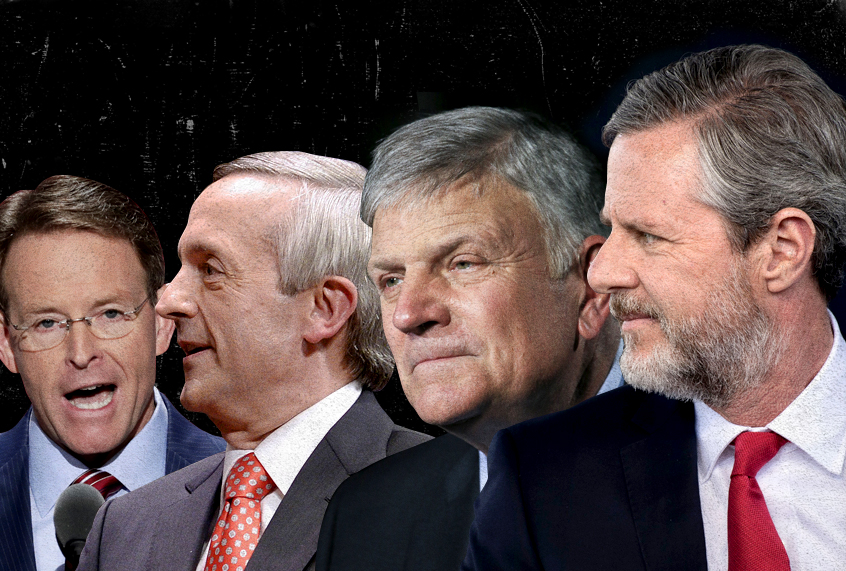
Some of the faces of "Christian" hypocrisy. 

I am often accused of hating religion.   That accusation is true when it comes to the "professional Christians" like Jerry Falwell, Jr., Franklin Graham, and Tony Perkins who spread a constant message of hate, as well as the scamvangelists (a term a blogger friend coined some years back) who use religion to line their own pockets and live lives of the tremendously wealthy - Joel Osteen and Pat Robertson among others springs to mind. Then, of course, there are the evangelicals who support the Trump/Pence regime.  And one certainly cannot exclude the Catholic Church hierarchy that has protected sexual predators for decades, if not centuries. The common theme among all of these individuals is rank hypocrisy along with a heavy dose of greed.  Nowhere do you see these individuals practicing Christ's gospel message of feeding the hungry, clothing the naked, giving shelter to the homeless, or welcoming refugees. Other than their loud protestations of their religiosity, one would never know these people are Christian.  Meanwhile, those who actually practice Christ's ideals tend to be invisible and most certainly fail to loudly and publicly challenge those giving religion a bad name.  The result is 40% of the under 30 generations leaving organized religion and others "hating" religion.  A column in the New York Times looks at the phenomenon.  Here are excerpts:
You don’t hear much about Sister Norma Pimentel in the secular press. She’s not a wacko, a hypocrite, a sexual predator or a political operative. Her life’s work, she says, is guided by seeing “the presence of God” in migrant children in the shelter she oversees in the Rio Grande Valley — vulnerable souls that her president would otherwise put in cages.
What you hear about is the phonies, the charlatans who wave Bibles, the theatrically pious, and they are legion. Vice President Mike Pence wears his faith like a fluorescent orange vest. But when he visited the border this summer and saw human beings crammed like cordwood in the Texas heat, that faith was invisible.
Pence is the chief bootlicker to a president who now sees himself in messianic terms, a president who tweets a description of himself as “the second coming of God.” As hard as it is to see God Part II boasting about grabbing a woman’s genitals, paying hush money to a porn actress, or calling neo-Nazis “very fine people,” millions of overtly religious Americans believe in some version of Jesus Trump, Superstar.
In Indiana this summer, Archbishop Charles C. Thompson stripped a Jesuit prep school of its Catholic identity for refusing to fire a gay, married teacher. The same threat loomed over another Indianapolis school, until it ousted a beloved teacher with 13 years of service. He was fired for getting married to another man — a legal, civil action.
The archbishop claimed he was upholding Catholic teaching, an example of the kind of selective moral policing that infuriates good people of faith.
Catholic teaching also frowns on divorce. But when a divorced teacher, at the same school where the gay teacher was fired, remarried without a church-sanctioned annulment and posted her status on Facebook as a dare, the archbishop did nothing. For this is a road that leads to thrice-married, politically connected Catholics like Newt Gingrich, whose wife Callista (with whom Gingrich carried on an adulterous affair before getting married) is now Donald Trump’s ambassador to the Vatican.
Archbishop Thompson says he tries to be “Christ-centered” in his decisions. If so, he should cite words from Christ condemning homosexuality, any words; there are none.
Religious hypocrites are an easy and eternal mark. The French Revolution was driven in part by the revulsion of starving peasants toward the overfed clerics who had taken vows of poverty. The Protestant Reformation took flight on disgust at a church in Rome that sold passages to heaven, enriching men who had multiple mistresses after taking vows of chastity. White evangelical Christians, the rotting core of Trump’s base, profess to be guided by biblical imperatives. They’re not. Their religion is Play-Doh. They have become more like Trump, not the other way around. It’s a devil’s pact, to use words they would understand. 
In one of the most explicit passages of the New Testament, Christ says people will be judged by how they treat the hungry, the poor, the least among us. And yet, only 25 percent of white evangelicals say their country has some responsibility to take in refugees.
[W]hat really thrills them is when Trump bullies and belittles their opponents, as counterintuitive as that may seem. Evangelicals “love the meanest parts” of Trump, the Christian writer Ben Howe argues in his new book, “The Immoral Majority.” Older white Christians rouse to Trump’s toxicity because he’s taking their side. It’s tribal, primal and vindictive.
So, yes, people hate religion when the loudest proponents of religion are shown to be mercenaries for a leader who debases everything he touches. And yes, young people are leaving the pews in droves because too often the person facing them in those pews is a fraud.
They hate religion because, at a moment to stand up and be counted on the right side of history, religion is used as moral cover for despicable behavior. This is not new to our age. Hitler got a pass from the Vatican until very late in the war.
And if you’re looking for hope in the midnight of the American soul, look no further than Sister Pimentel’s shelter for hundreds of desperate children in McAllen, Texas.  Growing up, Sister Pimentel was going to be an artist, she says, until she felt a strong tug on her soul; it compelled her to a lifetime of selfless service. Faith is not that complicated. Religion always is.

Wednesday, February 20, 2019

The Catholic Church's Continued Viciousness and Hypocrisy

As most readers know, I was raised Catholic and it took years of therapy to undo the psychological damage that a Catholic upbringing did to me. Thankfully, the media is finally publicizing the hypocrisy and moral cesspool that is the Church hierarchy with stories that expose things ranging from the sexual abuse of nuns by priest, special policies for priests who father children, to the global cover up of an immense sexual abuse problem that has targeted children and youths likely for seven decades, if not centuries.   A recent piece in the New York Times looked at the plight of gay priests and the hypocrisy of their treatment by the Church hierarchy.  One can perhaps find little sympathy for them given that one can argue that they knew what they were getting into, yet the mental and emotional anguish they describe in many ways describes what everyday LGBT people unfortunate to be born into the Church experience.  The fear of discovery, self-loathing, and fear of rejection are only too real and can be soul killing.  What is perhaps more instructive to the masses of the Church laity about the moral bankruptcy of the Church leadership is the viciousness that the Church directs towards non-clergy individuals who rightly or wrongly worked for the Church's institutions to help others.  A column in the New York Times looks at the witch hunt for LGBT Catholics within the Church.  Here are excerpts:
Pat Fitzgerald, 67, has long loved being a Catholic, and the part he loved maybe most of all, for the past quarter-century, was his role as a spiritual mentor at retreats for students at a church-affiliated high school in Indianapolis, where he lives.
But he has been told that he’s not wanted anymore. His crime? He publicly supported his daughter, a guidance counselor at the school, after its administrators moved to get rid of her because she’s married to a woman.
The school’s treatment of Shelly Fitzgerald, 45, was a big local story last summer that went national; she ended up on “The Ellen DeGeneres Show” in September. It was one of many examples of Catholic institutions deciding almost whimsically to exile longtime employees — not priests or nuns but coaches, teachers, counselors — who had long been known to be gay but were suddenly regarded as liabilities.
That’s what happened to Shelly Fitzgerald, and her 14 years of fine work at Roncalli High School no longer mattered. Only her 2015 marriage to her longtime partner did. She was told that she could stay on if she dissolved the union. She said no thanks and was kicked off school grounds in August.
 The aftershocks still complicate the lives — and faith — of people around her: her students, their parents, her dad.
 But there’s no peace for the Catholic Church here. It’s too mired in its own hypocrisy. The tension between its official teaching and unofficial practice — between the ignorance of the past and the illumination of the present — grows tauter all the time.
Most Catholics support same-sex marriage, in defiance of the church’s formal position, and many parishes fully welcome L.G.B.T. people. Yet there are places, and times, when the hammer comes down.
Church leaders know full well that the priesthood would be decimated if closeted gay men were exposed and expelled. Yet the church as a matter of policy bars men with “deep-seated homosexual tendencies” and considers gay people “objectively disordered.”
Catholics are supposed to show compassion. Yet Shelly and her dad were shown anything but.
There is, by many accounts, profound anger and hurt at Roncalli. As it happens, Shelly was one of two directors of counseling there; the other, Lynn Starkey, 62, is in a same-sex civil union and in November filed her own charge of discrimination with the E.E.O.C., claiming a “hostile work environment” in the aftermath of Shelly’s departure. For now she remains on the job.
Many students started an L.G.B.T. advocacy group, Shelly’s Voice, that also attracted parents and other adults in the community. A related Facebook page, Time to Be a Rebel, has more than 4,500 members.
But one parent told me that students who question Shelly’s dismissal fear repercussions. “Seniors are being told that if they speak out, they take the chance of not being able to graduate,” the parent, who spoke with me on condition of anonymity, said.
 [A] small cluster of Roncalli students were invited last month to a lunch with Archbishop Charles C. Thompson of Indianapolis, only to have him stress that homosexuality is a disorder and its expression sinful. One student called it an ambush.
 Shelly pointed out that the Catholic Church isn’t generally going after teachers who flout its rules by using birth control or divorcing or having sexual relations outside marriage. “They’re going after L.G.B.T. people,” she said. “They’re going to die on this hill.”
And they’re going to hurt people — like Shawn Aldrich, who attended Roncalli, just as his parents and his wife and her parents did. He has two children there now. What has happened to Shelly astounds him.
He and his wife plan to end their family tradition. They won’t send their third child, now in seventh grade, to Roncalli. “And that breaks our hearts,” he said. “That absolutely breaks our hearts.”
Shawn Aldrich has made the only decision that perhaps over time will force change and the end of rank hypocrisy within the Church leadership: walking away.  If enough decent and moral Catholics walk away, schools such as Roncalli will close as will parishes and the toxic hierarchy will have to decide between allowing the Church to wither away (at least outside of ignorant and uneducated parts of the world) or leaving its 12th century dogma.  For me, walking away was one of the most positive things I have ever done. 

Friday, July 06, 2018

Can the Catholic Church ‘Evolve’ on LGBT Rights?


One of the first things I did as I was "coming out" was to leave the Roman Catholic Church.  I did so for my emotional and psychological health - why remain involved in an institution that labels one as “intrinsically disordered” and representative of “strong tendency ordered toward an intrinsic moral evil”?   And I left despite having been a cradle Catholic who was baptized, confirmed, served as an altar boy for a decade, went to daily mass for years, and rose the the 4th Degree in the Knights of Columbus.  Of course, in retrospect, much of my "dedication" to the Church was a part of my desperate effort to "pray away the gay."  It did not work (and doesn't work) - something that all legitimate medical and mental health associations recognize.  The only thing I achieved was a great deal of self-hate and self-loathing, much due to the fact that I could not change.  I am not alone in my exodus from the Church.  I know numerous gay former Catholics.  Now, younger generations who are LGBT allies are leaving in droves.  A column looks at whether the Church can "evolve" from its 12th century dogma on sex and human sexuality. I am not optimistic.   Throughout its history, money, power and control have been the Church's true highest priorities.  Thus, only massive losses in membership and correspond declines in revenue will prompt change and even then, reactionary bishops and cardinals will drag their feet.  Here are column highlights:

A growing number of Americans now broadly support equal rights for gay, lesbian and transgender people. It’s tempting to view this as inevitable, but less than a decade ago many Democrats, including Barack Obama, didn’t even publicly support same-sex marriage. The speed at which L.G.B.T. rights became a mainstream issue, including for many religious denominations, represents nothing less than a dizzying cultural transformation.
What does this revolution mean for the Catholic Church, an ancient institution that thinks in centuries, and holds a view of human sexuality at odds with the shifting cultural winds?
[L]ast week, the Vatican used “L.G.B.T.” for what is believed to be the first time ever in a document prepared for a major gathering of bishops and young people in October. . . . The document also acknowledges that many young Catholics disagree with the church’s teaching on same-sex marriage. Catholic teaching documents have typically used “homosexual” or referred to those with “homosexual tendencies,” which reduce a person’s multidimensional humanity to the mechanics of sex. Using the L.G.B.T. descriptor, often preferred by many gay, lesbian and transgender people, is a sign of respect. When Pope Francis gave the most famous papal sound bite in history five years ago — “Who am I to judge?” — even his colloquial use of the word “gay” caused a stir in traditional Catholic circles. While the pope has strongly defended church teaching on marriage as exclusively between a man and a woman, he prioritizes listening and personal encounter over finger-wagging denunciations. He’s met with transgender people, and when he spoke privately last month with a Chilean clergy sexual abuse survivor, the pope told him that God made him gay and loved him.
There are other signs of progress. The prominent Jesuit priest and author Rev. James Martin, who has been banned from speaking at some Catholic institutions in the United States simply for encouraging the church to build bridges with L.G.B.T. people, was recently invited to give a keynote address at the Vatican-sponsored World Meeting of Families in Dublin later this summer. At the last gathering in Philadelphia three years ago, the only discussion about L.G.B.T. issues came from celibate gay Catholics who spoke about chastity.
Despite this progress, the Catholic Church must do far more not only to acknowledge the humanity of L.G.B.T. people, but also to recognize most want the same committed, loving relationships as straight couples. After the Supreme Court’s 2015 decision legalizing same-sex marriage, Cardinal Blase Cupich of Chicago called for “real, not rhetorical” respect for gays and lesbians. The court decision, which he opposed, still offered an opportunity for “mature and serene reflections,” the cardinal wrote. Catholic leaders in the United States should consider studying a proposal made by Bishop Franz-Josef Bode, the vice president of the German bishops’ conference, who has encouraged a thoughtful discussion on whether Catholic clergymen might offer a type of blessing for Catholics in same-sex relationships. “Although ‘marriage for all’ differs clearly from the church’s concept of marriage, it’s now political reality,” the bishop said. “We have to ask ourselves how we’re encountering those who form such relationships, . . . The church’s own language toward L.G.B.T. people is a stumbling block to its professed commitment to human dignity. While the Catholic catechism, which details church teaching, forbids any violence or “unjust discrimination” toward people who are gay or lesbian, it also describes sexual intimacy between them as “intrinsically disordered.” Before he became pope, Cardinal Joseph Ratzinger wrote in 1986 that homosexuality represents a “strong tendency ordered toward an intrinsic moral evil.” 
Many L.G.B.T. Catholics are also forced to live in what the Rev. Bryan Massingale, a Fordham University theologian, calls “the open closet.” This is particularly true at Catholic schools, where in recent years more than 70 L.G.B.T. church employees and Catholic schoolteachers have been fired or lost their jobs in employment disputes. L.G.B.T. Catholic employees have their lives subjected to moral scrutiny in ways heterosexual Catholics never do.
Five years into the Francis papacy, a pope who emphasizes mercy and strikes a more welcoming tone toward L.G.B.T. people is helping to rescue the church from a culture-war Christianity that drives people away. But until the Catholic hierarchy can find more tangible ways to institutionalize a commitment to the rights of gay, lesbian and transgender people, the exodus of Catholics will continue. Surveys show most Catholics support same-sex marriage, and the church’s opposition to L.G.B.T. rights drives young people away.
Those who are raised Catholic are more likely than those raised in any other religion to cite negative religious treatment of gay and lesbian people as the primary reason they leave . . . Firing L.G.B.T. Catholics and using degrading language such as “intrinsically disordered” erode the church’s credibility to speak about justice, love and human dignity.
If the first step toward change is listening, Bishop John Stowe of Lexington, Ky., had it right when he addressed a national gathering of L.G.B.T. Catholics last year. “In a church that has not always valued or welcomed your presence, we need to hear your voices and take seriously your experiences,” he said.  It’s time to make sure that is more than just an applause line.
Don't hold your breath waiting for change.  Should the Church ever change its anti-LGBT policies, I suspect it will be long after my lifetime is over.  Meanwhile, I encourage others to "vote with their feet" and to take the time to have their names removed from Church membership rosters (otherwise they will remain indefinitely and disguise one's departure from the Church).

Friday, April 21, 2017

14% of US Christians Left Their Churches After Trump's Election

Trump - a barometer for evangelical Christian moral bankruptcy
It would appear that Donald Trump, a/k/a Der Trumpenführer, is not only politically divisive but has also created division and an exodus of some evangelical Christians from their churches.  A Washington Post chartered survey found that 14% of church goers had left their churches since the November 2016 presidential election.  While the survey is not conclusive, the fact that 19% of evangelicals did not vote for the thrice married, serial adulterer, and pathological liar who embodies a number of the seven deadly sins suggests that some of those leaving their churches might be those fed up with their denomination's moral bankruptcy as evidenced by support of Der Trumpenführer.  A piece in The Independent looks at the survey findings.  Here are highlights:
The 2016 presidential contest highlighted just how deeply divided the United States is over both politics and religion. The vast majority of white evangelicals (81 percent) voted for Trump. A strong majority of religious “nones” — those who do not identify with any religious tradition — voted for Clinton (68 percent).
Of course, the divide does not stop at the vote. For example, between May 2016 and February 2017, almost every religious group came to oppose Trump’s proposed temporary ban on allowing Muslims into the US. The exception? White evangelical Protestants, who increased their level of support for the policy. The largest gap on this issue is the one between evangelicals and nones, which grew from 28 to 41 percentage points.
How did we get here? One answer is sorting. That is, people may reevaluate their religious membership when they sense political (or other) disagreement, leaving their houses of worship more homogeneous organisations. While this happens across the religious spectrum, here we highlight new evidence that disagreement over Trump’s candidacy actually led some evangelicals to leave their church.
Of those who said they had attended a house of worship in September, 14 percent reported that they had left that particular church by mid-November. . . . . This represents an enormous amount of churn in the religious economy.
But was that churn influenced by politics? To find out if they attended a “political church,” we asked respondents if their clergy addressed any of eight political topics. We also asked, more generally, if seeing evidence of politics reminded them of how divisive politics has become. About 15 percent of those who believe that American politics has become divisive left their political houses of worship. Of those who don’t think politics is inherently divisive, close to none left their political house of worship.
[T]hose who felt that they and their clergy disagreed over Trump in September were the most likely to report leaving that house of worship by November.
More specifically, for 20 years, liberal to moderate evangelicals have been leaving their churches because they disagree with the Christian right. This is important because it allows us to recognise that this sorting process is plural, local, and continual. It is not something owned by the left or right, but a regular and expected part of life in all religious organisations.
Are these patterns troubling? Observers’ opinions differ. Religious institutions have long been practice grounds for skills later turned toward politics. On the one hand, if people are leaving houses of worship because of political disagreements, they may not be learning the skills needed to talk across differences and participate in politics.
Personally, I hope that Trump and the evangelicals who showed their moral bankruptcy by supporting him ultimately hasten the demise of Christianity.  I look forward to the day when Christians are a minority in America and begin to experience the vile mistreatment they have dished out to others for centuries.  Karma could prove to be a major bitch.