Showing posts with label urban voters. Show all posts

Wednesday, September 11, 2019

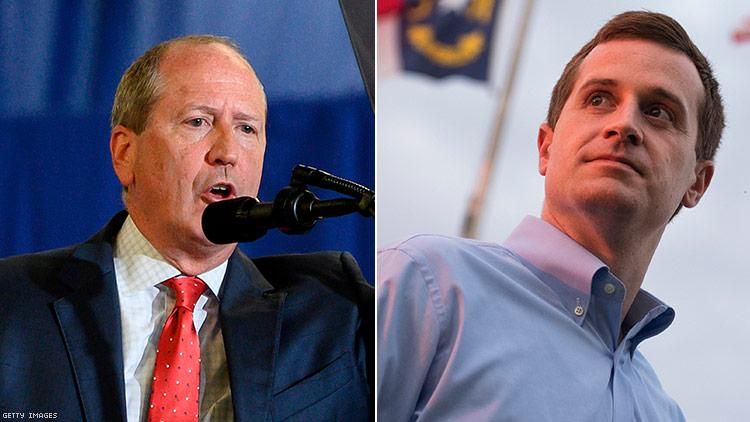
GOP Extremist Narrowly Wins North Carolina 9th District

With North Carolina roughly 30 miles or less from where I set, like many in Southeast Virginia and along Virginia's southern border, I pay attention to North Carolina politics particularly since the state has veered to the far right and made itself hostile to LGBT individuals. Thus, seeing the architect of North Carolina's anti-transgender bathroom bill - who was backed by anti-LGBT and anti-Muslim organizations and white supremacist groups - narrowly win (after rallies by both Trump and Pence to rally the ugliest elements of the right) doesn't make me want to visit that state anytime soon. The loss for Democrats suggests that the party's base still doesn't grasp the need to get out and vote in every election, not just presidential elections.  That said, the silver liming may be that Dan Bishop barely squeaked by in a district Trump won by almost 12 points in 2016.  A piece in Politico looks at why Bishop's win should not necessarily make Republicans hopeful for 2020.  Here are highlights:
Republicans went all-in to keep hold of a key congressional district in a special election Tuesday, and they won — but they still have good reason to be concerned about the result.
While the GOP can celebrate the election of a new congressman, Dan Bishop, his 2-point victory in a district President Donald Trump carried by 12 points in 2016 continues a worrisome trend for the party, which suffered heavy losses in the 2018 midterms and has not seen the political environment improve as Trump gears up for reelection.
Tuesday’s results outlined the path to 2020 victory for both parties, cut along the fundamental trend of politics in the Trump era: cities and suburbs swinging more and more Democratic, while the president’s appeal brings exurbs and rural voters deeper into the GOP fold. Trump pushed harder on one side of the scale to win in 2016; Democrats pushed back on the other side to take the House last year. And next year, it will decide whether Trump gets another term or a Democrat takes the White House for four years.
Trump’s election-eve rally for Bishop brought thousands to Fayetteville on Monday night on the eastern edge of the district, and it’s hard to argue with results: McCready had carried the surrounding county, Cumberland County, by more than 4 percentage points last year. But Bishop won it by the narrowest of margins on Tuesday, also making improvements in neighboring counties far from the Charlotte suburbs where McCready was strongest.
“The rest of the party is going to live or die based on how the president, in ’20, performs,” said Patrick Sebastian, a GOP consultant in the state. “If Trump can win North Carolina by a point or two, that’s excellent news for party.”
Meanwhile, Democrats were quick to find the silver lining in McCready’s narrow defeat. Rep. Cheri Bustos (D-Ill.), the chairwoman of the Democratic Congressional Campaign Committee noted that there are nearly three dozen GOP-held House seats that are less Republican-leaning than North Carolina’s 9th District.
“We fell an inch short tonight, but it took more than $6 million in outside Republican spending and a last-minute Trump rally to scrape by in a district that the president carried by 11.9 points,” Bustos said.
“If we don’t connect with rural voters — if we don’t show up in 2020 and win these places back — then Trump wins,” Montana Gov. Steve Bullock, a candidate for the Democratic presidential nomination, tweeted late Tuesday night.
Republicans were quick to trumpet the success of their coordinated effort — from last-minute visits from Trump and Vice President Mike Pence, all the way down to the congressional leaders and the constellation of official and outside groups and super PACs — in pushing Bishop across the finish line.
That may not be replicable in November 2020 all the way down the ballot. But Trump’s robust campaign operation — which he continues to build as Democrats fight for their party’s nomination — will be formidable, despite the president’s low political standing compared to past incumbents.
“We may not have won this campaign, but that does not mean we were wrong,” McCready said in his concession speech. “And as long as there are people who thrive off our division, there is still work to be done.”

Saturday, March 09, 2019

Brexit: Putin's Other Huge Victory


One of Vladimir Putin's long term goals has been to destabilize western democracies.  Toward this goal, Russian agents fanned the flames of the pro-Breit forces in the United Kingdom and at the same time worked to throw the 2016 presidential election to Donald Trump.  Putin has triumphed beyond his wildest dreams. Both the UK and the United States have been torn apart socially and politically as both nations have found themselves with two camps: (i) the rural, older, racist, xenophobic, less educated (and I would add, delusional) base that voted for Brexit and voted for Trump, and (ii) the urban, educated, younger, future facing base that voted to remain in the European Union and against Trump. In the UK, the division is becoming more extreme - and perhaps offers a glimpse of where the USA is headed - and is being likened by some to a civil war.  A piece in the New York Times looks at the simmering animosity splitting the British public.  Here are article excerpts:
Like the election of President Trump, the 2016 Brexit referendum vote crystallized divisions between cities and towns, young and old, the beneficiaries of globalization and those left behind.
And far from fading, the Brexit divide seems to have become entrenched within many British workplaces, families and social circles.
Friendships lost or relationships broken by Brexit have been bemoaned by politicians, featured in newspaper advice columns and spawned novels and at least one play.
According to one survey, more than a third of those who wish to remain in the European Union would be upset if a close relative married a strong leave supporter, suggesting that Brexit has morphed into a clash of values.
In the aftermath of the referendum, Relate, a counseling service, said that a fifth of the 300 relationship support practitioners surveyed had worked with clients who argued over Brexit. And analysts say Britons are increasingly likely to define themselves in relation to Brexit, rather than allegiance to a party, a dividing line noticed by psychotherapists too. “It’s a bit like 16th-century France between the Catholics and the Protestants,” said Brett Kahr, senior clinical research fellow in psychotherapy and mental health at the Center for Child Mental Health, adding: “I think there is a great deal of hatred of one position toward the other, and a lack of willingness to engage.
Some experts worry that, rather than open feuding, a chilly silence has descended across parts of a population that is often adept at avoiding confrontations.
“Brexit is ever-present in the consulting room,” said Sarah Niblock, chief executive of the United Kingdom Council for Psychotherapy. “It is now so excruciating, and so difficult for people to have conversations about Brexit — families, workplaces neighbors are so split — there is so much of a division between groups in society that it is almost as if the therapeutic room has become the last place people can talk with any ease.”
Those trying to make sense of it all include Candida Yates, professor of culture and communication at Bournemouth University, who is researching Brexit sentiment. . . . . For the remainers it was rather like a bereavement group. “There was this huge sense of loss. People talked about waking up on the day of the vote crying and in shock and they didn’t fully understand it themselves. They understood that they were upset but why did they feel so strongly? So it was a bit like a therapy group.”
For leavers there was more a sense of grievance than grief, Ms. Yates said, and a feeling “that they had been left behind, they had been forgotten, it was really this town-city divide.” Winning the referendum was an unexpected victory — some described it as a gift — but a precarious one.
“They couldn’t quite believe their luck and also said — even back then in 2016 — ‘It will be taken away,’ ” Ms. Yates said. “They were saying, ‘They won’t let us have it.’
There was a real feeling of ‘them and us’ and a feeling of powerlessness. They had managed to get this, but how long they could hang on to it, they didn’t know,” she added.
“People talked about it being like a civil war,” she said. Indeed, some mentioned Britain’s Civil War, which took place in the 17th century, or even episodes further back in history.  “They talked about the Civil War, they talked about the Norman yoke, people have gone back and back. It’s as if these earlier schisms had been reawoken.”
Frankly, I understand the feelings of the remainers.  I find it very difficult to understand or even remain close to those who voted for Trump.  Their vote, to me, demonstrated that I had misread who I thought these people were. They were not the intelligent, decent people that I thought they were.  Meanwhile, Vladimir Putin is smiling.

Friday, June 23, 2017

The GOP’s Suburban Nightmare


While there is much to be discouraged about if one holds progressive values, rejects the view that the poor are refuse to be disposed of, and believes in religious freedom for all, not just Christofascists, there may be some good news from the recent special elections in Georgia and South Carolina: the narrowness of the Republican victories and the GOP's dimming support in suburban areas, especially those near larger cities.  If the GOP decline in support in suburbia continues, along with the nation's changing demographics, it could mean the GOP's triumphal attitude may be short lived.  A long piece in Politico looks at what hopefully comes to mean the death knell for many Republican elected officials. Here are story highlights:
Surveying the Democratic wreckage after a disastrous 1952 campaign, Robert Taft, the typically taciturn Ohio Republican senator, made a bold prediction about the opposition. “The Democratic Party,” the onetime Senate majority leader asserted, “will never win another national election until it solves the problem of the suburbs.”
Taft wasn’t exactly right, but he wasn’t wrong either. The millions of voters fleeing overcrowded cities to seek the American dream would ultimately power Republicans to victory in six of the next nine presidential elections, and in the process, reshape the GOP’s postwar image as the party of the suburbs.
But that Republican Party is now gone, and suburbia is no longer its trusted wingman. Although Donald Trump managed to win the suburbs narrowly in 2016, 49 percent to Hillary Clinton’s 45 percent, a little over half of suburbia voted against him, according to exit polls. This marks the third presidential election in a row in which the GOP nominee failed to crack 50 percent of the suburban vote.
Once the Republican Party’s stronghold, suburban America threatens now to become its nemesis. A combination of demographic change and cultural dissonance is gradually eroding its ability to compete across much of suburbia, putting entire areas of the country out of the GOP’s reach. It’s a bigger crisis than the party acknowledges, a reckoning that threatens Trump’s reelection and the next generation of Republican office-seekers.
Karen Handel’s Georgia special-election victory Tuesday enabled the GOP to kick the can down the road, but not for long. The same Atlanta suburbs that once produced Republicans like Newt Gingrich voted for Clinton in November. They followed up a few months later by nearly sending a 30-year-old, first-time Democratic candidate to Congress. Republicans may be gloating now, but it’s an ominous sign for the 2018 midterm elections. . . 
Trump won the 2016 election, of course, boosted by the margins he ran up in smaller cities and rural areas. But he lost the populous close-in suburbs of Chicago, New York, Philadelphia and Washington, D.C., home to the precincts that first heralded suburbia’s arrival as a political powerhouse. That wasn’t the real story, though. He was also defeated in other, later-blooming suburban giants, including Atlanta’s Cobb County and Southern California’s iconic Orange County, both onetime exporters of Sun Belt conservatism that occupy storied roles in the formation of the contemporary Republican Party.
There’s a reason Ronald Reagan once said Orange County was the place good Republicans go to die—before 2016, it had last voted Democratic for president more than 80 years ago.
He [Trump] also barely squeaked by in traditional GOP stalwarts like Richmond’s Chesterfield County—the most populous in the state outside Northern Virginia—and Johnson County, the wealthy Kansas-side suburb of Kansas City. In many of the rock-ribbed Republican suburbs where Trump won easily—places like Waukesha County outside Milwaukee, and Hamilton County, on the outskirts of Indianapolis—he trailed well behind Mitt Romney’s 2012 pace.
But the truth is that Trump arrived in what was already the twilight of the GOP’s suburban era.
In the decades following World War II, the suburbs formed the electoral backbone of the party, providing a reliable counterweight to big-city Democratic margins.  . . . For suburbia, the GOP functioned not just as a validator of its lifestyle but also as a guarantor. It was the party of growth, low taxes and law and order. Just as important, it served as a bulwark against racial integration. . . 
The Northeastern and Midwestern suburbs were the first to go wobbly on the GOP, turned off by the culture wars waged by an increasingly Southern and socially conservative party.
Other subtle but important changes began to loosen the GOP’s grip. As the suburbs aged, they began to experience more and more of the pathologies previously associated with the cities—among them increased crime, poverty and crumbling infrastructure. At the same time, America’s great cities began to return to relative health.
Perhaps the biggest change of all: The suburbs themselves grew far more diverse. Between 2000 and 2010, the number of racially diverse suburbs increased by 37 percent, growing at a faster clip than majority-white suburbs, according to one study. . . . . there are 106 counties—with a combined population of 66.5 million—that include the near-in suburbs of most major cities and display many big-city characteristics. In 2016, Trump lost 89 of them. That’s a dramatic departure from Ronald Reagan’s 1984 performance in those places—he won 92 of those 106 . . . .
What happened in between Reagan and Trump? These suburbs gradually came into political alignment with their neighboring cities, moving the longtime antagonists toward something like a metropolitan alliance. At roughly the same time, the GOP largely gave up on competing among minorities and in the most densely populated areas.
The new GOP iteration differs in at least one important way from the one that dominated the suburbs in the Reagan years: It is now a conservative party that rejects metropolitan values, rather than a metropolitan party that embraces conservative values.
New York state stopped being competitive around the same time the populous New York City suburbs began going blue. The days when the GOP could carry Maryland ended when Baltimore County left the fold. Colorado and Virginia are likely to be the next dominoes to fall. Colorado’s Arapahoe and Jefferson counties, home to roughly 1.3 million residents, voted Republican in eight consecutive presidential elections through 2004. But since then, they’ve voted Democratic in the past three. In November, Trump bottomed out at 39 percent of the Arapahoe vote.
Trump’s coalition relied on several factors that won’t be easy to replicate going forward, though. First among them: Trump’s opponent. No matter the place designation—urban, suburban or rural—Clinton ran behind Obama’s pace, according to exit polls. And in the suburbs, she was outperformed by Obama, John Kerry and Al Gore.
Trump’s victory was also rooted in the strongest rural performance by a presidential nominee in decades—he won 61 percent amid a huge turnout. That’s where the GOP’s math problem comes in. To win reelection, Trump will need another gangbusters rural showing and to improve or at least maintain his 2016 levels in the suburbs, where roughly half the vote was cast last year. There’s little margin for error: Amped-up turnout in just three big cities alone—Detroit, Milwaukee and Philadelphia—could have flipped the 2016 election.
Three years is a long time, but it won’t be easy for Trump to win over his suburban detractors. Recent history suggests that once these big suburbs go blue, they don’t come back. . . . . The president need only gaze across the Potomac to get a close look at the problem. Northern Virginia’s suburban behemoth, Fairfax County, flipped in 2004—by 2016, Trump could manage only an anemic 29 percent there. In nearby Loudoun and Prince William counties, the tipping point came in 2008.
No Republican has won the presidency in the postwar era without winning the suburbs. Trump will put that to the test in 2020. And with that, the GOP’s suburban era may come full circle . . . 
Hopefully, the GOP decline in the suburbs will only accelerate.

Friday, June 09, 2017

Are the British Rethinking BREXIT?


Before Donald Trump won the presidency through a flaw in America's Electoral College system that ignored Trump's significant loss of the popular vote, we witnessed a campaign similar to that of Trump which emphasized xenophobia and bigotry in the United Kingdom for that nation's exit from the European Union.  As in America, many British were shocked that the forces of hatred and isolation won the day in the BREXIT vote.  Based on the results of yesterdays elections in the UK, perhaps many voters are having second thoughts.  Prime Minister Theresa May’s had called elections in what some see as remarkable gamble on a snap election to increase her party's power.  It backfired and now Conservatives no longer hold a majority of seats in the House of Commons.  As in America where urban areas oppose the Trump/GOP agenda, in the UK urban areas rejected the policies of the Conservatives and, by extension, Brexit.  A piece in the New York Times looks at how the election results may put Brexit in danger.  Here are highlights:
In a global economy amply stocked with anxiety-provoking variables, Britain just added another.
An election designed to bolster the government’s mandate instead yielded fundamental confusion over who is in charge as the nation prepares for fraught negotiations in its pending divorce from the European Union.
Prime Minister Theresa May had called the election on the assumption that her Conservative Party would emerge stronger, solidifying her negotiating position. Instead, the electorate’s stunning rebuke of her leadership all but guarantees a period of unpredictable political jockeying, intensifying uncertainty about future commercial dealings across the English Channel.
Investors took the latest turmoil in Britain as a prompt to unload the British pound. As European markets began trading on Friday, the currency slipped about 2 percent against the dollar.
And yet the shocking electoral outcome also has the potential to diminish the looming economic costs of Britain’s exit from the European Union, commonly known as Brexit.
It enhanced the possibility that a chastened government led by Mrs. May, or perhaps an administration led by someone else, would now strike a less confrontational approach with Europe while seeking a way to keep Britain within the bloc’s large single marketplace.
As Britain prepared for its face-off with Europe, the prime minister had been adamant that her country would impose strict limits on immigration, a posture seemingly enhanced by recent terrorist attacks. Yet limiting immigration appeared certain to cost Britain inclusion in the European single market, a swath of the globe stretching from Ireland to Greece and holding some 500 million relatively affluent consumers.
The European authorities have consistently emphasized that Britain’s continued inclusion in the single market requires that it abide by the bloc’s rules — not least, a provision that people be allowed to move freely within its confines.
This redrawing of the basic geography of European commerce was playing out just as President Trump was disavowing regional trade deals across the Atlantic and Pacific, while variously threatening trade hostilities with Canada, China, Germany and Mexico.
This election could change that trajectory.
Whoever will be in charge — a government led by a weakened Mrs. May, another member of her Conservative Party, or a coalition spearheaded by the Labour Party — might well construe a mandate to pursue a softer Brexit. The unexpected new political configuration might compel Britain to relinquish its pursuit of immigration limits in an effort to keep itself within the single market.
In short, the election has complicated the assumption that Britain is headed irretrievably toward the exits, producing a moment in which seemingly everything may be up for reconsideration.
Those who have favored Britain remaining within Europe, or at least softening the terms of its exit, now have “an expectation, or at least a hope, that cooler heads will prevail,” said Jeremy Cook, chief economist at World First, a company based in London that manages foreign exchange transactions. “It may be that hard Brexit has been rejected by the electorate.”
Worries about the economic impact of Brexit have been weighing heavily on the pound, which plunged after the referendum last June that unleashed Brexit. With Britain at risk of suffering barriers to trade, it has lost some of its considerable luster as a place for companies to invest, making its money a less desirable currency to hold.
A weakened pound has, in turn, translated into rising prices in Britain — on food, gasoline and imported components used by domestic factories. All of this has reinforced concerns about the fate of the economy. 
Would that America could hold a snap election.  With Trumps approval levels at new lows, perhaps Americans could rid themselves of the foul and dangerous occupant of the White House.  Meanwhile the Trump/GOP border tax could similarly impact prices in the USA and make goods more expensive for Trump's knuckle dragging supporters. 

Saturday, February 04, 2017

Rural vs. Urban America - A Nation Divided


The Commonwealth of Virginia is a microcosm  of the larger divide in America.  Virginia's urban centers - which can now out vote the rural regions - value diversity, modernity, knowledge and science, and tend to be less religious.  They also are the economic powerhouse that funds the rest of the state and end up supporting the rural regions that are most reliant of welfare and Medicaid payments.  Meanwhile, the rural regions tend to hate the residents of the urban centers and cling to "traditional values" that often equate to embracing ignorance and bigotry.  On a national level, states like California and New York send far more funds to the federal government than they receive back and as a result are forced to support the cretins in the Bible Belt and many red states who survive by virtue of the federal dole. It's little wonder why some in California would like to break away from America.  A piece in The Atlantic looks at this growing divide and one has to wonder when the progressive cities and states will say "enough!" to supporting the dead weight.  Here are highlights:
Republican reliance on suburbs and the countryside isn’t new, of course, but in the presidential election, the gulf between urban and nonurban voters was wider than it had been in nearly a century. Hillary Clinton won 88 of the country’s 100 biggest counties, but still went down to defeat.
American cities seem to be cleaving from the rest of the country, and the temptation for liberals is to try to embrace that trend. With Republicans controlling the presidency, both houses of Congress, and most statehouses, Democrats are turning to local ordinances as their best hope on issues ranging from gun control to the minimum wage to transgender rights. Even before Inauguration Day, big-city mayors laid plans to nudge the new administration leftward, especially on immigration—and, should that fail, to join together in resisting its policies.
But if liberal advocates are clinging to the hope that federalism will allow them to create progressive havens, they’re overlooking a big problem: Power may be decentralized in the American system, but it devolves to the state, not the city. Recent events in red states where cities are pockets of liberalism are instructive, and cautionary. Over the past few years, city governments and state legislatures have fought each other in a series of battles involving preemption, the principle that state law trumps local regulation, just as federal law supersedes state law. It hasn’t gone well for the city dwellers.
Close observers of these clashes expect them to proliferate in the years to come, with similar results. “We are about to see a shit storm of state and federal preemption orders, of a magnitude greater than anything in history,” says Mark Pertschuk of Grassroots Change, which tracks such laws through an initiative called Preemption Watch. By the group’s count, at least 36 states introduced laws preempting cities in 2016.
Most of these laws enforce conservative policy preferences. That’s partly because Republicans enjoy unprecedented control in state capitals—they hold 33 governorships and majorities in 32 state legislatures. The trend also reflects a broader shift: Americans are in the midst of what’s been called “the Big Sort,” as they flock together with people who share similar socioeconomic profiles and politics. In general, that means rural areas are becoming more conservative, and cities more liberal. Even the reddest states contain liberal cities: Half of the U.S. metro areas with the biggest recent population gains are in the South, and they are Democratic. Texas alone is home to four such cities; Clinton carried each of them. Increasingly, the most important political and cultural divisions are not between red and blue states but between red states and the blue cities within.
Nowhere has this tension been more dramatic than in North Carolina. . . . . HB2 was different, though—it set off a fierce nationwide backlash, including a U.S. Department of Justice lawsuit and boycotts by businesses, sports leagues, and musicians. Since corporate expansions, conventions, and concerts tend to take place in cities, North Carolina’s cities have suffered the most. Within two months of HB2’s passage, Charlotte’s Chamber of Commerce estimated that the city had lost nearly $285 million and 1,300 jobs—and that was before the NBA yanked its 2017 All-Star Game from the city. Asheville, a bohemian tourist magnet in the Blue Ridge Mountains, lost millions from canceled conferences alone.
Today’s clampdowns on cities echo 19th-century anxieties about urban progressivism, demographics, and insolvency. Many of the southern cities that have been targeted for preemption are seen as magnets for out-of-state interlopers. Republican officeholders have blasted nondiscrimination ordinances like Charlotte’s as contravening nature and Christian morality. They’ve argued that a patchwork of wage and sick-leave laws will drive away businesses, and that fracking bans will stifle the economy.
Yet the economic reality that underpinned rural-urban distrust in the 19th century is now inverted: In most states, agriculture is no longer king. Rural areas are struggling, while densely packed areas with highly educated workforces and socially liberal lifestyles flourish. In turn, rural voters harbor growing resentment toward those in cities, from Austin to Atlanta, from Birmingham to Chicago.
In this context of increasing rural-urban division, people on both sides of the political aisle have warmed to positions typically associated with their adversaries. The GOP has long viewed itself as the party of decentralization, criticizing Democrats for trying to dictate to local communities from Capitol Hill, but now Republicans are the ones preempting local government.
An important lesson of last year’s presidential election is that American political norms are much weaker than they had appeared, allowing a scandal-plagued, unpopular candidate to triumph—in part because voters outside of cities objected to the pace of cultural change. Another lesson is that the United States is coming to resemble two separate countries, one rural and one urban.  Only one of them, at present, appears entitled to self-determination.
The situation underscores the urgency in states like Virginia to have their residents turn out in force to elect Democrats to statewide levels so that the ignorant and bigotry based agenda of rural legislators can be vetoed and stopped.  The question is how to convince the non-politically involved that it is urgent that they get to the polls on election day?  

Monday, August 22, 2016

Trump’s Sour Virginia "Cocktail"

The low population areas are the GOP strongholds
While Donald Trump is a case unto himself in many ways, he embodies a growing problem for the Republican Party in Virginia.  As the demographics of Virginia have rapidly changed, as with Trump, the Virginia GOP focuses its policies on the aging white population with an attitude of "to Hell with everyone else."  The approach works in the carefully gerrymandered districts for the House of Delegates, but is a bust when it comes to state wide elections.  Now, Trump is exacerbating the problem through his racism, vulgarity and extremism - all things that could have been avoided but for Trump being Trump - as noted in an op-ed in the Washington Post. Here are excerpts:
Political arguments are rarely gentle or polite anymore, so it was a gift to see two Republicans who passionately disagree about what Donald Trump means for our nation hash out their differences with grace. Their exchange helps explain the mess Trump has made of his campaign.
One clear indicator: Trump, who campaigned in Fredericksburg on Saturday, has handed Hillary Clinton a substantial lead in this former bulwark of conservatism. He is thus speeding along a process by which Virginia, a state that voted for Republicans in every election from 1968 to 2004, finds itself on the verge of becoming reliably Democratic in presidential contests.
My window into the intra-Republican split came courtesy of a lunch here with Russ Potts, a genial moderate Republican legend who spent 16 years in Virginia’s state Senate, and his friend and business protege Zach Franz. Potts, 77, is president of his own sports marketing company; Franz, 33, serves as senior vice president. They have been through the business wars together, but they have very different views of 2016.
Potts speaks with pride of his time in the Virginia legislature — “the oldest continuous legislature in the free world,” he says, reflecting a devotion to the past that is very Virginia — and this has endowed him with a certain attitude toward politics. “I love the decorum and the history and the civility.” None is a word associated with Trump.
“He doesn’t make the cut for a lot of reasons,” Potts says, and he ticks off a comprehensive critique of Trump in bullet-point style, including references to the nominee’s disrespect toward the parents of a fallen Iraq veteran and a disabled journalist: “Character; six times he resorted to bankruptcy; and numerous times he cheated these poor souls who did his drywall or fixed his restaurant, plumbers and electricians. . . . Also, it really bothers me about the way he has treated the Muslim family, the way that he embarrassed the New York Times reporter.”
Potts plans to vote for Clinton, only the second time in his life he has voted for a Democratic presidential candidate. The last time was in 1964, when he voted for Lyndon B. Johnson in the landslide that buried Barry Goldwater.
[T]hat is where Trump finds himself. And Virginia is a state in which he cannot afford to offend so many upscale voters. His coarse rudeness will never go down well here. In a telephone interview, Rep. Don Beyer, a Democrat from Northern Virginia, cited an adage: “Virginians will vote for someone they feel comfortable having in their home for a cocktail party.” Trump, he says, doesn’t make the cut, adding: “All the defects of Trump hit home most securely with people who are smart, educated and sophisticated.”
Rep. Gerry Connolly, another Virginia Democrat from Washington’s suburbs, says such voters have revolutionized Old Dominion politics. North of the Rappahannock River, Connolly says, “Virginia looks more like a Mid-Atlantic state than a Southern state.” The vast suburban vote near the nation’s capital was key to President Obama’s ability to carry it twice and to what Connolly sees as a nearly insurmountable lead for Clinton this year.
That an alliance between suburban voters and African Americans is turning Virginia presidentially blue is especially alarming to Republicans because the same pattern is repeating itself in North Carolina and is making Georgia close. 
Trump could help Clinton solidify a great transformation in the geography of American politics.

Friday, May 08, 2015

Virginia to be Presidential Battlegound Again

Virginia 2013 vote when Democrats won every statewide office
Once upon a time Virginia was so predictable in how it would vote in presidential elections that the elections in the state were almost boring.  Now, with the Republican Party increasing unable to win statewide - the urbanized areas now can out vote the extremists in the rural areas - and Obama having won the state in 2008 and 2012, things have become more interesting and tumultuous.  For political junkies, that's a good thing, even if more nerve wracking.  A piece in the Virginian Pilot looks at the coming presidential battle for Virginia.  Here are some highlights:
Virginia has so far mostly been flyover country for presidential contenders zooming between New Hampshire, South Carolina and Iowa - the early primary and caucus states in next year's election.

But it won't stay that way: Virginia is viewed as key to victory in 2016. As one of a handful of "must win" states, several in the growing field of presidential candidates are building campaigns in the Old Dominion.

Texas Sen. Ted Cruz launched his bid for the Republican nomination in March at Liberty University in Lynchburg. Former Florida Gov. Jeb Bush is the school's commencement speaker Saturday. Those appearances likely have more to do with wooing support from conservative Christians who flock to the school, founded by the late Rev. Jerry Falwell, from around the country.

What isn't yet evident is the money that's beginning to flow and the strategies that are beginning to form as political consultants try to figure out the key to winning a state that twice voted for President Barack Obama.

Larry Sabato, a University of Virginian political scientist, stressed that it's "ridiculously early" to draw any conclusions about what might happen given the large field of [GOP] candidates. Three more Republicans entered the contest this week: former Arkansas Gov. Mike Huckabee, former high-tech executive Carly Fiorina and neurosurgeon Ben Carson.

There no sense in trying to handicap the race at this point, Sabato said, noting that the parties' primary debates begin in August. "Some of these candidates won't even make it to Iowa," he said.
Nonetheless, says Curtis Colgate, GOP chairman for the 2nd Congressional District, "Your hardcore activists are already choosing sides."

The first critical decision may come in June, when Virginia Republicans will determine what method they'll use to decide whom to back at the national convention, Colgate said. The state central committee is expected to decide whether to conduct a preference primary on March 1 - as the Democrats expect to do - or to assign their national delegates through a state convention.

The convention can be moneymaker for the state party, as presidential candidates reach out to local party groups and individuals rather than conducting broad media campaigns aimed at all voters. A convention also can give committed GOP activists more say than a primary that is open to all voters.

In the competition for the Democratic nomination, Clinton has a lock on support from top state Democrats.

Sabato, who leads U.Va.'s Center for Politics, predicted that once the parties have their nominees, Virginians can expect to see a lot of them and their surrogates during the general election.
Virginia will be one of seven states that will decide the presidency, "unless it turns into a landslide," he said.

Look for the presidential campaigns and their supporting PACs to spend considerably more in 2016 than they unloaded in 2012, when a blizzard of ads and voter outreach efforts on behalf of President Barack Obama and GOP candidate Mitt Romney blanketed the state, Sabato said. The two campaigns collectively spent roughly $2 billion.

"Believe me, if I had the cash right now, I'd invest in any TV station in Virginia," Sabato said.

Monday, December 02, 2013

The Growing Urban-Rural Divide: Is the GOP Paying Attention?


As the recent Virginia statewide elections demonstrated, rural voters are increasingly out numbered by urban voters and while the GOP's "God, guns and gays" and demonizing of the nation's first non-white president may play well in the hinterland, the game plan is falling flat in urban areas.  And urban area populations are increasing even as rural populations drop in many states.  Yet, like in so many other things, the GOP seems to be ignoring the hand writing on the wall in terms of what this means for the party's long term viability.  A piece in Bloomberg looks at the fact that all of America's largest cities are now governed by mayors who are Democrats.  Here are excerpts:

Twenty years ago, half the 12 largest U.S. municipalities had a Republican mayor. When Bill de Blasio takes office in New York on Jan. 1, none will.

As middle-class residents moved out of cities and immigrants and young people replaced them, the party lost its grip on population centers even as it increased control of governor’s offices and legislatures. The polarization has pitted urban interests against rural areas and suburbs, denying Republicans a power base. 

“The New York election hopefully is somewhat of a wake-up call,” said Scott Smith, the Republican mayor of Mesa, Arizona, and president of the U.S. Conference of Mayors. “If that doesn’t get Republicans on the national level more interested, then it should.” 

De Blasio’s election means that besides New York, there will be Democratic mayors next year in Los Angeles; Chicago; Houston; Philadelphia; Phoenix; San Antonio; Dallas; San Jose, California; Austin, Texas; and Jacksonville, Florida.

In all but three of the dozen most populous cities, mayoral elections are nonpartisan and candidates’ affiliations don’t appear on the ballot. Yet their party is often known to voters. 

Racial and ethnic minorities that overwhelmingly support Democrats accounted for 83 percent of U.S. population growth from 2000 to 2008, with most living in the largest metro areas, according to Brookings’s 2010 “State of Metropolitan America” report. And cities themselves are growing. Between 1950 and 2010, the proportion of Americans living in urban areas increased to 80.7 percent from 64 percent, according to the U.S. Census Bureau.

Voters selecting mayors care most about who can do the job, and national Republicans are more focused on dogma, said Mayor Greg Ballard in Indianapolis, the most populous U.S. city run by a Republican. 

“If they campaign or govern with a basis in ideology, they’re going to fail,” said Ballard, a 59-year-old former Marine who has supported mass transit and opposed a ban on same-sex marriage. “Being a mayor is about getting things done, and I do wish a few more people understood that.” 

The divide is dramatic in places such as Texas, where Houston, Dallas, San Antonio and Austin are run by Democrats while the state as a whole is reliably Republican. 

“Not only do people have different views, but they don’t even see the other people,” Kotkin said by phone. “Having a one-party system is just not a very good way to get to the best policy.”

Friday, November 08, 2013

Virginia's Metro Areas Sealed McAuliffe's Win

Virginia is becoming two different states.  One consists of the urban areas in crescent running from the Northern Virginia centers of Alexandria, Fairfax County and Arlington and extending southward through Richmond before arching southeast to Hampton Roads (Charlottesville and Roanoke are islands off to the west).  The other Virginia is comprised of everywhere else. The new Virginia, if you will, in the large metropolitan centers is progressive in relative terms and the GOP standard mantra of God, guns and gays simply no longer resonates.  In the old Virginia, racism, religious extremism, and the embrace of backwardness still holds sway.  Ironically areas like southwest Virginia bemoan their economic decline in a modern world yet are unwilling to leave the 1950's thus compounding the exodus of those who are educated and yearning for a better life.  The Virginian Pilot looks at this divide that is only going to intensify.  Here are highlights:

The seeds of Terry McAuliffe's gubernatorial victory blossomed in Virginia's population centers, where changing demographics are remaking the state's once-crimson political DNA.

Voters from Hampton Roads, Northern Virginia and the Richmond area formed an electoral backbone that made the Democrat the first governor elected from the party of the sitting president in 36 years. Election deficits in those regions spelled doom for Ken Cuccinelli, and they suggest cause for concern by his party as the political muscle of those communities swells.

While Lt. Gov. Bill Bolling concedes external factors may have played a role, he worries Republicans are flirting with disaster if they make excuses instead of adjusting to a state becoming more Democratic. "Were not going to get this party headed in the right direction until we understand we have a problem," said Bolling, who split with fellow Republican Cuccinelli after the latter's supporters orchestrated a takeover of the party nomination process last year.

Bolling maintains that Republicans' problems go deeper than this election. He points out that since 2005 the party has won just one statewide contest for president, U.S. Senate or governor: Bob McDonnell's 2009 gubernatorial victory.  That was a red dot in a sea of blue outcomes over a span that saw Democrats claim the governor's mansion twice, Barack Obama carry Virginia twice, and the U.S. Senate elections of Jim Webb, Mark Warner and Tim Kaine.

A look at the electoral map helps explain how McAuliffe turned the state Democratic only four years after McDonnell won in a landslide.

In South Hampton Roads, Chesapeake and Suffolk flipped from Republican to Democratic. Virginia Beach, the state's most populous city, stayed in the Republican column by a slim margin - 47.6 percent to 45.9 percent. In 2009, McDonnell carried the city with 64 percent.

In Northern Virginia, the state's most populous region, three counties - Fairfax, Loudoun and Prince William - switched from red to blue. So did Henrico County in the Richmond area.

Together, the 5.6 million residents of those three regions account for more than two-thirds of the state's estimated 8.1 million residents. Not all are registered voters.  Two university communities also flipped: Albemarle County near the University of Virginia and Montgomery County, home of Virginia Tech.

An election-eve poll of Hispanic and Asian- American voters yielded some clues to how Virginia's increasing diversity helped the Democratic ticket. Done by two groups that support liberalizing U.S. immigration laws, it showed overwhelming majorities of those voters - 66 percent of Hispanics and 63 percent of Asian- Americans - breaking for McAuliffe, who endorsed a pathway to citizenship for undocumented immigrants in the country illegally.

Harry Wilson, a professor of public affairs at Roanoke College, said the demographic profile of this year's voters resembled that of the 2012 presidential election more than 2009: a declining percentage of whites, more minorities and a respectable turnout of young voters. "As the electorate becomes more diverse and younger, that clearly favors Democrats," he said.

Will the Republican Party of Virginia get the message and stop catering almost exclusively to religious zealots, white supremacists and those driven by greed?  I doubt it.  It will take more defeats to reinforce the message delivered in this year's elections.  It ultimately comes down to a choice between the past and the future.  The Virginia GOP clearly wants to return to the 1950's.

Saturday, November 17, 2012

Why Virginia is Starting to Look Blue

For the second time in decades a Democrat carried Virginia, once a reliably red state.  This blog has noted before that Virginia's demographics are changing and that the backward facing elements in rural parts of the state are finally being out voted by the state's urban areas.  In addition, the younger voters are less beholden to the toxic propaganda of the Christofascists at The Family Foundation and similar faux "family values" groups.  A column in the Washington Post looks at the transformation.  Here are some excerpts:

A dozen years ago, Fairfax County was the partisan battle line in Virginia. Republicans won the more distant suburbs to the west and south, and Democrats generated huge margins in Arlington and Alexandria. But in 2008 and again in 2012, that line shifted to Prince William and Loudoun counties, with Barack Obama winning both each time.

Now Stafford and Spotsylvania counties, more distant parts of the ever-expanding Washington suburbs, seem destined to be the next frontier.

This has to be a deeply troubling trend for Virginia Republicans: The party is losing its once-large margins in many suburban counties around the commonwealth. With huge Democratic electorates in the state’s population centers, Republicans have historically relied on sizable suburban victories — coupled with large majorities in the state’s rural areas — to win statewide. But the GOP margins in the suburbs are eroding.

The counties are following a familiar pattern: As these distant suburbs have become less rural in character, they have become less Republican. The early round of suburbanization, including many ranch homes on large tracts, has given way to large townhouse complexes near major highways and clustered around Virginia Railway Express stops.

These two waves of suburban settlers tend to have different politics. The first migrants generally are older and more politically conservative, often seeking a more bucolic lifestyle. They are followed by younger migrants who are less likely to be able to afford a single-family home on an acre or more. Many do not even want such a spread. These later arrivals mainly want to live closer to work and are younger, more ethnically diverse and more Democratic in their partisan loyalties.

These changing suburban voting and residential patterns are not limited to the Washington area. Democrats used to struggle to get 45 percent of the vote in Henrico County, which surrounds Richmond. This year, Obama won Henrico with 55 percent of the vote. Obama did about as well in Albemarle County, which surrounds Charlottesville and was also once reliably Republican.
Virginia Beach also went for Romney, but Obama’s 48 percent showing there was well above Gore’s 41.6 percent.

Indeed, the majority of the counties in the eastern half of the state have become less Republican over the past dozen years. Even though Republicans continue to carry many of these suburban and rural jurisdictions, the narrower margins are swamped by Democratic votes in the cities and close-in suburbs.

Nearly a year ago, Gov. Robert F. McDonnell warned his GOP colleagues in Richmond against legislative extremism. They ignored his advice and spent time last winter talking about transvaginal ultrasounds for women seeking abortions, thus irritating many suburban voters.  .   .   .   If they don’t want Virginia to change from purple to blue, Republicans need to develop far more effective strategies to connect with these newer, younger outer-ring suburban dwellers. Another round of socially conservative lawmaking in Richmond this winter will not help the GOP win the governor’s race in 2013 or return the state’s electoral votes to the GOP in 2016.

Sadly, I do not anticipate any moderation on the part of Republicans in the General Assembly.  They are far too beholden - and terrified of - the extremists at The Family Foundation and will likely continue to allow Victoria Cobb to rule them like a foul dominatrix.  

Thursday, November 15, 2012

The Inconvenient Political Truths of 2012

With yesterday's press conference Barack Obama began the post-election agenda in earnest and one can only hope that both political parties, but especially the Republican Party and its members, will put the best interests of the nation ahead of partisan bickering and efforts to score points with their bases.  As noted before, I am not optimistic about the GOP given the alternate universe too many party leaders and members seem to inhabit.  A column in the Washington Post looks at where we find ourselves as a nation politically and, in my view correctly speculates where it all will lead to.  Here are excerpts:

Human nature and politics being what they are, Republicans will underestimate the trouble they’re in and Democrats will be eager to overestimate the strength of their post-2012 position.
Begin with the GOP: As Republicans dig out from a defeat that their poll-deniers said was impossible, they need to acknowledge many large failures. 

Their attempts to demonize President Obama and undercut him by obstructing his agenda didn’t work. Their assumption that the conservative side would vote in larger numbers than Democrats was wrong. The tea party was less the wave of the future than a remnant of the past. Blocking immigration reform and standing by silently while nativist voices offered nasty thoughts about newcomers were bad ideas. Latino voters heard it all and drew the sensible electoral conclusion.

Democrats are entitled to a few weeks of reveling because their victory really was substantial. Obama won all but one of the swing states and a clear popular-vote majority. The Democrats added to their Senate majority in a year that began with almost everyone predicting they’d lose seats. They even won a plurality of the vote in House races; Republicans held on because of gerrymandering. 

Just as important, the voters repudiated the very worst aspects of post-Bush conservatism: its harsh tone toward those in need, its doctrinaire inflexibility on taxes, its inclination toward extreme pronouncements on social issues, and its hard anti-government rhetoric that ignored the pragmatic attitude of the electorate’s great middle about what the public sector can and can’t do.

Yet Obama and his party need to understand that running a majority coalition is difficult.  .   .  .  .  
Obama needs to think about economic policies that deliver benefits across this wide spectrum of less well-to-do Americans. A longing for balanced budgets is not what drove these voters to the polls.

At the same time, there was a substantial middle- and upper-middle-class suburban component of the Democratic coalition that is moderate or liberal on social issues and sees the GOP as backward-looking.  .  .  .   But they are certainly not classic New Deal or Great Society Democrats.

Such voters are central to what has become known as the “Colorado strategy.” It’s a view that the Democrats’ long-term future depends on moderate, younger and suburban voters, especially women, combined with the growing Latino electorate. And in Colorado itself, this strategy worked exactly as advertised.

Democrats need to recognize that some of their core constituencies — young people, African Americans and Latinos — typically vote in lower numbers in off-year elections. The party requires a strategy for 2014. 

But these are happy problems compared with what the GOP and the conservative movement confront.  .  .  .  Many conservatives seem to hope that a more open attitude toward immigration will solve the Republicans’ Latino problem and make everything else better. It’s not that simple.  .  .  .  .  weaknesses among both Latinos and women owe not simply to immigration or to social issues, respectively, but also to the fact that both groups are more sympathetic to government’s role in the economy and in promoting upward mobility than current conservative doctrine allows.