Showing posts with label special election. Show all posts

Wednesday, September 11, 2019

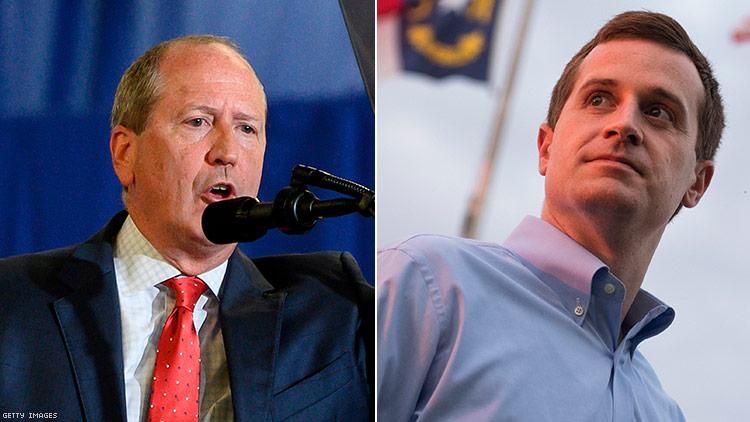
GOP Extremist Narrowly Wins North Carolina 9th District

With North Carolina roughly 30 miles or less from where I set, like many in Southeast Virginia and along Virginia's southern border, I pay attention to North Carolina politics particularly since the state has veered to the far right and made itself hostile to LGBT individuals. Thus, seeing the architect of North Carolina's anti-transgender bathroom bill - who was backed by anti-LGBT and anti-Muslim organizations and white supremacist groups - narrowly win (after rallies by both Trump and Pence to rally the ugliest elements of the right) doesn't make me want to visit that state anytime soon. The loss for Democrats suggests that the party's base still doesn't grasp the need to get out and vote in every election, not just presidential elections.  That said, the silver liming may be that Dan Bishop barely squeaked by in a district Trump won by almost 12 points in 2016.  A piece in Politico looks at why Bishop's win should not necessarily make Republicans hopeful for 2020.  Here are highlights:
Republicans went all-in to keep hold of a key congressional district in a special election Tuesday, and they won — but they still have good reason to be concerned about the result.
While the GOP can celebrate the election of a new congressman, Dan Bishop, his 2-point victory in a district President Donald Trump carried by 12 points in 2016 continues a worrisome trend for the party, which suffered heavy losses in the 2018 midterms and has not seen the political environment improve as Trump gears up for reelection.
Tuesday’s results outlined the path to 2020 victory for both parties, cut along the fundamental trend of politics in the Trump era: cities and suburbs swinging more and more Democratic, while the president’s appeal brings exurbs and rural voters deeper into the GOP fold. Trump pushed harder on one side of the scale to win in 2016; Democrats pushed back on the other side to take the House last year. And next year, it will decide whether Trump gets another term or a Democrat takes the White House for four years.
Trump’s election-eve rally for Bishop brought thousands to Fayetteville on Monday night on the eastern edge of the district, and it’s hard to argue with results: McCready had carried the surrounding county, Cumberland County, by more than 4 percentage points last year. But Bishop won it by the narrowest of margins on Tuesday, also making improvements in neighboring counties far from the Charlotte suburbs where McCready was strongest.
“The rest of the party is going to live or die based on how the president, in ’20, performs,” said Patrick Sebastian, a GOP consultant in the state. “If Trump can win North Carolina by a point or two, that’s excellent news for party.”
Meanwhile, Democrats were quick to find the silver lining in McCready’s narrow defeat. Rep. Cheri Bustos (D-Ill.), the chairwoman of the Democratic Congressional Campaign Committee noted that there are nearly three dozen GOP-held House seats that are less Republican-leaning than North Carolina’s 9th District.
“We fell an inch short tonight, but it took more than $6 million in outside Republican spending and a last-minute Trump rally to scrape by in a district that the president carried by 11.9 points,” Bustos said.
“If we don’t connect with rural voters — if we don’t show up in 2020 and win these places back — then Trump wins,” Montana Gov. Steve Bullock, a candidate for the Democratic presidential nomination, tweeted late Tuesday night.
Republicans were quick to trumpet the success of their coordinated effort — from last-minute visits from Trump and Vice President Mike Pence, all the way down to the congressional leaders and the constellation of official and outside groups and super PACs — in pushing Bishop across the finish line.
That may not be replicable in November 2020 all the way down the ballot. But Trump’s robust campaign operation — which he continues to build as Democrats fight for their party’s nomination — will be formidable, despite the president’s low political standing compared to past incumbents.
“We may not have won this campaign, but that does not mean we were wrong,” McCready said in his concession speech. “And as long as there are people who thrive off our division, there is still work to be done.”

Sunday, December 10, 2017

Roy Moore - A Referendum on Alabama's Identity

Alabama Capitol

Years ago my first job out of law school took me to Mobile, Alabama, where I lived and worked for four (4) years.  I found the people to be conservative, but gracious and nowhere deserving of the horrible reputation that Alabama had in much of the rest of the country (when visiting my former wife's family in New York City, it was always interesting to see people's reactions when we said we lived in Alabama). In the legal realm, the state had updated its rules of civil procedure and was actually much more modern than Virginia's to this day very outdated rules governing court actions.   Mobile, with its Catholic majority population was very different from the Baptist dominated northern part of the state.   Most importantly, the Christofascists had not yet hijacked the Alabama Republican Party.  But this latter event came to pass and now, Alabama has become a place I barely recognize, all thanks to the evangelicals/Christofascists.  Graciousness has given way to extremism in all too many contexts and, as a piece in the Washington Post notes, the state is posed to engage in a referendum on its identity and how it will be perceived by decent, moral people across the country and world.  The referendum centers on Roy Moore, a foul person in my view and a disgrace to Alabama.  Here are article highlights:
For many Alabama voters, unaccustomed to a competitive election and the national attention that has come with it, the bitter showdown between Republican Roy Moore and Democrat Doug Jones has become something more personal than a race to fill an open Senate seat. It is now a referendum on the state’s identity.
Supporters of Jones say with concern that a win Tuesday by the firebrand Moore would derail the state’s efforts to escape its painful history and rebrand as a forward-thinking place welcoming to Fortune 500 companies and a highly educated workforce. And they express a nagging feeling that a Moore victory would be a deflating sign that Alabama remains beholden to its past.
“You travel across the country and you say ‘Alabama,’ and something goes right across people’s eyes every time,” said retired actor Jonathan Fuller, a 61-year-old Democrat, as he shopped at the Piggly Wiggly supermarket in the suburbs south of Birmingham. “I don’t want to apologize anymore for where I’m from because there is this pocket of stubbornness in my state.”
Supporters of Moore, meanwhile, see his candidacy as a conduit for their rejection of the national media and political elites who they believe unfairly caricature their home state as a cultural backwater. They shrug off the notion that sexual misconduct allegations against Moore — allegations that some see as a fabrication by outsiders — should make a difference. . . . He said people outside of Alabama “have no right to judge us.”
The vivid contrast between the two candidates — Moore, 70, with his apocalyptic warnings about Muslims and gay rights, against Jones, a low-key 63-year-old lawyer best known for prosecuting Ku Klux Klan members who planned the 1963 bombing of the 16th Street Baptist Church in Birmingham — has put in sharp relief the idea that the results could speak volumes about Alabama to the rest of the country — and to itself.
One pivotal group on Tuesday will be voters who feel caught between these two visions and must pick a side, especially ­Republican-leaning voters who feel pulled between their traditional values and a desire to turn the page on the uglier parts of Alabama’s past.
“We’ve got a lot of good here, a lot of people who died for equal rights. And we’ve got a lot of people who are stuck in 1930, and that’s not going to change,” Phillip Hutchins, a 67-year-old Democrat and retired aircraft worker, said last week outside a grocery store in Titusville, a heavily black neighborhood in Birmingham.
Business-minded white Republicans — a bloc that sees itself as modern and puts an emphasis on education, commerce and tradition — have been uneasy about Moore. They have recoiled, too, at the cascade of controversies that have gripped the state this year, making the current race a culmination of various discomforts rather than a sudden drama.
The competition with other states for corporate investment is fierce, and state business executives have watched closely what happened in North Carolina after its ban on gender-neutral bathrooms.  Jones has courted the business establishment, many of them Republicans, on both moral and economic grounds, urging them to abandon their partisan instincts to protect the state’s economy and reputation.
But Jones, who supports abortion rights and whose campaign headquarters has a Planned Parenthood poster on its wall, has struggled to win over Republicans such as JoAnn Turner, a 71-year-old nurse who lives in Vestavia Hills, a mostly white Birmingham suburb.
“I’ve been in Alabama for 42 years, and I’m so tired of the publicity being so bad. It’s not who we are, and it’s embarrassing,” Turner said, . . . “All that said,” Turner added, “I can’t vote for Roy Moore, and I can’t vote for Doug Jones. . . . . Turner plans to write in Sen. Luther Strange (R-Ala.). . . .
[V]eteran Sen. Richard C. Shelby (R-Ala.) have remained wary of the former judge who was twice removed from the state Supreme Court — and have called the allegations against him credible and disturbing.  Shelby has opted to cast a write-in vote, telling The Washington Post that he is anxious about how a Moore victory would affect the corporate world’s impressions of Alabama. 
Outside of Birmingham and in rural towns to the east — home to massive evangelical churches and family-owned barbecue restaurants that puff black smoke out of chimneys — Moore’s support is heartier, particularly in his home town of Gadsden on the Coosa River. . . . Otis Dupree, a 53-year-old retired chicken-plant worker who works part time at the Burger King in Gadsden, said he is “disgusted” with the city’s embrace of Moore.
More than 100 miles southwest on the state’s flagship campus — the University of Alabama in Tuscaloosa — hundreds of students in athletic clothing and T-shirts stream out of dorm buildings and sorority mansions across the street from the school’s beloved Bryant-Denny Stadium.
As with the men and women in Vestavia Hills, many of them are financially stable and white — and Republican in a cultural sense as much as ideologically. They see themselves as Alabama’s future and are eager to define it.  Roy Moore isn’t part of that plan, according to Ella Jernigan, a 19-year-old Republican student who’s studying marketing. . . .  I can’t stand us getting pinned now as rednecks or uneducated.”  She added, “Every time you think we’re going forward, something like Roy Moore sets us back.”

Tuesday, January 07, 2014

Virginia 6th District: Lewis Ahead By 22 Votes over Coleman

Lewis
I hate to say it, but with only a margin of 22 votes in favor of Del. Lynwood Lewis, a lot of Democrats and progressives sat on their asses today and failed to vote.  Of course, these same folks will be the ones who whine and bitch the most if Coleman somehow wins and they suddenly see abortion completely outlawed, contraception restricted, and gay and minority rights utterly trashed under a GOP controlled Virginia Senate.  Unlike lazy Democrats, the extremists in the GOP base get out and vote regardless of cold temperature or inclement weather.  One can only hope that Lewis prevails. Once again I find myself thinking that maybe it is time to leave Virginia.  The Virginian Pilot reports as follows:
Democrat Lynwood Lewis, a longtime Eastern Shore state delegate, has a 22-vote lead over Republican Wayne Coleman, a Norfolk businessman, according to the preliminary results posted on the Virginia Board of Elections website.

The two candidates are vying to replace Virginia Sen. Ralph Northam, a Democrat, who was elected lieutenant governor.

The 6th District includes 25 precincts in Norfolk, one in Virginia Beach - the Chesapeake Beach precinct - and all of Accomack, Northampton and Mathews counties.

The race will help determine which party controls the Senate. The chamber is now split 20-20 between Republicans and Democrats.

Both parties have pulled out all the stops, pouring money into the campaigns.
 

Vote Today For Lynwood Lewis - 6th District Special Election Today

Given the rank ignorance that is now main stream thought in the Republican Party of Virginia as evidenced by the last post, it is all the more important that Del. Lynwood Lewis (pictured at left) be elected in today's special election to fill the seat vacated by Lt. Governor elect Ralph Northam.  Lewis' opponent, Wayne Coleman, is an adherent to all the usual bigotry and extremism that now defines the Republican Party of Virginia.  Coleman even blamed desegregation for the decline of public education in Virginia.  If you live in the 6th Senate District, PLEASE get out and vote for Lynwood Lewis today!  We do not need another Republican crackpot/extremist in the Virginia Senate.

Sunday, December 29, 2013

Daily Press and Virginian Pilot Endorse Lynwood Lewis

Listening to the political ads for the special election to fill the Virginia Senate seat of Lt. Governor elect Ralph Northam on January 7, 2014, is enlightening.  Despite what some have said about GOP candidate Wayne Coleman not being a typical Republican, his campaign ads are the same old angry attack ads that one has come to associate with the Virginia GOP.  In addition, Coleman has said little about what policies he supports other than the usual GOP sound bites, including the usual denunciations of gays and abortion.  Apparently, the Virginian Pilot and Daily Press have taken note.  Both have endorsed Democrat Lynwood Lewis for the 6th Senate District seat.  Here are highlights from the Daily Press endorsement:

The forces acting on the special election in Virginia Senate District 6 make the race a compelling one for voters and observers. All were weighed in our endorsement process, and made for a strong conclusion in favor of Del. Lynwood Lewis ascending to the General Assembly's upper chamber.

The Democrat, who faces Republican Wayne Coleman in the Jan. 7 election, has firm footing on the issues, a solid grounding in the district and a record of compromise. Those qualities make him a strong candidate for higher office and the better option in this race.

Democrat Lynwood Lewis, 52, is a five-term delegate who in November won another two years in the General Assembly serving residents of District 100. He is a native of Nassawadox who earned degrees at Hampden-Sydney College and the University of Richmond School of Law.

In terms of geographic size, District 6 may be the largest in the state, stretching from the Maryland state line down the eastern shore to central Norfolk and as far west as Mathews County. A majority of its population comes from Norfolk, but residents of Accomack and Northhampton counties are included with some from Matthews and Virginia Beach.

Del. Lewis has leveraged his public office to create jobs at Wallops Island on the eastern shore, advocated on behalf of expanding the port and been a determined defender of the environment. That he has accomplished these things as a Democrat in a Republican-controlled legislature speaks to his willingness and ability to compromise.

[A]s he touts his business acumen, Mr. Coleman also calls into question his preparedness for life in the public square. He recently appeared on a radio show and claimed that busing during integration led to the decline of public schools, an amazingly short-sighted and wrong-headed remark.

While Virginia's is a citizen legislature, its members should have at least some polish. Recent years have demonstrated the folly of empowering those prone to speaking before thinking. The commonwealth will struggle to project itself as a moderate, pro-business state without a government that reflects some level of maturity when discussing complex issues.

[T]he race here comes down to who best represents the district. In this case, Del. Lewis' record of moderate leadership while serving his constituents should win the day.  District 6 has a difficult decision to make early next year and there is no perfect candidate. Del. Lewis represents the better choice and voters should support him at the polls.