Showing posts with label nationalism. Show all posts

Sunday, July 05, 2020

Trump Is Turning America Into the "Shithole Country"

Donald Trump's campaign slogan was "Make America Great Again" which actually translated to make America white again.  Three and a half years into the Trump/Pence regime, America is diminished on every front, be it tattered alliances, an economy in serious trouble, racial unrest, and an out of control pandemic that has seen Americans banned from traveling to Europe, Canada and even Mexico.  The nation cannot take much more of Trump's winning and is rapidly headed towards, to quote Trump, shit hole country status.  Meanwhile, Trump cares nothing for average Americans and focuses solely on rallies and boasting that support his narcissistic ego. A column in The Atlantic looks at America's diminished status under Trump.  Here are highlights:

There is a lot of learned material written about nationalism—scholarly books and papers, histories of it, theories of it—but most of us understand that nationalism, at its heart, at its very deepest roots, is about a feeling of superiority: We are better than you. Our country is better than your country. Or even—and apologies, but this is the precise language deployed by the president of the United States: Your country is a shithole country. Ours isn’t.
In this sense, nationalism is not patriotism, which is the desire to work on behalf of your fellow citizens, to defend common values, to build something positive. Nationalism is not community spirit either, which seeks to pull people together. Nationalism has nothing to do with democratic values: Authoritarians can be nationalists; indeed, most are. Nationalism has nothing to do with the rule of law, justice, or opportunity. At its core, nationalism is rather a competition, an ugly and negative competition.
There’s a reason nationalism has so often become violent in the past. For if we—our nation—are better, then what right do others have to live beside us? Or to occupy land that we covet? Or even, maybe, to live at all?
Sure, people pretend otherwise. We’re just defending our right to be unique! We just want everyone to stay in their own country! We just like our own culture! But that’s not really what nationalists think, and everyone knows it. They can nod and wink at equality among nations, but really they are motivated by, driven by, addicted to a feeling of superiority. Our county is better than your country. So stay out.
I hear this when Donald Trump uses the slogan “America First”: This is why he needs a physical wall at the Mexican border; this is the source of his dislike for immigrants, for people with unfamiliar surnames or different skin colors. He regards all of them as lesser, inferior people who somehow got inside our borders and made our country worse.
[W]hat will Trump do, what will his followers and admirers do, when their understanding of the world is flipped on its head? What will happen when they realize that other countries are building walls between them and the United States?
Here it’s worth pointing out a genuine oddity: The world in the age of the coronavirus should be a nationalist’s paradise. Borders have slammed shut. Countries have fallen back on their own resources. . . . . everyone can look at everyone else’s country, read its media and social media, see how its institutions are coping with the crisis. We can’t leave our houses, but we can meet in cyberspace, where we can keep talking.
While we are there, we can see how other countries are dealing with the pandemic. Some are doing well, especially those that have decent bureaucrats, respect for science, and high levels of trust: South Korea and Taiwan, Germany and Slovakia, much of Scandinavia, New Zealand. Some countries are not doing well, especially those run by divisive populists on both the left and the right: Russia, Brazil, Mexico, and, of course, the United States. But even within this latter group, we stand out.
[T]he U.S. has the largest number of cases and the highest death toll. The U.S. isn’t merely suffering; the U.S. is suffering more than anybody else. . . . The numbers of American sick and dead are a source of wonder and marvel all over the world. They also inspire fear and anxiety. The European Union has decided to allow some foreigners to cross its borders now, but not Americans. Uruguayans and Rwandans can go to Italy and Spain, but not Americans. Moroccans and Tunisians can go to Germany and Greece, but not Americans. For the first time in living memory, Canada has kept its border closed with the United States. On July 3, the governor of the Mexican state of Sonora delivered the coup de grace: She announced the temporary closure of the border with Arizona and banned Americans from Sonoran beaches.
How will American nationalists cope with this new situation? I’m guessing many will pretend, like the president, that this isn’t happening: Months into the crisis, he has once again expressed the belief that the virus will magically “disappear.” But for some, it will be difficult to prevent the intrusion of reality: The stupid and pointless competition among nations continues in their heads—and they are losing. A major reckoning is coming. It can’t arrive too soon.

Tuesday, February 11, 2020

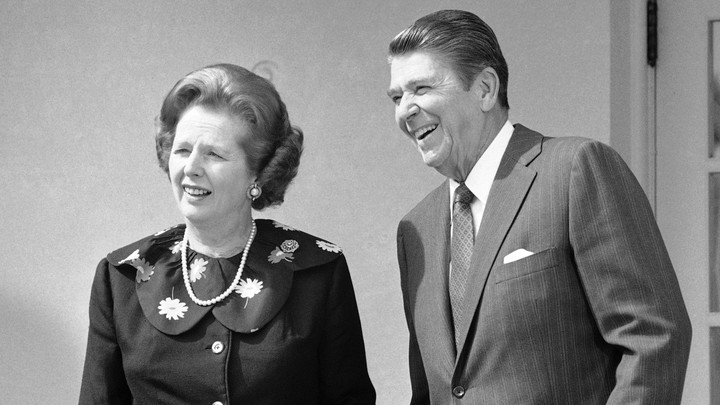
This Is How Reaganism and Thatcherism End

As the Democrat circular firing squad continues as results trickle in from New Hampshire, a lengthy piece in The Atlantic looks at the growing toxicity and ruthless nationalism of the right - all exemplified by the Trump?pence regime - and a virtual war on Enlightenment liberal values. Under this warped nationalism which would alarm Ronald Reagan or Margaret Thatcher, human rights are being diminished and the ability to see others as equally human is under relentless attack.   Indeed, democratic principles are being eroded with the right pushing for the supremacy of an oligarchy lead by a near autocrat as demonstrated by what is happening in Hungry where the press is being censored and universities are being taken over by the autocrat supporting central government.  One can only imagine how eager Trump is to remake America on this pattern, with Congressional Republicans only too happy to rubber stamp the steady erosion of rights so long as they get to remain in office.  Here are article highlights:
In an Italian hotel ballroom of spectacular opulence—on red velvet chairs, beneath glittering crystal chandeliers and a stained-glass ceiling—the conservative movement that once inspired people across Europe, built bridges across the Iron Curtain and helped to win the Cold War came, finally, to an end.
The occasion was a conference in Rome last week called “God, Honor, Country: President Ronald Reagan, Pope John Paul II, and the Freedom of Nations.”  . . . . . this event was co-organized by Chris DeMuth, a former president of the American Enterprise Institute (in the era when it supported global capitalism and the Iraq War) and John O’Sullivan, a former speechwriter for British Prime Minister Margaret Thatcher. . . . .  This was the successor to the National Conservatism Conference held in Washington, D.C., last year.
The purpose, at least at first, seemed a little more mysterious, too. If Reagan and John Paul II were linked by anything, it was a grand, ambitious, and generous idea of Western political civilization, one in which a democratic Europe would be integrated by multiple economic, political, and cultural links, and held together beneath an umbrella of American hegemony. John Paul II wanted Poland to join the European Union . . . . At least when she was still prime minister, Margaret Thatcher was also a proponent of this vision of the West. She was one of the driving forces behind the European single market, the continent-wide free-trade zone that also required a unified regulatory system—the same unified regulatory system that the British have now rejected—and had great faith in the importance of human rights. She said so explicitly: “The state is not, after all, merely a tribe. It is a legal entity,” . . . .
The new national conservatism, at least as articulated in Rome, is very different from Reaganism and Thatcherism. The starting point is that European integration and American hegemony are both evil, and that universal ideals like human rights are a dangerous ideology. These, in fact, are arguments made in Hazony’s book, The Virtue of Nationalism, a work that synthesizes biblical history, the writings of John Locke, and contemporary politics into a caricature of a political philosophy for our times.He also attributes all of the good things about modern civilization to the nation and all of the bad things to what he calls “imperialism.” He puts countries and institutions he likes into the first box, and those he doesn’t like into the second. Thus it emerges that the Nazis, who specifically called themselves nationalists, were not nationalists but imperialists, as is the European Union, an organization created to prevent the resurgence of Nazism. Britain, Spain, and France, despite their long history as empires on land and sea, count as nations.
In this worldview, democracy is of no significance. International treaties and obligations do not matter either, not even if people want them. Although membership in the European Union is voluntary—Brexit has just proved that—and is supported by majorities in most countries, Hazony writes and speaks as if the EU were an occupying power.
Many bad books have had great influence. This one has been very lucky, having appeared just as the word nationalism was adopted by Donald Trump, who finds it a useful way of dressing up a set of foreign and domestic policies that are largely governed by the his whims and dictated by his self-interest. . . . . To put it differently: The arc of history once described by Martin Luther King and Barack Obama is now bending the other way, and a lot of people are leaping aboard.
[O]ther speakers in Rome also reflected an almost paranoid sense of persecution. The idea that “the nation” has been outlawed is clearly something that a certain breed of conservative now genuinely perceives to be true. The American Christian writer Rod Dreher solemnly described a world in which he felt repressed, just as people had been under totalitarian communism. . . . calling on audience members to think of themselves as Christians persecuted for their faith in the past.
What makes this view odder is that it also clashes with political reality. National conservatives cannot simultaneously be helpless victims of a totalitarian culture and also hold enormous political power, which some of them plainly do.
Marion Marechal, the French politician who has dropped the surname Le Pen but still belongs to the family that founded the French party now known as the National Rally, spoke at length.
Marechal, who is sometimes described as a candidate for the French presidency in 2022, made a well-crafted speech that, like Hazony’s, drew a sharp, polarizing contrast between conservatives and enlightenment rational liberals, whom she called “progressives.” The term seemed to include everybody from President Emanuel Macron to French Stalinists. Her words were evocative: “We are trying to connect the past to the future, the nation to the world, the family to the society … We represent realism; they are ideology. We believe in memory; they are amnesia.” But her remarks don’t reflect reality. Macron spoke explicitly and at length about history and memory in Krakow, and has done so on many other occasions too. To Marechal’s fans, that may not matter. Perhaps they feel themselves to be a persecuted minority, and she echoes that view. Perhaps they just prefer to hear about history from someone like her, the spokesman for an ethnic definition of France and Frenchness, instead of Macron.
Some of what Marechal says to the French, and some of what Baudet says to the Dutch, is indisputably true. Economies really have become more global, which makes small communities more vulnerable; older landscapes have been destroyed by modernity; people have drifted away from churches, probably for good; technology is moving very quickly, in ways that frighten people. The argument is over how to address the legitimate fears created by these changes. Among others, the European Union itself has come up with a set of solutions, including the donation of money to culture and architecture and the protection of European agriculture, and thus European landscapes, against competition.
[T]he EU remains the only entity large enough to speak up for Europe on the world stage. The Netherlands alone—even Britain alone—will not be able to do it.
But other possibilities exist too. One can use the electorate’s fears, for example—fan them, exploit them—in order to build a new political movement. And because national conservatism very much wants to be a new political movement, this is a prospect that interests many people.
When the final speaker entered, he won a standing ovation. This was Viktor Orbán, the Hungarian prime minister, the man whose career probably best illustrates the distance that the conservatism of Reagan and Thatcher has traveled since 1989. Orbán, I realized, was the person that many in the room had really come to hear.
Famously, Orbán has gone one step further than many other European conservatives. For one, he has not been shy about using conspiratorial, sometimes hysterical nationalist language, echoing old anti-Semitic tropes, in order to exploit fear of the outside world. “We are fighting an enemy that is different from us,” he said in 2018.
More important, he has surpassed everyone else in Europe in his willingness to destroy the institutions that create the terrain that make democracy possible. Although conference participants in Rome spoke at length about oppressive left-wing ideology at universities, Hungary is the only European country to have shut down an entire university, to have put academic bodies (the Hungarian Academy of Sciences) under direct government control, and to have removed funding from university departments that the ruling party dislikes for political reasons. Although many said they feel repressed by left-wing media, Hungary is also the only European country that has used a combination of political and financial pressure to put most of the private and public media under ruling-party control too.
Orbán’s destruction of independent press and academia and his slow politicization of the Hungarian courts have served a purpose quite different from lofty ideas about national sovereignty or the beauty of landscapes. These machinations have enabled the prime minister’s family and his inner circle to camouflage the myriad ways in which they use state power to get rich. They have also helped him fiddle with electoral rules, gerrymander districts, and adjust the constitution in order to make sure he doesn’t lose.
His country is the best illustration of what happens when you dismiss universal values, repress journalists and academics who produce facts, undermine courts and the rule of law: When you get rid of all of those things, you are just a few short steps away from corruption and tyranny. This is the real face of the new “nationalism,” however carefully it is hidden behind an intellectual facade or dressed up as the successor of Reagan and John Paul II. You can see why it appeals to men like Netanyahu or Trump.
The world inhabited by Reagan and John Paul II is long past, and no one knows how they would react to so-called cancel culture and Twitter mobs, or the backlash against Western culture on American (but not Hungarian) college campuses, or some of the uglier strains of far-left thinking. But somehow I doubt their response would be the creation of a new, kleptocratic authoritarian right that chips away at the institutions preserving democracy. Nor do I believe they would have wanted to destroy the institutions that have long undergirded the West, as so many of these new “nationalists” want to do.
I don’t see why love of country and love of history would be incompatible with membership in broader Western communities. But in the political world we are now entering, they may soon become so.   
Seemingly, these conservatives learned nothing from the horrors that extreme nationalism and a disregard for human rights wrought on the world in the last century.

Sunday, March 13, 2016

Donald Trump's Ideology of Violence


Following up on the last post, Ezra Klein has a piece in Vox that looks deeper into Donald Trump's responsibility for the growing violence his supporters are willing to direct at those Trump is labeling as "other" or "them."  Like his Nazi predecessors, the fault for the circumstances in which his supporters find themselves is never due to their own failings - e.g., not finishing high school, clinging to and embracing ignorance, etc. - but due to someone else's behavior or undermining.  Those falling into the "other" or "them" categories are blacks, Hispanic immigrants, non-whites, non-Christians - the list is long.  And while Trump tries to blame the violence on outside protesters, he is continually send them message that is is perfectly alright - perhaps desired - that protesters be met with violence.  It is very, very scary.  That evangelical Christians are rallying to such a message shows the reality that conservative Christianity is itself a threat and evil as well.  Here are article highlights:
During a rally in St. Louis Friday, Donald Trump lamented that "nobody wants to hurt each other anymore." Yes, lamented.
The topic was protesters, and Trump's frustration was clear. "They're being politically correct the way they take them out," he sighed. "Protesters, they realize there are no consequences to protesting anymore. There used to be consequences. There are none anymore."
"Our country has to toughen up folks. We have to toughen up. These people are bringing us down. They are bringing us down. These people are so bad for our country, you have no idea."
This is more than an aside; this is the core of Trump's ideology. The protesters who interrupted his rally, the political correctness that kept the police from cracking their skulls, the press that takes the hippies' side — this is why America has stopped being great. We were strong, and we were tough, and we didn't take this kind of shit from anybody. And now we are weak, and we are scared, and we take this kind of shit from everybody.
How is a country that can't shut down a protester going to out-negotiate the Chinese? How is a country that that is so afraid of hurt feelings going to crush ISIS?
Violence is scary. But violence-as-ideology is terrifying. And that's where Trump's campaign has gone.
On February 1st, Trump made a promise to an angry crowd. You protect me, he said, and I'll protect you. "If you see someone getting ready to throw a tomato, knock the crap out of them, would you? Seriously. Knock the hell out of them. I promise you I will pay for the legal fees. I promise."
No one threw a tomato at that rally. But a few weeks later, Donald Trump showed that he meant what he said — if you used force to protect him, he'd have your back.  Trump was leaving a rally when Michelle Fields, a reporter for the Trump-friendly Breitbart News, stepped forward to ask a question. Corey Lewandowski, Donald Trump's campaign manager, grabbed her by the arm and threw her out of the way. His grip was hard enough to leave bruises on her arm. The moment was witnessed by Ben Terris, a Washington Post reporter, and there's audio and video record of it.
Donald Trump will pay your legal fees. He will believe your baldfaced lie. He is on your side against the protesters, the press, the losers who are bring America down. He knows things get rough sometimes. He's got your back.
The great mistake the media makes with Donald Trump is to pretend he has no ideology — that he's just a celebrity, a carnival barker, a reality star.
As my colleague Matt Yglesias has written, Trump does have an ideology. He does have an agenda. The core of Trumpism is "a revived and unapologetic American nationalism, which will stand for American interests abroad while defending the traditional conception of the American nation at home."
Like most nationalists, the emotional center of Trump's ideology is an Us vs. Them argument. "These are not the people who made our country great," Trump told the crowd in St. Louis. "We're going to make it great again, but these are not the people. These are the people that are destroying our country."
This is what Trump supporters hear at his rallies. They are told that America is no longer great. They are told who to blame. They are told that the reason these losers are dragging America down is we have become too politically correct, too scared, too weak, to stop them. They are told Trump will pay their legal fees if they want to do what's necessary. "There used to be consequences," Trump sighs. The crowd knows what he's asking. Make Consequences Real Again.
This is ugly, but it is coherent. What Trump is offering is an explanation and a solution; an argument and an ideology. It is dangerous, and it is violent, but it is not confusing, and it is not unclear.
And this is why Trump is something different and more dangerous in American life. He is a man with an evident appetite for suppressing dissent with violence, a man who believes America's problem is that it's too gentle to its dissidents. Trump is making an argument for a politics backed by force, for a security service unleashed from "political correctness," for a country where protesting has consequences. The results are playing out before us, night after night, on our televisions.
If Trump wins and this country goes down a dark path, we will never be able to say we didn't see it coming. We will never be able to say we weren't warned. 
Be very afraid - but also, do not sit back and quietly let this ugliness grow.  Trump and the ugliness that he and the GOP represent must be defeated.  Get involved and for God's sake get out an vote Democrat come November.

Saturday, May 09, 2015

How Russians Lost the War


Today is Victory Day in Russia - the day that marks the remembrance of the defeat of Nazi Germany.  The irony is that if one looks at Russia and Germany today, it is the German people who ultimately won the war through defeat.  Germany is a rich and prosperous nation and its people enjoy a enviable standard of living.  The cannot be said for Russian and its people.  Russia's leaders over all have squandered the victory of World War II just as so many prior leaders failed to put the interests of the Russian people.  One can argue that Vladimir Putin's Russia is governed by fear more than during many of the reigns of Russian Tsars.  I noted in the past I read the book "Red Fortress, History and Illusion in the Kremlin," and the over arching take away is that Russia people have been repeatedly condemned to substandard lives by Russia's leaders who typically use nationalism to distract attention from their failed leadership.  Putin is but the latest leader to do so .  A column in the New York Times bemoans this sad reality.  Here are excerpts:
Every year on May 9, Victory Day in Russia — marking the anniversary of the day that news of the German surrender in 1945 reached Moscow — my father would go to the closet and take out his sailor’s uniform, which required regular alteration to accommodate his growing belly, and pin on his medals. It was so important to me to be proud of my father: There had been a war and my papa had won it!

My father fought the evil of fascism, but he was taken advantage of by another evil. He and millions of Soviet soldiers, sailors and airmen, virtual slaves, brought the world not liberation but another slavery. The people sacrificed everything for victory, but the fruits of this victory were less freedom and more poverty.

My father was 6 when his father was arrested. A son wants to be proud of his father, but his father was called an enemy of the people. My grandfather perished in the gulag.

When the war began, the persecuted population heard from the loudspeakers, “Brothers and sisters!” The baseness of Russia’s rulers lies in the way they have always taken advantage of this remarkable human emotion: the love of homeland and the willingness to sacrifice everything for it.

So my father went off to defend his homeland. He was still a boy when he went to sea, in constant terror of drowning in that steel coffin. He ended up protecting the regime that killed his father.

The victory gave the slaves nothing but a sense of the grandeur of their master’s empire. The great victory only reinforced their great slavery.

During the Gorbachev era, we had lean times, and my father, as a veteran, received a ration that included items from Germany. For him, this was a personal insult. He got drunk and hollered: “But we won!” Then he quieted down and began to weep.   “Tell me,” he kept asking no one I could see, “did we win the war or lose it?”

I wish my homeland victory. But what would constitute a victory for my country? Each one of Hitler’s victories was a defeat for the German people. And the final rout of Nazi Germany was a victory for the Germans themselves, who demonstrated how a nation can rise up and live like human beings without the delirium of war in their heads.

Russians have been called, once again, to fight a war against fascism. The patriotic hysteria on the television is the regime’s miracle weapon. Thanks to the “zombie box,” the population now has a make-believe idea of the world: The West wants to destroy us, so we are compelled, like our fathers and grandfathers, to wage holy war against fascism and we must be prepared to sacrifice everything for victory.

Once again, the rulers are rewriting history and leaving in it only military victories and martial glory. They have added a chapter to school textbooks about Crimea’s glorious return. A stream of hysteria flows from TV screens: “Great Russia,” “Defend the Russian language,” “Gather in the Russian world” and “We will save the world from fascism.” Anyone who objects is a “national traitor.”

In the 16th year of his rule, President Vladimir V. Putin has achieved everything a dictator could strive for. 

[T]he Putin regime has set our peoples against each other. Sometimes, I think it’s good my parents did not live to see how Russians and Ukrainians are killing one another.  It is impossible to breathe in a country where the air is permeated with hatred. Much hatred has always been followed in history by much blood. What awaits my country? Transformation into a gigantic version of Ukraine’s eastern Donbass region?

Once again, the dictatorship is calling on its subjects to defend the homeland, mercilessly exploiting the propaganda of victory in the Great Patriotic War. Russia’s rulers have stolen my people’s oil, stolen their elections, stolen their country. And stolen their victory.  Father, we lost the war.
I find what has happened to Russia to be immeasurably sad.   Meanwhile, Americans need to be mindful to never allow themselves to be exploited by calls for patriotism and nationalistic agendas that only will further the interests of cynical leaders and plutocrats.  Russia can teach Americans a much needed lesson.

Saturday, November 22, 2014

Vladimir Putin Thinks it's Still 1985

Like the nutcases at NOM, Vladimir Putin has a hard time grasping the reality that the world has changed and objective reality has changed from the preferred period in time in which he is psychologically locked.  With NOM, Brian Brown and others want to roll time back to the 1950's.  With Putin, he wants time reversed back to the days before the Soviet dictatorship and its "empire" held hostage by the Soviet army all collapsed.  One must never forget that Putin first rose to power through the KGB, not exactly an institution that cares about the rights of the asses.  Its ultimate sole goal was to keep the dictators in power and living well.  An article in CNN notes that this is perhaps why Putin still thinks he is living in 1985 or before.  Sadly, the Russian people have yet to realize that Putin is the true source of most of their nation's troubles.  Here are article highlights:
The first frosts of winter have already dusted the spectacular city of St. Petersburg with a powder of glistening ice. The air outside feels sharp and crisp. Russians hurry along the elegant boulevards, wrapped up tight against the biting cold. Russia's winter, its annual deep freeze, has begun.

But this year there's more than just a bitter chill in the air. For the past nine months relations with the West have become decidedly frosty too. 

On the face of it the problem is Ukraine.  The West backed a popular uprising there in March, which toppled a Kremlin-friendly government.

Infuriated, Russia's president, Vladimir Putin, annexed the strategic Crimean Peninsula, where it has a key naval base.

One fascinating explanation for the failure of Western sanctions and rebukes to change this vast country's behavior may be in the mindset, the world view, of its strongman president.

I'm one of the few Western journalists to have sat down with Vladimir Putin. . . . I asked him back then if he could guarantee that Russian troops would not invade other former Soviet states, like Ukraine.

He reacted quite angrily, saying he objected to my question. It was Russians, he said, who should be given guarantees that no one attacks us.

The comment sheds light, I think, on how Vladimir Putin sees the world outside the walls of the Kremlin.

For him, Russia is under constant threat from the West. NATO expansion into former Eastern Bloc nations has eroded Russia's security. The prospect of Georgia joining the western military alliance, let alone Ukraine, is unthinkable for him.

The Cold War, from this perspective, has never really ended; we're still living in the 1980s.

The West, in particular the United States, still strives to "subjugate" Russia. President Putin repeated this just a few days ago in Moscow.

From a Western perspective, this seems like a cynical distortion of the facts, a Kremlin ploy to confuse and obfuscate.

But it may help explain why Russia is doing what it is doing, and why sanctions are not changing -- and may never change -- Kremlin policy.

It may also help to explain why, at a time of growing economic hardship, Russia's president remains so utterly popular at home.

His world view is theirs too. Like the harsh cold of the coming Russian winter, confrontation with the West is inevitable and must be endured.
Just as an insane Adolph Hitler led Germany to disaster by playing on German nationalism and sense of grievance, so too, Putin will be the downfall of Russia.  One hopes the Russian people come to recognize this sooner as opposed to later. 

Sunday, August 03, 2014

Are The Trigger Points for World War III In Place?


One Hundred years ago tomorrow, Germany invaded Belgium and Great Britain declared war on Germany.  While what became known as World War I had actually begun in the east a few days earlier when Germany declared war on Russia, August 4th was when the rest of the dominoes for that disaster for millions began in full earnest.  While the lead up to World War I differed in some ways  from German aggression in the late 1930's, a common thread in the events leading up to both wars was the same: imperial ambitions on the part of some rulers and rabid nationalism.  Some argue that one hundred years after the beginning of World War I, the triggers are now in place for World War III.  It would be nice to hope that humankind might have learned from the disasters and horrors of the past, yet if one looks at events in Ukraine and Gaza and and the personalities of Putin and Netanyahu, it is easy to see aspects reminiscent of Kaiser Wilhelm, Adolph Hitler, and Mussolini.  Here are excerpts from an article in The Atlantic which looks at today's triggers for disaster:
Pessimism is a useful prism through which to view the affairs of states. Their ambition to gain, retain, and project power is never sated. Optimism, toward which Americans are generally inclined, leads to rash predictions of history’s ending in global consensus and the banishment of war. Such rosy views accompanied the end of the Cold War. They were also much in evidence a century ago, on the eve of World War I.

Then, as now, Europe had lived through a long period of relative peace, after the end of the Napoleonic Wars. Then, too, rapid progress in science, technology, and communications had given humanity a sense of shared interests that precluded war, despite the ominous naval competition between Britain and Germany. Then, too, wealthy individuals devoted their fortunes to conciliation and greater human understanding. Rival powers fumed over provocative annexations, like Austria-Hungary’s of Bosnia-Herzegovina in 1908, but world leaders scarcely believed a global conflagration was possible, let alone that one would begin just six years later. The very monarchs who would consign tens of millions to a murderous morass from 1914 to 1918 and bury four empires believed they were clever enough to finesse the worst.

The unimaginable can occur. That is a notion at once banal and perennially useful to recall. Indeed, it has just happened in Crimea, where a major power has forcefully changed a European border for the first time since 1945.

Events cascade. It is already clear that the nationalist fervor unleashed by Putin after a quarter century of Russia’s perceived post–Cold War decline is far from exhausted. Russians are sure that the dignity of their nation has been trampled by an American and European strategic advance to their border dressed up in talk of democracy, the rule of law, and human rights. Whether this is true is irrelevant; they believe it. National humiliation, real or not, is a tremendous catalyst for war. That was the case in Germany after the Treaty of Versailles . . . .  Russia, convinced of its lost greatness, is gripped by a Weimar neurosis resembling Germany’s post–World War I longing for its past stature and power. The Moscow-backed separatists taking over government buildings in eastern Ukraine and proclaiming an independent “Donetsk People’s Republic” demonstrate the virulence of Russian irredentism. Nobody can know where it will stop. Appetite, as the French say, grows with eating.

[T]he realization that the Russian bear can bite as well as growl is timely. It is a reminder that a multipolar world in a time of transition, when popular resentments are rising over joblessness and inequality, is a dangerous place indeed.

The international system does not look particularly stable. The Cold War’s bipolar confrontation, despite its crises, was predictable. Today’s world is not. It features a United States whose power is dominant but no longer determinant; a one-party China that is a rising hegemon; an authoritarian Russia giddy on nationalism and the idea of a restored imperium; and a weak, navel-gazing, blasé Europe whose pursuit of an ever closer union is on hold and perhaps on the brink of reversal.

Pacifist tendencies in western Europe coexist with views of power held in Moscow and Beijing that Bismarck or Clausewitz would recognize instantly.
A century ago, in the absence of clear lines or rules, it was just this kind of feel-good hope and baseless trust in the judgment of rival powers that precipitated catastrophe. But that, it may be said, was then. The world has supposedly been transformed.

But has it? Consider this article in my father’s 1938 high-school yearbook:
The machine has brought men face to face as never before in history. Paris and Berlin are closer today than neighboring villages were in the Middle Ages. In one sense distance has been annihilated. We speed on the wings of the wind and carry in our hands weapons more dreadful than the lightning … The challenge of the machine is the greatest opportunity mankind has yet enjoyed. Out of the rush and swirl of the confusions of our times may yet arise a majestic order of world peace and prosperity.
The ghosts of repetition reside alongside the prophets of progress. From the “rush and swirl” of 1938 where “distance has been annihilated” would follow in short order the slaughter of Stalingrad, the mass murder of European Jewry, the indiscriminate deaths in Hiroshima and Nagasaki, and the anguish of all humanity. We should not lightly discard a well-grounded pessimism or the treaties it has produced.