Showing posts with label oligarchy. Show all posts

Tuesday, February 11, 2020

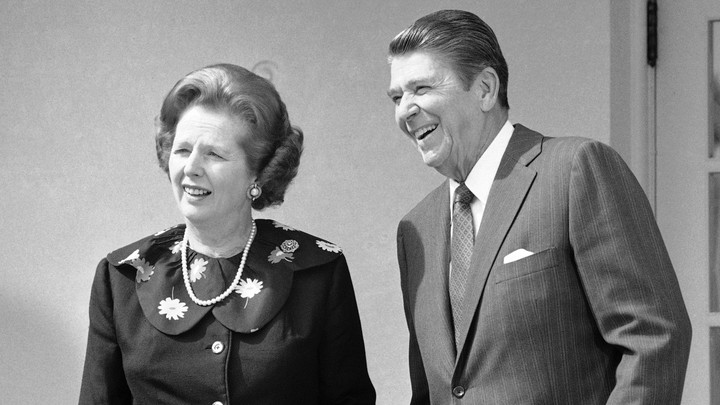
This Is How Reaganism and Thatcherism End

As the Democrat circular firing squad continues as results trickle in from New Hampshire, a lengthy piece in The Atlantic looks at the growing toxicity and ruthless nationalism of the right - all exemplified by the Trump?pence regime - and a virtual war on Enlightenment liberal values. Under this warped nationalism which would alarm Ronald Reagan or Margaret Thatcher, human rights are being diminished and the ability to see others as equally human is under relentless attack.   Indeed, democratic principles are being eroded with the right pushing for the supremacy of an oligarchy lead by a near autocrat as demonstrated by what is happening in Hungry where the press is being censored and universities are being taken over by the autocrat supporting central government.  One can only imagine how eager Trump is to remake America on this pattern, with Congressional Republicans only too happy to rubber stamp the steady erosion of rights so long as they get to remain in office.  Here are article highlights:
In an Italian hotel ballroom of spectacular opulence—on red velvet chairs, beneath glittering crystal chandeliers and a stained-glass ceiling—the conservative movement that once inspired people across Europe, built bridges across the Iron Curtain and helped to win the Cold War came, finally, to an end.
The occasion was a conference in Rome last week called “God, Honor, Country: President Ronald Reagan, Pope John Paul II, and the Freedom of Nations.”  . . . . . this event was co-organized by Chris DeMuth, a former president of the American Enterprise Institute (in the era when it supported global capitalism and the Iraq War) and John O’Sullivan, a former speechwriter for British Prime Minister Margaret Thatcher. . . . .  This was the successor to the National Conservatism Conference held in Washington, D.C., last year.
The purpose, at least at first, seemed a little more mysterious, too. If Reagan and John Paul II were linked by anything, it was a grand, ambitious, and generous idea of Western political civilization, one in which a democratic Europe would be integrated by multiple economic, political, and cultural links, and held together beneath an umbrella of American hegemony. John Paul II wanted Poland to join the European Union . . . . At least when she was still prime minister, Margaret Thatcher was also a proponent of this vision of the West. She was one of the driving forces behind the European single market, the continent-wide free-trade zone that also required a unified regulatory system—the same unified regulatory system that the British have now rejected—and had great faith in the importance of human rights. She said so explicitly: “The state is not, after all, merely a tribe. It is a legal entity,” . . . .
The new national conservatism, at least as articulated in Rome, is very different from Reaganism and Thatcherism. The starting point is that European integration and American hegemony are both evil, and that universal ideals like human rights are a dangerous ideology. These, in fact, are arguments made in Hazony’s book, The Virtue of Nationalism, a work that synthesizes biblical history, the writings of John Locke, and contemporary politics into a caricature of a political philosophy for our times.He also attributes all of the good things about modern civilization to the nation and all of the bad things to what he calls “imperialism.” He puts countries and institutions he likes into the first box, and those he doesn’t like into the second. Thus it emerges that the Nazis, who specifically called themselves nationalists, were not nationalists but imperialists, as is the European Union, an organization created to prevent the resurgence of Nazism. Britain, Spain, and France, despite their long history as empires on land and sea, count as nations.
In this worldview, democracy is of no significance. International treaties and obligations do not matter either, not even if people want them. Although membership in the European Union is voluntary—Brexit has just proved that—and is supported by majorities in most countries, Hazony writes and speaks as if the EU were an occupying power.
Many bad books have had great influence. This one has been very lucky, having appeared just as the word nationalism was adopted by Donald Trump, who finds it a useful way of dressing up a set of foreign and domestic policies that are largely governed by the his whims and dictated by his self-interest. . . . . To put it differently: The arc of history once described by Martin Luther King and Barack Obama is now bending the other way, and a lot of people are leaping aboard.
[O]ther speakers in Rome also reflected an almost paranoid sense of persecution. The idea that “the nation” has been outlawed is clearly something that a certain breed of conservative now genuinely perceives to be true. The American Christian writer Rod Dreher solemnly described a world in which he felt repressed, just as people had been under totalitarian communism. . . . calling on audience members to think of themselves as Christians persecuted for their faith in the past.
What makes this view odder is that it also clashes with political reality. National conservatives cannot simultaneously be helpless victims of a totalitarian culture and also hold enormous political power, which some of them plainly do.
Marion Marechal, the French politician who has dropped the surname Le Pen but still belongs to the family that founded the French party now known as the National Rally, spoke at length.
Marechal, who is sometimes described as a candidate for the French presidency in 2022, made a well-crafted speech that, like Hazony’s, drew a sharp, polarizing contrast between conservatives and enlightenment rational liberals, whom she called “progressives.” The term seemed to include everybody from President Emanuel Macron to French Stalinists. Her words were evocative: “We are trying to connect the past to the future, the nation to the world, the family to the society … We represent realism; they are ideology. We believe in memory; they are amnesia.” But her remarks don’t reflect reality. Macron spoke explicitly and at length about history and memory in Krakow, and has done so on many other occasions too. To Marechal’s fans, that may not matter. Perhaps they feel themselves to be a persecuted minority, and she echoes that view. Perhaps they just prefer to hear about history from someone like her, the spokesman for an ethnic definition of France and Frenchness, instead of Macron.
Some of what Marechal says to the French, and some of what Baudet says to the Dutch, is indisputably true. Economies really have become more global, which makes small communities more vulnerable; older landscapes have been destroyed by modernity; people have drifted away from churches, probably for good; technology is moving very quickly, in ways that frighten people. The argument is over how to address the legitimate fears created by these changes. Among others, the European Union itself has come up with a set of solutions, including the donation of money to culture and architecture and the protection of European agriculture, and thus European landscapes, against competition.
[T]he EU remains the only entity large enough to speak up for Europe on the world stage. The Netherlands alone—even Britain alone—will not be able to do it.
But other possibilities exist too. One can use the electorate’s fears, for example—fan them, exploit them—in order to build a new political movement. And because national conservatism very much wants to be a new political movement, this is a prospect that interests many people.
When the final speaker entered, he won a standing ovation. This was Viktor Orbán, the Hungarian prime minister, the man whose career probably best illustrates the distance that the conservatism of Reagan and Thatcher has traveled since 1989. Orbán, I realized, was the person that many in the room had really come to hear.
Famously, Orbán has gone one step further than many other European conservatives. For one, he has not been shy about using conspiratorial, sometimes hysterical nationalist language, echoing old anti-Semitic tropes, in order to exploit fear of the outside world. “We are fighting an enemy that is different from us,” he said in 2018.
More important, he has surpassed everyone else in Europe in his willingness to destroy the institutions that create the terrain that make democracy possible. Although conference participants in Rome spoke at length about oppressive left-wing ideology at universities, Hungary is the only European country to have shut down an entire university, to have put academic bodies (the Hungarian Academy of Sciences) under direct government control, and to have removed funding from university departments that the ruling party dislikes for political reasons. Although many said they feel repressed by left-wing media, Hungary is also the only European country that has used a combination of political and financial pressure to put most of the private and public media under ruling-party control too.
Orbán’s destruction of independent press and academia and his slow politicization of the Hungarian courts have served a purpose quite different from lofty ideas about national sovereignty or the beauty of landscapes. These machinations have enabled the prime minister’s family and his inner circle to camouflage the myriad ways in which they use state power to get rich. They have also helped him fiddle with electoral rules, gerrymander districts, and adjust the constitution in order to make sure he doesn’t lose.
His country is the best illustration of what happens when you dismiss universal values, repress journalists and academics who produce facts, undermine courts and the rule of law: When you get rid of all of those things, you are just a few short steps away from corruption and tyranny. This is the real face of the new “nationalism,” however carefully it is hidden behind an intellectual facade or dressed up as the successor of Reagan and John Paul II. You can see why it appeals to men like Netanyahu or Trump.
The world inhabited by Reagan and John Paul II is long past, and no one knows how they would react to so-called cancel culture and Twitter mobs, or the backlash against Western culture on American (but not Hungarian) college campuses, or some of the uglier strains of far-left thinking. But somehow I doubt their response would be the creation of a new, kleptocratic authoritarian right that chips away at the institutions preserving democracy. Nor do I believe they would have wanted to destroy the institutions that have long undergirded the West, as so many of these new “nationalists” want to do.
I don’t see why love of country and love of history would be incompatible with membership in broader Western communities. But in the political world we are now entering, they may soon become so.   
Seemingly, these conservatives learned nothing from the horrors that extreme nationalism and a disregard for human rights wrought on the world in the last century.

Thursday, June 27, 2019

Republicans Will Paint Democrats As Socialists as the GOP Pushes a Fascist Agenda

As the second night of Democrat presidential candidate debates takes place with serious discussions about means to address some of the most pressing problems facing millions and millions of average Americans, including the nation's health care crisis, an economy that is providing little if any financial increase to working Americans, and a thoroughly broken immigration system, a column in the New York Times looks at the lies and disingenuous tactics Republicans will utilize to dupe voters into voting against their own best interests.  Yes, the familiar ploys of racism and religious extremism will be trotted out, but the lead GOP mantra will likely be that Democrats are socialists and they seek to take the nation down the road of Venezuela - ignoring, of course, that Democrat plans are no different than those in other leading western industrial nations.  The piece also calls attention to just how extreme the GOP agenda is in terms of historic perspective.  Indeed, the GOP has become a de facto white supremacist, oligarchical political party. Lastly, the piece looks at the need for the media to stop parroting Republican lies and report lies as the lies they are in fact.  Here are column excepts:

The Democratic Party has clearly moved left in recent years, but none of the presidential candidates are anything close to being actual socialists — no, not even Bernie Sanders . . . . Nobody in these debates wants government ownership of the means of production, which is what socialism used to mean. Most of the candidates are, instead, what Europeans would call “social democrats”: advocates of a private-sector-driven economy, but with a stronger social safety net, enhanced bargaining power for workers and tighter regulation of corporate malfeasance. They want America to be more like Denmark, not more like Venezuela.
Leading Republicans, however, routinely describe Democrats, even those on the right of their party, as socialists. . . . And everyone in the news media accepts this as the normal state of affairs.  Which goes to show the extent to which Republican extremism has been accepted simply as a fact of life, barely worth mentioning.
To see what I mean, imagine the media firestorm, the screams about lost civility, we’d experience if any prominent Democrat described Republicans as a party of fascists, let alone if Democrats made that claim the centerpiece of their national campaign. And such an accusation would indeed be somewhat over the top — but it would be a lot closer to the truth than calling Democrats socialists.
The other day The Times published an Op-Ed that used analysis of party platforms to place U.S. political parties on a left-right spectrum along with their counterparts abroad. The study found that the G.O.P. is far to the right of mainstream European conservative parties. It’s even to the right of anti-immigrant parties like Britain’s UKIP and France’s National Rally. Basically, if we saw something like America’s Republicans in another country, we’d classify them as white nationalist extremists.
[I]t matches up with lots of other evidence. Political scientists who use congressional votes to track ideology find that Republicans have moved drastically to the right over the past four decades, to the point where they are now more conservative than they were at the height of the Gilded Age.
Or just compare the G.O.P., point by point, with parties almost everyone would classify as right-wing authoritarians — parties like Hungary’s Fidesz, which has preserved some of the forms of democracy but has effectively created a permanent one-party state.
Fidesz has cemented its power by politicizing the judiciary, creating rigged election rules, suppressing opposition media and using the power of the state to reward the party’s cronies while punishing businesses that don’t toe the line. Does any of this sound like something that can’t happen here? In fact, does any of it sound like something that isn’t already happening here, and which Republicans will do much more of if they get the chance?
One might even argue that the G.O.P. stands out among the West’s white nationalist parties for its exceptional willingness to crash right through the guardrails of democracy. Extreme gerrymandering, naked voter suppression and stripping power from offices the other party manages to win all the same — these practices seem if anything more prevalent here than in the failing democracies of Eastern Europe.
So it’s really something to see Republicans trying to tar Democrats as un-American socialists. If they want to see a party that really has broken with fundamental American values, they should look in the mirror.
But that won’t happen, of course. Whoever the Democrats nominate — even if it’s Joe Biden — Republicans will paint him or her as the second coming of Hugo Chávez. The only question is whether it will work.
Republicans have squandered much of the accusation’s force. And Donald Trump, who was installed in office with Russian help and clearly prefers foreign dictators to democratic allies, is probably less able to play the “Democrats are unpatriotic” card than previous Republican presidents.
Still, a lot will depend on how the news media handle dishonest attacks. Will we keep seeing headlines that repeat false claims (“Trump Says Democrats Will Ban Hamburgers”), with the information that the claim is false buried deep inside the article? Will we get coverage of actual policy proposals, as opposed to horse-race analysis that only asks how those proposals seem to be playing?  I guess we’ll soon find out.

Monday, April 15, 2019

Is the United States Becoming and Oligarchy?

While the United States still has the political trappings of a democracy, economically, it seems rapidly headed toward becoming an oligarchy where wealth and power is becoming increasingly concentrated in the few.  Not since the Gilded Age have we seen such extremes in wealth and and such concentrated attacks on safety and environmental protection regulations. Such attacks are, of course are motivated so that the few can amass even more wealth even as average citizens suffer physically and economically. As a column in the New York Times notes, this is NOT the model that the Founding Fathers envisioned.  Instead, they favored a political and economic system where "the greatest happiness of the greatest Number is the point to be obtained."  This concept could not be further than the model pushed by the Trump/Pence regime and today's GOP which favors the few over the many.   To win in November, 2020 - and November 2019 here in Virginia - Democrats need to push the vision of the Founders and rebut Trump's efforts to label them all as socialists (except Bernie Sanders, who outright states he's a socialist).  Here are column excerpts:

Pete Buttigieg, who’s shown an impressive knack for putting matters well in these early days of the 2020 presidential race, nailed it recently when Chuck Todd of NBC asked him about capitalism. Of course I’m a capitalist, he said; America “is a capitalist society.”
But, he continued: “It’s got to be democratic capitalism.”
Mr. Buttigieg said that when capitalism becomes unrestrained by democratic checks and impulses, that’s no longer the kind of capitalism that once produced broad prosperity in this country. “If you want to see what happens when you have capitalism without democracy, you can see it very clearly in Russia,” he said. “It turns into crony capitalism, and that turns into oligarchy.”
[H]is rhetoric reminds us of a crucial point: There is, or should be, a democratic element to capitalism — and an economic element to how we define democracy.
After all, oligarchy does have an economic element to it; in fact, it is explicitly economic. Oligarchy is the rule of the few, and these few have been understood since Aristotle’s time to be men of wealth, property, nobility, what have you.
But somehow, as the definition of democracy has been handed down to us over the years, the word has come to mean the existence and exercise of a few basic rights and principles. The people — the “demos” — are imbued with no particular economic characteristic. This is wrong. Our definition of democracy needs to change.
Democracy can’t flourish in a context of grotesque concentration of wealth. This idea is neither new nor radical nor alien. It is old, mainstream and as American as Thomas Jefferson.
I invoke Jefferson for a reason. Everyone knows how he was occupying his time in the summer of 1776; he was writing the Declaration of Independence. But what was he up to that fall? He was a member of the Virginia House of Delegates, and he was taking the lead in writing and sponsoring legislation to abolish the commonwealth’s laws upholding “entail” (which kept large estates within families across generations) and primogeniture.
He believed, as the founders did generally, that excess inherited wealth was fundamentally incompatible with democracy.
They were most concerned with inherited wealth, as was the Scottish economist Adam Smith, whom conservatives invoke constantly today but who would in fact be appalled by the propagandistic phrase “death tax” — in their time, inherited wealth was the oppressive economic problem.
They saw clearly the link between democratic health and general economic prosperity. Here is John Adams, not exactly Jefferson’s best friend: All elements of society, he once wrote, must “cooperate in this one democratical principle, that the end of all government is the happiness of the People: and in this other, that the greatest happiness of the greatest Number is the point to be obtained.” “Happiness” to the founders meant economic well-being, and note that Adams called it “democratical.”
So, yes, democracy and the kind of economic inequality we’ve seen in this country in recent decades don’t mix.
A number of scholars have made these arguments in recent years, notably Ganesh Sitaraman in his book “The Crisis of the Middle-Class Constitution.” All that work has been vitally important. But now that some politicians are saying it, we can finally have the broad national conversation we’ve desperately needed for years.
Bernie Sanders has proposed an inheritance tax that the founders would love, and Elizabeth Warren has proposed a wealth tax of which they’d surely approve. But you don’t have to be a supporter of either of those candidates or their plans to get behind the general idea that great concentration of wealth is undemocratic.
Policies built around this idea will not turn America into the Soviet Union or, in the au courant formulation, Venezuela. They will make it the nation the founders intended. And this, as Mr. Buttigieg’s words suggest, is how Democratic candidates should answer the socialism question (with the apparent exception of the socialist Mr. Sanders). No, I’m a capitalist. And that’s why I want capitalism to change.

Friday, December 01, 2017

America, the Banana Republic


Perhaps I am dating myself, but I have lived at this point under 13 different occupants of the White House and never has there been such an embarrassment - indeed, threat to the nation, like the current occupant. Given polling results, it appears that a majority of the citizenry agrees with that assessment.  Seemingly, only evangelical Christians - who have glaringly displayed their moral bankruptcy - white supremacists, and greed driven vulture capitalist on Wall Street appear to continue to support the current occupant who daily displays his unfitness for office.  His Vice President who makes Sergeant Schultz from Hogan's Heroes look like a pillar of decisiveness and wisdom.  America has become a caricature of the banana republics once so derided during my lifetime.  Frighteningly, there is no clear sign post of how the national nightmare will end.  Even America's closest ally, the United Kingdom, with all of its own problems, does not want Trump to visit. A piece at Moyers.com looks at how low America has fallen.   Here are excerpts:


When people call Donald Trump an authoritarian, it almost gives him more credit
than he deserves.  You don’t think favorably of authoritarians; they are despicable. But you do think of them as monstrously large, grievously terrifying, as somehow taking the measure of the polity they control and drawing on its stature to puff themselves up, even as they destroy their nation’s moral core. Despots like Mussolini and Hitler epitomized evil on the grandest possible scale. To call them clowns would trivialize the unconscionable horrors they inflicted.

Trump is certainly an authoritarian, but he is more of a tinhorn dictator, a tiny, negligible man who, rather than inflating himself with the nation’s grandeur, has managed to deflate the nation with his own insipidness. Thanks to him, America is now a banana republic. It is no longer a country of soaring ideas and idealism, a beacon to the world, an example of freedom at home and a protector of freedom abroad, an anchor of sanity in a world often bouncing on the waves of madness.

Whatever her failings, America was once majestic. Now she is hopelessly diminish
-ed — a wealthier version of the corrupt nations in the developing world that we 
used to ridicule. And we owe it all to Donald Trump for making America small again.

The meme of America withering into a banana republic is not a new one. Some observers made the claim after the 2000 presidential election, when Republicans successfully wrested the presidency from Al Gore, just the way cabals do in those banana republics. 

In Vanity Fair, the late Christopher Hitchens was more expansive. He enumerated 
the many ways in which America, the last great hope of mankind, had become 
a banana republic — primarily the way the government was willing to bail out 
the oligarchs while letting the general public suffer.

Hitchens added that there is absolutely no accountability for the thieves. This all 
should sound very familiar this week, as Republicans retool the entire tax system 
to rob from the poor and middle classes and give to corporations and the 
wealthy. If that isn’t a banana republic, I don’t know what is.

But Krugman and Hitchens were writing before we had a bona fide banana republic dictator to rule our kleptocracy. And while America long has had the economic and social characteristics of a banana republic, it took Trump, who has the instincts and temperament of a gangster, to finish the transformation. There is no disguising it now. We are what we are.

Trump is the kleptocrat-in-chief. He not only appears to be using the presidency as his own personal ATM, now promoting a tax-cut scam by which he stands to gain tens of millions of dollars, he also has been petty enough to steer business to his hotels and hawked his “Make America Great Again” tchotchkes. Check.

Apparently not satisfied to have enriched himself at the public’s expense, Trump has brought unprecedented nepotism to the presidency in a way that only tinhorn dictators do, giving his family access to the public trough while placing his unqualified cronies in positions of power. In this administration, everyone may be on the take. Check.

Just about every Trump directive, from health care to the environment to so-called tax reform to trade policy, seems expressly designed to give benefits to a small coterie of the wealthiest Americans while the rest of the country goes to hell. . . . Sure sounds like a banana republic to me. Check.

Like other tinhorn dictators, Trump has no use for the essentials of democracy. 
He openly attacks a free press and has a house press of his own, Fox News, and soon, 
quite possibly, Time Inc.

[T]here are allegations that he may using the levers of government to punish his 
press opponents, using the Justice Department’s antitrust suit against the
proposed AT&T purchase of Time Warner to try to force the divestment of CNN.  
This, too, is unprecedented in an American democracy, but not in a banana republic. 

Trump has taken aim at the electoral process itself, not only claiming that his loss 
of the popular vote was a fraud, but empaneling a government commission whose 
sole purpose is thought to be the disenfranchisement of voters who might oppose 
him. This is pure banana republicanism and an affront to democracy. Check.

Banana republics are often agent states — that is, they operate at the behest of larger
states. In fact the phrase “banana republic” first was coined by the writer O. Henry 
back in 1904, to describe the dependence of Central American countries on American 
businesses like United Fruit, which ran plantations in those countries and exported 
bananas.

Now, America itself is one of those agent states, thanks to Trump’s troubling obeisance to Russia’s Vladimir Putin. Let’s not pretend otherwise just so we can save some face. There is no more face to save. American elections interfered with by Russia and a president intimidated by a Russian dictator? Check.

Tinhorn dictators do everything they can to dismantle a system of checks and 
balances. Trump has done everything in his power to do the same — from 
dismissing FBI Director James Comey, who was investigating Trump, 
intimidating the Justice Department and taking over the Consumer Financial 
Protection Bureau to…. well, you name it. Untrammeled power is his goal. Check.

In a banana republic, the dictator makes his own rules and lives by his 
own reality. Clearly, Trump thinks he is above the law, be it legal or moral. 
He boasts of it. He also is above fact. The latest example of the thousands 
of his presidency: According to The New York Times, he privately has 
declared that the Access Hollywood tape was not actually him! Banana 
republic time. Check.

Donald Trump has demeaned himself, but he has also demeaned the country
that was deranged enough to elect him. These characteristics speak to a corrupt
and desiccated nation, one that is staggering into oblivion.

The “alt-right” insist that until Trump, America was going the way of Rome — rotting from the inside. They are wrong. It is not decadence that is destroying America, but petulance. We are going not the way of Rome but the way of Guatemala or Zimbabwe or the Philippines — the way of banana republics. Thus does this once great nation tumble.
 
As for those who cite the fall of the Western Roman Empire as precedent, they miss two things (among others).  One of the precursor was that they system became so tilted in favor of the wealthy class, that average people simply ceased to see a benefit from living under the empire.  A second factor was the insidious rise of Christianity and its call to ignore fact and objective reason with its adherents withdrawing into a fantasy world that undermined the empire.  We see both of these elements growing under the Trump/Pence regime.

Monday, July 07, 2014

Progressives Need to Reclaim the Constitution


Under conservatives - reactionaries might be more apt - both the U.S. Constitution and state constitutions across the country have been used to erode rights of citizens.  In Virginia, bizarrely, the Bill of Rights portion of the Virginia Constitution was amended to deprive gays of rights allowed to other citizens.  Thankfully, a U.S. District Court struck down the ban and hopefully, the 4th Circuit Court of Appeals will soon do the same.  All in all, it is a perverse phenomenon to see founding documents aimed at protecting rights being used to the reverse effect - or used to grant special rights to reactionary Christian extremists.  A column in the Washington Post makes the case that this trend needs to be reversed.  The following are column highlights:
You cannot talk for very long to a conservative these days without hearing the words “constitutional” and “constitutionalist.” 

Formulations such as “I am a constitutional conservative” or “I am a constitutionalist” are tea party habits, but they are not confined to its ranks. Many kinds of conservatives contend that everything they believe is thoroughly consistent with the views and intentions of our 18th-century Founders. 

The framers could not possibly have foreseen what the world would look like in 2014. In any event, they got some important things wrong, most glaringly their document’s acceptance of slavery. 

Moreover, because the Constitution was written primarily as a foundation for government, it can answer only so many questions. David Strauss of the University of Chicago Law School authored a book called “The Living Constitution” to make plain that there is a lot more to this concept than its detractors suggest. He notes that “a great part of the framers’ genius lay exactly in their ability to leave provisions general when they should be left general, so as not to undermine the document’s ability to serve as common ground.”

The problem with “originalists,” Strauss says, is that they “take general provisions and make them specific,” even when they’re not. One might add that the originalists’ versions of specificity often seem to overlap with their political preferences.

In the May issue of the Boston University Law Review, Joseph R. Fishkin and William E. Forbath of the University of Texas School of Law show that at key turning points in our history (the Jacksonian era, the Populist and Progressive moments and the New Deal), opponents of rising inequality made strong arguments “that we cannot keep our constitutional democracy — our republican form of government — without constitutional restraints against oligarchy and a political economy that maintains a broad middle class, accessible to everyone.”

Their view is that by empowering the wealthy in our political system, Supreme Court decisions such as Citizens United directly contradict the Constitution’s central commitment to shared self-rule.

“Extreme concentrations of economic and political power undermine equal opportunity and equal citizenship,” they write. “In this way, oligarchy is incompatible with, and a threat to, the American constitutional scheme.”

[W]riting during the Gilded Age, a time like ours in many ways, the journalist James F. Hudson argued that “imbedded” in the Constitution is “the principle” mandating “the widest distribution among the people, not only of political power, but of the advantages of wealth, education and social influence.”

The idea of a Constitution of Opportunity is both refreshing and relevant. For too long, progressives have allowed conservatives to monopolize claims of fealty to our unifying national document. In fact, those who would battle rising economic inequalities to create a robust middle class should insist that it’s they who are most loyal to the Constitution’s core purpose. Broadly shared well-being is essential to the framers’ promise that “We the people” will be the stewards of our government.

Tuesday, April 22, 2014

Retired Justice Stevens Condemns Majority in McCutcheon v. Federal Election Commission


With the sometimes exception of Justice Anthony Kennedy (particularly in the area of gay rights), the conservative majority on the U.S. Supreme Court hold most average Americans in open contempt and have sided with the wealthy, huge corporations and GOP racists.  With its ruling in McCutcheon v. Federal Election Commission, this majority more or less put the government up for sale to big money interests and amazingly found that huge campaign bribes contributions while one is a candidate is miraculously different than a huge bribe while in office.  The distinction, of course defies belief and common sense.  Former Justice John Paul Stevens has condemned the ruling and has suggested a constitutional amendment to protect America's democracy.  A piece in the New York Times looks at Justice Stevens' views.  Here are excerpts:
Justice John Paul Stevens, who turned 94 on Sunday, is a mild man with an even temperament. He has a reverence for the Supreme Court, on which he served for almost 35 years until his retirement in 2010, and he is fond of his former colleagues.

But there was a hint of anger in some of his remarks when I went to see him last week in his Supreme Court chambers. He said the court had made a disastrous wrong turn in its recent string of campaign finance rulings.

“The voter is less important than the man who provides money to the candidate,” he said. “It’s really wrong.”

He talked about what he called a telling flaw in the opening sentence of last month’s big campaign finance ruling. He filled in some new details about the behind-the-scenes maneuvering that led to the Citizens United decision. And he called for a constitutional amendment to address what he said was the grave threat to American democracy caused by the torrent of money in politics.

Chief Justice John G. Roberts Jr. started his controlling opinion with a characteristically crisp and stirring opening sentence: “There is no right more basic in our democracy than the right to participate in electing our political leaders.”

But that was misleading, Justice Stevens said. “The first sentence here,” he said, “is not really about what the case is about.”

The plaintiff, Shaun McCutcheon, an Alabama businessman, had made contributions to 15 candidates in the 2012 election. He sued so he could give money to 12 more. None of the candidates in the second group was running in Alabama.

Mr. McCutcheon was not trying to participate in electing his own leaders, Justice Stevens said. “The opinion is all about a case where the issue was electing somebody else’s representatives,” he said.

The occasion for our talk was Justice Stevens’s new book, “Six Amendments: How and Why We Should Change the Constitution.” One of those amendments would address Citizens United, which he wrote was “a giant step in the wrong direction.”

The new amendment would override the First Amendment and allow Congress and the states to impose “reasonable limits on the amount of money that candidates for public office, or their supporters, may spend in election campaigns.”

His own book has, in addition to the chapter on campaign finance, chapters on gun control, the death penalty, gerrymandering and aspects of state sovereignty. Each concludes with a proposed amendment.

Wednesday, April 16, 2014

Study: The USA is an Oligarchy


I rail against the GOP effort to restore the Gilded Age and a new study would seem to confirm that the effort is having a great deal of success.  More frightening, with the recent U.S. Supreme Court ruling that there should be no limit to political bribes so long as they are paid while elected officials are candidates rather than while in office, the trend will likely intensify.  The study that I refer to is one done by researchers from Princeton University and Northwestern University suggests that the United States' political system serves the wealthy and special interest organizations, not ordinary voters.  The Telegraph has a piece that looks at the researchers' findings.  Here are highlights:
The US government does not represent the interests of the majority of the country's citizens, but is instead ruled by those of the rich and powerful, a new study from Princeton and Northwestern Universities has concluded.
The report, entitled Testing Theories of American Politics: Elites, Interest Groups, and Average Citizens, used extensive policy data collected from between the years of 1981 and 2002 to empirically determine the state of the US political system.
After sifting through nearly 1,800 US policies enacted in that period and comparing them to the expressed preferences of average Americans (50th percentile of income), affluent Americans (90th percentile) and large special interests groups, researchers concluded that the United States is dominated by its economic elite.
The peer-reviewed study, which will be taught at these universities in September, says: "The central point that emerges from our research is that economic elites and organised groups representing business interests have substantial independent impacts on US government policy, while mass-based interest groups and average citizens have little or no independent influence." 
Researchers concluded that US government policies rarely align with the the preferences of the majority of Americans, but do favour special interests and lobbying oragnisations: "When a majority of citizens disagrees with economic elites and/or with organised interests, they generally lose. Moreover, because of the strong status quo bias built into the US political system, even when fairly large majorities of Americans favour policy change, they generally do not get it." 

The study comes in the wake of McCutcheon v. Federal Election Commission, a controversial piece of legislation passed in The Supreme Court that abolished campaign contribution limits, and record low approval ratings for the US congress. 
Yes, individual voters can change election results but ultimately, polcy will likely be set by the rich and powerful.  Sometimes the interests of the rich and the average person overlap, but more often they do not.


Monday, April 07, 2014

America - On the Road to Oligrachy


The far right members of the U.S. Supreme Court like to claim that they value tradition and similar claptrap as they work steadily to dismantle the progressive era.  These efforts work in parallel with the efforts of Republicans at both the state and federal level to aid the wealthy and destroy the social safety net.  Indeed, if there is any blue print that seems to back their agenda it is one for establishing an oligarchy or some modern day version of the Europe of old when an aristocracy controlled the bulk of power and wealth.  For everyone else, life was pretty brutal and often desperate.  A column in the Washington Post looks at this dangerous trend in America which is being further fueled by the the Supreme Court's inability to see the difference between supposed free speech and the buying of politicians by those like the Koch brothers. Here are excerpts:


An oligarchy, Webster’s dictionary tells us, is “a form of government in which the ruling power belongs to a few persons.” It’s a shame that the Republican majority on the Supreme Court doesn’t know the difference between an oligarchy and a democratic republic.

Yes, I said “the Republican majority,” violating a nicety based on the pretense that when people reach the high court, they forget their party allegiance. We need to stop peddling this fiction.

On cases involving the right of Americans to vote and the ability of a very small number of very rich people to exercise unlimited influence on the political process, Chief Justice John G. Roberts Jr. and his four allies always side with the wealthy, the powerful and the forces that would advance the political party that put them on the court. The ideological overreach that is wrecking our politics is now also wrecking our jurisprudence.

The court’s latest ruling in McCutcheon et al. v. Federal Election Commission should not be seen in isolation. (The “et al.,” by the way, refers to the Republican National Committee.) It is yet another act of judicial usurpation by five justices who treat the elected branches of our government with contempt and precedent as meaningless.

Notice how these actions work in tandem to make the wealthy more powerful and those who have suffered oppression and discrimination less powerful. You don’t need much imagination to see who benefits from what the court is doing.

Roberts’s McCutcheon ruling obliterates long-standing rules that limit the aggregate amounts of money the super-rich can contribute to various political candidates and committees in any one election cycle.

Those using the word “oligarchy” to describe the political regime the Supreme Court is creating are not doing so lightly. Combine McCutcheon with the decision in the Citizens United case and you can see that the court is systematically transferring more power to a tiny, privileged sliver of our people. 

I keep emphasizing the word “power” because the Roberts decision pretends that the concept is as distant from this issue as Pluto is from Earth. The philosopher Michael Walzer, in his book “Spheres of Justice,” made the essential distinction: “Freedom of speech, press, religion, assembly: none of these require money payments; none of them are available at auction; they are simply guaranteed to every citizen.

In his McCutcheon opinion, Roberts piously declares: “There is no right more basic in our democracy than the right to participate in electing our political leaders.” This lovely commitment escaped him entirely last summer when he and his allies threw out Section 4 of the Voting Rights Act. Suddenly, efforts to protect the right of minorities “to participate in electing our political leaders” took second place behind all manner of worries about how Congress had constructed the law.

Thus has this court conferred on wealthy people the right to give vast sums of money to politicians while undercutting the rights of millions of citizens to cast a ballot.