Showing posts with label greed and power. Show all posts

Tuesday, February 11, 2020

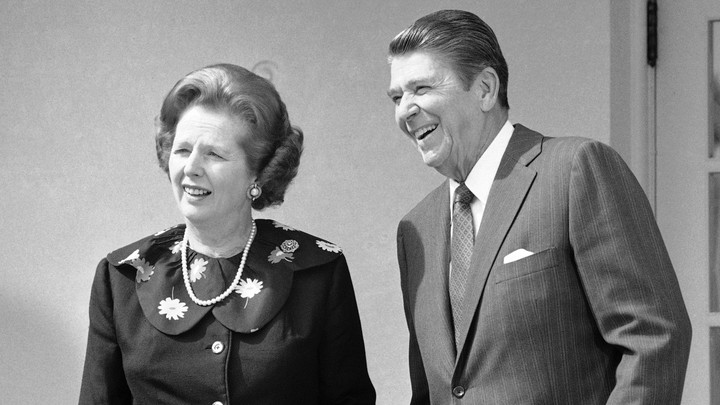
This Is How Reaganism and Thatcherism End

As the Democrat circular firing squad continues as results trickle in from New Hampshire, a lengthy piece in The Atlantic looks at the growing toxicity and ruthless nationalism of the right - all exemplified by the Trump?pence regime - and a virtual war on Enlightenment liberal values. Under this warped nationalism which would alarm Ronald Reagan or Margaret Thatcher, human rights are being diminished and the ability to see others as equally human is under relentless attack.   Indeed, democratic principles are being eroded with the right pushing for the supremacy of an oligarchy lead by a near autocrat as demonstrated by what is happening in Hungry where the press is being censored and universities are being taken over by the autocrat supporting central government.  One can only imagine how eager Trump is to remake America on this pattern, with Congressional Republicans only too happy to rubber stamp the steady erosion of rights so long as they get to remain in office.  Here are article highlights:
In an Italian hotel ballroom of spectacular opulence—on red velvet chairs, beneath glittering crystal chandeliers and a stained-glass ceiling—the conservative movement that once inspired people across Europe, built bridges across the Iron Curtain and helped to win the Cold War came, finally, to an end.
The occasion was a conference in Rome last week called “God, Honor, Country: President Ronald Reagan, Pope John Paul II, and the Freedom of Nations.”  . . . . . this event was co-organized by Chris DeMuth, a former president of the American Enterprise Institute (in the era when it supported global capitalism and the Iraq War) and John O’Sullivan, a former speechwriter for British Prime Minister Margaret Thatcher. . . . .  This was the successor to the National Conservatism Conference held in Washington, D.C., last year.
The purpose, at least at first, seemed a little more mysterious, too. If Reagan and John Paul II were linked by anything, it was a grand, ambitious, and generous idea of Western political civilization, one in which a democratic Europe would be integrated by multiple economic, political, and cultural links, and held together beneath an umbrella of American hegemony. John Paul II wanted Poland to join the European Union . . . . At least when she was still prime minister, Margaret Thatcher was also a proponent of this vision of the West. She was one of the driving forces behind the European single market, the continent-wide free-trade zone that also required a unified regulatory system—the same unified regulatory system that the British have now rejected—and had great faith in the importance of human rights. She said so explicitly: “The state is not, after all, merely a tribe. It is a legal entity,” . . . .
The new national conservatism, at least as articulated in Rome, is very different from Reaganism and Thatcherism. The starting point is that European integration and American hegemony are both evil, and that universal ideals like human rights are a dangerous ideology. These, in fact, are arguments made in Hazony’s book, The Virtue of Nationalism, a work that synthesizes biblical history, the writings of John Locke, and contemporary politics into a caricature of a political philosophy for our times.He also attributes all of the good things about modern civilization to the nation and all of the bad things to what he calls “imperialism.” He puts countries and institutions he likes into the first box, and those he doesn’t like into the second. Thus it emerges that the Nazis, who specifically called themselves nationalists, were not nationalists but imperialists, as is the European Union, an organization created to prevent the resurgence of Nazism. Britain, Spain, and France, despite their long history as empires on land and sea, count as nations.
In this worldview, democracy is of no significance. International treaties and obligations do not matter either, not even if people want them. Although membership in the European Union is voluntary—Brexit has just proved that—and is supported by majorities in most countries, Hazony writes and speaks as if the EU were an occupying power.
Many bad books have had great influence. This one has been very lucky, having appeared just as the word nationalism was adopted by Donald Trump, who finds it a useful way of dressing up a set of foreign and domestic policies that are largely governed by the his whims and dictated by his self-interest. . . . . To put it differently: The arc of history once described by Martin Luther King and Barack Obama is now bending the other way, and a lot of people are leaping aboard.
[O]ther speakers in Rome also reflected an almost paranoid sense of persecution. The idea that “the nation” has been outlawed is clearly something that a certain breed of conservative now genuinely perceives to be true. The American Christian writer Rod Dreher solemnly described a world in which he felt repressed, just as people had been under totalitarian communism. . . . calling on audience members to think of themselves as Christians persecuted for their faith in the past.
What makes this view odder is that it also clashes with political reality. National conservatives cannot simultaneously be helpless victims of a totalitarian culture and also hold enormous political power, which some of them plainly do.
Marion Marechal, the French politician who has dropped the surname Le Pen but still belongs to the family that founded the French party now known as the National Rally, spoke at length.
Marechal, who is sometimes described as a candidate for the French presidency in 2022, made a well-crafted speech that, like Hazony’s, drew a sharp, polarizing contrast between conservatives and enlightenment rational liberals, whom she called “progressives.” The term seemed to include everybody from President Emanuel Macron to French Stalinists. Her words were evocative: “We are trying to connect the past to the future, the nation to the world, the family to the society … We represent realism; they are ideology. We believe in memory; they are amnesia.” But her remarks don’t reflect reality. Macron spoke explicitly and at length about history and memory in Krakow, and has done so on many other occasions too. To Marechal’s fans, that may not matter. Perhaps they feel themselves to be a persecuted minority, and she echoes that view. Perhaps they just prefer to hear about history from someone like her, the spokesman for an ethnic definition of France and Frenchness, instead of Macron.
Some of what Marechal says to the French, and some of what Baudet says to the Dutch, is indisputably true. Economies really have become more global, which makes small communities more vulnerable; older landscapes have been destroyed by modernity; people have drifted away from churches, probably for good; technology is moving very quickly, in ways that frighten people. The argument is over how to address the legitimate fears created by these changes. Among others, the European Union itself has come up with a set of solutions, including the donation of money to culture and architecture and the protection of European agriculture, and thus European landscapes, against competition.
[T]he EU remains the only entity large enough to speak up for Europe on the world stage. The Netherlands alone—even Britain alone—will not be able to do it.
But other possibilities exist too. One can use the electorate’s fears, for example—fan them, exploit them—in order to build a new political movement. And because national conservatism very much wants to be a new political movement, this is a prospect that interests many people.
When the final speaker entered, he won a standing ovation. This was Viktor Orbán, the Hungarian prime minister, the man whose career probably best illustrates the distance that the conservatism of Reagan and Thatcher has traveled since 1989. Orbán, I realized, was the person that many in the room had really come to hear.
Famously, Orbán has gone one step further than many other European conservatives. For one, he has not been shy about using conspiratorial, sometimes hysterical nationalist language, echoing old anti-Semitic tropes, in order to exploit fear of the outside world. “We are fighting an enemy that is different from us,” he said in 2018.
More important, he has surpassed everyone else in Europe in his willingness to destroy the institutions that create the terrain that make democracy possible. Although conference participants in Rome spoke at length about oppressive left-wing ideology at universities, Hungary is the only European country to have shut down an entire university, to have put academic bodies (the Hungarian Academy of Sciences) under direct government control, and to have removed funding from university departments that the ruling party dislikes for political reasons. Although many said they feel repressed by left-wing media, Hungary is also the only European country that has used a combination of political and financial pressure to put most of the private and public media under ruling-party control too.
Orbán’s destruction of independent press and academia and his slow politicization of the Hungarian courts have served a purpose quite different from lofty ideas about national sovereignty or the beauty of landscapes. These machinations have enabled the prime minister’s family and his inner circle to camouflage the myriad ways in which they use state power to get rich. They have also helped him fiddle with electoral rules, gerrymander districts, and adjust the constitution in order to make sure he doesn’t lose.
His country is the best illustration of what happens when you dismiss universal values, repress journalists and academics who produce facts, undermine courts and the rule of law: When you get rid of all of those things, you are just a few short steps away from corruption and tyranny. This is the real face of the new “nationalism,” however carefully it is hidden behind an intellectual facade or dressed up as the successor of Reagan and John Paul II. You can see why it appeals to men like Netanyahu or Trump.
The world inhabited by Reagan and John Paul II is long past, and no one knows how they would react to so-called cancel culture and Twitter mobs, or the backlash against Western culture on American (but not Hungarian) college campuses, or some of the uglier strains of far-left thinking. But somehow I doubt their response would be the creation of a new, kleptocratic authoritarian right that chips away at the institutions preserving democracy. Nor do I believe they would have wanted to destroy the institutions that have long undergirded the West, as so many of these new “nationalists” want to do.
I don’t see why love of country and love of history would be incompatible with membership in broader Western communities. But in the political world we are now entering, they may soon become so.   
Seemingly, these conservatives learned nothing from the horrors that extreme nationalism and a disregard for human rights wrought on the world in the last century.

Saturday, August 24, 2019

David Koch’s Monstrous Legacy

Perhaps is a result of the better aspects of my Catholic upbringing - something former Speaker of the House Paul Ryan seemingly never internalized - but I was raised to believe each of us has an obligation to leave the world a better place and to have a legacy of having helped others and most certainly not to have a legacy of harming the planet and leaving others more economically desperate. At the time of his death, as a piece in New York Magazine notes, David Koch was worth $42,4 billion - more than anyone can spend in a lifetime and and amount which could have done untold good for millions of people. True, Koch donated to museums and the arts, but his political legacy and the harm done to the environment and the debasement of the lives of countless workers are much more defining of the man who number one motivation seemingly was greed and the amassing of ever more money. Equally disgusting is the toxic political forces Koch funded with his brother that some will argue gave America the nightmare of the Trump presidency, a legacy that continues to harm lives daily.  Here are highlights from the New York Magazine piece:

By the time he died on Friday at the age of 79, David Koch was worth $42.4 billion. He will be remembered for what he did with it. Some people will probably praise his charitable spirit, perhaps even his support for criminal-justice reform, or his skepticism of military intervention. “The vast bulk of Koch’s philanthropy was not political,” Brian Doherty noted in an obit for Reason magazine.
But Koch’s largesse wasn’t free. We are paying for it now, and have been paying for it for decades. Koch’s legacy is a testament to the power of weaponized philanthropy. For Koch did not restrict himself to supporting artists and scientists. He, along with his brother Charles, who survives him, committed their vast family fortune to the construction of a powerful conservative network. We live in the world that he helped build, and it is on fire.
Koch, who ran for office on the Libertarian Party ticket in 1980, helped funnel billions into climate-change-denying organizations for decades. His motivation wasn’t a mystery: He did it because he was greedy. Political action to arrest climate change threatened Koch’s business interests. His family originally made its money in oil and gas, and Koch Industries, as Tim Dickinson laid out in a 2014 piece for Rolling Stone, is one of the biggest polluters in the U.S.
The legacy of David Koch cannot be extricated from the work he undertook with his brother. As Jane Mayer reported for The New Yorker in 2010, the brothers were ideologically sympatico, bound together by their disbelief in climate science and their opposition to industry regulation. Their work had massive reach, though their use of shell trusts and foundations can make their money difficult to trace. Mayer, however, has reported much of it out over the years, in pieces for The New Yorker and in her 2016 book, Dark Money.
They donated copiously to the Heritage Foundation, which wraps climate change denial into a broader conservative platform that opposes LGBT rights and legal abortion. They helped establish the anti-regulatory Mercatus Center at George Mason University, and that came with certain privileges; in 2018, Inside Higher Ed reported that the university had given the Kochs a say in faculty hiring. Similar funding agreements also existed at Florida State University and Utah State University. Koch money bankrolled right-to-work groups that have worked for decades to reduce union membership — a goal that has, according to most experts, contributed significantly to America’s increasing wealth inequality.
But what’s bad for workers tends to be good for the Kochs. Unions cut into a corporation’s bottom line; they make it slightly more difficult for lowly businessmen to purchase Park Avenue penthouses worth millions. The same principle of self-interest applies to one of David’s pet projects. Through the Americans for Prosperity Foundation, which he founded, the family fortune helped mobilize the tea party movement. The id they unleashed — the naked white nationalism, the anti–big government hysteria, all those conspiracy theories — helped seed the ground for Donald Trump. David and his brother refused to donate to Trump, but he is in many ways the culmination of their work.
David Koch died before he could reap the full bounty of his works. We will not be so lucky. His legacy is poisoned water and dirty air, decimated unions, and Donald Trump. No amount of arts patronage can purify that stain. It is likely not coincidental that the small government the Kochs desire would leave artists and scientists at the mercy of billionaires’ largesse. It’s as if he and his brother wanted to pitch us all on their vision for the world: If we let their companies gobble as much as they could, they would throw us a scrap or two. Never enough to live on; just enough to hold us until the next handout. They would allow us a glimpse of beauty, a mirage of progress, so that we would readily accept a cage.
Protected from consequences by death as his money protected him in life, David Koch is dead.
Sometimes one must speak ill of the dead in the hope that others might not follow a similar path of greed and harm to the world and others. 

Wednesday, July 06, 2016

The Fabricated Theology of Donald Trump

As long time readers of this blog surely know, among those I hold in the lowest regard of anyone are the "godly folk," the evangelical Christian crowd which is neither godly nor morally decent.  Lies, hypocrisy, and Pharisee like behavior are their hallmarks.  Ranking only a short way behind them are Republican politicians who claim to support "family values" and the nation's alleged Christian heritage even as they push a legislative agenda that is the antithesis of the Gospel message.  With the rise of Donald Trump to the position of presumptive GOP presidential nominee, we have had an opportunity to see evangelicals showing their true colors and the lengths to which they will go to debase and prostitute themselves to someone like Trump in their quest for their true love: power.  A column in the New York Times looks at this disgusting example of the moral bankruptcy of those who would seek to impose their feigned morality on all of society.  Here are excerpts:
SINCE Donald Trump assures us that the Bible is his favorite book, it’s worth asking: Just what is his theology?
After Mr. Trump met with hundreds of evangelical Christians a couple of weeks ago, James Dobson, who is among the most influential leaders in the evangelical world and serves on Mr. Trump’s evangelical executive advisory board, declared that “Trump appears to be tender to things of the Spirit,” by which Dr. Dobson meant the Holy Spirit.
Of all the descriptions of Mr. Trump we’ve heard this election season, this may be the most farcical. As described by St. Paul, the “fruit of the Spirit” includes forbearance, kindness, goodness, faithfulness, gentleness and self-control, hardly qualities one associates with Mr. Trump. It shows you the lengths Mr. Trump’s supporters will go to in order to rationalize their enthusiastic support of him.
Dr. Dobson is not alone. Jerry Falwell Jr., the president of Liberty University, has praised Mr. Trump’s life as in many ways exemplary and said that he believes that “Donald Trump is God’s man to lead our nation.” Eric Metaxas, who has written popular biographies of William Wilberforce and Dietrich Bonhoeffer, has rhapsodized about Mr. Trump and argued that Christians “must” vote for him because he is “the last best hope of keeping America from sliding into oblivion.”
And should your conscience tell you that Mr. Trump might not be the right choice, Robert Jeffress, the influential pastor of First Baptist Church in Dallas, explains that “any Christian who would sit at home and not vote for the Republican nominee” is “motivated by pride rather than principle.”
This fulsome embrace of Mr. Trump is rather problematic, since he embodies a worldview that is incompatible with Christianity. If you trace that worldview to its source, Christ would not be anywhere in the vicinity.
Time and again Mr. Trump has shown contempt for those he perceives as weak and vulnerable — “losers,” in his vernacular. They include P.O.W.s, people with disabilities, those he deems physically unattractive and those he considers politically powerless. He bullies and threatens people he believes are obstacles to his ambitions. He disdains compassion and empathy, to the point where his instinctive response to the largest mass shooting in American history was to congratulate himself: “Appreciate the congrats for being right.”
In his comments to that gathering of evangelicals, Mr. Trump said this: “And I say to you folks, because you have such power, such influence. Unfortunately the government has weeded it away from you pretty strongly. But you’re going to get it back. Remember this: If you ever add up, the men and women here are the most important, powerful lobbyists. You’re more powerful. Because you have men and women, you probably have something like 75, 80 percent of the country believing. But you don’t use your power. You don’t use your power.”
In eight sentences Mr. Trump mentioned some variation of power six times, to a group of individuals who have professed their love and loyalty to Jesus, who in his most famous sermon declared, “Blessed are the poor in spirit” and “Blessed are the meek,” . . . 
To better understand Mr. Trump’s approach to life, ethics and politics, we should not look to Christ but to Friedrich Nietzsche, who was repulsed by Christianity and Christ. . . . Whether or not he has read a word of Nietzsche (I’m guessing not), Mr. Trump embodies a Nietzschean morality rather than a Christian one. It is characterized by indifference to objective truth (there are no facts, only interpretations), the repudiation of Christian concern for the poor and the weak, and disdain for the powerless.
Mr. Trump’s entire approach to politics rests on dehumanization. If you disagree with him or oppose him, you are not merely wrong. You are worthless, stripped of dignity, the object of derision. This attitude is central to who Mr. Trump is and explains why it pervades and guides his campaign. If he is elected president, that might-makes-right perspective would infect his entire administration.
All of this is important because of what it says about Mr. Trump as a prospective president. But it is also revealing for what it says about Christians who now testify on his behalf (there are plenty who don’t). . . . . Evangelical Christians who are enthusiastically supporting Donald Trump are signaling, even if unintentionally, that this calling has no place in politics and that Christians bring nothing distinctive to it — that their past moral proclamations were all for show and that power is the name of the game.
The French philosopher and theologian Jacques Ellul wrote: “Politics is the church’s worst problem. It is her constant temptation, the occasion of her greatest disasters, the trap continually set for her by the prince of this world.” In rallying round Mr. Trump, evangelicals have walked into the trap. The rest of the world sees it. Why don’t they?

Saturday, April 26, 2014

The Double Standards in Bankruptcies - Why Do Banks Get Special Treatment?


With the city of Detroit filing bankruptcy the spotlight is being focused on the unequal application of the bankruptcy laws to seemingly everyone else other than the big banks.  When the financial markets collapsed largely because of the utter recklessness and in some cases outright fraud of the big banks and mortgage companies, the big banks got bailed out with tax payer money and were supposed to pass along relief to beleaguered homeowners - something that from what I have seen in the real estate industry simply never happened.  The banks were quick to take the taxpayer funds but have made a practice of screwing over homeowners in loan modifications and have shown little regard for the properties they tossed off to HUD and the VA to deal with.  Yet in Detroit's case, we are seeing a whole different standard.  The New York Times looks at the troubling situation.  Here are excerpts:
Developments in the Detroit bankruptcy have exposed a double standard in federal bankruptcy law, an injustice in urgent need of congressional reform.

In Detroit, the judge has ruled that under Chapter 9 of the bankruptcy law, the city’s creditors include even municipal pensioners whose payouts are guaranteed under the Michigan Constitution. Accordingly, the pensioners have reached a tentative deal to reduce retiree benefits; along with concessions made by other creditors, the goal is to help the debtor, the city of Detroit, get a fresh start and move forward.

Contrast that with what happened in the housing bust. The creditors in that fiasco — including powerful banks — did not have to cut deals in court with bankrupt homeowners. Under Chapter 13 of the bankruptcy law, a section heavily influenced by the financial industry, lenders cannot be forced to rework most residential mortgages in bankruptcy.

That is where the legal double standard comes in. In Detroit’s bust, even pensioners have to negotiate new terms; in the housing bust, big banks did not have to negotiate, leaving many homeowners in the dust.

That special treatment for banks may have helped them recover from the financial crisis. But it made things worse for borrowers and the economy. Today, 8.6 million homeowners still owe more on their mortgages than their homes are worth, for a total of $430 billion in negative equity, according to Moody’s Analytics. Some 2.1 million of the underwater homeowners are in or near foreclosure, on top of 9.6 million who have lost their homes since 2007.

Congress could have changed the law early in the financial crisis to allow for bankruptcy court relief for homeowners. Its refusal to do so has contributed to unnecessary impoverishment and a protracted weak recovery.

Congress must change the bankruptcy law to ensure that banks have to modify mortgages in court for bankrupt borrowers. Anything less violates bankruptcy’s tough principles of shared pain for creditors and second chances for debtors.
 Yes, I hold the banking industry in low regard.  The banking system and Wall Street created the financial crisis and except in the cases of relative small banks where decision makers have been prosecuted and gone to jail, NO ONE in the big banks or on Wall Street has been similarly prosecuted.  Something is seriously wrong with this picture.

Saturday, April 19, 2014

The "Down Low" Sex Life of Jesus


When I was relatively new to blogging I was lucky enough to be invited to the LGBT Blogger Summit orchestrated by Mike Rogers and underwritten in part by Progressive Insurance and Microsoft.  Among the bloggers I got to meet was Irene Moore, an ordained minister and someone who resisted the anti-gay message so often associated with American Christianity.  As a woman, she also found the patriarchal structure of Christian churches less than appealing, not to mention inconsistent with the true history of early Christianity before that history was rewritten to fit the agenda of those seeking power over and control of the Church's message.  Irene has an interesting piece in the San Diego Gay & Lesbian News that uses the recent stories on the apparent antiquity of the so-called "Gospel of Jesus' Wife" to review the Church's historic problem Jesus' sexuality.  Here are some highlights:  

While many biblical scholars have ignored non-canonical texts like the gnostic and apocryphal gospels that suggested Jesus had a wife, they are now not ignoring the 2012 discovery of a faded fragment of papyrus that suggest he did.

According to this month's New York Times article, "Papyrus Referring to Jesus' Wife Is More Likely Ancient Than Fake, Scientists Say" the papyrus is now known as the "Gospel of Jesus's wife."

This discovery, however, disrupts the Christian church’s depiction of Jesus for many reasons. The Church doesn't want to say that Jesus had a wife because his evangelizing with 12 disciples clearly points to the fact that he wasn't a family man.

Also, the Church doesn't want to accept that Jesus might have been married to Mary Magdalene -- the second most important woman in the New Testament Scriptures after Mary, the mother of Jesus -- because the misogyny written in the patriarchal narratives of Jesus's ministry cast her as a whore.

New evidence suggests that Mary Magdalene may have been one of Jesus's disciples, may have bankrolled his ministry, may possibly have been his wife, and that Mary Magdalene was clearly Jesus's go-to-girl for a lot of things.

This discovery, also, reopens the “down-low” secret about Jesus’ sexuality that not only attacks the pillars of Christianity, but also profoundly plays into the oppression that women as well as lesbian, gay, bisexual, transgender and queer (LGBTQ) people face today in both church and society.

And that open secret about Jesus’ sexuality — suggesting that he was gay or married, not that the two are mutually exclusive if Jesus was on the “down low” — points to the cultural war issues we are wrestling with today, namely the institution of marriage, women in the church, and gay clergy.

However, the debate about Jesus’ sexuality takes him from his mother’s womb to his tomb. The Christian depiction of Jesus as that of a life-long virgin who had no sexual desire and who never engaged in sexual intercourse raises anyone’s suspicion, because by today’s sexual standards, Jesus’ homosocial environment of 12 men suggests, according to the law of averages, that at least one out of the bunch was gay.

Given the nature of compulsory heterosexuality playing in Jewish marital laws during Jesus’ time, Jesus might have been forced to be on the “down low” -- if gay.

Encrypted in Leonardo Da Vinci’s 1498 painting “The Last Supper” is a spiritual and sensual narrative about both the sacred feminine and homoeroticism found in religious life.

And while many Christian fundamentalists and evangelicals find Da Vinci’s sensuous painting blasphemous, Da Vinci’s gay male homoerotic subtext pries open the door to the alluring quality about the Roman Catholic Church that gay men find both rabidly homophobic and ravenously homoerotic.

It is unlikely, given Jewish marital customs, that Jesus was not married, and he probably was assigned a wife long before he became an itinerant preacher and met up with male and female disciples on the road.
I refuse to believe that an itinerant rabbi with a gang of 12 horny men, they were virgins, celibate and not married.
- See more at: http://sdgln.com/commentary/2014/04/18/down-low-sex-life-jesus-comes-light#sthash.FOvFWaGS.dpuf

I refuse to believe that an itinerant rabbi with a gang of 12 horny men, they were virgins, celibate and not married.
 I am in agreement with Irene.  Like so much else in the Bible, the true story - if Jesus really existed - was revised and modified to meet the needs of fallible men who were motivated by a desire for power and most importantly control over others. 
 - See more at: http://sdgln.com/commentary/2014/04/18/down-low-sex-life-jesus-comes-light#sthash.FOvFWaGS.dpuf