Showing posts with label autocracy. Show all posts

Tuesday, February 11, 2020

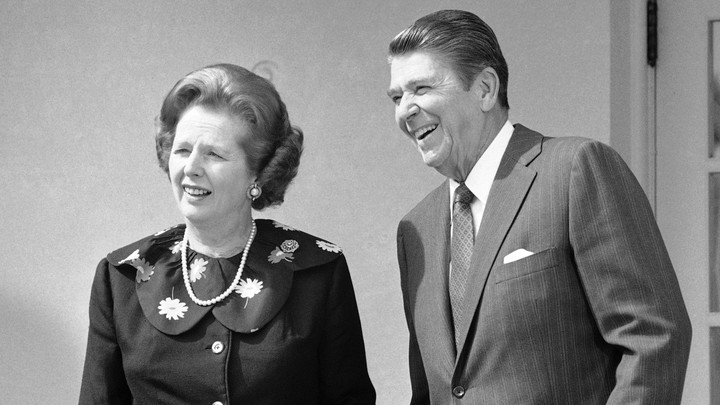
This Is How Reaganism and Thatcherism End

As the Democrat circular firing squad continues as results trickle in from New Hampshire, a lengthy piece in The Atlantic looks at the growing toxicity and ruthless nationalism of the right - all exemplified by the Trump?pence regime - and a virtual war on Enlightenment liberal values. Under this warped nationalism which would alarm Ronald Reagan or Margaret Thatcher, human rights are being diminished and the ability to see others as equally human is under relentless attack.   Indeed, democratic principles are being eroded with the right pushing for the supremacy of an oligarchy lead by a near autocrat as demonstrated by what is happening in Hungry where the press is being censored and universities are being taken over by the autocrat supporting central government.  One can only imagine how eager Trump is to remake America on this pattern, with Congressional Republicans only too happy to rubber stamp the steady erosion of rights so long as they get to remain in office.  Here are article highlights:
In an Italian hotel ballroom of spectacular opulence—on red velvet chairs, beneath glittering crystal chandeliers and a stained-glass ceiling—the conservative movement that once inspired people across Europe, built bridges across the Iron Curtain and helped to win the Cold War came, finally, to an end.
The occasion was a conference in Rome last week called “God, Honor, Country: President Ronald Reagan, Pope John Paul II, and the Freedom of Nations.”  . . . . . this event was co-organized by Chris DeMuth, a former president of the American Enterprise Institute (in the era when it supported global capitalism and the Iraq War) and John O’Sullivan, a former speechwriter for British Prime Minister Margaret Thatcher. . . . .  This was the successor to the National Conservatism Conference held in Washington, D.C., last year.
The purpose, at least at first, seemed a little more mysterious, too. If Reagan and John Paul II were linked by anything, it was a grand, ambitious, and generous idea of Western political civilization, one in which a democratic Europe would be integrated by multiple economic, political, and cultural links, and held together beneath an umbrella of American hegemony. John Paul II wanted Poland to join the European Union . . . . At least when she was still prime minister, Margaret Thatcher was also a proponent of this vision of the West. She was one of the driving forces behind the European single market, the continent-wide free-trade zone that also required a unified regulatory system—the same unified regulatory system that the British have now rejected—and had great faith in the importance of human rights. She said so explicitly: “The state is not, after all, merely a tribe. It is a legal entity,” . . . .
The new national conservatism, at least as articulated in Rome, is very different from Reaganism and Thatcherism. The starting point is that European integration and American hegemony are both evil, and that universal ideals like human rights are a dangerous ideology. These, in fact, are arguments made in Hazony’s book, The Virtue of Nationalism, a work that synthesizes biblical history, the writings of John Locke, and contemporary politics into a caricature of a political philosophy for our times.He also attributes all of the good things about modern civilization to the nation and all of the bad things to what he calls “imperialism.” He puts countries and institutions he likes into the first box, and those he doesn’t like into the second. Thus it emerges that the Nazis, who specifically called themselves nationalists, were not nationalists but imperialists, as is the European Union, an organization created to prevent the resurgence of Nazism. Britain, Spain, and France, despite their long history as empires on land and sea, count as nations.
In this worldview, democracy is of no significance. International treaties and obligations do not matter either, not even if people want them. Although membership in the European Union is voluntary—Brexit has just proved that—and is supported by majorities in most countries, Hazony writes and speaks as if the EU were an occupying power.
Many bad books have had great influence. This one has been very lucky, having appeared just as the word nationalism was adopted by Donald Trump, who finds it a useful way of dressing up a set of foreign and domestic policies that are largely governed by the his whims and dictated by his self-interest. . . . . To put it differently: The arc of history once described by Martin Luther King and Barack Obama is now bending the other way, and a lot of people are leaping aboard.
[O]ther speakers in Rome also reflected an almost paranoid sense of persecution. The idea that “the nation” has been outlawed is clearly something that a certain breed of conservative now genuinely perceives to be true. The American Christian writer Rod Dreher solemnly described a world in which he felt repressed, just as people had been under totalitarian communism. . . . calling on audience members to think of themselves as Christians persecuted for their faith in the past.
What makes this view odder is that it also clashes with political reality. National conservatives cannot simultaneously be helpless victims of a totalitarian culture and also hold enormous political power, which some of them plainly do.
Marion Marechal, the French politician who has dropped the surname Le Pen but still belongs to the family that founded the French party now known as the National Rally, spoke at length.
Marechal, who is sometimes described as a candidate for the French presidency in 2022, made a well-crafted speech that, like Hazony’s, drew a sharp, polarizing contrast between conservatives and enlightenment rational liberals, whom she called “progressives.” The term seemed to include everybody from President Emanuel Macron to French Stalinists. Her words were evocative: “We are trying to connect the past to the future, the nation to the world, the family to the society … We represent realism; they are ideology. We believe in memory; they are amnesia.” But her remarks don’t reflect reality. Macron spoke explicitly and at length about history and memory in Krakow, and has done so on many other occasions too. To Marechal’s fans, that may not matter. Perhaps they feel themselves to be a persecuted minority, and she echoes that view. Perhaps they just prefer to hear about history from someone like her, the spokesman for an ethnic definition of France and Frenchness, instead of Macron.
Some of what Marechal says to the French, and some of what Baudet says to the Dutch, is indisputably true. Economies really have become more global, which makes small communities more vulnerable; older landscapes have been destroyed by modernity; people have drifted away from churches, probably for good; technology is moving very quickly, in ways that frighten people. The argument is over how to address the legitimate fears created by these changes. Among others, the European Union itself has come up with a set of solutions, including the donation of money to culture and architecture and the protection of European agriculture, and thus European landscapes, against competition.
[T]he EU remains the only entity large enough to speak up for Europe on the world stage. The Netherlands alone—even Britain alone—will not be able to do it.
But other possibilities exist too. One can use the electorate’s fears, for example—fan them, exploit them—in order to build a new political movement. And because national conservatism very much wants to be a new political movement, this is a prospect that interests many people.
When the final speaker entered, he won a standing ovation. This was Viktor Orbán, the Hungarian prime minister, the man whose career probably best illustrates the distance that the conservatism of Reagan and Thatcher has traveled since 1989. Orbán, I realized, was the person that many in the room had really come to hear.
Famously, Orbán has gone one step further than many other European conservatives. For one, he has not been shy about using conspiratorial, sometimes hysterical nationalist language, echoing old anti-Semitic tropes, in order to exploit fear of the outside world. “We are fighting an enemy that is different from us,” he said in 2018.
More important, he has surpassed everyone else in Europe in his willingness to destroy the institutions that create the terrain that make democracy possible. Although conference participants in Rome spoke at length about oppressive left-wing ideology at universities, Hungary is the only European country to have shut down an entire university, to have put academic bodies (the Hungarian Academy of Sciences) under direct government control, and to have removed funding from university departments that the ruling party dislikes for political reasons. Although many said they feel repressed by left-wing media, Hungary is also the only European country that has used a combination of political and financial pressure to put most of the private and public media under ruling-party control too.
Orbán’s destruction of independent press and academia and his slow politicization of the Hungarian courts have served a purpose quite different from lofty ideas about national sovereignty or the beauty of landscapes. These machinations have enabled the prime minister’s family and his inner circle to camouflage the myriad ways in which they use state power to get rich. They have also helped him fiddle with electoral rules, gerrymander districts, and adjust the constitution in order to make sure he doesn’t lose.
His country is the best illustration of what happens when you dismiss universal values, repress journalists and academics who produce facts, undermine courts and the rule of law: When you get rid of all of those things, you are just a few short steps away from corruption and tyranny. This is the real face of the new “nationalism,” however carefully it is hidden behind an intellectual facade or dressed up as the successor of Reagan and John Paul II. You can see why it appeals to men like Netanyahu or Trump.
The world inhabited by Reagan and John Paul II is long past, and no one knows how they would react to so-called cancel culture and Twitter mobs, or the backlash against Western culture on American (but not Hungarian) college campuses, or some of the uglier strains of far-left thinking. But somehow I doubt their response would be the creation of a new, kleptocratic authoritarian right that chips away at the institutions preserving democracy. Nor do I believe they would have wanted to destroy the institutions that have long undergirded the West, as so many of these new “nationalists” want to do.
I don’t see why love of country and love of history would be incompatible with membership in broader Western communities. But in the political world we are now entering, they may soon become so.   
Seemingly, these conservatives learned nothing from the horrors that extreme nationalism and a disregard for human rights wrought on the world in the last century.

Saturday, August 25, 2018

How Will The Trump/Pence Nightmare End


As Andrew Sullivan notes "There was a sense among some this week that we had at last reached that golden “inflection point” when all of Trump’s lies, scams, cons, and crimes finally sink in with Republicans, and the cult begins to crack."  A piece in The Atlantic notes a similar feeling but then cautions "This is an inflection point. And yet an equally well-informed friend insists, “I no longer believe in political inflection points and neither should you.”  How the national nightmare ends - and I include Mike Pence who once misused campaign funds in the past along lines that now has GOP Rep. Duncan Hunter under multiple federal indictment - is unclear.   Were we back in the Watergate era, when Republicans put the rule of law and the nation above continued self-enrichment and political power, the end game would be clear and the optimism of some that Trump is going to go down would be justified.  Now, most Republicans are little better than Trump and his base is truly the "basket of depolarables" that Hillary Clinton aptly called them even if her honesty was not politically correct.  Sullivan takes a darker view of where America might be headed given the hatred of others that motivates the Trump/Pence base and the lawlessness of Trump (Pence stands by and quietly applauds him).  Here's a portion of what Sullivan warns could happen:
I tend to think something else is happening: that we are entering the most dangerous phase of Donald Trump’s presidency. We always knew this would happen — that the rule of law and Trump would at some point be unable to coexist — but we had no idea how it would specifically play out. Now we see the lay of the land a little more clearly.
Trump has also revealed himself this week to regard Watergate hero John Dean as a “rat” for defending the rule of law under Nixon, a view that even Nixon never expressed in public. And he holds the views of a mob boss when it comes to the idea of plea bargains as a way of shutting down organized crime: “I know all about flipping. For 30, 40 years, I’ve been watching flippers. Everything is wonderful and then they get ten years in jail and they flip on whoever the next highest one is or as high as you can go … It’s called ‘flipping’ and it almost ought to be illegal.” Almost.
Who else, by the way, do you know has spent four decades of his life “watching” the intricacies of mob round-ups? Yes, I know Trump made his fortune in part through the mob. They were regulars at his Taj Mahal casino, which was found to have “willfully violated” the money-laundering rules of the Bank Secrecy Act, was the subject of four separate IRS investigations for “repeated and significant” deviations from money-laundering laws, and was forced to pay what was then an industry record for the largest money-laundering fine. The Russian mob was critical to buying his real estate in secret as well. This is a president who has surrounded himself with criminals, especially Russian criminals, for decades. But still: the man who took an oath to enforce the laws of the land is openly touting the logic of mobsters in their battle with law enforcement. Before this presidency, that would have been inconceivable.
A republic cannot be governed by a man who acts like a mafia boss, following mafia rules. The minute that happens, the corrosion begins. Every day such a crook holds the highest office in the land represents yet another crack in the law of the land. If this figure decides to wage an actual war on the rule of law, and retains the solid support of his own party, all bets are off. And it is a staggering fact that in the wake of this week’s verdicts and Trump’s responses, no Republican leaders have yet decisively called their president out, and no right-wing media outlet has sounded any kind of alarm. It has fallen to Jeff Sessions to issue a statement defending the DOJ.
 [T]his is the beginning, not the end. Everything we know about Trump would lead you to believe he will defend himself, like every other mafia boss, to the bitter end. His current strategy is to dismiss the recent convictions as nothing to do with him, and nothing to do with collusion with Russia. “NO COLLUSION.” And that may well work with his base — unless evidence does emerge of a knowing conspiracy with Russia, giving Mueller the goods without any serious doubt. Or unless we discover that Trump himself obviously used his constitutional powers to obstruct justice.
But if the evidence for one or both does come to light, that’s also when the implicit danger becomes explicit. At that point, Trump would have several options. He could fire Sessions and Rosenstein and others until he found someone who would fire Mueller. (And he has just signaled that that is exactly what he will do.) He could pardon everyone implicated by Mueller and declare the entire affair a travesty of justice.
But Trump could also launch a political campaign to purge the government of those he views as global elitists who have been trying to overturn the result of a democratic election since November 2016. He could perform, in other words, a mini-Erdogan, go to the country in 2020, and appeal for mass support against the “swamp.” He could double down on the populism. If impeached, he would encourage and foment what Rudy Giuliani called this week a “people’s revolt.”
He could also ratchet up the foul white-nationalist rhetoric he has been spouting for so long, seizing on events, such as the awful murder of Mollie Tibbetts, to generate anti-immigrant hysteria. Newt Gingrich, one of the most sinister figures in modern American politics, has openly mused about running a midterm campaign on fears of violence by brown illegal immigrants. Trump could tweet out scare stories about land reform in South Africa, raising classic fears of black violence against whites, in order to rally his base. He could openly allow Russia to interfere again with the elections, this time the midterms, and indeed his administration just blocked a vital new bill to provide support for election security.
And in all this, he will have a completely shameless state propaganda network [Fox News] to amplify the message, and legitimize it.
I would like to believe that Trump would fail, and be removed from office, or, better still, voted decisively out of it. That would actually strengthen our liberal democracy. But it’s impossible to view the tribalism now defining our culture and the despicable character of this president and find this conclusion inevitable. The good news this week is that a poll shows growing support for the Mueller investigation, and a Democratic wave this November could force even this putrefying version of what was once the GOP to reconsider its options.
As Salena Zito noted this week: “Right now the value of Trump to the Trump voter is he is all that stands between them and handing the keys to Washington back over to the people inside Washington. That’s it. He’s their only option. You’ve got to pick the insiders or him.”
But what if picking him over the insiders means picking autocracy over the rule of law? The next few months will tell us if enough Americans prefer a criminal president to a Democratic one. I’m genuinely afraid of what the answer may be.
Frighteningly, Sullivan's assessment is, to me, on point.  I have no faith in today's GOP or the hideous GOP base to opt for the rule of law and democracy. 

The piece in The Atlantic is less dark and cautionary and hopes for a better end.  But it too notes the current foul state of the GOP and its knuckle dragging base (for Fox News viewers, Mussolini was an Italian dictator aligned with Hitler who was ultimate hanged by his people):
A tyrant is unloved, and although the laws and institutions of the United States have proven a brake on Trump, his spirit remains tyrannical—that is, utterly self-absorbed and self-concerned, indifferent to the suffering of others, knowing no moral restraint. He expects fealty and gives none. Such people can exert power for a long time, by playing on the fear and cupidity, the gullibility and the hatreds of those around them. Ideological fervor can substitute for personal affection and attachment for a time, and so too can blind terror and sheer stupidity, but in the end, these fall away as well.
And thus their courtiers abandon even monumental tyrants like Mussolini—who at least had his mistress, Claretta Petacci, with him at his ignominious end. (Melania’s affections are considerably less certain.) The normal course of events is sudden, epic desertion, in which an all-powerful political figure who loomed over everything is suddenly left shrunken and pitiful, a wretched little figure in gaudy robes absurdly too big for him, a figure of ridicule as much as, and even more than, hatred.
This is going to happen to Trump at some point. Of the Republicans in Congress it may be said of most of them: Those he commands move only in command, nothing in love. For now, admittedly, there are those who still court his favor—Senator Lindsey Graham, for example, once the trusty vassal of Senator John McCain, the bravest of warriors and noblest of dukes, seems to have switched his allegiance from his dying lord to the swaggering upstart aged prince. But that is about ambition, not affection.
For the moment, the Republicans will not turn on Trump. They fear a peasant revolt, many of them; they still crave favors; they may think his castle impregnable, although less so if they believe what the polls tell them about some of its tottering walls. But if they suffer a medieval-style slaughter on Election Day, the remnants of the knights of the GOP will know a greater fear than that of being primaried. And at the moment when they no longer fear being swept away in 2020, when the economy may be in recession and Robert Mueller’s probe is complete with revelations whose ghastliness would delight the three witches of the Scottish play, they will suddenly turn on Trump. Act V of this play will also have a nonlinear finish.
And what of Trump himself? In this respect he will be like Macbeth. Where Nixon, who was a statesman, saw the inevitable and resigned, this president is more likely to go down spitting defiance.
And so it will likely be, as Americans gaze back and wonder how on earth this rare monster, now deposed, ended up as their president.
How do we insure a good end?  Make sure you and everyone you know is registered to vote and that you and all of them vote Democrat in November.  Only an electoral massacre will push today's Republicans to do what those of 1974 did with Nixon. 

Wednesday, May 31, 2017

Is America Headed to Being a Middle East Style Autocracy?


Despite its many misdeeds throughout its history - inconvenient facts ignored by the political right wing - and missteps, America has largely been viewed as a defender of democracy and western values.  Not so much anymore with Der Trumpenführer in the White House.  Crude, obnoxious behavior is increasingly the norm flowing from the White House and decades of foreign relations building is being torn asunder  America's version of Odoacer who over threw the western Roman Empire.  All of this may play well for the moment among rural and red state Trump supporters, but the time will come when America needs the allies that Trump is alienating. The reckoning could be far worse than the ignorance embracing, xenophobic Trumpians imagine.  Indeed, an op-ed in the New York Times suggests that America is headed toward rule akin to that of a Middle East autocracy, aided by the complicity of what I refer to as the Vichy Republicans (Fox News viewers will need to look up the term Vichy).  Here are column highlights:
President Trump’s trip to Europe was truly historic.
He left our most important allies there so uncertain about America’s commitment to their security from Russia and to shared values on trade and climate change that German leader Angela Merkel was prompted to tell her countrymen that Europe’s days of relying on America are “over to a certain extent,” and therefore Germany and its European allies “really must take our fate into our own hands.”
No U.S. president before had ever put a crack in the Atlantic alliance on his inaugural tour. Historic.
“Who is America today?” is the first question I’ve been asked on each stop through New Zealand, Australia and South Korea. My answer: We’re not the U.S.A. anymore. We’re the new U.A.E.: the United American Emirate.
We have an emir. His name is Donald. We have a crown prince. His name is Jared. We have a crown princess. Her name is Ivanka. We have a consultative council (Congress) that rubber-stamps whatever the emir wants. And like any good monarchy, our ruling family sees no conflict of interest between its personal businesses and those of the state.
So any lingering Kennedyesque thoughts about us should be banished, I explained. Let every nation know, whether it wishes us well or ill, that we shall pay no price, bear no burden, meet no hardship, support no friend, oppose no foe to assure the success of liberty — unless we’re paid in advance. And we take cash, checks, gold, Visa, American Express, Bitcoin and memberships in Mar-a-Lago.
The Trump doctrine is very simple: There are just four threats in the world: terrorists who will kill us, immigrants who will rape us or take our jobs, importers and exporters who will take our industries — and North Korea. Threats to democracy, free trade, the environment and human rights are no longer on our menu. Therefore, no matter how unsavory you are as a foreign leader, you can be the United American Emirate’s best friend if you:
1.) Pay us by buying our weapons. . . .
2.) Pay us in higher defense spending for NATO — not to deter Russia, which is using cyberwarfare to disrupt every democratic election it can, but to deter “terrorism,” something that tanks and planes are useless against.3.) Pay us in trade concessions. And it doesn’t matter how lame those concessions are. All that matters is that Emir Trump can claim “concessions.”4.) Pay us by freeing any U.S. citizen you arrested on trumped-up charges to annoy Barack Obama and to intimidate human rights activists.5.) Pay us by grossly flattering our emir about how much of an improvement he is over Obama.6.) Be Russia, and you pay nothing.
[I]f you do any one of these six things the United American Emirate’s commitment to you — and it’s ironclad — is that you can do anything you want “out back.” You can deprive your people of whatever human rights you like out back. You can be as corrupt as you want out back. You can steal as many elections as you like out back. Just keep the arms purchases coming, the NATO dues rising, the phony trade concessions flowing and the compliments gushing — or be Vladimir Putin — and anything goes.
It took us decades to build the Atlantic alliance and it has brought us so many tangible and intangible benefits in the form of security, stability, growth and friendships. Trump could actually break it, not just crack it. 
I would add that like Middle Eastern autocrats, Trump similarly seems only too happy to allow religious extremists to work to trash the First Amendment and its guaranty of religious freedom for all, not just Christofascists.  America's image abroad is being destroyed. 

Thursday, February 02, 2017

How to Build an Autocracy in America


As each day passes and we seem more autocratic behavior coming from the current occupant of the White House, I continue to be stunned and terrified by the number of people who show no concern or alarm over what is happening.  First the Muslim ban, now a likely license to discriminate law that will give special rights and preferences to Christian extremists - and the Republican Party just shrugs and allows the Frankenstein monster to careen down the road towards a death of American democracy.  I feel as if I am reliving the history of earl 1930's Germany or an episode of the Twilight Zone, except it is really happening.  Conservative David Frum has a very lengthy piece in The Atlantic that paints a picture of where America may find itself under an defacto autocracy, and not a benevolent one.  Here are excerpts, but read the entire piece:
IT’s 2021, and president donald trump will shortly be sworn in for his second term. The 45th president has visibly aged over the past four years. He rests heavily on his daughter Ivanka’s arm during his infrequent public appearances.
Fortunately for him, he did not need to campaign hard for reelection. His has been a popular presidency: Big tax cuts, big spending, and big deficits have worked their familiar expansive magic. Wages have grown strongly in the Trump years, especially for men without a college degree, even if rising inflation is beginning to bite into the gains. The president’s supporters credit his restrictive immigration policies and his TrumpWorks infrastructure program.
The president’s critics, meanwhile, have found little hearing for their protests and complaints. A Senate investigation of Russian hacking during the 2016 presidential campaign sputtered into inconclusive partisan wrangling. Concerns about Trump’s purported conflicts of interest excited debate in Washington but never drew much attention from the wider American public.
Allegations of fraud and self-dealing in the TrumpWorks program, and elsewhere, have likewise been shrugged off. The president regularly tweets out news of factory openings and big hiring announcements. . . 
The business community learned its lesson early. “You work for me, you don’t criticize me,” the president was reported to have told one major federal contractor, after knocking billions off his company’s stock-market valuation with an angry tweet. Wise business leaders take care to credit Trump’s personal leadership for any good news, and to avoid saying anything that might displease the president or his family.
The media have grown noticeably more friendly to Trump as well. The proposed merger of AT&T and Time Warner was delayed for more than a year, during which Time Warner’s CNN unit worked ever harder to meet Trump’s definition of fairness. Under the agreement that settled the Department of Justice’s antitrust complaint against Amazon, the company’s founder, Jeff Bezos, has divested himself of The Washington Post. The paper’s new owner—an investor group based in Slovakia—has closed the printed edition and refocused the paper on municipal politics and lifestyle coverage.
Meanwhile, social media circulate ever-wilder rumors. Some people believe them; others don’t. It’s hard work to ascertain what is true.
Nobody’s repealed the First Amendment, of course, and Americans remain as free to speak their minds as ever—provided they can stomach seeing their timelines fill up with obscene abuse and angry threats from the pro-Trump troll armies that police Facebook and Twitter. Rather than deal with digital thugs, young people increasingly drift to less political media like Snapchat and Instagram.
Trump-critical media do continue to find elite audiences. Their investigations still win Pulitzer Prizes; their reporters accept invitations to anxious conferences about corruption, digital-journalism standards, the end of nato, and the rise of populist authoritarianism.
Yet somehow all of this earnest effort feels less and less relevant to American politics. President Trump communicates with the people directly via his Twitter account, ushering his supporters toward favorable information at Fox News or Breitbart.
People crack jokes about Trump’s National Security Agency listening in on them. They cannot deeply mean it; after all, there’s no less sexting in America today than four years ago. Still, with all the hacks and leaks happening these days—particularly to the politically outspoken—it’s just common sense to be careful what you say in an email or on the phone. When has politics not been a dirty business? When have the rich and powerful not mostly gotten their way? The smart thing to do is tune out the political yammer, mind your own business, enjoy a relatively prosperous time, and leave the questions to the troublemakers.
Everything imagined above—and everything described below—is possible only if many people other than Donald Trump agree to permit it. It can all be stopped, if individual citizens and public officials make the right choices. The story told here, like that told by Charles Dickens’s Ghost of Christmas Yet to Come, is a story not of things that will be, but of things that may be. Other paths remain open. It is up to Americans to decide which one the country will follow.
No society, not even one as rich and fortunate as the United States has been, is guaranteed a successful future. When early Americans wrote things like “Eternal vigilance is the price of liberty,” they did not do so to provide bromides for future bumper stickers. They lived in a world in which authoritarian rule was the norm, in which rulers habitually claimed the powers and assets of the state as their own personal property.
Larry Diamond, a sociologist at Stanford, has described the past decade as a period of “democratic recession.” Worldwide, the number of democratic states has diminished. Within many of the remaining democracies, the quality of governance has deteriorated.
What has happened in Hungary since 2010 offers an example—and a blueprint for would-be strongmen. Hungary is a member state of the European Union and a signatory of the European Convention on Human Rights. It has elections and uncensored internet. Yet Hungary is ceasing to be a free country.
The transition has been nonviolent, often not even very dramatic. Opponents of the regime are not murdered or imprisoned, although many are harassed with building inspections and tax audits. If they work for the government, or for a company susceptible to government pressure, they risk their jobs by speaking out. Nonetheless, they are free to emigrate anytime they like. Those with money can even take it with them. Day in and day out, the regime works more through inducements than through intimidation. The courts are packed, and forgiving of the regime’s allies. Friends of the government win state contracts at high prices and borrow on easy terms from the central bank. Those on the inside grow rich by favoritism; those on the outside suffer from the general deterioration of the economy.
Prime Minister Viktor Orbán’s rule over Hungary does depend on elections. These remain open and more or less free—at least in the sense that ballots are counted accurately. Yet they are not quite fair. Electoral rules favor incumbent power-holders in ways both obvious and subtle. Independent media lose advertising under government pressure; government allies own more and more media outlets each year. The government sustains support even in the face of bad news by artfully generating an endless sequence of controversies that leave culturally conservative Hungarians feeling misunderstood and victimized by liberals, foreigners, and Jews.
You could tell a similar story of the slide away from democracy in South Africa under Nelson Mandela’s successors, in Venezuela under the thug-thief Hugo Chávez, or in the Philippines under the murderous Rodrigo Duterte. A comparable transformation has recently begun in Poland, and could come to France should Marine Le Pen, the National Front’s candidate, win the presidency.
[T]he American system is also perforated by vulnerabilities no less dangerous for being so familiar. Supreme among those vulnerabilities is reliance on the personal qualities of the man or woman who wields the awesome powers of the presidency. A British prime minister can lose power in minutes if he or she forfeits the confidence of the majority in Parliament. The president of the United States, on the other hand, is restrained first and foremost by his own ethics and public spirit. What happens if somebody comes to the high office lacking those qualities?
Donald Trump, however, represents something much more radical. A president who plausibly owes his office at least in part to a clandestine intervention by a hostile foreign intelligence service? Who uses the bully pulpit to target individual critics? Who creates blind trusts that are not blind, invites his children to commingle private and public business, and somehow gets the unhappy members of his own political party either to endorse his choices or shrug them off? If this were happening in Honduras, we’d know what to call it. It’s happening here instead, and so we are baffled.
DONALD TRUMP will not set out to build an authoritarian state. His immediate priority seems likely to be to use the presidency to enrich himself. But as he does so, he will need to protect himself from legal risk. Being Trump, he will also inevitably wish to inflict payback on his critics. Construction of an apparatus of impunity and revenge will begin haphazardly and opportunistically. But it will accelerate. It will have to.
If Congress is quiescent, what can Trump do? A better question, perhaps, is what can’t he do?