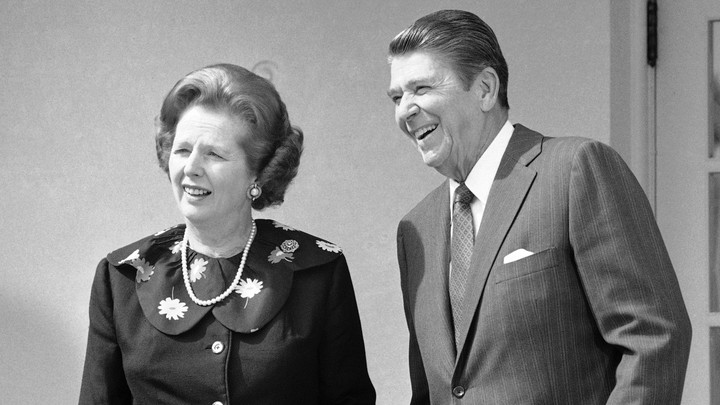
As the Democrat circular firing squad continues as results trickle in from New Hampshire, a lengthy piece in The Atlantic looks at the growing toxicity and ruthless nationalism of the right - all exemplified by the Trump?pence regime - and a virtual war on Enlightenment liberal values. Under this warped nationalism which would alarm Ronald Reagan or Margaret Thatcher, human rights are being diminished and the ability to see others as equally human is under relentless attack. Indeed, democratic principles are being eroded with the right pushing for the supremacy of an oligarchy lead by a near autocrat as demonstrated by what is happening in Hungry where the press is being censored and universities are being taken over by the autocrat supporting central government. One can only imagine how eager Trump is to remake America on this pattern, with Congressional Republicans only too happy to rubber stamp the steady erosion of rights so long as they get to remain in office. Here are article highlights:
In an Italian hotel ballroom of spectacular opulence—on red velvet chairs, beneath glittering crystal chandeliers and a stained-glass ceiling—the conservative movement that once inspired people across Europe, built bridges across the Iron Curtain and helped to win the Cold War came, finally, to an end.The occasion was a conference in Rome last week called “God, Honor, Country: President Ronald Reagan, Pope John Paul II, and the Freedom of Nations.” . . . . . this event was co-organized by Chris DeMuth, a former president of the American Enterprise Institute (in the era when it supported global capitalism and the Iraq War) and John O’Sullivan, a former speechwriter for British Prime Minister Margaret Thatcher. . . . . This was the successor to the National Conservatism Conference held in Washington, D.C., last year.
The purpose, at least at first, seemed a little more mysterious, too. If Reagan and John Paul II were linked by anything, it was a grand, ambitious, and generous idea of Western political civilization, one in which a democratic Europe would be integrated by multiple economic, political, and cultural links, and held together beneath an umbrella of American hegemony. John Paul II wanted Poland to join the European Union . . . . At least when she was still prime minister, Margaret Thatcher was also a proponent of this vision of the West. She was one of the driving forces behind the European single market, the continent-wide free-trade zone that also required a unified regulatory system—the same unified regulatory system that the British have now rejected—and had great faith in the importance of human rights. She said so explicitly: “The state is not, after all, merely a tribe. It is a legal entity,” . . . .
The new national conservatism, at least as articulated in Rome, is very different from Reaganism and Thatcherism. The starting point is that European integration and American hegemony are both evil, and that universal ideals like human rights are a dangerous ideology. These, in fact, are arguments made in Hazony’s book, The Virtue of Nationalism, a work that synthesizes biblical history, the writings of John Locke, and contemporary politics into a caricature of a political philosophy for our times.He also attributes all of the good things about modern civilization to the nation and all of the bad things to what he calls “imperialism.” He puts countries and institutions he likes into the first box, and those he doesn’t like into the second. Thus it emerges that the Nazis, who specifically called themselves nationalists, were not nationalists but imperialists, as is the European Union, an organization created to prevent the resurgence of Nazism. Britain, Spain, and France, despite their long history as empires on land and sea, count as nations.
In this worldview, democracy is of no significance. International treaties and obligations do not matter either, not even if people want them. Although membership in the European Union is voluntary—Brexit has just proved that—and is supported by majorities in most countries, Hazony writes and speaks as if the EU were an occupying power.
Many bad books have had great influence. This one has been very lucky, having appeared just as the word nationalism was adopted by Donald Trump, who finds it a useful way of dressing up a set of foreign and domestic policies that are largely governed by the his whims and dictated by his self-interest. . . . . To put it differently: The arc of history once described by Martin Luther King and Barack Obama is now bending the other way, and a lot of people are leaping aboard.
[O]ther speakers in Rome also reflected an almost paranoid sense of persecution. The idea that “the nation” has been outlawed is clearly something that a certain breed of conservative now genuinely perceives to be true. The American Christian writer Rod Dreher solemnly described a world in which he felt repressed, just as people had been under totalitarian communism. . . . calling on audience members to think of themselves as Christians persecuted for their faith in the past.
What makes this view odder is that it also clashes with political reality. National conservatives cannot simultaneously be helpless victims of a totalitarian culture and also hold enormous political power, which some of them plainly do.
Marion Marechal, the French politician who has dropped the surname Le Pen but still belongs to the family that founded the French party now known as the National Rally, spoke at length.
Marechal, who is sometimes described as a candidate for the French presidency in 2022, made a well-crafted speech that, like Hazony’s, drew a sharp, polarizing contrast between conservatives and enlightenment rational liberals, whom she called “progressives.” The term seemed to include everybody from President Emanuel Macron to French Stalinists. Her words were evocative: “We are trying to connect the past to the future, the nation to the world, the family to the society … We represent realism; they are ideology. We believe in memory; they are amnesia.” But her remarks don’t reflect reality. Macron spoke explicitly and at length about history and memory in Krakow, and has done so on many other occasions too. To Marechal’s fans, that may not matter. Perhaps they feel themselves to be a persecuted minority, and she echoes that view. Perhaps they just prefer to hear about history from someone like her, the spokesman for an ethnic definition of France and Frenchness, instead of Macron.
Some of what Marechal says to the French, and some of what Baudet says to the Dutch, is indisputably true. Economies really have become more global, which makes small communities more vulnerable; older landscapes have been destroyed by modernity; people have drifted away from churches, probably for good; technology is moving very quickly, in ways that frighten people. The argument is over how to address the legitimate fears created by these changes. Among others, the European Union itself has come up with a set of solutions, including the donation of money to culture and architecture and the protection of European agriculture, and thus European landscapes, against competition.
[T]he EU remains the only entity large enough to speak up for Europe on the world stage. The Netherlands alone—even Britain alone—will not be able to do it.
But other possibilities exist too. One can use the electorate’s fears, for example—fan them, exploit them—in order to build a new political movement. And because national conservatism very much wants to be a new political movement, this is a prospect that interests many people.
When the final speaker entered, he won a standing ovation. This was Viktor Orbán, the Hungarian prime minister, the man whose career probably best illustrates the distance that the conservatism of Reagan and Thatcher has traveled since 1989. Orbán, I realized, was the person that many in the room had really come to hear.
Famously, Orbán has gone one step further than many other European conservatives. For one, he has not been shy about using conspiratorial, sometimes hysterical nationalist language, echoing old anti-Semitic tropes, in order to exploit fear of the outside world. “We are fighting an enemy that is different from us,” he said in 2018.
More important, he has surpassed everyone else in Europe in his willingness to destroy the institutions that create the terrain that make democracy possible. Although conference participants in Rome spoke at length about oppressive left-wing ideology at universities, Hungary is the only European country to have shut down an entire university, to have put academic bodies (the Hungarian Academy of Sciences) under direct government control, and to have removed funding from university departments that the ruling party dislikes for political reasons. Although many said they feel repressed by left-wing media, Hungary is also the only European country that has used a combination of political and financial pressure to put most of the private and public media under ruling-party control too.
Orbán’s destruction of independent press and academia and his slow politicization of the Hungarian courts have served a purpose quite different from lofty ideas about national sovereignty or the beauty of landscapes. These machinations have enabled the prime minister’s family and his inner circle to camouflage the myriad ways in which they use state power to get rich. They have also helped him fiddle with electoral rules, gerrymander districts, and adjust the constitution in order to make sure he doesn’t lose.
His country is the best illustration of what happens when you dismiss universal values, repress journalists and academics who produce facts, undermine courts and the rule of law: When you get rid of all of those things, you are just a few short steps away from corruption and tyranny. This is the real face of the new “nationalism,” however carefully it is hidden behind an intellectual facade or dressed up as the successor of Reagan and John Paul II. You can see why it appeals to men like Netanyahu or Trump.
The world inhabited by Reagan and John Paul II is long past, and no one knows how they would react to so-called cancel culture and Twitter mobs, or the backlash against Western culture on American (but not Hungarian) college campuses, or some of the uglier strains of far-left thinking. But somehow I doubt their response would be the creation of a new, kleptocratic authoritarian right that chips away at the institutions preserving democracy. Nor do I believe they would have wanted to destroy the institutions that have long undergirded the West, as so many of these new “nationalists” want to do.
Seemingly, these conservatives learned nothing from the horrors that extreme nationalism and a disregard for human rights wrought on the world in the last century.I don’t see why love of country and love of history would be incompatible with membership in broader Western communities. But in the political world we are now entering, they may soon become so.


