Showing posts with label social media. Show all posts

Thursday, June 04, 2020

The incredible Gullibility of Trump Supporters/the Right

Idaho white vigilantes.
As I have noted many times, I continue to amazed - shocked might be a better term - at the willingness of Trump supporters, evangelical christians (lower case "c"), and the far right in general to believe every Trump lie and far fetched lie put out by extremist groups or just as likely Russian bots. Fact checking is seemingly an unknown concept to many of these people and they share falsehoods on social media and have near apoplexy over "news stories" that are not even true - often not even legitimate.  I truly do not comprehend a mindset so eager to believe the worse about others or believe any and ever inflammatory lie. Are they simply ignorant and too lazy to fact check, bigots or some mix of the two?  This gullibility and mindlessness was recently illustrated by events in a town in Idaho that were based on a social media myth that bore no relation to reality.  A piece in the Washington Post looks at the manner in which armed white vigilantes/residents were played for fools while endangering the rest of the public.  Here are article excerpts:
Protesters had only begun assembling peacefully in Idaho when a Facebook page for retired police officers advised its followers to stay on high alert. “We will protect our neighborhoods,” it vowed.
So when early reports about potential violence surfaced a day later — claiming “ANTIFA agitators” were storming the state this week — scores of residents took to the streets. Armed with military-style assault rifles, they stood guard in places such as Coeur d’Alene, a resort town of 50,000 on a lake in northwest Idaho.
“Enough of us swung into action, and put the word out on social media and elsewhere, that we were able to deploy and meet any violent elements that might come here from out of state,” said Trevor Treller, a sommelier and one of the armed locals. Treller, 48, said he mobilized after hearing from trusted voices that “antifa types” were on the move.It would not prove to be true.
As vigils and protest actions unfolded in Idaho this week, local officials across the state confirmed that not a single participant was known to have defiled a home or storefront in the name of “antifa,” a loose label attributed to far-left activists. Many of the rumors about violent protests originated from dubious Facebook posts, often shared widely and rarely debunked, residents there said.
The raft of myths and misstatements that triggered visceral reactions throughout Idaho illustrates how long-standing grievances have fused with the vast reach of social media during protests that have swept through the country — in big cities and rural towns — after the killing of a black man in the custody of Minneapolis police last week.
As President Trump militarizes the government’s response to the roiling demonstrations, armed civilians across the country are taking matters into their own hands. They have engaged in preemptive acts of escalation, often in response to imaginary threats, raising tensions at demonstrations touched off by the death of 46-year-old George Floyd and intensified by the coronavirus pandemic and the resulting economic collapse, which have disproportionately affected black Americans.
Such actions are particularly visible in Idaho’s Treasure Valley, long a hotbed of the anti-government militia movement and a magnet for disaffected whites fleeing more-diverse and increasingly liberal enclaves, experts said. The mobilization of counterprotesters, these observers said, offers stark evidence that rising calls for racial justice are echoing across the country at the very moment that white resentment is also flaring.
“It’s combustible,” said Todd Shallat, a historian at Boise State University. “The local acts of vigilantism show how a rising population of discontented whites is reacting to the increasingly visible claims of minority groups.”
There’s so much implicit bias about black people’s criminality that some people assume there’s going to be violence or infiltration when we gather,” said Whitney Mestelle, a local activist in Boise who helped organize a peaceful vigil Tuesday. “They may even have good intentions, but it doesn’t make me feel more comfortable to see people open-carry.”
[D]iscussion about antifa has reverberated especially widely across Facebook, including on a page that bills itself as “North Idaho News.” The page acknowledges in fine print that it is “not affiliated with any real news company.” On Monday, though, it claimed to have “credible information that violent rioters, not just peaceful protesters, have plans to come to Coeur d’Alene.” Reached Wednesday via Facebook message, the unidentified operator of North Idaho News declined to comment.
The post quickly gained widespread attention, troubling the likes of Chris Dawson, a retired police officer from Santa Clarita, Calif., and the president of the ex-law-enforcement group on Facebook that put its members on high alert. His Facebook page shared the notice, and Dawson said he had been “given information that antifa would be coming in from Portland or Seattle.” Amplifying their fears was the destruction that marked some demonstrations in neighboring states.
Soon, armed members of local militia groups began patrolling the streets of cities including Coeur d’Alene, said David Hagar, a captain in the city’s police department who described the gatherings as peaceful. Asked whether antifa-affiliated individuals had targeted the city, Hagar said, “Not that we’ve identified.”
“I think a lot of it was fueled by social media,” Hagar said.
Similar rumors gripped Payette County, a rural expanse on Idaho’s western edge. One post shared widely on Facebook said antifa had dispatched a “plane load of people” arriving from Seattle, targeting Idaho’s rural regions. “The sheriff in Payette has already spotted some of them,” the notice continued.
Phone calls soon flooded the sheriff’s office, leaving local law enforcement perplexed.
The false notion continues to have traction with local paramilitary groups, including the far-right Three Percenters, who draw their name from the disputed claim that just 3 percent of American colonists were fighting at any one time during the revolt against the British crown. An Idaho branch said in a Facebook post Sunday that it had “credible intel” about plans for an antifa-induced riot in Boise. No such riot took place.
What is truly frightening is that people this ignorant and bigoted are walking around with military assault style weapons.  They would appear to be a bigger threat to public safety than mythical leftists.


Tuesday, August 06, 2019

White Nationalist Terror - Is the Worst Is Yet to Come?


With messaging coming out of the White House indicating that racism and white nationalism involves "fine people" and social media websites failing to ban racists and misogynistic messaging, it is hard to not believe that things are going to get far worse in America - two countries advised citizens to avoid travel to the USA - before, hopefully, Trump and the GOP lose power and the pendulum will begin to swing back towards normalcy.  A piece at The Atlantic that interviews a former white nationalist adds to concerns that things may well get worse in the near term. That being the case, all that most of us can do is be sure to vote Republicans - especially Trump in 2020 - out of office and demand that social media sites take action to block hate motivated white nationalist propaganda.  Here are highlights from The Atlantic piece: 
It’s going to get worse. That’s the warning of a former violent extremist, Christian Picciolini, who joined a neo-Nazi movement 30 years ago and now tries to get people out of them. White-supremacist terrorists—the ones who have left dozens dead in attacks in Pittsburgh, New Zealand, and El Paso, Texas, in recent months—aren’t just trying to outdo one another, he told us. They’re trying to outdo Timothy McVeigh, the anti-government terrorist who blew up an Oklahoma City federal building and killed more than 100 people in 1995—the worst terrorist attack in the United States before September 11, 2001.
On Saturday morning in El Paso, a gunman shot and killed 22 people, including children, at a Walmart. The store was crowded for back-to-school-shopping season. The victims included a high-school student, an elementary-school teacher, and a couple carrying their infant son, who survived. And the shooter, according to an online manifesto [that quoted Trump] authorities attributed to the suspect, saw himself fighting a “Hispanic invasion” as he gunned them down.
That shooting, along with another one hours later, in which an attacker killed nine people over 30 seconds in Dayton, Ohio, renewed the clamor for gun-control laws that has become a grim ritual after such events. But Picciolini said that even if the U.S. could get a handle on its gun problem, terrorists can always find other ways.
“I have to ask myself, Do we have white-nationalist airline pilots?” Picciolini said. “There have to be. I knew people in powerful positions, in politics, in law enforcement, who were secretly white nationalists. I think we’d be stupid and selfish to think that we don’t have those in the truck-driving industry.” Picciolini . . . . spoke with us yesterday morning about the mainstreaming of white nationalism, what it takes to de-radicalize far-right extremists, and why the problem is metastasizing.   . .  . this whole idea of the “Great Replacement,” of “white genocide,” the belief that immigrants are going to overwhelm the white race. That, frankly, is a crock of shit. But we see things in the news that seem to kind of stand behind these notions—that border facilities are overwhelmed. Even though it’s not really a threat to anyone’s race. Migration has been happening for centuries, and we’re still here. Nations change over centuries, borders have been different. But that’s all the language white supremacists have been using for decades. It’s no longer a lone-wolf-type situation, which is something we were pushing in the ’80s and ’90s. The ideology then was that there were no leaders, there was no centralized movement, individuals were empowered to act on their own. But the internet has really solidified this movement globally through all these forums online; they’re connected in the virtual world in ways that we often can’t be in the real world. I would say that the threat of a transnational, global white-supremacist terrorist movement is spreading.

Tuesday, May 21, 2019

Russia's Ongoing Effort to Sow Racial Discord — and Violence — in the U.S.

If one wonders where Donald Trump and many on the far right - e.g., those who sabotaged Virginia Democrats in early February using race - who are fanning racial division in America got their agenda from, look no farther than Vladimir Putin's Russia. NBC News reports on newly reviewed documents connected to some of the Russian operatives indicted by Robert Mueller that indicate fanning racial discord - and even violence - was part of the 2016 Russian game plan to elect Trump and that the agenda , in fact continues and could be a problem in 2020.  In addition to causing division and racial hatred, a goal is to suppress the black vote and thereby help Republicans, namely Trump.  It's something blacks mentioned in a prior post ought to be conscious of as they wring their hands over Pete Buttigieg's "whiteness" (his gayness will likely also be targeted by the ever conniving Russian operatives who likely recognize the ease with which black pastors can be played).  Here are article highlights that ought to make thinking individuals of all races think twice before falling for Russia originated efforts at division and discord:

LONDON — Russians who were linked to interference in the 2016 U.S. election discussed ambitious plans to stoke unrest and even violence inside the U.S. as recently as 2018, according to documents reviewed by NBC News.
The documents — communications between associates of Yevgeny Prigozhin, a Kremlin-linked oligarch indicted by special counsel Robert Mueller for previous influence operations against the U.S. — laid out a new plot to manipulate and radicalize African-Americans. The plans show that Prigozhin’s circle has sought to exploit racial tensions well beyond Russia’s social media and misinformation efforts tied to the 2016 election.
The documents were obtained through the Dossier Center, a London-based investigative project funded by Russian opposition figure Mikhail Khodorkovsky. NBC News has not independently verified the materials, but forensic analysis by the Dossier Center appeared to substantiate the communications.
One document said that President Donald Trump’s election had “deepened conflicts in American society” and suggested that, if successful, the influence project would “undermine the country’s territorial integrity and military and economic potential.”
The revelations come as U.S. intelligence agencies have warned of probable Russian meddling in the 2020 election.
The documents contained proposals for several ways to further exacerbate racial discord in the future, including a suggestion to recruit African-Americans and transport them to camps in Africa “for combat prep and training in sabotage.” Those recruits would then be sent back to America to foment violence . . . There is no indication that the plan — which is light on details — was ever put into action, but it offers a fresh example of the mindset around Russian efforts to sow discord in the U.S.
The blueprint, entitled “Development Strategy of a Pan-African State on U.S. Territory,” floated the idea of enlisting poor, formerly incarcerated African-Americans “who have experience in organized crime groups” as well as members of “radical black movements for participation in civil disobedience actions.”
The goal was to “destabilize the internal situation in the U.S.”
Frank Figliuzzi, a former assistant director of counterintelligence at the FBI and an NBC News contributor, who reviewed the documents, said that they offer a warning to the U.S. . . . “The unfortunate reality is that we’re seeing an adversary that will consider virtually anything to get what it wants, and if it means violence or splitting America along racial lines or eroding our trust in institutions, they’ll do it.”
Some of the documents appear to have been sent by Dzheykhun “Jay” Aslanov, an employee of the Internet Research Agency, the St. Petersburg-based troll farm that played a key role in the 2016 Russian meddling campaign. Aslanov was one of 13 Russians indicted by Mueller in February 2018 for his role with the IRA.
The plan was shared with Mikhail Potepkin, a Russian businessman, who then circulated it more widely, according to communications reviewed by NBC News.
Both Aslanov and Potepkin have been linked to Prigozhin, a Russian catering magnate often described as “Putin’s chef.” Prigozhin was also indicted by Mueller for funding the IRA. Widely perceived as a Kremlin operative, he has been connected to a shadowy mercenary outfit known as the Wagner Group, whose guns-for-hire are reported to have been involved in Russian military operations in Syria and Eastern Ukraine, according to U.S. military officials.
The Mueller report exposed how Russian trolls, employed by associates of Prigozhin, deliberately inflamed racial tensions by spreading false and incendiary stories to African-Americans via social media. Among the objectives was to suppress black turnout in the 2016 U.S. election.
“Russia understands how critical the African American vote is to determining the outcome of elections,” said Demings, who sits on the House Intelligence Committee. “And because we have not effectively dealt with racism as a country ourselves, I believe we've made ourselves vulnerable to foreign powers like Russia to continue to try to undermine.”
The documents also discuss how to expand Russia’s clout on the African continent and win business there, from arms sales to mining contracts. They outline propaganda efforts to target Africans and stir up negative opinions about Europe and the U.S.
“Even though these kinds of initiatives from the Russians aren’t new to us, what is new is the rapidity with which they can get this message out on social media and saturate the American consumer with these kinds of thoughts,” said Figliuzzi, the former FBI official. “That puts the Russian initiative on steroids and should scare all of us.”


Sadly

Thursday, March 28, 2019

US Government: Gay App Grindr is a National Security Risk

The intrusiveness of social media platforms allowed Russia to influence the 2016 presidential election and in the process mined all kinds of personal information about unwitting Americans.  Now, the gay chat/dating app Grindr is in the spotlight as concerns grow over the purchase of the app by a Chinese company and possible access to account holder information by the Chinese government.  A piece in Metro Weekly picks up on a story in Reuters that indicates the US government views the gay chat/dating app Grindr as a national security risk seemingly because of its use by so many members of the U.S. military and intelligence personnel.  Yes, here in Hampton Roads, there are LOTS of service members on Grindr.  Apparently the same holds true for intelligence personnel, all of whom can be geographically located with precision via Grindr.  Similarly, all of the personal information can be accessed.  Here are article highlights:
Gay dating app Grindr is to be sold by its Chinese owners because of a potential threat to national security.
That’s the news from Reuters, which reports that the Committee on Foreign Investment in the United States (CFIUS) has told Beijing Kunlun Tech Co Ltd that its ownership of the app is a national security risk.
[S]peculation is rife about why Grindr is considered a security risk, though both Reuters and Engadget have speculated that the presence of U.S. military and intelligence personnel on the app could be to blame.That’s in part because the U.S. government is becoming increasingly interested in how app developers handle their users’ personal information, particularly private or sensitive data — such as the location of U.S. troops or an intelligence official using the app.
Misuse of data is a particularly sore spot for Grindr, which has been hit with a number of unflattering headlines over the past year, including the revelation that the app was sharing users’ HIV status with other companies.
Grindr, which is currently celebrating its tenth anniversary, admitted to sharing users’ HIV status with two outside companies for testing purposes, as well as the “last tested date” for those who are HIV-negative or on pre-exposure prophylaxis (PrEP).
[T]he data being shared was so detailed — including users’ GPS data, phone ID, and email — that it could be used to identify specific users and their HIV status.
Another insight into Grindr’s data security policies came early last year when a D.C.-based developer created a website that allowed users to see who had previously blocked them on the app — information that is normally inaccessible.
The website, C*ckBlocked, tapped into Grindr’s own APIs to display the data after developer Trever Faden discovered that Grindr stored the list of who a user had both blocked and been blocked by in the app’s code.
Faden also revealed that he could use Grindr’s data to generate a map showing the breakdown of individual profiles by neighborhood, including information such as age, sexual position preference, and general location of users in that area.
With regards Grindr’s sale, Reuters reports that the app will be put up for auction, after Kunlun’s original plans to float Grindr for an initial public offering (IPO) were abandoned. Kunlun assumed control of Grindr in 2016, buying total control of the app in 2018.

Be it Facebook, Twitter, or now Grindr, apparently we have no secrets from those who want to spy on us.

Tuesday, December 18, 2018

Russian Intelligence Teams Are Targeting Robert S. Mueller


In the wake of a Senate report yesterday that looked at the pervasive and broad scale efforts of Russia to influence the 2016 presidential election, yet another Senate report reveals similar efforts by Russian agents to attack and discredit  Robert Mueller and the Russiagate investigation. Further, as in the presidential contest, numerous Americans all too willing to support Trump because he (and the Russians) have played to their prejudices have re-posted and bought into lies that track directly to enemies of the United States. The other disturbing aspect of the report is how the various social media platforms did far too little, too late to stop Russian efforts.  Seemingly, money and outwardly expanding usage of their platforms was far more important than protecting users from manipulation and stopping subversion of the nation's election system. A long piece in the Washington Post looks at how Mueller was targeted to the delight of the Fox News viewing segment of the public.  The unanswered question is one of how much the Trump/Pence regime has coordinated with the Russian effort.  Here are highlights:
Months after President Trump took office, Russia’s disinformation teams trained their sights on a new target: special counsel Robert S. Mueller III. Having worked to help get Trump into the White House, they now worked to neutralize the biggest threat to his staying there.
The Russian operatives unloaded on Mueller through fake accounts on Facebook, Twitter and beyond, falsely claiming that the former FBI director was corrupt and that the allegations of Russian interference in the 2016 election were crackpot conspiracies. One post on Instagram — which emerged as an especially potent weapon in the Russian social media arsenal — claimed that Mueller had worked in the past with “radical Islamic groups.”
Such tactics exemplified how Russian teams ranged nimbly across social media platforms in a shrewd online influence operation aimed squarely at American voters.
One of the reports, written by Oxford University’s Computational Propaganda Project and network analysis firm Graphika, became public when The Washington Post obtained it and published its highlights Sunday. The other report was by social media research firm New Knowledge, Columbia University and Canfield Research.
Together the reports describe the Russian campaign with sweep and detail not before available. The researchers analyzed more than 10 million posts and messages on every major social media platform to understand how the Russians used American technology to build a sprawling online disinformation machine, with each piece playing a designated role while supporting the others with links and other connections.
Twitter hit political and journalistic elites. Facebook and its advertising targeting tools divided the electorate into demographic and ideological segments ripe for manipulation, with particular focus on energizing conservatives and suppressing African Americans, who traditionally are more likely to vote for Democrats.
YouTube provided a free online library of more than 1,100 disinformation videos. PayPal helped raise money and move politically themed merchandise designed by the Russian teams, such as “I SUPPORT AMERICAN LAW ENFORCEMENT” T-shirts. Tumblr, Medium, Vine, Reddit and various other websites also played roles.
One unexpected star of the new reports Monday was Facebook’s photo-sharing subsidiary Instagram. Over the years of the disinformation campaign, Instagram generated responses on a scale beyond any of the others — with 187 million comments, likes and other user reactions, more than Twitter and Facebook combined. . . . . Instagram’s use by the Russian teams more than doubled in the first six months after Trump’s election, the researchers found. It also offered access to a younger demographic and provided easy likes in a simple, engaging format.
On Monday, the NAACP called for a week-long boycott of Facebook starting Tuesday, saying the company’s business practices — and the spread of “disingenuous portrayals of the African American community” on its site — should prompt further congressional investigation. 
The emergence of Mueller as a significant target also highlights the adaptability of the Russian campaign. He was appointed in May 2017 as special counsel to investigate allegations of Russian influence on the Trump campaign. In that role, he has indicted on criminal charges a Kremlin-linked troll farm called the Internet Research Agency and others affiliated with the disinformation campaign.
A Clemson University research team, not affiliated with either of the reports released Monday, found that the Russians tweeted about Mueller more than 5,000 times, including retweets first posted by others. Some called for his firing, while others mocked him as incompetent and still others campaigned for the end of his “entire fake investigation.”
The report by New Knowledge highlighted the focus on Mueller and fired FBI director James B. Comey, who was falsely portrayed as “a dirty cop.”
On Capitol Hill, top Democrats said Monday that the revelations in the pair of Senate reports underscored the need to study social media and consider fresh regulation in order to stop Russia and other foreign actors from manipulating American democracy in future elections.
In particular, Schiff described the Instagram revelations as “surprising,” contradicting the data and testimony Facebook previously provided to the committee. “If Facebook was unaware of it, it’s one problem,” he said. “If they were aware of it and didn’t share that information, that’s a completely different problem.”
Sen. Richard Burr (R-N.C.), the chairman of the committee that asked the researchers to analyze the tech companies’ data, said the findings show “how aggressively Russia sought to divide Americans by race, religion and ideology.”
Sadly, far too many of my Republican "friends" took the Russian bait hook, line and sinker as they retweeted and re-posted Russian derived lies, never bother to check out the truth of the wild claims. 

Saturday, February 17, 2018

Bombshell Russia Indictments - Russian Interference Was Real


Donald Trump - one of the biggest liars in Washington, D.C., if not the world - continues to argue that claims that Russia sought to interfere in the 2016 presidential election are all a "hoax."  The indictments handed down today against thirteen Russian defendants ans organizations pretty much blow Trump's lies to hell. Indeed, it is clear that Russian interference was very real and overall sought to throw the election to Trump.  Along the way, the Russian efforts also sought to increase Bernie Sanders' chances against Hillary Clinton and also sought to boost Jill Stein - the same individual who had dined with Putin in Moscow along with Mike Flynn who has struck a guilty plea with special counsel Robert Mueller.  Not surprisingly, Fox News is hyping the indictments as Russian efforts to undermine American democracy but there is nary a mention of Russia's efforts to throw the election to Trump.  Conservative columnist and former Republican Jennifer Rubin has a column in the Washington Post that looks at some of the bombshells disclosed by the indictments which also suggests that their are as yet unindicted co-conspirators.  Here are excerpts:
Making the first documented case of a complex plot by Russians to influence our elections and specifically to bolster President Trump, special prosecutor Robert S. Mueller III has indicted 13 Russians and obtained a plea bargain from a cooperating U.S. witness accused of identity theft. The special counsel’s actions raise a host of questions, but here is what we can say with confidence:
  • There is no “hoax,” and Trump’s insistence that the Russia investigation is about nothing only reinforces the perception that his ego won’t allow him to concede that he received Russian help and/or that he’s been trying to disable the Russia investigation, precisely because he did not want this plot of interference to come out.
  • It will be exceptionally hard, if not impossible, for Trump now to fire Rosenstein or Mueller.
  • Mueller and his team are moving with remarkable speed, wrapping up witnesses and substantiating a conspiracy to influence the election. There is much more to this than “just” evidence of obstruction. There is an embarrassing scheme to fix our election by a hostile foreign power that certainly could have been the motive for Trump’s effort to thwart the Russia investigation. Mueller has multiple cooperating witnesses: Michael Flynn, Richard Pinedo(the indicted American), George Papadopoulos and soon, we are told, Rick Gates). Trump and his legal team should be exceptionally worried about what else Mueller has.
  • The president’s failure to take action to protect the U.S. election system and prevent another assault on our democracy — a real and ongoing concern voiced by the unanimous testimony of his top intelligence officials — appears to be a gross dereliction of Trump’s duties and an abrogation of his oath.
  • The Russian plan was specifically aimed at helping Trump.
  • While Rosenstein said there was no evidence that the actions in the indictment affected the election outcome, such an assertion, he surely must know, is not a provable fact and is legally immaterial. No one can prove how many people were affected by what the Russians put out.
  • A plan of this magnitude involving so many people and so much money could not have feasibly been conducted without the knowledge or assistance of the Kremlin.
  • Carter Page is largely irrelevant to the larger plot to undermine the U.S. election system.
Republicans’ efforts, led by the clownish Rep. Devin Nunes (R-Calif.), to assist and enable Trump now look foolish or worse. What has been implicit is now explicit: They are doing the Russians’ work for them. “We are hopeful that these new facts will finally drive the White House and Republicans in Congress who have worked to hamper the investigation to admit the reality and the scope of the attack and the threat from Russia which is ongoing today as we approach our next election. It is time for Congress and the White House to put their country before their party. The attacks on Special Counsel Robert Mueller and his investigators are disgraceful and must cease.” Rosenstein described help afforded to the Russians by “unwitting” figures linked to the Trump campaign. However, as one Russia guru points out to me, “on the ‘unwitting’ Trump campaign officials, we know there was a hell of a lot of ‘witting.’ That is effectively what the June 9 meeting [at Trump Tower] and [outreach to Russians from] Papadopoulos show.” Once more, we are reminded how little we know about what Mueller has already found. If he has this much evidence just on the quadrant of a Russian troll farm, what else is out there? Stay tuned. We are nowhere near the end of this investigation.


Sunday, February 11, 2018

Trump Supporters Biggest Purveyors of "Fake News"


We hear Der Trumpenführer and his supporters constantly labeling inconvenient facts and news reports as "fake news" whenever they do not support Trumps daily lies or his supporters prejudices and effort to deny objective reality.  Yet a new study has found that those who circulate false information - fake news, if you will - are Trump's supporters. The level of dishonesty among Trump supporters should perhaps come as little surprise since some 81 percent of evangelical Christians - the most dishonest element in American society in my experience - remain strong Trump supporters.  A piece in Alternet looks at the study findings.  Here are some highlights:

[N]o candidate in modern American history has benefitted more from the proliferation of "fake news" on social media than the former host of "The Apprentice." For evidence, one need look no further than the latest findings of Oxford University's Computational Propaganda Research Project.
After studying the Twitter feeds of 13,000 users across the political spectrum, the Project determined that Trump supporters are among the most prolific purveyors of "misleading, deceptive or incorrect information purporting to be real news about politics, economics or culture.” (For the purposes of its research, the Oxford team compiled a "watch list" of approximately 100 websites with a history of publishing conspiracy theories or overt propaganda.)
The numbers are striking. Less than 16 percent of the sample group—2,000 accounts who have either shared explicitly pro-Trump links or contain the hashtag #MAGA in their bios—were responsible for 55 percent of the "junk news" tweeted out. Of the 47,000 Facebook accounts the Project examined, Trump supporters posted 60 percent of the content deemed spurious or inaccurate.
"The social networks mapped from public Twitter and Facebook data show that the junk political news and information was concentrated among Trump’s supporters," the report concludes.
Lisa-Maria Neudert, one of the study's lead researchers, believes these findings may contain a "silver lining." As she tells Denise Clifton of Mother Jones, the fact that Trump dead-enders have distributed a disproportionate amount of this dreck "could suggest that most other groups are less susceptible to extremist or conspiratorial content." 
One thing is certain: When it comes to promulgating misinformation and outright lies, the president couldn't ask for a more pliant base. 

Tuesday, December 26, 2017

Russian Cyber Attacks on America Continue


America may find itself in the midst of the Christmas/New Year's holiday season, but that doesn't mean that America's foes, especially Vladimir Putin's Russia, takes a  holiday from efforts to undermine American democracy or power across the globe.  A disturbing piece in the Washington Post authored by Michael Morell, a former deputy director and twice acting director of the Central Intelligence Agency, and Michigan Republican Mike Rogers, who served in the House from 2001 to 2015 and was chairman of the Intelligence Committee, ought to make Americans wonder why so little is being done to combat cyber attacks on America, especially through Russian propaganda being disseminated via social media.   These attacks are being used to subvert American institutions and whip up a frenzy among the Fox News viewing Trump base, a group only too happy to believe fake news that plays to the prejudices.  Are American efforts to deter such attacks being undermined by an occupant of the White House who refuses to admit Russian interference in the first place and/or who is a Russian intelligence asset himself?  I will let readers ponder the question.  Here are article excerpts:
Every first-year international-relations student learns about the importance of deterrence: It prevented a Soviet invasion of Western Europe during the height of the Cold War. It prevented North Korea from invading South Korea in the same time frame. Today, it keeps Iran from starting a hot war in the Middle East or other nations from initiating cyberattacks against our infrastructure.
And yet, the United States has failed to establish deterrence in the aftermath of Russia’s interference in the 2016 election. We know we failed because Russia continues to aggressively employ the most significant aspect of its 2016 tool kit: the use of social media as a platform to disseminate propaganda designed to weaken our nation.
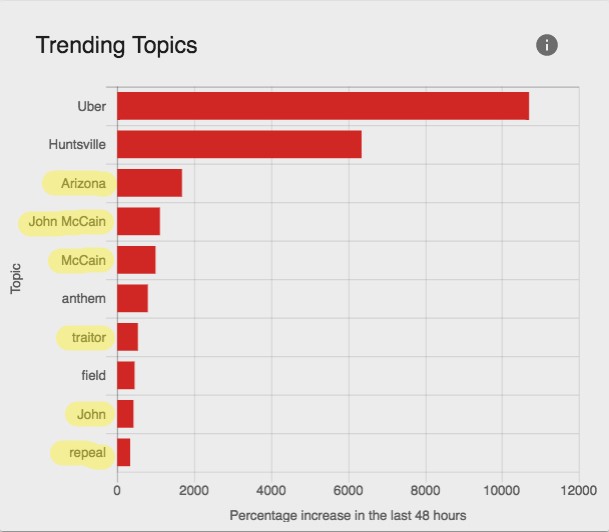
There is a perception among the media and general public that Russia ended its social-media operations following last year’s election and that we need worry only about future elections. But that perception is wrong. Russia’s information operations in the United States continued after the election and they continue to this day. This should alarm everyone — Republicans, Democrats and independents alike. Foreign governments, overtly or covertly, should not be allowed to play with our democracy. In a single week this month, Moscow used these accounts to discredit the FBI after it was revealed that an agent had been demoted for sending anti-Donald Trump texts; to attack ABC News for an erroneous report involving President Trump and Michael Flynn, the former national security adviser; to critique the Obama administration for allegedly “green lighting” the communication between Flynn and then-Russian Ambassador Sergey Kislyak; and to warn about violence by immigrants after a jury acquitted an undocumented Mexican accused of murdering a San Francisco woman. This continues a pattern of similar activity over the past year. Russian operatives have frequently targeted Republican politicians who have been critical of Trump, including Sen. Jeff Flake (Ariz.), Sen. Lindsey O. Graham (S.C.) and Sen. Bob Corker (Tenn.). In September, they also attacked Sen. John McCain (Ariz.) after his decisive “no” vote against the Republican health-care bill.
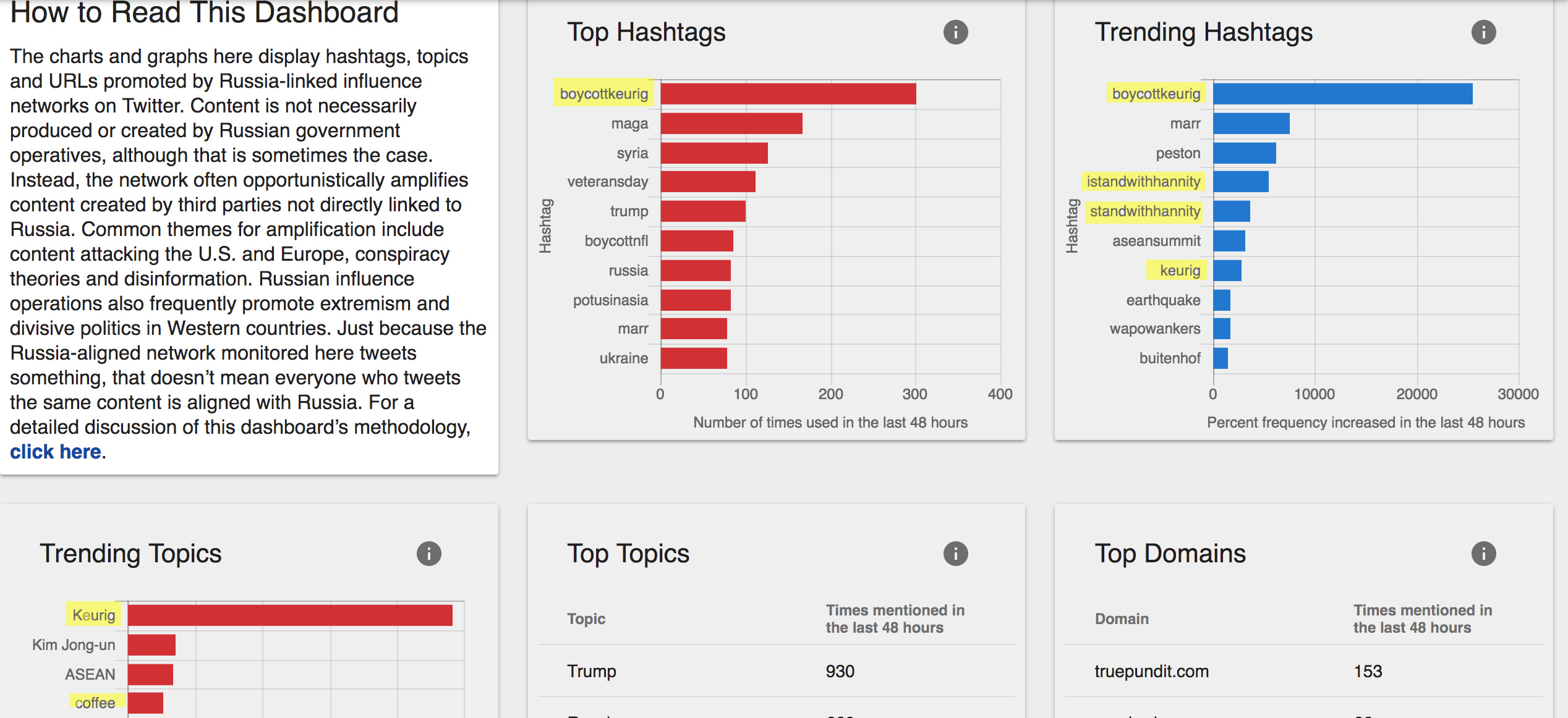
And in mid-November, after Keurig pulled its advertising from Sean Hannity’s Fox News show for comments the host made defending Alabama Senate candidate Roy Moore, the Russians used their social media accounts to urge a boycott of the company. For two days, #boycottkeurig was the most used hashtag among Kremlin-influenced Twitter accounts. 
 More troublingly, other countries are beginning to follow Russia’s lead on social media, according to research provided by the Alliance for Securing Democracy. The Chinese are doing so in Taiwan, . . . While those information operations have not yet reached the United States, they most certainly will. Russia’s use of social media as a political weapon will continue, and more countries will follow suit — until deterrence is established.
 The sanctions that the Obama administration and Congress put in place in the aftermath of the 2016 election are steps in the right direction, but they were not significant enough to check Russian President Vladimir Putin. True deterrence requires policies that prevent adversaries from achieving their objectives while imposing significant costs on their regimes. So far, we have done neither.

Tuesday, October 10, 2017

Moscow Used Fake You-tubers and Google Ads to Bash Hillary Clinton


The extent and sophistication of Russian operatives using social media to sabotage the 2016 presidential elections continues to grow.   Most of the exposes have been ferreted out by American media outlets - excluding Fox News and Breitbart, of course - and at this point in time it appears that American social user users seem to have viewed Russian authored fake news and fake social media shares up to 340 million times.  That's right, that equates to almost one viewing for every living American.  Why Facebook, Twitter, Google and other massive corporations sat on this information so long (and allowed it to happen in the first place) and have been less than forthcoming are questions that to be answered. It seems inconceivable that no one at any of these massive tech companies detected the scope of the Russian efforts.  Were they lazy, incompetent, or simply focused on raking in money without any regard to the cyber attack being conducted against American's democracy.  Two pieces look at the situation, one in The Daily Beast and the other in the Washington Post.  First highlights from The Daily Beast:
 ccording to the YouTube page for “Williams and Kalvin,” the Clintons are “serial killers who are going to rape the whole nation.” Donald Trump can’t be racist because he’s a “businessman.” Hillary Clinton’s campaign was “fund[ed] by the Muslim.”
These are a sample of the videos put together by two black video bloggers calling themselves Williams and Kalvin Johnson, whose social media pages investigators say are part of the broad Russian campaign to influence American politics. Across Facebook, Twitter, Instagram, and YouTube, they purported to offer “a word of truth” to African-American audiences.
“We, the black people, we stand in one unity. We stand in one to say that Hillary Clinton is not our candidate,” one of the men says in a November video that warned Clinton “is going to stand for the Muslim. We don’t stand for her.”
Williams and Kalvin’s content was pulled from Facebook in August after it was identified as a Russian government-backed propaganda account, The Daily Beast has confirmed with multiple sources familiar with the account and the reasons for its removal. Williams and Kalvin’s account was also suspended from Twitter in August. But the YouTube page for Williams and Kalvin remains live at press time.
It’s reminiscent of the Russian attempts to impersonate a California-based Muslim group and piggyback off of the Black Lives Matter protests to spread the Kremlin’s message. But this time, the Kremlin operation used real people, not just memes and hijacked hashtags.

The discovery of living, breathing, real-life avatars for Kremlin talking points deepens and complicates the emerging picture of how Russian propaganda reached what Facebook alone estimated last week were 10 million users in the United States—a number considered by many outside experts to be a lowball estimate.
According to Clint Watts, a former FBI counter terrorism agent who testified to the Senate Intelligence Committee on Russian cyber-attacks, using third party contractors from both inside Russia and countries with cheap labor is a method used by the Kremlin to “muddy the waters on attribution” of propaganda.
“Often, (the Kremlin) will contract out entities to do this so they can say, ‘You can’t prove that it’s us,’” Watts told The Daily Beast. “It’s pretty routine for them to try to gain resources through third parties and contract cutouts.”
Williams and Kalvin were hardly the only fronts used in the Russian campaign effort to throw the 2016 election to Donald Trump.  Bogus LGBT personas and bogus black activist personas were created, as were bogus "American patriot" personas,  all of which pumped out false propaganda pieces that were picked up by the gullible on the right - I have one "friend" who continues to fall for these types of fake news efforts - as well as hard core bigots.  As the Washington Post reports even Google's gamil seems to have been co-opted by Russian only to eager to destabilize America by placing an unfit lunatic in the White House.  Here are highlights from the Times piece:  
Russian operatives bought ads across several of Google’s services without the company’s knowledge, the latest evidence that their campaign to influence U.S. voters was as sprawling as it was sophisticated in deploying the technology industry’s most powerful tools.
The revelation about Google, made by people familiar with an internal company investigation, adds it to a growing list of iconic tech companies used by a dis­information operation that U.S. intelligences services have said was approved by the Kremlin. Twitter and Facebook already had disclosed some Russian accounts, and U.S. investigators say other companies likely were exploited as well.
Google found that tens of thousands of dollars were spent on ads by Russian agents whose targets included Google’s YouTube and gmail services, along with the company’s signature search engine and its DoubleClick ad network, said the people familiar with the internal investigation, who spoke on the condition of anonymity to discuss matters that had not been made public.
Adding to the significance of the discovery, the Russian ads bought on Google do not appear to be the work of the Internet Research Agency, the shadowy Russian troll farm linked to previous disclosures by companies. Facebook has said that it, too, has been studying thousands of ads that may have been bought by operatives working somewhere other than the Internet Research Agency.
The revelations add to the ­evidence that the Russian dis­information campaign had not only multiple targets among U.S. technology companies but also multiple centers of operations.
“We see the Russia presence on social media metastasizing,” said Rep. Adam B. Schiff of California, the ranking Democrat on the House Intelligence Committee. “The extent of the Russian presence just continues to grow and grow, and I don’t think we yet have any kind of full understanding of just how expansive this presence may have been.”
Schiff said congressional investigators will ask the companies “why it has taken them so long to discover the Russian use of their technology and how thorough their forensic effort has been, what the impediments are, and how much work remains to be done, and, of course, most importantly, how are they going to ferret this out in the future.”
Several independent researchers also have found that the Russian disinformation flowed across platforms and onto the wider Web, taking advantage of technology that allows advertisers to identify potential voters and follow and re-target ads to them based on their political inclinations. The goal was to influence voting behavior, in some cases by suppressing turnout. Albright also has found links to Russian disinformation on Pinterest, YouTube and Instagram, as well as Twitter, Facebook and Google. Clicking on links on any of these sites allowed Russian operatives to identify and track Web users ­wherever they went on the Internet.


Sunday, September 17, 2017

Will Zuckerberg, Facebook, Twitter and Others Face Robert Mueller’s Wrath?


A thought provoking piece at Vanity Fair looks at the role that Facebook, Twitter and social media more generally played in Russian interference with the 2016 presidential election. Among other things, it raises the question of why no one at these companies noticed the suspicious activities of foreign agents. Facebook can follow my shopping habits, but it did notice the buying activities of agents working in Moscow?  With Robert Mueller now having secured search warrants of some of the suspicious foreign accounts, one cannot help but hope that changes will be made to stop anything like this from happening again in the future.  Ditto for hate groups using the platforms to spread hate, bigotry and intolerance. Here are highlights from the piece:
Twenty thousand six hundred and fifty-eight. That’s a pretty big number, especially when you consider that it’s the number of people who are currently employed by Facebook. Those 20,000 employees include insanely smart people with degrees from Stanford, Harvard, and M.I.T., many of whom spend their days toiling away on various revenue products, particularly in advertising-technology features—or ad tech, as it’s known in the industry—that helped the company generate some $27.6 billion in total revenue last year.
So why is it that none of those employees noticed that Russian operatives were using Facebook to manipulate the U.S. electoral process? And why is it—months after Donald Trump was sworn in as president, and after deadly protests in Charlottesville—that those workers allowed organizations to buy ads on the platform targeting people who searched for phrases such as “Jew haters”?
This ad-targeting mess has quickly become the Exxon Valdez of the Internet. Google, for its part, has 72,053 employees, many of whom are also working on smart algorithms to improve the company’s ad revenue, which accounts for 88 percent of its income. And yet, on Friday, BuzzFeed reported that Google allows groups to target ads toward people searching for racist phrases. So when people type in search queries like “Jewish parasite,” “black people ruin everything,” or “the evil Jew,” ads can potentially be served next to those keywords, and Google makes money off the transaction. The Daily Beast, meanwhile, also reported that Twitter allows people to target users on the platform who use the n-word and other putrid, disgusting, racist terms.
Since the election (and even leading up to it), it’s become abundantly clear that social media presented itself as a profoundly useful tool for the Russians, extremists, and possibly even people within the Trump campaign, to potentially disfigure our electoral process. Before Trump co-opted the term “fake news” to describe entirely accurate, if unfavorable, stories about him, real fake news was being created and proliferated at scale. Algorithms on Facebook didn’t work to try to stop this from happening, but rather to ensure that these fake stories landed right on the digital doorsteps of the people who might find them most interesting, and who might change their votes as a result of that content. Twitter’s problem with political bots has existed for as long as I can remember.
This might seem harmless on some level, but these accounts had been disseminating incredibly divisive (and oftentimes fake) stories about Brexit, Ukraine, and Syria, plus anti-immigration articles from outlets like Breitbart and excessively schismatic articles from the Daily Mail. The researcher also found that these accounts only tweeted between 8 a.m. and 8 p.m. Moscow time, and only during the week—almost as if it were someone’s job in Russia to do so. The accounts have tens of thousands of followers, and the suspected propagandists behind them stoked the flames of dissent by creating far-left bots which would go after Trump and his supporters.
Of course people are going to try to manipulate these technologies. The larger issue, however, is that these enormous, profoundly wealthy companies aren’t doing enough to stop them, and are not being held accountable. (Twitter and Facebook have attempted to crackdown on trolls in some ways since the election.) Curiously, Wall Street, which still remains oddly buoyant in the Trump era (it’s amazing what the rich will sacrifice for tax reform) is not chastising Silicon Valley for the extensive role it played in the mess we find ourselves in today. Facebook is worth $491 billion, despite months’ worth of news stories indicating it allowed Russian accounts to buy and target pages and ads on its network during the election, which estimates say could have reached 70 million Americans. Twitter’s stock, while bumpy, has barely moved since news definitively broke about all of the “fake Americans” that Russia created and operated on the social network during the election.
There are also reports that there is now a “red-hot” focus on social media by special counsel Robert Mueller’s investigation into the 2016 election. But in both of these instances, there needs to be real consequences. It doesn’t take 20,000 employees to see the apathy and neglect these platforms have played, and continue to play, in the attacks against democracy by the people who want to see it fall.

Thursday, April 20, 2017

Putin-Linked Think Tank Drew up Plan to Sway U.S. 2016 Election


The pathological liar that currently occupies the White House continues to deny that Russian efforts sought to throw the 2026 presidential election in his favor.  Likewise, he denies that he and his henchmen colluded in the Russian efforts.  Further, Vladimir Putin denies that Russia engaged in any such efforts.  Based on reports from Reuters, both Trump and Putin are lying. Documents obtained by American intelligence agencies reveal that a Putin directed Russian think tank drew up a detailed plan of actions to be used to sway the election and undermine American democracy in general.  The irony is that many far right American outlets that claim to be ultra-patriots in fact ran with the concocted lies that derived from Russian efforts.  Here are excerpts from Reuters:
A Russian government think tank controlled by Vladimir Putin developed a plan to swing the 2016 U.S. presidential election to Donald Trump and undermine voters’ faith in the American electoral system, three current and four former U.S. officials told Reuters.
They described two confidential documents from the think tank as providing the framework and rationale for what U.S. intelligence agencies have concluded was an intensive effort by Russia to interfere with the Nov. 8 election. U.S. intelligence officials acquired the documents, which were prepared by the Moscow-based Russian Institute for Strategic Studies [en.riss.ru/], after the election.
The first Russian institute document was a strategy paper written last June that circulated at the highest levels of the Russian government but was not addressed to any specific individuals.
It recommended the Kremlin launch a propaganda campaign on social media and Russian state-backed global news outlets to encourage U.S. voters to elect a president who would take a softer line toward Russia than the administration of then-President Barack Obama, the seven officials said.
A second institute document, drafted in October and distributed in the same way, warned that Democratic presidential candidate Hillary Clinton was likely to win the election. For that reason, it argued, it was better for Russia to end its pro-Trump propaganda and instead intensify its messaging about voter fraud to undermine the U.S. electoral system’s legitimacy and damage Clinton’s reputation in an effort to undermine her presidency, the seven officials said.
The current and former U.S. officials spoke on the condition of anonymity due to the Russian documents’ classified status. They declined to discuss how the United States obtained them. U.S. intelligence agencies also declined to comment on them.
Four of the officials said the approach outlined in the June strategy paper was a broadening of an effort the Putin administration launched in March 2016. That month the Kremlin instructed state-backed media outlets, including international platforms Russia Today and Sputnik news agency, to start producing positive reports on Trump’s quest for the U.S. presidency, the officials said.
Russia Today and Sputnik published anti-Clinton stories while pro-Kremlin bloggers prepared a Twitter campaign calling into question the fairness of an anticipated Clinton victory, according to a report by U.S. intelligence agencies on Russian interference in the election made public in January. [bit.ly/2kMiKSA]
Russia Today’s most popular Clinton video - “How 100% of the 2015 Clintons’ ‘charity’ went to ... themselves” - accumulated 9 millions views on social media, according to the January report. [bit.ly/2os8wIt]
The report said Russia Today and Sputnik “consistently cast president elect-Trump as the target of unfair coverage from traditional media outlets."
Neither of the Russian institute documents mentioned the release of hacked Democratic Party emails to interfere with the U.S. election, according to four of the officials. The officials said the hacking was a covert intelligence operation run separately out of the Kremlin.
The overt propaganda and covert hacking efforts reinforced each other, according to the officials. Both Russia Today and Sputnik heavily promoted the release of the hacked Democratic Party emails, which often contained embarrassing details.
Five of the U.S. officials described the institute as the Kremlin’s in-house foreign policy think tank. 
How much more will it take before my Republican "friends" who voted for Trump admit that they were played for fools?  Or were Trump's calls to racism and white supremacy all they really cared about?