Monday, May 04, 2020

Models Shift to Predict Dramatically More U.S. Covid-19 Deaths

Virginia's governor Ralph Northam - the only US governor who is a physician - just extended Virginia's business shutdown for another week as reported by the Virginian Pilot. Whether the May 15, 2020, opening date gets further delayed will depend on whether Virginia sees 14 days of improvement.  Meanwhile, a number of GOP lead states are opening up businesses and playing a game of Russian roulette with their citizens' lives.  New reports on models predicting the Covid- 19 death rate suggest that  Northam may be taking the wiser choice given the new predictions that 134,000 Americans will die of Covid-19 between now and August (243,000 if one includes the upper end of the margin of error).  A Johns Hpkins report predicted 3,000 deaths per day by June (that would be a daily death rate not too much less than the 9-11 fatality number).   It goes without saying that Trump is cheering on governors reopening their states focusing as always only on himself and what a weak economy could mean for his re-election hopes. The Washington Post looks at the disturbing model predictions.  Here are excerpts:
A key model of the coronavirus pandemic favored by the White House nearly doubled its prediction Monday for how many people will die from the virus in the U.S. by August – primarily because states are reopening too soon.
The Institute for Health Metrics and Evaluation at the University of Washington’s School of Medicine is now projecting 134,000 coronavirus-related fatalities, up from a previous prediction of 72,000. Factoring in the scientists’ margin of error, the new prediction ranges from 95,000 to 243,000.
Dr. Christopher Murray, the director of IHME, told reporters on a call Monday the primary reason for the increase is many states’ “premature relaxation of social distancing.”
For the first time, Murray explained, the model is factoring in data from four different cell phone providers showing a major uptick in Americans’ going out in public. This rise of mobility in the last week or 10 days is likely leading to an increase in transmission, he said.
Even with its latest forecast, the University of Washington model is still far more optimistic than a model developed by Johns Hopkins for CDC predicting as many as 3,000 deaths per day by June.
In a statement on Monday evening, the Johns Hopkins Bloomberg School of Public Health called the leaked models “preliminary analyses,“ saying that they had been provided to the Federal Emergency Management Agency to help in scenario planning, were not a final version and were not meant to be used or presented as forecasts.
Still, the statement added, “the information illustrates that there are some scenarios, including the premature relaxation of social distancing, that are likely to cause significant increases in the number of COVID-19 cases and deaths in the United States.“
In a statement to reporters, White House deputy press secretary Judd Deere said that the internal report obtained by The New York Times was “not a White House document” and hadn’t been presented to the coronavirus task force.
The CDC document projects north of 175,000 new cases of Covid-19, the respiratory illness caused by the novel coronavirus, each day. That’s up from about 25,000 new cases per day last week and more than four times the peak of about 37,000 new cases per day.
The alarming modeling comes as some states are already beginning to put parts of the White House’s phased reopening plan into motion despite concerns that the administration’s guidelines for doing so have not yet been met. It also underscores fears that moving too fast to relax strict social-distancing restrictions could fuel a dangerous second wave of infections.
The CDC document found some reason for optimism, noting that nationwide, the trajectory of new illnesses in "multiple counties, including hard hit areas in Louisiana and in the New York City region" has continued to decrease, and that incidence rates have recently plateaued around Chicago.
Still, it found that there "remains a large number of counties whose burden [of illness] continues to grow or are in an elevated incidence plateau, including in the Great Lakes region, parts of the Southeast, Northeast, and around southern California." The document includes a color-coded map of the country with darker spots peppered throughout, and it states that the goal "is to have all communities be represented in the lighter colors, demonstrating little to no disease burden and no increase in trajectory."
Murray also noted that the updated University of Washington model also now takes into account the ramping up of testing in most states, as well as warming temperatures heading into late spring and early summer. But he cautioned that the impact of temperature on coronavirus transmission is not yet fully understood, and likely will not be for several more months.
For now, IHME is assuming that every degree Celsius the temperature goes up will lead to a 2 percent decline in transmission. “Are we sure about that? No,” he said.

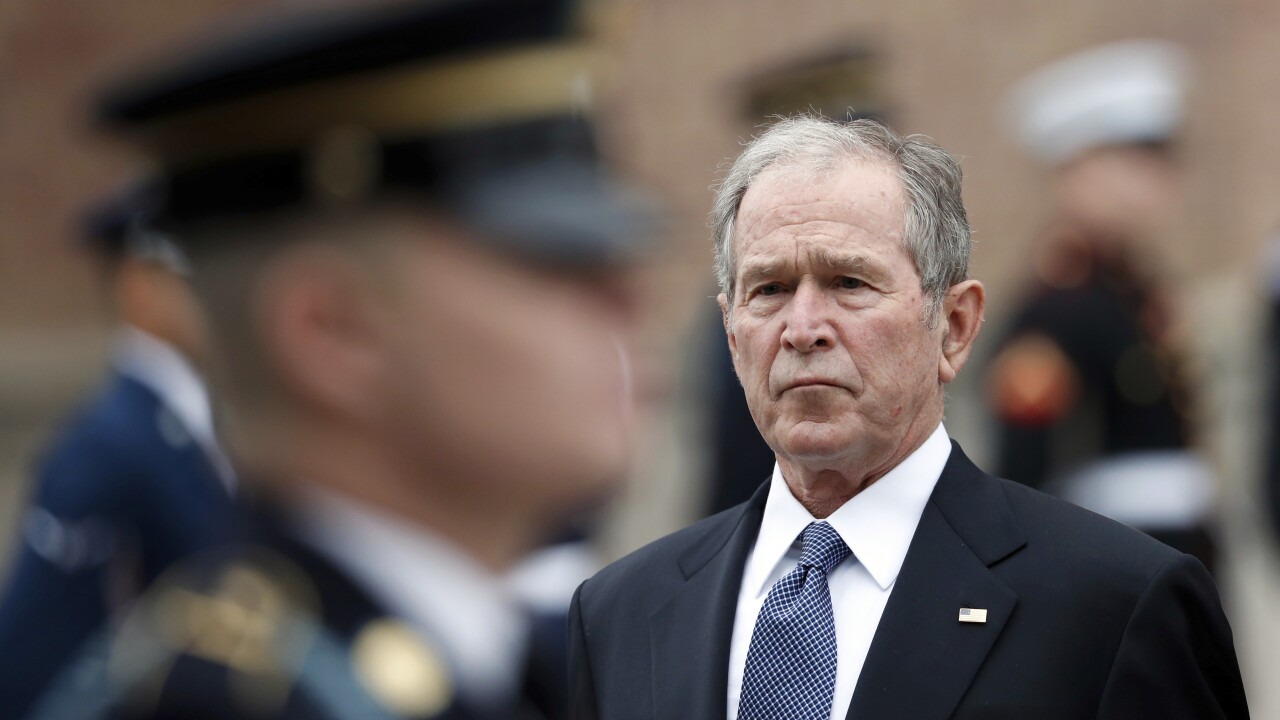
Trump Attacks George W. Bush's Call for National Unity

If there has been one beneficiary of the Trump presidency it is George W. Bush who no longer needs to fear the label "worse president ever."  Indeed, Trump has made Bush look like a better president despite his many terribly wrong decisions, the Iraq War being perhaps the most tragic.  Similarly, Bush was never always focused on himself, something Trump is utterly incapable of doing.  With Trump, it is all about him 24/7 and he truly has no empathy for anyone else.  Absolutely none - something his idiot supporters still have not figured out as he plays them for fools by appealing to their bigotry and misplaced grievances. The Hill looks at Trump's tantrum over Bush's call for national unity in this time of crisis.  Here are excerpts:
President Trump on Sunday took aim at George W. Bush after the former Republican president issued a call to push partisanship aside amid the outbreak of the novel coronavirus. 
In a three-minute video shared on Twitter on Saturday, Bush urged Americans to remember "how small our differences are in the face of this shared threat."
"In the final analysis, we are not partisan combatants. We are human beings, equally vulnerable and equally wonderful in the sight of God," Bush said. "We rise or fall together, and we are determined to rise."
In an early morning tweet on Sunday, Trump called out Bush for his failure to support him as he faced an impeachment trial earlier this year over his alleged dealings with Ukraine.
While Bush never commented publicly on the allegations and the trial, he and other members of his family have voiced criticism of the president and his policies. 
The former president released the video as confirmed cases of COVID-19, the disease caused by the novel coronavirus, continued to rise in parts of the U.S. The country has confirmed more than 1.1 million COVID-19 cases and more than 66,000 deaths from it.
Bush invoked the Sept. 11, 2001, terrorist attacks in his message, noting that the U.S. has faced "times of testing before." 
"Let's remember that the suffering we experience as a nation does not fall evenly. In the days to come, it will be especially important to care in practical ways for the elderly, the ill and the unemployed," he [Bush] said. 
Trump has faced continued scrutiny for his early response to the outbreak. The president in February suggested the virus would suddenly "disappear" and later predicted that everyone who needed a test would have access to one. He's repeatedly pushed back against concerns from governors about testing and medical equipment shortages. 

Monday Morning Male Beauty


Republicans Have Much to Fear and Rightly So

For reasons I will never understand the Republican Party sold its soul and jumped on the Trump bandwagon with once seemingly principled office holders shamelessly prostitution themselves to Trump - think Lindsey Graham - and, of course, Mitch McConnell ever pushing the GOP's reverse Robin Hood agenda. At this point in time as the pandemic continues and the nation's economy is on the skids, polls suggest that if things continue, November could be a truly horrible, but much deserved, comeuppance for the GOP at many levels.  The harm, if it occurs, will be self-inflicted and would mirror what happened to Virginia Republicans last fall.  Arrogance and a refusal to recognize the will and desires of the majority of citizens can lead to electoral disaster.  A column in the Washington Post looks at current polls that ought to have the GOP terrified.  Here are highlights:
Rarely have polls painted as consistent a portrait of President Trump’s and Republicans’ standing: Terrible. In multiple polls, former vice president Joe Biden has a comfortable lead nationally, and a small but consistent lead in battleground states ranging from Pennsylvania to Michigan to Arizona (!) and North Carolina. Needless to say, if the numbers hold and Biden wins Arizona, this will be a blowout election.
PRRI’s poll of battleground states finds, “Trump’s favorability in battleground states has dropped substantially since March, from 53% to 38%.” Non-college-educated voters, who previously were a key part of his base, are falling away. “Trump’s favorability among non-college graduates in battleground states has dropped 20 percentage points between March and April (59% to 39%), . . . . “Large declines are also evident among those living in battleground states (-15 percentage points), those age 65 and over (-14 percentage points), white Americans without a college degree (-12 percentage points), and white women (-9 percentage points).”
This does not mean Trump is a goner. It does not mean Biden is home free. It does mean there has been a considerable erosion in Trump’s support, making him look more vulnerable than at any time this year. One can cite a host of reasons why . . . . Trump’s constant presence and irrational, incoherent rants make him seem even less capable and sober.
However, Trump is not the only one who looks vulnerable. Republican Senate Republicans’ polls are dreadful. An internal GOP poll from Georgia shows, “Voters are evenly split on Trump, but [Gov. Brian] Kemp’s disapproval rating (52%) outweigh [sic] his approval rating (43%). [Republican Sen. Kelly] Loeffler is deeper underwater after grappling with an uproar over her stock transactions during the pandemic, with an approval of 20% and disapproval of 47%.”  This is Georgia, folks.
Republicans’ undiluted support for Trump, resistance to stay-at-home orders and refusal to come to the aid of their states and cities with adequate financial relief may be taking their toll.
Trump could recover if, for example, there is no second wave of coronavirus cases, the deaths abate quickly, and states are getting back to work by Election Day. If you find that unlikely, you are in good company. . . . . Economists are gradually worsening their outlook for the second and third quarters of 2020. In short, things may look worse a few months from now.
Even more damaging for Trump, he is unlikely to stop being Trump. He cannot give up his daily press fix (despite stories he was going to cut back), and we know he is not suddenly going to become the voice of reason and science. Trump will be Trump. And that’s the problem for him and Republicans.
In a stunning failure of leadership and governance, Republicans have been entirely unable to comfort the country and provide confidence they have a path forward. They may finally have exhausted the voters’ patience.

Sunday, May 03, 2020

More Sunday Male Beauty


How to Win LGBT Equality in the South

After years of effort LGBT Virginians will have non-discrimination protects effective July 1, 2020. What finally allowed this to happen?  The short answer is Democrats took control of the Virginia General Assembly while holding the governor's mansion.  The more detailed answer is that the majority of Virginians finally said "no more' to the Virginia GOP's three pillars of its agenda: demonizing gays, unrestricted gun rights, and pandering to the hate merchants who parade as "Christians" while basically pushing a white supremacist agenda.  With Democrats now able to revise the redistricting process, Republic strength in the state, which relied heavily on gerrymandering, will likely be reduced further. Making similar progress across the rest of the South will be far more difficult as the GOP remains entrenched and blindly follows the dictates of Christofascists even as the lack of non-discrimination protections makes other Southern states less competitive in attracting new businesses - something that ought to priority No. 1 in the age of an economically crippling pandemic.  A piece in The Advocate looks at the situation and concludes that federal legislation may be the only way to bring LGBT protections to the South as a whole (yet another reason to strive to have Democrats take control in Washington, DC).  Here are article highlights:
In a time when COVID-19 has brought such heartbreak to so many and has so disrupted the normal routines of life, it can be hard to yank our attention from the moment we are in. 
But something truly significant has taken place in Virginia this month. The politics of the state’s legislature finally caught up with the values of the state’s people as a law ensuring comprehensive nondiscrimination protections for lesbian, gay, bisexual, and transgender people went into effect. Years and years of tenacious and hopeful work went into this historic bipartisan LGBTQ victory in Virginia — the first statewide win for a comprehensive nondiscrimination bill in the South. 
Winning anywhere in the South matters for the LGBTQ people who are actually impacted by the passage of a law, but it also ripples across the region’s political and cultural climate, and it changes the story: Now, it is possible to pass nondiscrimination legislation here. 
The South demands a multipronged strategy. There are states where it will take too long to win on the state level, and that’s why we must push hard for federal legislation, the most effective way to deliver protections to every corner of the South. 
In many Southern states, legislatures remain a bastion of anti-LGBTQ sentiment — just witness the recent cluster of bills targeting transgender youth that made headlines this year in South Carolina, Georgia, Alabama, Kentucky, and more. Far-right conservatives continue to be overrepresented in Southern legislatures, and their positions are increasingly out of sync with the growing majority that supports LGBTQ rights. 
Look at North Carolina’s efforts to pass a bill protecting young people from anti-LGBTQ “conversion therapy,” . . . . the bill hasn’t yet moved out of committee — it was held up without even a hearing because Republican leadership of the North Carolina General Assembly wanted it defeated. Specifically,  a small group of powerful legislators who were doubling down on a view held by just the 13 percent of Republicans who opposed banning “conversion therapy.”
Stories like this are a salient reminder that LGBTQ Southerners continue to meet every formal definition of political powerlessness. Indeed, it is a particular variety of political powerlessness when a minority group has the support of an overwhelming majority of the public but still can’t achieve the basic threshold of equal protection under the law because a small group of politically powerful politicians are systematically blocking natural progress. 
Deploying both real-time and long-game organizing strategies is critical in every single Southern state. But this approach creates a patchwork of progress rather than a blanket of protections. That’s why we need to simultaneously focus on the passage of federal legislation like the Equality Act, which passed in the House of Representatives but is currently stalled in the Senate.
More than one-third of all LGBTQ Americans live in the South. This is our home, and we’ll continue to fight for and celebrate progress like this victory in Virginia. Indeed, as millions of Americans face unemployment and grave health and financial challenges during the COVID-19 pandemic, nondiscrimination protections in the workplace, healthcare settings, and housing are more essential than ever. 
We are ultimately hopeful about what’s possible in the South. But we simply cannot wait for every state legislature to catch up with the people of the South. 
Every poll you can find and countless stories I could share, from the mountains of North Carolina to the Gulf Coast of Missisissipi, demonstrate that the people of the South are ready for federal LGBTQ protections. The next step is to move from “ready for” to “calling for” and “demanding.” 
This is what it will take to compel Congress to do its job and pass clear and comprehensive protections from anti-LGBTQ discrimination. It’s time that no one — not in the South or in any other region — is left vulnerable to discrimination.

Sunday Morning Male Beauty


Is A New Great Depression And A Political Transformation Coming?

The GOP approach to the poor and unemployed.
Many red states are rushing to "reopen" after shutdowns for the coronavirus in part to try to jump start their economies but perhaps also to avoid citizens from realizing that failed GOP policies starting at the White House and spreading downward made America so unprepared for the pandemic and left so many Americans vulnerable to a financial disaster as soon as they missed their first paycheck.  The GOP's reverse Robin Hood agenda that has sought to establish a new Gilded Age even as the social safety net was eroded could result in not only a depression but also calls for dramatic change in America's economies/social system that throws too many to the gutter while the wealthy hoard an ever growing portion of the nation's total wealth. The pandemic has also put on display the problem with America's private health insurance system that relies far too heavily on employer based insurance.  With 30 million Americans now unemployed, the ranks of the uninsured have skyrocketed with employees with no ability to extend coverage under COBRA for the simple reason that they have no income.  A column in the New York Times looks at the ongoing financial catastrophe for so many and speculates on what the political repercussions might be.  Here are excerpts:
After more than a month of coronavirus lockdowns, [Andrew] Yang’s prediction [of America's need for a universal basic income] looks quaintly optimistic. “That obviously happened not in four years, it happened in four weeks,” he told me. “And it wasn’t 30 percent, it was virtually 100 percent.”
Many of those stores will come back — some have already — but analysts predict that thousands won’t. Jobs lost to automation during this time — in warehouses and supermarkets, among other places — are especially unlikely to return. Americans, increasingly desperate in lockdown, are going to emerge from this period into a transformed and blighted world.
Yang used to believe that we were five or 10 years away from seeing some version of his signature policy enacted. “Now I believe this is very immediate and could happen this year,” he said. Representative Justin Amash, who’s exploring running for president as a libertarian, is calling for a U.B.I. for the next three months. The House speaker, Nancy Pelosi, recently said a guaranteed minimum income is “perhaps” worthy of attention. Last month Pope Francis spoke warmly of the idea.
Several candidates campaigned for the Democratic presidential nomination on what Senator Elizabeth Warren called “big structural change,” and lost. Yet in a hideous historical irony, the end of the primaries has coincided with a calamity that necessitates an enormous federal response.
Covid-19 has killed more Americans than died in the Vietnam War and led to unemployment numbers that are likely worse than those during the Great Depression. Implicit in Joe Biden’s campaign was a promise of a return to normalcy. That may have always been illusory, but now it’s been revealed as an impossibility.
As we approach this year’s election, we’re looking at an abyss. The question is what will fill it. Societal disaster can have horrific political consequences: Around the world, despots are using the pandemic as an excuse to grab ever more power. But the need to rebuild the country comes with opportunities.
At this point, even many Republicans acknowledge that the era of small government is over. (“Big-Government Conservatives Mount Takeover of G.O.P.,” said a recent Politico headline.) In such an environment, ambitious progressive ideas that once seemed implausible, at least in the short term, start to become more imaginable.
“I do think there’s an F.D.R. moment,” said Senator Edward Markey, Democrat of Massachusetts and co-author of the Green New Deal resolution, which calls for a huge new public works program to build environmentally sustainable infrastructure. “Like 1933 — which would be 2021 — we can see that it is now time to discuss universal child care, universal sick leave and a guaranteed income for everyone in our society.”
Unsurprisingly, mass unemployment — a particular catastrophe in a system in which most people’s health insurance is tied to their jobs — seems to have made Americans more supportive of New Deal-like policies. Figures from the left-leaning polling firm Data for Progress show that support for a Green New Deal has risen from 48 percent last May to 59 percent this spring. Backing for “Medicare for all” went from 47 percent in November to 53 percent in March, when coronavirus layoffs were just starting.
“People who were doing well at small businesses who have either lost their jobs or faced extraordinary hardship, and suddenly they are now having to confront the difficulties of being uninsured. They’re having to confront the challenges of the private health system.” Khanna sees a much broader awareness “of how uncertain economic life can be,” he said, which creates a bigger coalition for progressive ideas to improve the social safety net.
[Elizabeth] Warren and Khanna recently released a proposal for what they’re calling an “Essential Workers Bill of Rights,” which folds many longtime progressive labor priorities into a plan to address our current emergency. The proposal includes a mandate for free adequate personal protective equipment, hazard pay, universal paid sick leave and paid family leave, a crackdown on employers that misclassify full-time employees as independent contractors, and protections for union organizing.
That last part is important, because Warren believes we’re on the cusp of a new wave of labor mobilization. There have already been strikes, walkouts and other demonstrations across the country by workers forced to expose themselves to potential infection, including bus drivers, Amazon warehouse workers and employees at fast-food restaurants.
If so, it will echo what happened during the Great Depression. “This is what shocked everyone,” Warren said. “All of the economists thought the Great Depression in the 1930s would be the end of unions because so many people were unemployed and there was such a large labor supply, and unionization was going down during the 1920s. But that’s not what happened. In a time of great stress, more workers decided their only chance of survival was to come together and exercise their power through a union.”
Mass unemployment also makes some version of a Green New Deal seem like more of a near-term possibility, at least if Biden wins the presidency. During the primaries, Biden’s environmental proposals were generally more modest than his rivals’, but with the pandemic ravaging the economy he’s called for a trillion-dollar infrastructure program focused on green jobs.
The economy was always more fragile than the top-line numbers suggested; in some surveys a majority of Americans said they were living paycheck to paycheck before the coronavirus hit. But now the economy’s weakness is no longer a matter of debate.
Now, with so many of our assumptions about the way our country works collapsing around us, it’s progressives stepping forward with a set of answers they’ve been refining for years.
“We are going to be faced with a national rebuilding project at a scale that has never existed in our lifetimes,” said Yang. The biggest battle in politics now is over who will control that project, and whom it will prioritize.


If Republicans retain control of the U.S. Senate, it's a safe bet they will prioritize the wealthy as they have for the last quarter century.  If Democrats can win the White House and the Senate while holding the House of Representatives, then there is a chance that America;s broken economic system may see much needed improvements.

Saturday, May 02, 2020

More Saturday Male Beauty


The Morbid Ideology Behind "Reopen America" Protests

As several posts have noted, the protests to "reopen America" are supposed to give the impression that they are "grassroots" and "spontaneous" actions of patriotic Americans.  Sadly, the mainstream media - especially TV networks - gives them coverage and never looks behind the facade.  In reality, the protests trace to billionaires and money interests (with help from white supremacists) that have funded their organization and manipulated those aggrieved by  the loss of white status/privilege as they are about the economic shutdown.   The goals of the behind the scenes backers?  Actually, there are several, one being to distract from the Trump/Pence regimes utter bungling of the federal government response to the pandemic. Another is to distract attention from the GOP's agenda of A piece in New Republic looks at this malignant ideology behind the protests which in true GOP/right wing form use racism and resentment to play those who have suffered most because of GOP policies.  Here are excerpts:

Photos of the small “reopen America” protests, which have made the rounds on social media over the past week, have revealed a spectacle as cartoonish as it is macabre: a rogue’s gallery of right-wing groups coming together to share in the spirit of defiance and, presumably, tiny droplets of mucusfar right  and saliva. The protests (and their backing by deep-pocketed funders) invited many comparisons to the Tea Party movement of a decade ago. Unlike that movement, these small protests are likely to die out soon. Nevertheless, they have captured something vitally important about how the right is responding to this fraught moment in our recent history.
As jobless claims have soared past an astonishing 26 million with no end in sight, the Covid-19 pandemic may well push the United States into a profound and long-lasting economic crisis. . . . The onset of this immiseration has begun to propel bold ideas and movements from the left to demand a reorganization of the economy and a fundamental shift in political power. But the right is swiftly establishing its own morbid template for how to interpret and respond to both the pandemic and its economic effects.
Republican politicians and right-wing pundits endlessly echo a central claim: “The cure is worse than the disease.” In other words, you can either risk dying from the virus or face certain economic ruin, as if there are no other choices. Their hope is that people already conditioned by an ideology centered on the marketplace, the individual, and the nation will be more likely to believe that their lives and livelihoods are under greater threat from state-ordered economic shutdowns and coercive social measures than they are from the disease. For them, the idea that Covid-19 could ultimately be overcome–even if at great human cost–by working and shopping is more appealing, and even more imaginable, than a new politics of mutuality that might redistribute power and resources in an egalitarian way.  
Recall the Tea Party’s origins during the Great Recession. . . . . Those two animating features of the movement—anti-black racism and opposition to the Affordable Care Act—defined a movement that in essence chose investments in whiteness over the assurance of at least some semblance of health care.
This was followed in the 2016 election by a Republican candidate who surged among voters who had high levels of racial resentment, strong feelings of political powerlessness, and growing economic anxiety (regardless of income level). Donald Trump . . . . demonizing Latinos, immigrants, Muslims, black protesters, and foreign rivals. All of this set the stage for how the right would come to respond to the current pandemic.
The rhetorical oppositions of work to welfare, self-reliance to dependence, individual to state, citizen to foreigner—oppositions animated by race, gender, and class—run deep in American political culture. All are reflected in the politics of the pandemic right now, making for a grim political vision of American freedom.
The dozen or so Republicans in the House of Representatives refusing to wear masks when called to vote on the latest coronavirus relief bill performed precisely that kind of political theater for their constituents. It is meant as a tough-guy taunt, to show their own robustness and the weakness of their opponents. But it also reveals something more pathological. The risky behavior demonstrates vitality precisely because it tempts fate, suggestive of Freud’s death drive, which he described as a force “whose function is to assure that the organism shall follow its own path to death.”
There is now a well-documented relationship between whiteness, status, and morbidity. . . . . over the last few years, there have been long-term increases in “deaths of despair”—overdoses, suicides, alcohol-related fatalities—among middle-aged whites without college degrees. There is much yet to be understood about reasons for this phenomenon, but a sense of the declining status of whiteness appears tightly connected to collective self-harm.
Demands to reopen states provide great cover for the Trump administration, the Republican Party in Congress, red state governors, and the Federal Reserve, who are working to keep current wealth stratifications in place and protect the rich from economic harm—and doing so without much pushback from Democrats. As conditions become more dire, the right will do all it can to enlist the loyalty of middle- and working-class victims of the crisis. Here, the logics of race and nation will become increasingly important.
Many of the demonstrators at the recent protests, repeating Fox News talking points, focused their ire on urban America . . . and beneath it, the racial demonization of black and brown denizens of cities. It is this sentiment that gives cover to Republican resistance to federal spending when couched in language like Mitch McConnell’s opposition to “blue state bailouts.”
Within the Trump administration, the nationalist tide continues to rise. . . . . Defenders of the current political order will continue to do whatever is necessary to protect wealth and privilege. They understand that to address the enormity of the economic crisis would upend the neoliberal consensus of this second Gilded Age, which has greatly enriched a few while systematically dismantling public goods, disempowering workers, and diminishing democratic rule. Their hope is that enough Americans go along with this resistance, even if it kills them. 
Try as I might, I find it difficult to have any empathy for the participants in these protests, not the least because so many are motivated ultimately by racism.  In addition, they refuse to look at themselves as a major cause of their own plight.  Many rejected education, have embraced ignorance, and have supported right wing politicians - like Trump - who have worked against their financial interests. Because of their own bad decisions in many cases they feel their skin color is their only claim to privilege.