Showing posts with label detachment from reality. Show all posts

Saturday, April 11, 2020

Coronavirus Has Laid Bare the Flaws of America's Society/Economy

As America and the world continues to be in a tail spin from the coronavirus pandemic, the situation has been clarifying in many ways. It has demonstrated that the American business community's (and this extends to America's hospitals where even supposed non-profits act as if they were out to maximize cash flow) approach of "just-in-time" supply lines and moving manufacturing and even medical supply production to the areas with the lowest wages in the world, principally China, leaving the nation desperately dependent on foreign supply sources and ultimately foreign governments.  Meanwhile, at home labor has been beaten down and the vast majority of Americans live pay check to pay check and one medical crisis leads to bankruptcy - many who have physically sickened and then survived Covid-19 will likely be facing financial ruin from the medical bills.  Politically, much of the nation has been forced to face the reality of the consequences of election an individual who is a combination of crime syndicate boss and carnival huckster to the White House (there are Trump mini-me's when it comes to incompetence in a number of governor's mansions as well - think Texas  and Alabama for starters).  A piece in New York Magazine looks at this clarifying situation, especially America's insane dependence on a political enemy, China, to keep its economy and society from collapsing.  Here are column highlights:

The most advanced, sophisticated, and wealthy civilization ever to exist on planet Earth — our glorious, multinational, globalized, technological miracle — has now been brought to a screeching halt by a pathogen so tiny no one was able to see their complex structures until the last century. For all our unparalleled wealth and knowledge, our streets are empty; our businesses for the most part are suspended; and our efficiency and technological mastery have been mocked by a speck of nature. This minuscule organism that isn’t even technically alive could, all by itself, generate a global depression unlike any since the 1930s.
All our carefully maintained, just-in-time supply lines have crashed in a matter of days. Our addictive elixir, economic growth, has evaporated. Global trade has been put on ice. We have no vaccine — and, barring a miracle, we won’t until next year. We have no effective treatments, although that may, with any luck, change. We have only very porous defenses — social distancing — which amount to a drastic, utterly unsustainable shift in how we live from day to day. And that’s it. We don’t know how contagious this virus is, how exactly it may mutate, how widespread it already is in the population at large, and even if it can reactivate in those who have recovered from infection.
Yes, there are some more successful countries like Germany, and some outliers, like South Korea, but the rest seem to be following the same rough trajectory. And yes, we are flattening the curve … but it’s a temporary flattening due to unprecedented global shutdown of human activity. We may well be able, by suspending our entire way of life for a long while, to keep this virus from wreaking excessive and immediate damage, and overwhelming our hospitals. But we will not have beaten COVID-19. We will merely have stretched out the time it takes to spread.
The moment we relax, it will come back. Singapore, an early model for suppressing the virus, is now seeing a new wave after relaxing some controls. A leaked draft of a memo from the E.U. notes that “any level of [gradual] relaxation of the confinement will unavoidably lead to a corresponding increase in new cases.” The same risks of a rebound are being seen in China, in so far as we can believe a word that murderous dictatorship tells us.
It’s a brutal reality check, this thing — relentlessly ripping the veil off our delusions of control. So much is being laid bare. The promise of a truly globalized world, where government is increasingly international, and trade free, and all would benefit, was already under acute strain. Now, it’s broken, perhaps irrevocably.
The nation-state was beginning to reassert itself before, but COVID-19 has revealed its indispensability. Europeans realized, if they hadn’t already, that a truly continental response was beyond the E.U. Borders were suddenly enforced, resources hoarded by individual nations, and the most important decisions were made by national governments, in national interests. Americans, for their part, saw their own dependence on foreign countries, especially dictatorships, for core needs — like medicine, or medical equipment — as something to be corrected in the future. Japan is now spending a fortune paying its own companies to relocate from China to the homeland.
And for both Europe and America, the delusions that sustained the 21st-century engagement with China have begun to crack. We still don’t know how this virus emerged — and China hasn’t given any serious explanation of its origins. What we do know is that the regime punished and silenced those who wanted to sound the alarm as early as last December, and hid the true extent of the crisis from the rest of the world.
On January 18, despite the obvious danger, the Chinese dictatorship allowed a huge festival in Wuhan that drew tens of thousands of people.
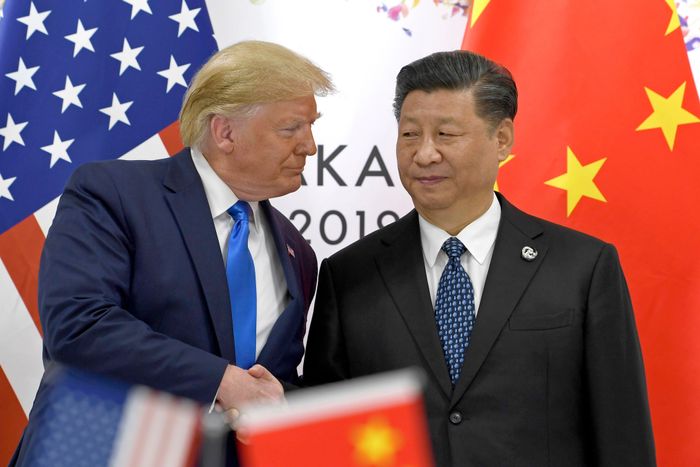
On January 23, President Xi locked down all air traffic from Wuhan to the rest of China — but, as Niall Ferguson pointed out, not to the rest of the world. It’s as if they said to themselves, “Well, we’re going under, so we might as well bring the rest of the world down with us.” This is not the behavior of a responsible international state actor. Trump’s ban on Chinese travel was better than nothing, but it did not prevent over 400,000 non-Chinese from arriving in the U.S. from China as COVID-19 was gaining momentum. It’s fair to say, I think, that after the immediate, unforgivable cover-up in China, a global pandemic was inevitable.
I’m not excusing Trump for his delusions, denial, and dithering — he is very much at fault — but the core source of the destruction was and is Beijing. Bringing a totalitarian country, which is herding its Muslim inhabitants into concentration camps, into the heart of the Western world was, in retrospect, a gamble that has not paid off.
The Chinese dictatorship is, in fact, through recklessness and cover-up, responsible for a global plague and tipping the entire world into a deep depression.
In other cases, the cold triumph of reality represented by the virus has been salutary. It’s been remarkable to observe something Donald Trump cannot lie his way out of. He tried. And he’s still trying. He’s gaming out various ways to get himself reelected in a pandemic, but the pandemic keeps reminding us that this is in its control, not his. His daily performances are not informing anyone about anything — they are failing attempts to impose a narrative on an epidemic which has its own narrative, and doesn’t give two fucks about Trump.
And this is the truth about reality. It really does exist (whatever the postmodernists might argue). It’s complicated. And even if it can be ignored or forgotten in our very human discourses, it wins in the end. This virus is, in a way, a symbol of that reality. It can be stymied for a while; it can be suppressed and avoided.
[O]nly a vaccine can make a real difference. The coming months will be an unsatisfying series of starts and stops as we struggle to live with it. We are not, in other words, fighting and winning this war — we are merely negotiating the terms of our surrender to reality. And there is nothing more humbling for humans than that. And nothing more clarifying either.
Trump, various business interests, the Christofascist Trump has embraced, and, of course, the right wing media will continue to try to dupe Americans into looking away from and accepting reality, but for once they may have met a force that will succumb to their lies and propaganda. Thinking Americans need to take stock on how our economy and society need to be reordered to be prepared for future pandemics once we put this one behind us. 

Friday, March 28, 2014

Putin is Living in a 19th Century Fantasy World


I recently read a a book entitled the "Red Fortress: History and Illusion in the Kremlin," which tracks over 800 years of Russian history with focus on how the Kremlin has played a role in the unfolding drama.  One take away from the book - although this is not its objective - is that Russia has too often been ruled by nutcases and megalomaniacs and that long term it is always the Russian people who have suffered as a consequence.  Fast forward to today, and Vladimir Putin fits the stereotype of the Russian ruler untethered from objective reality as defined by the rest of the world.  And when it comes to state control of the press and repression, Putin makes the regime of the incompetent Tsar Nicholas II look both enlightened and benevolent.  A column in the Washington Post looks at Putin's 19th century fantasy world.  Here are excerpts:
Russia’s invasion of Ukraine has brought to the fore an important debate about what kind of world we live in. Many critics charge that the Obama administration has been blind to its harsh realities because it believes, as the Wall Street Journal opined, in “a fantasy world of international rules.” John McCain declared that “this is the most naive president in history.” The Post’s editorial board worried that President Obama misunderstands “the nature of the century we’re living in.” 

Almost all of these critics have ridiculed Secretary of State John Kerry’s assertion that changing borders by force, as Russia did, is 19th-century behavior in the 21st century. Well, here are the facts.


Before 1950, wars between nations resulted in border changes (annexations) about 80 percent of the time. After 1950, that number dropped to 27 percent. In fact, since 1946, there have been only 12 examples of major changes in borders using force — and all of them before 1976. So Putin’s behavior, in fact, does belong to the 19th century.

The transformation of international relations goes well beyond border changes.  . . . . “after a 600-year stretch in which Western European countries started two new wars a year, they have not started one since 1945. Nor have the 40 or so richest nations anywhere in the world engaged each other in armed conflict.” Colonial wars, a routine feature of international life for thousands of years, are extinct. Wars between countries — not just major powers, not just in Europe — have also dropped dramatically, by more than 50 percent over the past three decades.

[T]he most astonishing, remarkable reality about the world is how much things have changed, especially since 1945. It is ironic that the Wall Street Journal does not recognize this new world because it was created in substantial part through capitalism and free trade.

The best way to deal with Russia’s aggression in Crimea is not to present it as routine and national interest-based foreign policy that will be countered by Washington in a contest between two great powers. It is to point out, as Obama did eloquently this week in Brussels, that Russia is grossly endangering a global order that has benefited the entire world. 

Compare what the Obama administration has managed to organize in the wake of this latest Russian aggression to the Bush administration’s response to Putin’s actions in Georgia in 2008. That was a blatant invasion. Moscow sent in tanks and heavy artillery; hundreds were killed, nearly 200,000 displaced. Yet the response was essentially nothing. This time, it has been much more serious. Some of this difference is in the nature of the stakes, but it might also have to do with the fact that the Obama administration has taken pains to present Russia’s actions in a broader context and get other countries to see them as such.

You can see a similar pattern with Iran. The Bush administration largely pressured that country bilaterally. The Obama administration was able to get much more effective pressure because it presented Iran’s nuclear program as a threat to global norms. . .

There is an evolving international order with new global norms making war and conquest increasingly rare. We should strengthen, not ridicule, it. Yes, some places stand in opposition to this trend — North Korea, Syria, Russia. The people running these countries believe that they are charting a path to greatness and glory. But they are the ones living in a fantasy world.
The author is correct.  Look at the disasters of the Bush/Cheney regime: billions wasted, thousands of lives thrown away and nothing to show for it.  It makes sense to try a different approach after Bush/Cheney's bankrupting wars and squandering of American lives.  It's past time to reject the same old cries and whining of the neocons who helped give us the Bush/Cheney disasters. 

Monday, March 04, 2013

The Shrinking Tent of the GOP's Policies of Obstruction

I don't much like columnist Jennifer Rubin, but in a column in the Washington Post she a kick in the ass litany of what's wrong with today's Republican Party and its fantasy world that we are still living in the 1980's and that all the GOP needs to do is fix its "messaging problem."  The reality is that the world and the country have changed and are continuing to change yet the GOP base - especially the reality denying Christofascists - simply do not get that message.  She candidly states that the GOP needs to change or die.  Candidly, I am not going to hold my breath and expect that to happen any time soon.  The party grass roots has become an insane asylum where acceptance of reality simply isn't on the agenda.  Here are column highlights:

If the GOP can’t win elections and win adherents, it is headed for the ash heap of history.

The right is not divided into moderates and conservatives, as a smart pollster told me, but between those who can count and those who cannot. If conservatives do not attract larger numbers in the fastest-growing parts of the electorate, they will not win elections, their agenda will become a dusty artifact on the shelf and the country will slide further into decline.

Those who say that the right needs only to be more articulate and more forceful in defense of the exact same agenda are kidding themselves. Those who say they can’t find common ground with gay conservatives who believe in capitalism, Second Amendment rights, and federalism are harming the movement, the party, and the country. Those who refuse to recognize that we will not deport 11 million immigrants who came here illegally are in Never Never Land and are defending a lawless system, not the “rule of law.”

It is also time to stop complaining about the left and the voters. Conservatives sound too whiny; victimhood is unappealing. They need to be forward-looking, optimistic and practical. It is not enough to be against Obamacare. They must be for market-based health-care reform. It is insufficient to be against excessive spending. They must be for entitlement and tax reform. It’s not enough to rail against the breakdown of the family. They must be for policies that encourage and sustain marriage and make child rearing easier and less costly. It’s not going to work just to inveigh against teachers unions; conservatives have to enact school reform including school choice.
It is time to get out of the 1980s and into the 21st century.

CPAC should pass out some writings of Edmund Burke and Russell Kirk. They were practical and prudent, and they understood that we cannot remake our fellow citizens or reinvent their habits and inclinations. 

The leaders of CPAC and many in the conservative movement have lost track of that. They are creatures of the 1980s, when our problems, our country and the world were different. They became so adept at the politics of the 1980s that they never left that decade.

Monday, February 11, 2013

Eric Cantor and the Ignorance Caucus

As even casual readers have probably figured out, I dislike Eric Cantor immensely and view him as a power hungry sleazy politician who would sell his soul for power.  He's illustrative of what's wrong with today's Republican Party where those who aren't outright crazy - a vanishing phenomenon - are so power mad that they will do anything to ingratiate themselves to the ranks of the haters and Tea Party extremists.  That includes parroting the most tired and untrue lies that sit so well with the Christofascists and ignorance embracing GOP base.  A column in the New York Times looks at Cantor and his self-prostitution to these negative forces in today's toxic Republican Party.  And yes, the column even mentions the Virginia GOP's refusal to admit that sea level rise is occurring even as Norfolk, one of Virginia's largest cities is slowly being overwhelmed by rising sea levels.  A lobotomy is indeed becoming a prerequisite for GOP membership.  Here are some column excerpts:

Last week Eric Cantor, the House majority leader, gave what his office told us would be a major policy speech. And we should be grateful for the heads-up about the speech’s majorness. Otherwise, a read of the speech might have suggested that he was offering nothing more than a meager, warmed-over selection of stale ideas. 

To be sure, Mr. Cantor tried to sound interested in serious policy discussion. But he didn’t succeed — and that was no accident. For these days his party dislikes the whole idea of applying critical thinking and evidence to policy questions. And no, that’s not a caricature: Last year the Texas G.O.P. explicitly condemned efforts to teach “critical thinking skills,” because, it said, such efforts “have the purpose of challenging the student’s fixed beliefs and undermining parental authority.”

And such is the influence of what we might call the ignorance caucus that even when giving a speech intended to demonstrate his openness to new ideas, Mr. Cantor felt obliged to give that caucus a shout-out, calling for a complete end to federal funding of social science research.

Want other examples of the ignorance caucus at work? Start with health care, an area in which Mr. Cantor tried not to sound anti-intellectual; he lavished praise on medical research just before attacking federal support for social science.

But Mr. Cantor’s support for medical research is curiously limited. He’s all for developing new treatments, but he and his colleagues have adamantly opposed “comparative effectiveness research,” which seeks to determine how well such treatments work. 

What they fear, of course, is that the people running Medicare and other government programs might use the results of such research to determine what they’re willing to pay for. Instead, they want to turn Medicare into a voucher system and let individuals make decisions about treatment. But even if you think that’s a good idea (it isn’t), how are individuals supposed to make good medical choices if we ensure that they have no idea what health benefits, if any, to expect from their choices? 

Still, the desire to perpetuate ignorance on matters medical is nothing compared with the desire to kill climate research, where Mr. Cantor’s colleagues — particularly, as it happens, in his home state of Virginia — have engaged in furious witch hunts against scientists who find evidence they don’t like. True, the state has finally agreed to study the growing risk of coastal flooding; Norfolk is among the American cities most vulnerable to climate change. But Republicans in the State Legislature have specifically prohibited the use of the words “sea-level rise.”
 
And there are many other examples, like the way House Republicans tried to suppress a Congressional Research Service report casting doubt on claims about the magical growth effects of tax cuts for the wealthy.

The truth is that America’s partisan divide runs much deeper than even pessimists are usually willing to admit; the parties aren’t just divided on values and policy views, they’re divided over epistemology. One side believes, at least in principle, in letting its policy views be shaped by facts; the other believes in suppressing the facts if they contradict its fixed beliefs. 

In her parting shot on leaving the State Department, Hillary Clinton said of her Republican critics, “They just will not live in an evidence-based world.” She was referring specifically to the Benghazi controversy, but her point applies much more generally. And for all the talk of reforming and reinventing the G.O.P., the ignorance caucus retains a firm grip on the party’s heart and mind.

Wednesday, July 27, 2011

The GOP Denial of Reality

Increasingly, the one underlying thread to GOP policies is a denial of reality. Scientific facts, objective reality, and even common sense no longer factor into the GOP policies be they support of the myth of "ex-gays"to climate change, to economic realities and an admission that it was their party and the numb skull Chimperator and Darth Vader Cheney, not Obama who created the deficit disaster now before the country. Today's New York Times looks at this frightening situation in the context of the debt ceiling deadline in it's main editorial. The real issue facing the country is how do we move forward when one political party is no longer sane? Here are highlights (it's no surprise that Michele Bachmann is described as living in an alternative reality):
*
How can so many Republican lawmakers justify pushing their country toward catastrophic default just to score ideological points? The answer can be found in their statements and writings: They are constructing an alternative reality far different from that of most Americans.
*
A large number of Republican lawmakers, for example, simply don’t accept that the United States is going to be in default as of Tuesday. (Wall Street banks say the nation will run out of money within a few days of that date.)
*
The Treasury Department, which keeps the government bankbook, set the Aug. 2 deadline, but they say it cannot be trusted because it is an arm of the Obama administration. Representative Joe Walsh, a freshman from Illinois, recorded an instantly notorious video in which he accused President Obama of “lying” about the dangers of default. “There’s plenty of money to pay off our debt and cover all of our Social Security obligations,” he said, without saying where all these billions might be hidden.
*
Representative Michele Bachmann, the Tea Partier running for president, went even further, saying there would be no default at all because the government would always find a way to pay the interest on its debt. Her level of disbelief in any statement made by the White House is so complete that she disregarded the possibility that the global financial system could impose its own devastating downgrade on the government’s obligations.
*
Jim Jordan of Ohio, who leads an influential group of House conservatives, said he is willing to go down with the cut, cap and balance ship even if default is the only option, since he, too, is not persuaded that the Treasury is telling the truth.
*
House members have been encouraged in their destructive daydream by many outside organizations and Web sites. An arm of the Heritage Foundation sent out a letter Tuesday saying the government should live under the current debt ceiling rather than pass the Boehner plan, ignoring the need to raise the ceiling to pay for bills already incurred. Several right-wing bloggers, notably Erick Erickson of RedState, have threatened brimstone on any errant Republican lawmaker who even considers compromise with the president.
*
If the economy does begin to crumble next week, the trail back toward the reason will not be hard to follow.

Monday, April 11, 2011

The Trashing of the Democratic Party Base

In the grand scheme of things, it seems time and time again the LGBT community sees itself being told to get out and vote, hand over hard earned money and "support the party" by the Democratic insiders and, of course the current White House administration. The reward is typically to then be flung under the bus once the desired votes and money has been wrung out of our community. The syndrome, however, is not unique to the LGBT community and instead seems to be standard procedure as the party base is manipulated and constantly confronted with the GOP bogey man. Yes, the GOP agenda IS scary and needs to be defeated. However, that should not mean that we merely roll over and follow the "we know best" mantra coming from the White House and party insiders. Glenn Greenwald has a piece in Salon that looks at the mistreatment the Democrat base receives and contrasts it to the GOP's constant coddling of its base regardless of how crazy and untethered it may demonstrate itself to be. Here are some highlights(read the whole piece):
*
How can the base itself possibly change this dynamic, whereby politicians of the Democratic Party are not only willing, but eager, to "kick them whenever possible," on the ground (among others) that doing so is good politics? I'd submit that this is not only one of the most important domestic political questions (if not the most important), but also the one that people are most eager to avoid engaging. And the reason is that there are no comforting answers.
*
One thing is for certain: right now, the Democratic Party is absolutely correct in its assessment that kicking its base is good politics. Why is that? Because they know that they have inculcated their base with sufficient levels of fear and hatred of the GOP, so that no matter how often the Party kicks its base, no matter how often Party leaders break their promises and betray their ostensible values, the base will loyally and dutifully support the Party and its leaders (at least in presidential elections; there is a good case that the Democrats got crushed in 2010 in large part because their base was so unenthusiastic).
*
In light of that fact, ask yourself this: if you were a Democratic Party official, wouldn't you also ignore -- and, when desirable, step on -- the people who you know will support you no matter what you do to them? That's what a rational, calculating, self-interested, unprincipled Democratic politician should do: accommodate those factions which need accommodating (because their support is in question), while ignoring or scorning the ones whose support is not in question, either because they will never vote for them (the hard-core right) or will dutifully canvass, raise money, and vote for them no matter what (the Democratic base). Anyone who pledges unconditional, absolute fealty to a politician -- especially 18 months before an election -- is guaranteeing their own irrelevance.
*
It was often said that Bush/Cheney used fear as their principal political weapon -- and they did -- but that's true of the Democratic Party as well. When it comes to their base, Democratic leaders know they will command undying, unbreakable support no matter how many times they kick their base, because of the fear that has been instilled in the base -- not fear of Terrorists or Immigrants (that's the GOP's tactic), but fear of Sarah Palin, the Kochs and the Tea Party.
*
If you spend two years vehemently objecting that certain acts so profoundly offend your principles but then pledge unequivocal support no matter what almost two years in advance to the politicians who engage in them, why would you expect your objections to be heeded? Any rational person would ignore them, and stomp on your beliefs whenever doing so benefited them.
*
But what I do know is that Rachel [Maddow]'s optimistic proclamation that "only the base itself will ever change" this dynamic cannot be fulfilled without giving the Party and its leaders a true reason to pay attention or care about disenchantment (and, some day, to fear alienating their base). For those who are hopeful that this will happen, what do they envision will cause it? What would ever make Democratic Party leaders change how they view this dynamic?

Monday, May 18, 2009

Onward Christian Soldiers - Bush's Daily Briefings

GQ of all publications has published a series of top secret daily intelligence briefings from Donald Rumsfeld's office at the Pentagon for the Chimperator a/k/a President George W. Bush early in the Iraq war. What is both startling and frightening is that all are adorned with militaristic Bible verses perhaps further proving that for 8 years the USA was headed by a delusional religious nutcase. Bob Felton aptly describes it over at Civil Commotion:
*
I don’t suppose we’ll ever really know how much this sort of thing influenced Bush’s thinking but, increasingly, the more we learn the more he appears to have been out of touch with reality, believed himself invested by God with a great work, and certain that everything would come right in the end so long as he held inflexibly to the cosmic instructions given him.
*
I urge readers to watch the GQ slide show here and to ponder long and hard whether we can survive more of this kind of lunacy in our elected officials and political policies. Remember too that this is the mindset that controls the opponents of gay rights and candidates like Bob McDonnell who are able to grasp objective reality because of their extreme religious beliefs. I am not anti-religion per se, but at some point some connection with reality is required. Obviously, George W. , the leadership of the Christian Right, and the GOP base do not have that much needed connection with reality.