Showing posts with label social change. Show all posts

Tuesday, June 09, 2020

The NFL's "Black Lives Matter Moment" Shows Trump’s Growing Weakness

I will admit I am not a fan of professional sports, especially football.  I go to a friend's annual Super Bowl party for the social event aspect, but never the game.  To the extent I follow sports at all, it's at the college level, typically focused on my alma mater and that of my late parents. And growing up, I focused on individual sports like cross country, skiing, water skiing and surfing.  All of this is a roundabout way of saying that I'm not a fan of the NFL which is all about money and appeasing fans as opposed to sportsmanship.  As for NFL/football fans, if as much attention and time was placed on politics so as to elect decent politicians and on bettering our communities, the nation would be a far better place.  Thus, I found it interesting that outwardly the NFL altered its position on racial discrimination and embraced (somewhat insincerely, in my view) the Black Lives Matter cause.  I doubt that the move was motivated by any real conviction but instead due to (i) the shifting winds of public opinion and (ii) the flagging influence of the racist-in-chief in the White House.  A piece in New York Magazine looks at Trump's shrinking ability to intimidate the NFL.  Here are excerpts:
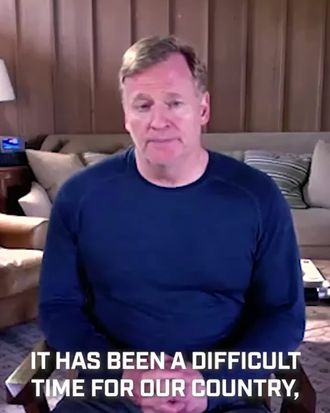
When NFL commissioner Roger Goodell admitted in an oddly low-res video on Friday evening that the league was wrong for “not listening to NFL players earlier” — and then actually uttered the phrase “Black Lives Matter” — it was widely seen as a cynical gesture from a company hack who finally acquiesced to public pressure, rather than a heartfelt gesture of genuine remorse.
Slate’s Joel Anderson saw Goodell’s pandering for what it was, writing, “Goodell’s empty gestures tell us nothing about what the NFL thinks of black lives. . . . . the NFL loves nothing more than a hollow branding opportunity. Goodell’s “admission” was yet another one.
What happened next should not have been surprising. On Sunday night, President Trump, tweeting through it as always, attempted to bust out one of his greatest hits.
[B]ack when the NFL-kneeling story line began, Trump muscled his way into the conversation by claiming that owners should “get that son of a bitch off the field right now” when players took a knee, and encouraging fans to leave the stadium when it happened. (A month later, his vice-president would do just that, at considerable taxpayer expense.) Goodell called Trump’s comments “divisive,” but ignored players’ requests that he support a racial equality program. Ultimately, Goodell caved to Trump and his supporters by banning kneeling altogether during the national anthem; nevertheless, Trump was back at it a year later, just to make sure Goodell remembered who held the leash. That Goodell acceded so quickly and totally to Trump three years ago is one of the reasons his statement on Friday felt so empty; nobody believes his platitudes anymore, nor should they.
[T]here is reason to think that this time will be different. That’s partly because Goodell and the NFL owners have witnessed the same shift in power and influence over the last fortnight that you and I can. And it’s partly because so much of the frustration with the NFL’s stance on Black Lives Matter has come from inside Goodell’s organization; a terrific Athletic piece details how a video made by NFL players, and produced internally by a “rogue” employee, forced Goodell’s hand. I wonder, though, if the bigger reason for Goodell’s new posture is even simpler: Goodell isn’t particularly scared of Trump anymore. There was a time when Goodell had to bob and weave along with every presidential broadside, when he had to pattern league policy around Trump’s Twitter mood swings. But the Trump of 2017 — or even of a few months ago — was a much more powerful Trump than the one we have before us now.
You could attach Trump’s diminishment in influence to the widespread condemnation and disgust with his gassing of protesters for a particularly lame-brained photo-op stunt last Monday. You could say it’s because of his lagging poll numbers generally, or the fact that Trump is looking more and more like a scared man hiding inside a black-fence-fortified prison of his own making. But one of the undeniable takeaways from the last week is that Trump looks weaker than he has at any time during his presidency. (We have reached the point of the cycle when aides are anonymously complaining that his wife is undermining him.) And when you are weak, no matter how much you might bluster and stomp your feet, people don’t fear you like they once did. Even someone as skittish as Goodell.
When Trump’s national anthem tweets were front-page news, the NFL owners and a few player representatives held a secret meeting, which the Times obtained audio of. What’s telling reading that story today is how terrified the league was of Trump:
If there’s a lesson the NFL earned from the entire debacle, it’s that Trump didn’t have the power back then that they feared he did … and that he definitely doesn’t have it now. Look at the week Drew Brees just had. On Wednesday, he told Yahoo Finance he would “never agree with anybody disrespecting the flag.” There has probably never been a time in NFL history, up until now, when  expressing that opinion would have constituted  a problem for Brees. But on Thursday, after an overwhelming uproar (including among his own teammates), Brees apologized, and then apologized again. That led Trump to tweet that he was a “big fan” of Brees but that he should have never said sorry,  and that “OLD GLORY is to be revered, cherished, and flown high.” But Brees, smartly, realized that Trump was nothing to be scared of. He went on Instagram and addressed the president directly: “We must stop talking about the flag and shift our attention to the real issues of systemic racial injustice, economic oppression, police brutality, and judicial & prison reform.”
That has to be a large part of the mindset of Goodell: While the safe thing three years ago might have been to capitulate to Trump, the safe thing now is to do the exact opposite. In 2017, you knew you had to deal with the president, one way or another, for the next three years. Now? Now you might be rid of him in a few months. And you’re aware — more aware than you were then — that his bark is a lot worse than his bite. This is the one trick he has, the Big Kneeling Threat. He’s beginning to look like an elderly coach trying to win in today’s NFL with the old T-formation playbook he used in the 1950s — in other words, like someone whose time has passed.
How is the league going to deal with Trump trying to turn this into a wedge issue once again? I think Goodell and the NFL are going to just ignore him. The players have shown the power they have in this situation, and their willingness to wield it. The fan base has shown it isn’t actually going to stop watching football because of Trump’s perpetual culture war.
The proper response, it’s becoming increasingly clear, is to either pretend he doesn’t exist — or maybe even to actively defy him. He’s not the Trump of three years ago. The movement and the people are more powerful than he is, and they always were. Roger Goodell knows that now. The NFL knows that now. Maybe, now, we all do.

Monday, July 25, 2016

Republican Delusions of Chaos in the Streets


The Democrat National Convention starts today and it will be telling to compare the image of America that it will project versus the nightmarish image that was painted in Cleveland by Donald Trump and his sycophants.  While America has many problems, the reality is far different from what Trump and company describe as near chaos and danger in the streets, an irony since it is the Republicans' refusal to enact sane gun laws that has facilitated the mass shootings that have rocked the nation.  A column in the New York Times makes the case that crime, especially the murder rate, has gone down significantly and then looks at the psychosis that seems to drive conservative fears that simply are not supported by statistics.  Here are highlights:
Yet there’s no question that many voters — including, almost surely, a majority of white men — will indeed buy into that vision. Why?
Well, I do have a hypothesis, namely, that Trump supporters really do feel, with some reason, that the social order they knew is coming apart. It’s not just race, where the country has become both more diverse and less racist (even if it still has a long way to go). It’s also about gender roles — when Mr. Trump talks about making America great again, you can be sure that many of his supporters are imagining a return to the (partly imagined) days of male breadwinners and stay-at-home wives.
Not incidentally, Mike Pence, Mr. Trump’s running mate, used to fulminate about the damage done by working mothers, not to mention penning an outraged attack on Disney in 1999 for featuring a martially-minded heroine in its movie Mulan.
But what are the consequences of these changes in the social order? Back when crime was rising, conservatives insistently drew a connection to social change — that was what the whole early ’90s fuss over “family values” was about. Loose the bonds of traditional society, and chaos would follow.
Then a funny thing happened: Crime plunged instead of continuing to rise. Other indicators also improved dramatically — for example, the teen birthrate has fallen 60 percent since 1991. Instead of societal collapse, we’ve seen what amounts to a mass outbreak of societal health. The truth is that we don’t know exactly why. Hypotheses range from the changing age distribution of the population to reduced lead poisoning; but in any case, the predicted apocalypse notably failed to arrive.
The point, however, is that in the minds of those disturbed by social change, chaos in the streets was supposed to follow, and they are all too willing to believe that it did, in the teeth of the evidence.
The question now is how many such people, people determined to live in a nightmare of their own imagining, there really are.

Saturday, December 26, 2015

Christianity Is Dying in America


As the caption of this post notes and a number of surveys on religion have documented, Christianity is dying in America.  And a leading cause in the decline in religion, especially with the younger generations, is the "godly Christians" themselves  as they daily show Christianity - or at least their toxic version of it - to be principally about hate and division.  True, there are other causes, including scientific progress that undermines the myths set out in the Bible, yet the godly folk refuse to look in the mirror at themselves or changing demographics since it is far easier to blame gays, liberals and "secular humanist" who are alleged to be at war against Christianity.  A piece  The Daily Beast looks at Christianity's much deserved decline and the Christofascists' efforts to deflect blame on to others.   Here are highlights:
Among the Christian Right, and most Republican presidential candidates, it’s now an article of faith that the United States is persecuting Christians and Christian-owned businesses—that religion itself is under attack.   “We have seen a war on faith,” Ted Cruz has said to pick one example.

Why has this bizarre myth that Christianity is under assault in the most religious developed country on Earth been so successful? Because, in a way, it’s true. American Christianity is in decline—not because of a “war on faith” but because of a host of demographic and social trends. The gays and liberals are just scapegoats.

The idea that Christians are being persecuted resonates with millennia-old self-conceptions of Christian martyrdom. Even when the church controlled half the wealth in Europe, it styled itself as the flock of the poor and the marginalized. Whether true or not as a matter of fact, it is absolutely true as a matter of myth. 

[T]he percentage of the U.S. population that identifies as Christian has dropped from 78.4 percent in 2007 to 70.6 percent in 2014. Evangelical, Catholic, and mainline Protestant affiliations have all declined.  Meanwhile, 30 percent of Americans ages 18-29 list “none” as their religious affiliation (the figure for all ages is about 23 percent). Nearly 40 percent of Americans who have married since 2010 report that they are in “religiously mixed” marriages, which means that many individuals who profess Christianity are in families where not everyone does. . . . . The Pew report noted Americans are also changing religions more than in the past, and when they do so, they are more likely to move away from Christianity than toward it.

But no one likes a “constellation of reasons” to explain why the world they grew up in, and the values they cherish, seem to be slipping away. Enter the scapegoat: the war on religion, and the persecution of Christianity.

It’s much easier to explain changes by referring to a single, malevolent cause than by having to understand a dozen complex demographic trends. Plus, if Christianity is declining because it’s being attacked, then that decline could be reversed if the attack were successfully repelled. Unlike what is actually happening—a slow, seemingly irrevocable decline in American Christianity—the right’s argument that “religious liberty” is under assault mixes truth and fantasy to provide a simpler, and more palatable, explanation for believers.

Take, as an example, Christmas. The weird idea that there is a “War on Christmas” orchestrated by liberal elites—Starbucks cups in hand—is, on its face, ridiculous, even if it is widely held on the right.

Unfortunately, even if the war on religion is fictive, the “defense” against it is very real and very harmful. This year alone, 17 states introduced legislation to protect “religious freedom” by exempting not just churches and religious organizations (including bogus ones set up to evade the law) from civil rights laws, domestic violence laws, even the Hippocratic Oath, but also but private individuals and for-profit businesses.

Meanwhile, the “war on religion” narrative appears to be gaining ground.. . . . . 61 percent of white evangelicals believe that religious liberty is being threatened today. (Only 37 percent of non-white Christians believe this, suggesting that what’s really happening is an erosion of white Christian hegemony; the “browning of America” goes hand in hand with the de-Christianizing of America.) They believe they have lost the culture war, and even that LGBT people should now pity them.

Christianity is, in a sense, losing the war—but the fighters on the other side aren’t gay activists or ACLU liberals but faceless social forces of secularization, urbanization, and diversification.

[M]ythic thinking creates a personification of evil who is fighting the war on religious liberty, the war on Christmas, the war on Christianity. These malevolent evildoers are like a contemporary Satan: a fictive embodiment of all of the chaotic, complex forces that threaten the stability of religious order.
Fundamentalist Christianity - and fundamentalist Islam - is a pervasive cause of evil and hatred.  The world would be a far better place if both simply disappeared from the face of the Earth.  For parasitic professional Christians, sleazy televangelists, and religious institutions obsessed with power and control over others (and the flow of money that these bring) , the decline of Christianity is terrifying.  Their free ride and ability to prey on the gullible is in decline and the money flow that enables them to live a comfortable live peddling myths and lies is threatened.  Expect the hysteria to increase as the decline continues and hopefully accelerates.
 

Saturday, January 03, 2015

Belgian Catholic Bishop Advocates Church Recognition of Gay Relationships


The Roman Catholic Church has always lead up the rear guard resisting social change be it in terms of contraception, women's rights, divorce, and, of course, gay rights. And in every instance, the Vatican's intransigence to change has cost the Church membership.  It's not without reason that so many raised as Catholics sever their relationship with the Church.  Gay rights and gay marriage are but the latest issue to pit the bitter old men in Rome against the views of the younger generations and parents and family members who simply no longer will stand for the Church's denigration of their  gay children, siblings, etc.  Bishop Johan Bonny of Antwerp, Belgium (pictured above), seemingly understands the corrosive and suicidal element that the Church's opposition to gays poses.  His solution? The needs to give ecclesiastical recognition to gay relationships.  Here are highlights from the National Catholic Reporter:

Bishop Johan Bonny of Antwerp, Belgium, has called for ecclesiastical recognition of gay relationships, according to an interview published in De Morgen, a Belgian newspaper, on Dec. 27.  The official teaching that the Catholic church can recognize only male-female committed relationships has to change, Bonny said.

 "There should be recognition of a diversity of forms," he said. "We have to look inside the church for a formal recognition of the kind of interpersonal relationship that is also present in many gay couples. Just as there are a variety of legal frameworks for partners in civil society, one must arrive at a diversity of forms in the church. … The intrinsic values are more important to me than the institutional question. The Christian ethic is based on lasting relationships where exclusivity, loyalty, and care are central to each other."

Bonny made headlines in September when he issued a letter to the Vatican in preparation for the Synod on the family in October. At that time, Bonny stressed that the church urgently needs to connect with contemporary society, showing more respect for homosexuality, divorced people and modern kinds of relationships.

“In his or her life,” he said, “everyone has to deal with relationships, friendship, family, and children's education. We should not deny that dealing with these issues within the church has brought injuries and traumas. Too many people were excluded for a long time."

Bonny stressed openness, the need for further reflection and the danger of getting wrapped up in a complex ideological discussion. He stressed as well that he is a strong advocate for recognizing a diversity of relationships that arise from serious reflection on practical pastoral realities.

Professor Rik Torfs, canon law expert and rector of the Catholic University of Leuven, warned that one should not minimize Bonny’s approach.

"Do not underestimate the significance of this,” he said. “Bonny advocates a change from principles long held as unshakable, something no bishop could have done under the dogmatic pontificates of Pope John Paul II and Pope Benedict XVI."

Most observers see him becoming the next archbishop (and cardinal) of the Malines-Brussels archdiocese, when the incumbent, Archbishop André-Joseph Léonard, offers the pope his letter of retirement, at age 75, in May.
Perhaps driving Bonny's call for change is the reality that not a single priest was ordained for Antwerp in 2012, 2013, or 2014.

Friday, May 16, 2014

Don’t Ask a Same-Sex Couples Who is the “Husband” or the “Wife.”

Me and "the husband"
Recently married myself, I have begun referring to "the boyfriend" as "the husband."  I like the change.  Especially since I never really felt comfortable with the term "partner"  given my background in the legal realm and law firms where members of law firms are often called "partners."  Similar terminology likewise exists in many businesses that are structured as general or limited partnerships.  Calling one's lover/best/friend/significant other your "partner" just doesn't cut it in my book.  A column in the Washington Post makes the same case.  Here are highlights:
Let me attempt to clear up that confusion. Your question seems to assume that when a same-sex couple adopts “husband” and “wife” as their preferred term, they pick one apiece. That’s not the case. When two men have married, there are two husbands; for women, there are two wives. The bottom line: Don’t ask a same-sex couple who is the “husband” or the “wife.
 
You’re right — I do call Jim my “husband” since we got hitched in August; for the record, he also calls me his “husband.” When we use that language, we’re signaling that we’re legally married — no longer sweethearts, boyfriends or the ambiguous “partners.”

We’re not, however, announcing gendered aspects of our relationship, as your question implies. (Still, I couldn’t help but notice that the boyfriend of Michael Sam, the first openly gay football player to be drafted by an NFL team, was incorrectly called out by some as Sam’s “wife” and “trophy wife” on social media, highlighting the traditional stereotypes of “husband/wife” roles.) 

Put another way: When a heterosexual couple use “husband” or “wife,” are they disclosing what goes on behind closed doors, or who does the dishes vs. who takes out the garbage? I don’t think so; they’re simply using the conventional terms for a married couple.

[W]hy not use “partner”? First of all, it is confusing. Before we married, Jim and I called each other “partners,” and I can’t tell you how many times we were asked, “What business are you guys in?”  

In short, once legally wed, spouses — whether straight or gay — have earned the titles “husbands” and “wives.” That doesn’t mean that every gay or lesbian couple will embrace those terms, just as some opposite-sex couples prefer partner or spouse despite their legal status. 

I understand that much of this nomenclature is new to you — as it is to many others. But unfamiliar as the words may be, more and more same-sex weddings are in our future. 

The bottom line for those uncomfortable with the new use of familiar terms?  Get over it.  Times are changing and so must you.