Showing posts with label middle class. Show all posts

Tuesday, September 03, 2019

Most Canadians Are Now Better Off Than Most Americans

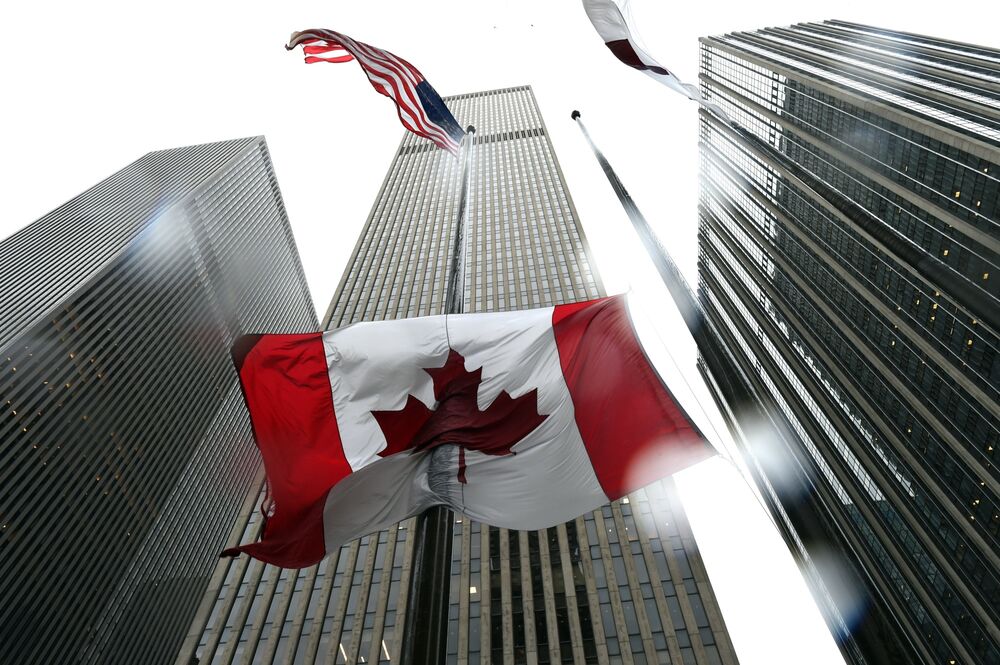
While the malignant individual in the White House bloviates about "making America great again" and tells his knuckle dragging supporters that he will bring back their economic hopes, a piece in Bloomberg reports that other than America's obscenely rich very wealthy, Canadians are better off economically than their American counterparts (seemingly without factoring the fact that Canadians have a national healthcare system).   Moreover, the piece notes that a number of other advanced nations are seeing their citizens pulling ahead of their American counterparts.  The net take away?  The GOP's version of America's vulture capitalism is serving the very rich but failing the majority of Americans.  Here are article excerpts:

Everybody knows that the U.S. version of capitalism is rougher and tougher than is the norm in other affluent countries. The rich are richer here, the poor poorer and the welfare state less exhaustive. Not surprisingly, the U.S. scores poorly versus other rich nations in terms of health outcomes, education levels and other such metrics.
Defenders of the U.S. approach can point, though, to the fact that per-capita gross domestic product has remained higher in the U.S. than in all but a few small nations with unique characteristics (Qatar, Luxembourg, Singapore, Switzerland, Norway, etc.) — so much higher that even with the less-equal income distribution here, most Americans continue to have higher incomes than their peers in other large, affluent countries.
Times may be changing, though, and international income comparisons are definitely getting more precise. Five years ago, David Leonhardt and Kevin Quealy of the New York Times showed using numbers from the Luxembourg Income Study Database that the median income in Canada had caught up with that of the U.S. as of 2010, and speculated that Canada had probably passed the U.S. since.
Now there’s more evidence. A report released this summer by the Centre for the Study of Living Standards, an Ottawa nonprofit, contends that as of 2016 Canada had in fact pulled ahead of the U.S. in median household income, with a $59,438 to $58,849 advantage in U.S. dollars . . . . The study also compares incomes in every percentile of the income distribution, and finds that up through the 56th percentile Canadians are better off than their U.S. counterparts.
U.S. residents at the top of the income distribution make a lot more than Canadians at the top of the distribution, and Canadians at the bottom make a lot more than their south-of-the-border peers. In the middle of the distribution the income differences are much smaller, but the Canadians have seized the advantage.
Finally, and this is of course totally anecdotal, but I think most Americans who have visited Canada lately would attest that it feels like a more broadly affluent place than the U.S. does. That is, the claim that most Canadians are more prosperous than most Americans is not patently unreasonable.
It’s not just in Canada that those in the middle of the income distribution have been gaining on their American peers. From 1990 through 2018, according to the World Bank, per-capita real gross domestic product grew at the same 1.5% annual rate in the U.S., the European Union and the OECD, which counts 36 affluent democracies on five continents as members. In other words, the rough-and-tough U.S. approach to capitalism hasn’t delivered faster per-capita growth, and istribution, that means Americans in the middle and the bottom have been losing gbecause growth in the U.S. has been concentrated at the very top of the income dround to their counterparts in other countries.
The bottom line: When it comes to improving the lives of the middle class, other rich countries have been doing a better job than the United States.

Wednesday, November 26, 2014

Who Will Save the Democratic Party From Itself?


After its disastrous experience in the 2014 midterm elections, some think that the Democratic Party needs to refocus itself and return to some of its historic roots as a champion of the working and middle classes.  One such person is former Virginia Senator James Webb who has announced an exploratory effort on a run for the Democratic presidential nomination in 2016.  There are positive aspects to Webb's vision, but the question is whether he or anyone else can cause the party to recalibrate itself and/or force Hillary Clinton to do so.  The Democrats need a stirring theme and agenda and just saying that they are not crazy and/or a bunch of hate merchants like the Republicans - true as that may be - isn't enough to recapture the battered middle class.  We need to reignite social mobility for the younger voters and give parents an ability to once again believe their children have a better future.  Here are highlights from a New York Times editorial:
Not everyone agrees that Hillary Clinton’s selection as the Democratic nominee is unstoppable. The first to challenge her is Jim Webb, a one-term former senator from Virginia.

Here is the case for the Democratic Party renegade.  When Webb, who served as secretary of the Navy under Ronald Reagan, announced the formation of a presidential exploratory committee on Nov. 19, he sought to capitalize on Democratic discontent. Taking a swipe at both Wall Street and Clinton’s potential bid for the nomination, Webb declared:
Our Constitution established a government not to protect the dominance of an aristocratic elite, but under the principle that there should be no permanent aristocracy, that every single American should have equal protection under the law, and a fair opportunity to achieve at the very highest levels.
Webb suggested that he could bring working class whites back into the Democratic fold and restore the biracial Democratic coalition:
We have drifted to the fringes of allowing the very inequalities that our Constitution was supposed to prevent. Walk into some of our inner cities if you dare, and see the stagnation, poverty, crime and lack of opportunity that still affects so many African-Americans. Or travel to the Appalachian Mountains, where my own ancestors settled and whose cultural values I still share, and view the poorest counties in America – who happen to be more than 90 percent white, and who live in the reality that “if you’re poor and white you’re out of sight.”
Webb’s exploration of a presidential bid is based on the premise that he can tap into a crucial but alienated segment of the electorate.

This bloc includes voters convinced that Wall Street owns both parties, voters tired of politicians submitting to partisan orthodoxy and voters seeking to replace “identity group” politics with a restored middle- and working-class agenda.

Webb is one answer to the weaknesses of today’s center-left, the so-called “upstairs-downstairs” coalition described by Joel Kotkin, presidential fellow in Urban Futures at Chapman University. Kotkin argues in his recently published book, “The New Class Conflict,” that the Democratic Party has been taken over by what he calls “gentry liberals,” an elite that has undermined the historic purpose of the Democratic Party.  Kotkin contends that
The great raison d'ĂȘtre for left-wing politics – advocating for the middle- and working classes – has been refocused to attend more closely to the policy imperatives and interests of small, highly affluent classes, as well as the powerful public sector.
I asked Kotkin what he thought of the themes Webb intends to raise, and he wrote back “I think he’s onto something.”

Al Hunt, a Bloomberg columnist, warned that Webb “could be Hillary Clinton’s worst nightmare,” noting that Webb
seems an improbable candidate. He has taken illiberal positions, was President Ronald Reagan’s Navy secretary, has few relationships within the Democratic Party, and has no serious fund-raising network. What he does possess is a long-held and forceful opposition to U.S. interventions in Iraq and Libya, and potentially Syria, as well as solid anti-Wall Street credentials. In Democratic primaries, these may be Clinton’s greatest impediments to rallying a hard-core activist base.
To gauge Webb’s prospects, I looked at the exit poll data for the 2006 Virginia Senate race, when he unseated George Allen, the favored Republican. I then compared Webb’s performance among key constituencies to the performance of all House Democrats running nationwide in the same year.

The results of this comparison do not support the portrayal of Webb as a candidate equipped to win over key white constituencies.

What are the prospects of winning the presidential nomination for a candidate who challenges current Democratic Party strategic orthodoxy? This strategy calls for identity group, rather than class-based, mobilization, on the assumption that turning out single women, the young, and racial and ethnic minorities is more effective than an uphill struggle to revive support in the recalcitrant white middle and working class.

As much as such a shift to a class-based strategy might result in economic policies more beneficial to less affluent Democratic constituencies, and therefore to more votes in the long haul, so far there has been insufficient intraparty pressure to force a change in strategic orientation.

It is not lost on Democratic strategists that President Obama won twice deploying a group-based rather than a class-based strategy. Even if the next Democratic nominee does not inspire the high minority turnout levels of 2008 and 2012, the 2016 electorate will be less Republican than it was in 2012. Every four years, the heavily Republican white share of voters drops by a little over 2 percent, and the disproportionately Democratic minority share grows by the same amount.

Insofar as the Republican Party tempers its retrograde stance on social-sexual and moral-racial issues, Democratic campaigns stressing alleged threats from conservatives — the threat to freedom and privacy posed by the Christian right; the threat to Hispanic family unity posed by anti-immigrant activists; the threat to programs serving the poor posed by deficit hawks — will run out of gas.

Democrats, according to Pew, retained an advantage on less tangible qualities such as empathy, honesty and a willingness to compromise.  As attractive as those characteristics are, they are not top priorities for voters. . . . . voters’ top priorities consistently include bread-and-butter issues, jobs and the economy.

The Democrats’ lack of credibility on economic issues will hobble, if not extinguish, the party’s prospects. Unless the Democrats develop a coherent, comprehensive strategy for the have-nots, it won’t matter whether the party’s nominee is Clinton, Webb or anyone else.

Thursday, September 04, 2014

Bring Back the Party of Lincoln


If one knows the full history of the Republican Party it quickly becomes apparent that today's GOP is an ugly aberration away from what the party once stood for.  Fueling the GOP's decline into something ugly, as I have argued before, have been the Christofascists, many of whom are the modern day descendants of racist Southern whites and white supremacists who are terrified at what they perceive to be the loss of white privilege.  The GOP has transformed from a party of fiscally conservative, socially moderate country club Republicans to a party of religious extremists, robber barons and what my New Orleans belle grandmother would have deemed poor white trash.   A piece in the New York Times seeks to remind us of what the GOP once was and argues that the party needs to return to its roots.  Here are excerpts:
FOR all the differences between establishment Republicans and Tea Party insurgents, their various efforts to rebrand the Grand Old Party tend to start from a common premise: the belief that Ronald Reagan was the quintessential Republican, and that his principle of defending wealth and the wealthy should remain the party’s guiding vision.

In doing so, they misunderstand the party’s longer history. They would do better to look to earlier presidents, and model their new brand on the eras when the Republican Party opposed the control of government by an elite in favor of broader economic opportunity.

The history of the Republican Party is marked by vacillation between its founding principle of opportunity and its domination by the wealthy elite. The party came together in the 1850s in opposition to the wealthy slaveholders who controlled the federal government. Democrats acting on their behalf insisted that America’s primary principle was the Constitution’s protection of property, and they pushed legislation to let planters monopolize the country’s resources at the expense of the working class.

Abraham Lincoln and others recoiled from the idea of government as a prop for the rich. In organizing the Republican Party, they highlighted the equality of opportunity promised in the Declaration of Independence and warned that a healthy economy depended on widespread prosperity. Northerners and hardscrabble Westerners flocked to that vision, and elected Lincoln to the White House in 1860.

Even as the Civil War raged, Republicans made good on their promise: They gave farmers their own land, created public colleges, funded a transcontinental railroad, took control of the national currency away from rich bankers, and ended slavery. To pay for their initiatives, they invented national taxes, including the income tax. The middle class grew, and the North and West, regions covered by the new programs, boomed.

But as soon as the war ended, wealthy Americans joined with those who hated African-Americans and immigrants to insist that slaveholders had been right: Permitting poor men to have a say in government had produced policies that redistributed wealth. Only a few years after building a federal system that cleared the way for equal opportunity, Republicans faced a racist and xenophobic backlash against an active government — and they folded. 

In 1893, the economy crashed, and too few Americans had enough purchasing power to revive it. Lincoln had been right: Government that served the wealthy would ruin the country.

The party responded, and a new Republican Party emerged from the Panic of 1893, rededicated to Lincoln’s vision. Led by Theodore Roosevelt, the progressive Republicans recognized that government had to address the systemic inequalities of industrialization or no man could rise.

They cleaned up the cities, promoted public education, protected workers and regulated business. Their policies fed a strong and growing middle class; their vision resurrected the Republican Party.

It took a new leader who would embrace Lincoln’s principles to return the party to health. Dwight D. Eisenhower’s experiences in World War II convinced him that the only way to prevent the rise of dictators was to promote economic equality around the world. He used the government to desegregate American schools, promote higher education and start the largest public works program in American history, the 1956 Federal-Aid Highway Act.

The consequences were predictable: After Reagan’s 1980 election, economic stability turned into the Great Divergence, in which wealth moved steadily upward. In 2008, the economy crashed.

Twice in its history, the Republican Party regained its direction and popularity after similar disasters by returning to its original defense of widespread individual economic success. The same rebranding is possible today, if Republicans demote Reagan from hero to history and rally to a leader like Lincoln, Roosevelt or Eisenhower — someone who believes that the government should promote economic opportunity rather than protect the rich.

Yes, re-branding is possible, but I do not see how sane, decent people can easily re-brand a party whose base is controlled mostly by extremists and those most motivated by their hatred of others.  I don't see anyone among today's GOP leaders up to the challenge.

Thursday, April 24, 2014

How the Democrats Can Hold the Base and Woo Swing Voters


With the chances that the Democrats may hold onto control of the U.S. Senate after all looking up slightly, the main issue becomes one of how to (A) motivate the party base to get off their often lazy, complacent butts and go to the polls in November, and (B) woo enough swing voters to win general elections in closely contested states.  As prior posts have noted, the GOP obsession with Obamacare bashing may be weakening except among the most hard core Kool-Aid drinking elements of the GOP base.  But the Democrats need to step up their game and go on the offensive rather just sit back and play defense.  A column in the Washington Post suggests a possible strategy.  Here are column highlights:

The Democrats’ biggest strategic challenge in maintaining control of the Senate involves motivating the party’s base while simultaneously attracting swing and even Republican voters in contests being waged in conservative states.

This base-vs.-swing dilemma exists in every election, but the tension is aggravated for Democrats this year because they are trying to hold so many seats in Republican territory. Incumbents such as Mary Landrieu in Louisiana, Mark Pryor in Arkansas, Mark Begich in Alaska and Kay Hagan in North Carolina can’t win with the base alone. The Democrats’ hopes to take seats away from the GOP in Kentucky and Georgia also hinge on reaching beyond loyalists.

Compounding the Democrats’ quandary: President Obama’s approval ratings are particularly low in the red states with tough Senate races. This explains the ambivalence of many in his party toward the Affordable Care Act (ACA), and it’s the reason Republicans insist on calling it “Obamacare.”

The law has been working far better than Republicans who predicted its demise last fall said it would. And if Democrats don’t force Republicans to acknowledge the high costs of repealing the ACA, the airwaves will be dominated by horror stories — many of them made up out of whole cloth — about the law’s shortcomings.

Democrats are trying to figure out how to defend the “care” part of Obamacare while encouraging voters outside their base to forget the “Obama” part.

But the decisive question may be whether Democrats can find crossover issues that turn out their core constituencies while also persuading undecided voters in the red states to come their way.

Both publicly and privately, Democrats say they are well into this quest. Senate Majority Leader Harry Reid of Nevada and Sen. Chuck Schumer of New York have been pushing what they call the party’s “fair shot” agenda. Its components include raising the minimum wage and measures to make college more affordable. They are also aggressively seeking to tie the entire Republican Party to David and Charles Koch, the billionaire brothers who are spending lavishly on behalf of the GOP.

[R]evive the party’s 2012 campaign theme contrasting the interests of the top “1 percent” with what’s good for the rest of the country. They would have the party link this overarching theme to policies promising relief and opportunity to middle-class voters, especially women who are already more inclined toward the Democrats. 

Similarly, economists Jared Bernstein and Harry Holzer, writing Wednesday in the Hill, outlined a battery of policies on job training, immigration, corporate taxes, labor regulation and infrastructure investment that would lead companies to create jobs in the United States rather than overseas. The point, again, is that shared growth will be achieved only through affirmative steps by government.

The 2014 elections will hang on many tactical decisions. But above all, they underscore how urgent it is for center and left alike to make a sustained and credible argument that individual prosperity requires thoughtful public action. It’s a case the liberal base wants to hear and that swing voters need to find compelling.

Sunday, June 23, 2013

The Decline of American Society and the Revolt of the Global Middle Class


As the parent of three adult children it is interesting that none of my children expect to do as well financially or to have the life style that my late parents achieved.  Admittedly, my parents died as millionaires, but neither I nor my siblings can be assured of the same financial success in our lifetimes and for our children the deck is stacked even more decidedly in favor of the truly wealthy as social mobility in America falls behind that of Europe and wealth disparities exceed those of former banana republics.  It is little wonder why the Republican Party is faring poorly with younger voters.   But the phenomenon is not limited to  America as we see unrest in Brazil and Turkey and other nations as well.  Sadly, the status quo favors the few and the rest of us are increasingly expected to be satisfied with the table scraps that are left over.  A piece in The Guardian looks at what has happened to America.  Here are highlights:

In or around 1978, America's character changed. For almost half a century, the United States had been a relatively egalitarian, secure, middle-class democracy, with structures in place that supported the aspirations of ordinary people. You might call it the period of the Roosevelt Republic. Wars, strikes, racial tensions and youth rebellion all roiled national life, but a basic deal among Americans still held, in belief if not always in fact: work hard, follow the rules, educate your children, and you will be rewarded, not just with a decent life and the prospect of a better one for your kids, but with recognition from society, a place at the table.

This unwritten contract came with a series of riders and clauses that left large numbers of Americans – black people and other minorities, women, gay people – out, or only halfway in. But the country had the tools to correct its own flaws, and it used them: healthy democratic institutions such as Congress, courts, churches, schools, news organizations, business-labour partnerships.

The large currents of the past generation – deindustrialisation, the flattening of average wages, the financialisation of the economy, income inequality, the growth of information technology, the flood of money into Washington, the rise of the political right – all had their origins in the late 70s.  ..

The institutions that had been the foundation of middle-class democracy, from public schools and secure jobs to flourishing newspapers and functioning legislatures, were set on the course of a long decline. It as a period that I call the Unwinding.

Once American pre-eminence was challenged by international competitors, and the economy hit rough seas in the 70s, and the sense of existential threat from abroad subsided, the deal was off. Globalisation, technology and immigration hurried the Unwinding along, as inexorable as winds and tides. It is sentimental at best, if not ahistorical, to imagine that the social contract could ever have survived – like wanting to hang on to a world of nuclear families and manual typewriters.

But there was nothing inevitable about the aftermath – an unmanaged free-for-all in which unemployed workers were left to fend for themselves, while corporate raiders bought the idle hulks of the mills with debt in the form of junk bonds and stripped out the remaining value. It may have been inevitable that the constraints imposed on US banks by the Glass-Steagall Act of 1933 would start to slip off in the era of global finance. But it was a political choice on the part of Congress and President Bill Clinton to deregulate Wall Street so thoroughly that nothing stood between the big banks and the destruction of the economy.

Much has been written about the effects of globalisation during the past generation. Much less has been said about the change in social norms that accompanied it. American elites took the vast transformation of the economy as a signal to rewrite the rules that used to govern their behaviour: a senator only resorting to the filibuster on rare occasions; a CEO limiting his salary to only 40 times what his average employees made instead of 800 times; a giant corporation paying its share of taxes instead of inventing creative ways to pay next to zero. There will always be isolated lawbreakers in high places; what destroys morale below is the systematic corner-cutting, the rule-bending, the self-dealing.
It is little wonder that many younger voters have little faith in America and the future.  But the phenomenon is not limited to America as noted in a piece in The Atlantic which notes that what has happened in America is happening elsewhere - e.g., Brazil and Turkey.  Here are excerpts from that article:

From Turkey to Brazil to Iran the global middle class is awakening politically. The size, focus and scope of protests vary, but this is not unfolding chaos -- it is nascent democracy. Citizens are demanding basic political rights, accountable governments and a fairer share of resources.  

Overall, though, Americans jaded about world affairs should see the activism as positive. The protesters are performing the same role as middle classes have in developed nations. As their standard of living rises, so do their expectations of government.

The political dynamic in each country is different, of course. In Turkey, the protests are not the equivalent of the Arab Spring demonstrations that toppled governments across the Middle East. Nor are they simply a pitched battle between religious conservatives and secular liberals. Instead, they are deeply Turkish -- and hugely important.

Brazil presents a different dynamic.The ruling Workers' Party is left-leaning and its economic reforms have helped the poor and middle class. But now a souring economy, corruption scandals and $12 billion in government spending on 2014 World Cup stadiums has sparked one million people to take to the streets.

Marcelo Ridenti, a leading Brazilian sociologist, said reduced inequality and increased education have raised expectations. The number of university students in Brazil, for example, doubled from 2000 to 2011.

"This generates huge changes in society, including changes in expectations among young people," he told the New York Times . "They expect to get not only jobs, but good jobs."  

Pro-reform and urban Iranians frustrated with the country's weak economy, isolation and conservative monopoly on power apparently handed Rohani the presidency. Rohani may prove to be more conservative than expected, but his victory prompted thousands of Iranians to take to the streets.

"I am hopeful about the future," Hoda, a 26-year-old who asked that her last name not be used, told Reuters. "Hopeful that we will have more social freedoms, more stability in Iran, better relations with other countries and hopefully a much better economy.".

[O]bservers see parallels between Brazil's protests, India's anti-corruption movement , austerity protests in Europe, the U.S. Occupy Movement and similar demonstrations in Israel. 

First, the explosive spread of social media played a role in the movements. Networks of like-minded people were able to immediately communicate with one another -- and potential recruits. Some online information has been false orrestricted, but technological change has unquestionably sped up the pace of political organizing.

Second, all three movements are demanding basic individual rights and accountable government. They want non-corrupt leaders who respect their right to protest, gather and speak freely. From minority rights in Turkey, to fair elections in Iran, to better policing, healthcare and transit in Brazil, protesters want improved governance. 

That's right. These overseas movements want many many Americans want. especially an accountable government.  Barack Obama and Congressional Republicans, are you listening??  History has a lesson: when the majority of citizens are finding it harder and harder to survive, their interest in supporting the current political structure declines and governments fall, be it in ancient Rome or elsewhere.rest in supporting the

Wednesday, March 13, 2013

Republicans go after Obamacare (and the Middle Class). Again.

The GOP indeed sounds like a broken record.  At least when it comes to ranting and raving about the Affordable Health Care Act, a/k/a Obamacare and vowing to repeal it even thought the U.S. Supreme Court upheld most of the law last year.  And when it comes to slashing programs that assist the poor and the middle class.  Leading the charge is Joe McCarthy want to be and look alike, Senator Ted Cruz from Texas who makes one wonder what is in the water in the Lone Star State.  A column in the Washington Post looks at this weird obsession.  Here are excerpts:

Republicans campaigned for repeal in 2012, but President Obama was reelected and Democrats gained seats in the Senate and the House and won the popular vote. Since the election, Republican governors have begun to embrace the law. 

Here in Washington, though, it is as though tea party activists are still marching on the Capitol. On Wednesday, Senate Republicans supported legislation proposed by the freshman Cruz to defund Obamacare — the 35th attempt, give or take, to abolish the program.  This one failed, like all the others. 

Doing the same thing again and again and expecting a different result, it has been said, defines insanity. But among Senate Republicans, the lunatics are running the asylum. A few of the most junior members, with support from conservative activists, are calling the shots, while the caucus’s nominal leaders, intimidated by the newcomers’ power, have become followers.

This time it was the quixotic repeal effort by Cruz, who has been on the job for all of two months; McConnell made an unscheduled appearance on the Senate floor to associate himself with the doomed effort.

Cruz, the 42-year-old junior senator from Texas who will be the keynote speaker at this weekend’s Conservative Political Action Conference, was rallying his fellow Republicans in support of a dubious principle that implementing Obamacare means imminent economic ruin. “At a minimum, in my judgment, Obamacare should not be funded,” he said on the Senate floor, because “implementing it right now could well force us into a recession.”  “At a minimum.” That’s the same phrase Cruz used last month to imply that Chuck Hagel, now defense secretary, was on foreign payrolls.

At a minimum, Cruz is making Republican leadership look weak. Seniority has been tossed aside as McConnell of Kentucky and the No. 2 GOP leader, John Cornyn (Tex.), follow the cues of the junior senators from their home states, Paul and Cruz.  

The young Texan had managed to pull Senate Republicans even further to the right than their counterparts in the House, who opted not to seek a repeal of Obamacare in the legislation they just passed to fund the federal government. And House Budget Committee Chairman Paul Ryan’s budget would repeal the health-care law but keep $1 trillion in tax increases associated with the program.

The GOP descent into utter insanity seems to be proceeding without let up.  Of course, here in Virginia we have the equally insane and unhinged Ken Cuccinelli as the ostensible GOP standard bearer.

Sunday, March 10, 2013

GOP Meltdown: Paul Ryan Budget Attacks GOP's Last Stronghold

With the Republican Party's base increasingly made up of angry, aging white voters, one would think that the last thing that the GOP would seek to do is attack programs that cater to this demographic.  Yet Paul "Modern Day Pharisee" Ryan's budget proposals do precisely that and could drive older voters towards the Democrats, leaving the GOP only with younger Christofascists (a diminishing breed) and younger white supremacists in the GOP base.  A piece in The Daily Beast looks at this potentially suicidal policy that with luck will hasten the demise of the GOP in its current incarnation.  Here are highlights:

After years of drifting apart, the jobs report and the stock market aligned this week, at least momentarily, as unemployment fell to the lowest level in over four years while the Dow and the S&P 500 continued to climb. We’re hardly out of the woods— the workforce participation rate remains stuck in neutral, overall growth remains sluggish, and worker income is still lagging behind the stock market gains—but there are signs of hope.

Yet some things don’t change. As the sputtering economy tries to get into gear, House Budget Committee Chairman Paul Ryan keeps talking about depriving hard working-taxpaying Americans of their retirement benefits, while offering nothing in return. This is the strategy that failed Mitt Romney and Ryan in November, and that alienates not just senior citizens, but voters over 45 — one of the few groups that’s so far remained reliably right-leaning as Asians, Hispanics, upscale Episcopalians, graduate degree holders and others have abandoned the shrinking GOP tent.
If the President’s electoral playbook called for uniting the rich and poor and treating the middle class as an afterthought, the Congressman has a more direct, if less palatable, approach: he simply attacks the middle class, by trying to gut their earned entitlement programs.

Apparently, the failed vice presidential candidate has not internalized these lessons. Instead, Ryan & Co. seems to be doubling down on 2012’s failed bet, and treating working Americans as little more than moochers. A year ago, Candidate Ryan called for voucher care instead of Medicare for Americans who were then 55 and under. Now, he is pressing the idea of setting the cut-off at 56 in an effort to force more Americans off of Medicare.


Single women now rival white evangelicals as a voting bloc, and the former – which preferred Obama to Romney by a staggering two-to-one margin—is just not cottoning to the Republicans’ message on personal autonomy or anything else. With childrearing and marriage increasingly distinct and recent studies showing that the life expectancies of subgroups of women are declining regionally, even as life expectancy on the whole is rising, a call to replace a long-established safety net with faux personal responsibility is not a winning message.
Religion also has lost traction at the lower end of the income spectrum, particularly outside of the South. .  .  .  . 
The question for the Republican Party is whether it has the will to change. After losing five straight elections to FDR's New Deal Coalition, the Republicans got their act together. Will history repeat itself? One thing is for sure: Alienating your base when you need every vote that you can get is not smart politics.

Thursday, October 11, 2012

Mitt Romney's Tax Mythology Made Simple

Mitt Romney's not only telling opportunistic lies about his meeting with the lat Glen Doherty.  He is also lying when he talks about his fantasy land tax plan.  Simple math demonstrates that the numbers do not add up.  Even elementary school level math proves it easily if one adds it a 20% tax cut across the board and massive increases in military spending - spending at levels even the Pentagon has not requested.  A column in the Washington Post looks at Romney's dishonest approach to tax policy - his lies, if you will - that he repeated again during last week's debate.  The fact that most in the mainstream news media are not hammering Romney on this issue is akin to the same abandonment of journalistic responsibility that got the nation in the fool's errand known as the Iraq War.  Liars need to be exposed to protect the nation's well being.  Here are some column excerpts:

I’ve said this before, but Mitt Romney’s new formulation of his tax plan — one he used at the debate, and which he repeated to Wolf Blitzer yesterday — makes it absolutely clear that he’s lying about something. You don’t need complicated Tax Policy Center analysis, or for that matter anything beyond basic logic, to see why his pledge of revenue neutrality doesn’t jibe with what he’s saying. Here’s his quote to Blitzer:
“Well, I’ve made it pretty clear that my principles are, number one, simplify the code; number two, create incentives for small businesses and large businesses to grow; number three, don’t reduce the burden on high income taxpayers; and number four, remove the burden somewhat from middle income people.”
Now, in real life, we know that Romney’s actual specific pledges would yield a big tax cut for the rich. But even if you accept this version of Romney’s plan — even if you accept that Romney would cut the wealthy’s tax rates, and then offset that by taking away loopholes and deductions the rich enjoy — the overall math of his plan simply can’t work.

For some people, Romney says he’ll keep taxes the same. For everyone else, he’ll lower them.
I’ll repeat that just to make sure everyone gets it. Some have the same taxes; some have less. I’ll even put Romney’s pledge in equation form, for those mathematically inclined:
0 + (-X) = 0, where X > 0
That simply can’t work. Romney can’t do what he says and yet keep revenues the same. At least, not unless he’s using one of those spells that Hermione bothered learning while everyone else was hanging out on the Quidditch pitch.

There’s just no excuse for reporters to ignore this glaring, central impossibility. Hey, reporters! Next time you interview Mitt Romney and he repeats this formula about lower taxes for some and the same taxes for everyone else, ask him how that goes with his pledge that he won’t increase the deficit with his tax plan.

And while you’re at it, push him on the real key question: if it turned out that his fantasy math falls short and the experts are correct, what would he give up: the big cut in rates? Tax levels for the middle class? Or revenue neutrality? It has to be one of them. Because not even Dumbledore could make Romney’s basic “principles” work.

Friday, October 05, 2012

Romney Dodges the Facts

I noted yesterday the many lies that Mitt Romney told during the first presidential debate - 27 by last count - and fortunately some in the media are slamming him for both his dishonesty and for the ruinous consequences of his tax plan that he lied about as well during the debate.  The man is a pathological liar and flip flops on his positions so often and so sharply it is nothing sort of a miracle that he doesn't have whip lash.  The Washington Post's main editorial goes after this sorry excuse of a man in today's issue of that paper.  Here are excerpts:

Republican nominee Mitt Romney has a plan to make it [the U.S. budget deficit] worse.  To understand that harsh assessment, you have to spend a few minutes with some facts that Mr. Romney did his best to obscure Wednesday.

“First of all, I don’t have a $5 trillion tax cut,” he said.

In fact, Mr. Romney has proposed lowering income tax rates, abolishing the estate tax and making other changes that would cost $5 trillion over 10 years. When he says he has no such plan, he means that he intends to make up for the lost revenue by closing loopholes — what’s benignly known as “broadening the base.” Moreover, he says he can close so many loopholes for rich people that the middle class will end up paying less.

But even if you close every rich person’s loophole, you don’t save enough money to do everything Mr. Romney wants to do. The Republican cites studies that he says prove that wrong, but when you look closely, they prove him wrong. For example, Harvard economist (and Romney adviser) Martin Feldstein showed that you could pay for Mr. Romney’s tax cut by taking away deductions — mortgage interest, charitable, state and local tax — from households making more than $100,000. But then Mr. Romney said he considers households earning up to $250,000 to be middle class. So the math collapses again.

Mr. Romney’s plan is irresponsible, even if he could pay for it. The bipartisan Simpson-Bowles commission, which he chastised Mr. Obama for not endorsing, concluded that the country cannot solve its fiscal problem without raising revenue and cutting spending. 

An op-ed column in the Washington Post also looks at the factual dishonesty of Mr. Romney.  Here are highlights:

The Republican nominee produced a rare presidential smile when he spoke of being the father of five boys and, therefore, “used to people saying something that’s not always true, but just keep on repeating it and ultimately hoping I’ll believe it.” Yet Romney was the ultimate practitioner of this repeated-enough tactic, especially on the topic of his plan to cut personal income tax rates by 20 percent.

Romney waved away any questions about how to fill the $5 trillion hole with airy promises of curtailed deductions, unspecified, and economic growth, assumed. Reputable analyses show this is not feasible without raising taxes on the middle class? “There are all these studies out there,” Romney said, waving them away. But facts are stubborn things.

Asked what he would cut, Romney was reduced, once again, to citing Big Bird. “I’m sorry, Jim, I’m going to stop the subsidy to PBS,” he told moderator Jim Lehrer. Amount of federal spending on the Corporation for Public Broadcasting in fiscal year 2013? A whopping $445 million. Million, with an M. Chump-change cuts like this can hardly be taken seriously.

Romney was blatantly dishonest at numerous points. He said the new Medicare payment board would “tell people ultimately what treatments they’re going to receive,” when the statute specifically prohibits such judgments. He said reelecting Obama would mean “dramatic” and “devastating” military cuts — when those are called for in the to-be-avoided-at-all-costs sequester that Romney’s running mate voted for.

Thursday, October 04, 2012

The 27 Debate Lies of Mitt Romney

I've noted previously that I found Mitt Romney's lies last night during the first presidential debate to be both infuriating and to be nauseating but sadly all to typical of today's Republicans and politicians who wrap themselves in religiosity even as the do violence to the dictates of the Ten Commandments.  It seems that a number of media outlets are endeavoring to expose Romney's blatant and deliberate lies and I hope the phenomenon continues to grow.  It is crucial that Americans realize that Mitt Romney is  cynical liar who will say whatever he thinks will further his cause.  Frankly, most whores are more honest than Romney.  Think Progress has put together a good summary of the top 27 lies of Mitt Romney during last night's debate.  Due to the importance of exposing Romney's shameless and deliberate lies, the following is a more or less verbatim excerpt of the Think Progress piece:

[Romney] spoke for 38 minutes of the 90 minute debate and told at least 27 myths:

1) “[G]et us energy independent, North American energy independent. That creates about 4 million jobs”. Romney’s plan for “energy independence” actually relies heavily on a study that assumes the U.S. continues with fuel efficiency standards set by the Obama administration. For instance, he uses Citigroup research based off the assumption that “‘the United States will continue with strict fuel economy standards that will lower its oil demand.” Since he promises to undo the Obama administration’s new fuel efficiency standards, he would cut oil consumption savings of 2 million barrels per day by 2025.

2) “I don’t have a $5 trillion tax cut. I don’t have a tax cut of a scale that you’re talking about.” A Tax Policy Center analysis of Romney’s proposal for a 20 percent across-the-board tax cut in all federal income tax rates, eliminating the Alternative Minimum Tax, eliminating the estate tax and other tax reductions, would reduce federal revenue $480 billion in 2015. This amounts to $5 trillion over the decade.

3) “My view is that we ought to provide tax relief to people in the middle class. But I’m not going to reduce the share of taxes paid by high-income people.” If Romney hopes to provide tax relief to the middle class, then his $5 trillion tax cut would add to the deficit. There are not enough deductions in the tax code that primarily benefit rich people to make his math work.

4) “My — my number-one principal is, there will be no tax cut that adds to the deficit. I want to underline that: no tax cut that adds to the deficit.” As the Tax Policy Center concluded, Romney’s plan can’t both exempt middle class families from tax cuts and remain revenue neutral. “He’s promised all these things and he can’t do them all. In order for him to cover the cost of his tax cut without adding to the deficit, he’d have to find a way to raise taxes on middle income people or people making less than $200,000 a year,” the Center found.

5) “I will not under any circumstances raise taxes on middle-income families. I will lower taxes on middle-income families. Now, you cite a study. There are six other studies that looked at the study you describe and say it’s completely wrong.” The studies Romney cites actually further prove that Romney would, in fact, have to raise taxes on the middle class if he were to keep his promise not to lose revenue with his tax rate reduction.

6) “I saw a study that came out today that said you’re going to raise taxes by $3,000 to $4,000 on middle-income families.” Romney is pointing to this study from the American Enterprise Institute. It actually found that rather than raise taxes to pay down the debt, the Obama administration’s policies — those contained directly in his budget — would reduce the share of taxes that go toward servicing the debt by $1,289.89 per taxpayer in the $100,000 to $200,000 range.

7) “And the reason is because small business pays that individual rate; 54 percent of America’s workers work in businesses that are taxed not at the corporate tax rate, but at the individual tax rate….97 percent of the businesses are not — not taxed at the 35 percent tax rate, they’re taxed at a lower rate. But those businesses that are in the last 3 percent of businesses happen to employ half — half of all the people who work in small business.” Far less than half of the people affected by the expiration of the upper income tax cuts get any of their income at all from a small businesses. And those people could very well be receiving speaking fees or book royalties, which qualify as “small business income” but don’t have a direct impact on job creation. It’s actually hard to find a small business who think that they will be hurt if the marginal tax rate on income earned above $250,000 per year is increased.

8) “Mr. President, all of the increase in natural gas and oil has happened on private land, not on government land. On government land, your administration has cut the number of permits and licenses in half.” Oil production from federal lands is higher, not lower: Production from federal lands is up slightly in 2011 when compared to 2007. And the oil and gas industry is sitting on 7,000 approved permits to drill, that it hasn’t begun exploring or developing.

9) “The president’s put it in place as much public debt — almost as much debt held by the public as all prior presidents combined.” This is not even close to being true. When Obama took office, the national debt stood at $10.626 trillion. Now the national debt is over $16 trillion. That $5.374 trillion increase is nowhere near as much debt as all the other presidents combined.

10) “That’s why the National Federation of Independent Businesses said your plan will kill 700,000 jobs. I don’t want to kill jobs in this environment.” That study, produced by a right-wing advocacy organization, doesn’t analyze what Obama has actually proposed.

11) “What we do have right now is a setting where I’d like to bring money from overseas back to this country.” Romney’s plan to shift the country to a territorial tax system would allow corporations to do business and make profits overseas without ever being taxed on it in the United States. This encourages American companies to invest abroad and could cost the country up to 800,000 jobs.

12) “I would like to take the Medicaid dollars that go to states and say to a state, you’re going to get what you got last year, plus inflation, plus 1 percent, and then you’re going to manage your care for your poor in the way you think best.” Sending federal Medicaid funding to the states in the form of a block grant woud significantly reduce federal spending for Medicaid because the grant would not keep up with projected health care costs. A CBO estimate of a very similar proposal from Paul Ryan found that federal spending would be “35 percent lower in 2022 and 49 percent lower in 2030 than current projected federal spending” and as a result “states would face significant challenges in achieving sufficient cost savings through efficiencies to mitigate the loss of federal funding.” “To maintain current service levels in the Medicaid program, states would probably need to consider additional changes, such as reducing their spending on other programs or raising additional revenues,” the CBO found.

13) “I want to take that $716 billion you’ve cut and put it back into Medicare…. But the idea of cutting $716 billion from Medicare to be able to balance the additional cost of Obamacare is, in my opinion, a mistake. There’s that number again. Romney is claiming that Obamacare siphons off $716 billion from Medicare, to the detriment of beneficiaries. In actuality, that money is saved primarily through reducing over-payments to insurance companies under Medicare Advantage, not payments to beneficiaries. Paul Ryan’s budget plan keeps those same cuts, but directs them toward tax cuts for the rich and deficit reduction.

14) “What I support is no change for current retirees and near-retirees to Medicare.” Here is how Romney’s Medicare plan will affect current seniors: 1) by repealing Obamacare, the 16 million seniors receiving preventive benefits without deductibles or co-pays and are saving $3.9 billion on prescription drugs will see a cost increase, 2) “premium support” will increase premiums for existing beneficiaries as private insurers lure healthier seniors out of the traditional Medicare program, 3) Romney/Ryan would also lower Medicaid spending significantly beginning next year, shifting federal spending to states and beneficiaries, and increasing costs for the 9 million Medicare recipients who are dependent on Medicaid.

15) “Number two is for people coming along that are young, what I do to make sure that we can keep Medicare in place for them is to allow them either to choose the current Medicare program or a private plan. Their choice. They get to choose — and they’ll have at least two plans that will be entirely at no cost to them.” The Medicare program changes for everyone, even people who choose to remain in the traditional fee-for-service. Rather than relying on a guaranteed benefit, all beneficiaries will receive a premium support credit of $7,500 on average in 2023 to purchase coverage in traditional Medicare or private insurance. But that amount will only grow at a rate of GDP plus 1.5 percentage points and will not keep up with health care costs. So while the federal government will spend less on the program, seniors will pay more in premiums.

16) “And, by the way the idea came not even from Paul Ryan or — or Senator Wyden, who’s the co-author of the bill with — with Paul Ryan in the Senate, but also it came from Bill — Bill Clinton’s chief of staff.” Romney has rejected the Ryan/Wyden approach — which does not cap the growth of the “premium support” subsidy. Bill Clinton and his commission also voted down these changes to the Medicare program.

17) “Well, I would repeal and replace it. We’re not going to get rid of all regulation. You have to have regulation. And there are some parts of Dodd-Frank that make all the sense in the world.” Romney has previously called for full repeal of Dodd-Frank, a law whose specific purpose is to regulate banks. MF Global’s use of customer funds to pay for its own trading losses is just one bit of proof that the financial industry isn’t responsible enough to protect consumers without regulation.
18) “But I wouldn’t designate five banks as too big to fail and give them a blank check. That’s one of the unintended consequences of Dodd-Frank… We need to get rid of that provision because it’s killing regional and small banks. They’re getting hurt.” The law merely says that the biggest, systemically risky banks need to abide by more stringent regulations. If those banks fail, they will be unwound by a new process in the Dodd-Frank law that protects taxpayers from having to pony up for a bailout.
19) “And, unfortunately, when — when — when you look at Obamacare, the Congressional Budget Office has said it will cost $2,500 a year more than traditional insurance. So it’s adding to cost.” Obamacare will actually provide millions of families with tax credits to make health care more affordable.

20) “[I]t puts in place an unelected board that’s going to tell people ultimately what kind of treatments they can have. I don’t like that idea.” The Board, or IPAB is tasked with making binding recommendations to Congress for lowering health care spending, should Medicare costs exceed a target growth rate. Congress can accept the savings proposal or implement its own ideas through a super majority. The panel’s plan will modify payments to providers but it cannot “include any recommendation to ration health care, raise revenues or Medicare beneficiary premiums…increase Medicare beneficiary cost-sharing (including deductibles, coinsurance, and co- payments), or otherwise restrict benefits or modify eligibility criteria” (Section 3403 of the ACA). Relying on health care experts rather than politicians to control health care costs has previously attracted bipartisan support and even Ryan himself proposed two IPAB-like structures in a 2009 health plan.

21) “Right now, the CBO says up to 20 million people will lose their insurance as Obamacare goes into effect next year. And likewise, a study by McKinsey and Company of American businesses said 30 percent of them are anticipating dropping people from coverage.” The Affordable Care Act would actually expand health care coverage to 30 million Americans, despite Romney fear mongering. According to CBO director Douglas Elmendorf, 3 million or less people would leave employer-sponsored health insurance coverage as a result of the law.

22) “I like the way we did it [health care] in Massachusetts…What were some differences? We didn’t raise taxes.” Romney raised fees, but he can claim that he didn’t increase taxes because the federal government funded almost half of his reforms.

23) “It’s why Republicans said, do not do this, and the Republicans had — had the plan. They put a plan out. They put out a plan, a bipartisan plan. It was swept aside.” The Affordable Care Act incorporates many Republican ideas including the individual mandate, state-based health care exchanges, high-risk insurance pools, and modified provisions that allow insurers to sell policies in multiple states. Republicans never offered a united bipartisan alternative.

24) “Preexisting conditions are covered under my plan.” Only people who are continuously insured would not be discriminated against because they suffer from pre-existing conditions. This protection would not be extended to people who are currently uninsured.

25) “In one year, you provided $90 billion in breaks to the green energy world. Now, I like green energy as well, but that’s about 50 years’ worth of what oil and gas receives.” The $90 billion was given out over several years and included loans, loan guarantees and grants through the American Recovery Act. $23 billion of the $90 billion “went toward “clean coal,” energy-efficiency upgrades, updating the electricity grid and environmental clean-up, largely for old nuclear weapons sites.”

26) “I think about half of [the green firms Obama invested in], of the ones have been invested in have gone out of business. A number of them happened to be owned by people who were contributors to your campaigns.” As of late last year, only “three out of the 26 recipients of 1705 loan guarantees have filed for bankruptcy, with losses estimated at just over $600 million.”

27) “If the president’s reelected you’ll see dramatic cuts to our military.” Romney is referring to the sequester, which his running mate Paul Ryan supported. Obama opposes the military cuts and has asked Congress to formulate a balanced approach that would avoid the trigger.

Wednesday, September 05, 2012

Bill Clinton's Speech Taking Down Romney

Bill Clinton just did a masterful job of calling Mitt Romney (and Paul Ryan) a liar.  No mincing of words, simply calling him out for telling deliberate lies.  It gets directly to the issues of the hypocrisy and betrayal of the Gospel message by the Republicans that drives me crazy.  Andrew Sullivan has some good bullet points in his live blogging.  Here is a sampling:

[B]y being a former president and exposing the shameless lies perpetrated by Romney, especially on welfare reform, he was able to say things no one else could. I don't buy the argument that Obama is more liberal than Clinton and never have. But for those who do, tonight was a brilliant reminder of the things that unite them. 

11.18 pm. Republicanism today is failed arithmetic. Clinton is really bringing this home - intellectually. It is not a series of platitudes; it is a series of arguments rebutting last week's entire convention arguments. It has far more policy substance than Romney's or Ryan's speeches. And it has the added benefit of being true.

11.15 pm. Clinton is now equating Obama's plan with Bowles-Simpson. And when you spell out the Romney plan as it exists, it does not add up. And it's perverse. Cutting revenues as a way to cut debt when revenues are at 50 year lows is not a policy. It's madness.

11.11 pm. Now the important passage on Romney's massive welfare lie. The requirement was for more work, not less. Bill Clinton is the perfect man to rebut this lie. I wonder if it will have some serious blowback for Romney. A former president has called him out on a clear lie.

11.10 pm. Now he's telling seniors that slashing Medicaid means slashing home-care for the elderly.

10.51 pm. Clinton's summary of Republican malfeasance these past four years is simply liberating. Liberating because it is true: their moral and intellectual and political degeneracy is our biggest challenge. And he is directly comparing his re-election to Obama's. And he's being as honest as he can: no one could have repaired the full damage of the 2008 crash in four years - but the green shoots are there.

10.49 pm. Genius: "We left him a total mess and he hasn't cleaned it up fast enough so we should get back into power".
 
I haven't always liked Bill Clinton, but he did a wonderful job of exposing the abject lives that are the norm in today's GOP and the Romney-Ryan campaign.

Thursday, August 30, 2012

Quote of the Day: Andrew Sullivan on Romney's Speech:

Mitt Romney is proving that he's the perfect ideological fit with Paul Ryan - both are total liars and think the rest of us are fools.  They are the political figure equivalents to faux historian David Barton who rewrites history to have it fit his Christofascist agenda.  It's both mind numbing and frightening that this duo might land in the White House.  They might be better fit to be part of Adolph Hitler's propaganda machine.  They are not more dishonest.  Andrew Sullivan is appalled:

What we have been allowed to see is so spectacularly vacuous, I really don't know what to say. There is also a huge lie to start with:
Four years ago, I know that many Americans felt a fresh excitement about the possibilities of a new president. That president was not the choice of our party but Americans always come together after elections. We are a good and generous people who are united by so much more than divides us.
In the middle of the worst recession since the 1930s, in his first weeks in office, the GOP monolithically voted against his stimulus, including the third of it which was tax cuts. They even opposed tax cuts because Obama proposed them! Mitch McConnell said the following out loud:
"The single most important thing we want to achieve is for President Obama to be a one-term president."
Americans did not come together. One party, Mitt's, set out from the get-go to destroy Obama's presidency, regardless of the impact of the recession, which they helped intensify by slashing public sector jobs across the country and blocking any new stimulus after 2010. Then this lie about the situation in early 2009:
Every small business wanted these to be their best years ever, when they could hire more, do more for those who had stuck with them through the hard times, open a new store or sponsor that Little League team. Every new college graduate thought they'd have a good job by now, a place of their own, and that they could start paying back some of their loans and build for the future. This is when our nation was supposed to start paying down the national debt and rolling back those massive deficits.
Again, this is surreal. As the country was losing jobs at a rate of what can only be called free-fall, did everyone expect a sudden immediate boom, the best years of their lives? Was that the time when we should have suddenly started cutting spending? Romney knows this line of argument is premised on a fantasy. It's as if Romney cannot address the actual reality and propose solutions, but chooses to invent an entire alternative universe in which he can invent dreams no one in February 2009 had, listening to an Inaugural Address that told them that affairs were grim and foreboding and difficult.

Candidly, the tawdriest whore has move integrity than Mitt Romney.  The man's dishonesty is unbelievable and scary!   Let's be clear: I despise the man and think he and his reverse Robin Hood policies that would steal from the working poor and middle class and give to the rich are a danger to the country.

Thursday, August 23, 2012

Five Myths About the Romney/Ryan Budget

A number of stories around the Internet have described the Romney/Ryan campaign as the most dishonest ever.  Indeed, the approach seems to be to throw out as many lies as possible and leave it to the media and voters to figure out that they are being played for fools.  One of the areas in which shameless lies are being disseminated by Romney, Ryan and the GOP supporting PAC's is on what the GOP budget proposal would do.  They claim they would cut the budget deficit, but guess what, it's a lie.  A column in the Washington Post demolishes five of the myths/lies being put forth by the disingenuous GOP.  Here are excerpts:

Ryan, Mitt Romney’s running mate in the presidential election, has convinced many in Washington that his budget blueprint is a serious proposal for solving our long-term fiscal problems. Unfortunately, it’s not. Let’s dig into the asterisks of Ryan’s plan and unearth the fine print.
1. Paul Ryan’s budget would reduce the deficit.  The Ryan budget is a Potemkin village: It looks good from afar but is just a facade. The Congressional Budget Office has estimated that the plan would cut the public debt almost in half as a share of the economy by 2040. Sounds good, right?

Take a closer look, and you’ll see that the Ryan budget rests on three pillars that rely on capping and punting — limiting spending to a certain level but providing no specifics on how to achieve that number.

First, federal Medicaid spending is currently forecast to double by 2040, from 2 percent of gross domestic product to 4 percent. Under Ryan’s budget, it is projected to be cut in half over that period. This dramatic turnaround will supposedly occur by turning Medicaid over to the states through block grants. Anyone want to bet that will work?
 
Second, the Wisconsin congressman has specified $4.5 trillion in tax cuts, counting on massive rollbacks of tax breaks — such as the mortgage interest deduction — to pay for them. But he offers no details as to how to achieve such reductions, and most serious tax analysts don’t think such changes are politically feasible.

Third, Ryan assumes that nondefense discretionary spending, including education and basic government services, will fall from more than 12 percent of GDP last year to less than 5 percentby 2040. Again, he provides scant details on how to get there.

If you take out everything Ryan is assuming and look at his concrete proposals, his budget is not fiscally conservative. 

2. The Ryan budget would help the middle class.  Ryan says he would cut tax rates for all families, but that doesn’t mean the middle class would be any better off. Even after the Bush tax cuts, Ryan’s reductions would amount to about $1,000 a year for families with annual incomes between $50,000 and $75,000— compared with a cut of more than $250,000 a year for those with incomes above $1 million.

Furthermore, unlike the proposal from the nonpartisan Domenici-Rivlin deficit-reduction commission, the Ryan budget does not include any provisions to create jobs immediately. 

3. Ryan’s proposal would cut health-care spending by reforming Medicare.  Ryan says his plan would reduce health-care spending by increasing competition, but reality doesn’t remotely match his rhetoric. The CBO analyzed Ryan’s 2011 budget proposal, which would over time move Medicare entirely to private plans, and found that it would significantly increase total health-care spending (that is, spending by the government and Medicare beneficiaries).

4. Ryan’s plan would provide certainty to the markets and the economy.  Ryan likes to highlight the job-killing effects of uncertainty, but his budget would exacerbate it. Corporate executives hold back on investment and hiring when they don’t know what will happen next in terms of government policy. From that perspective, uncertainty is created when specifics are unknown — just like in Ryan’s plan.

5. If Romney wins, Ryan’s budget will be his fiscal blueprint.  .   .   .   .    if the Romney-Ryan ticket wins, their administration would probably have to choose one or two of the big three items: tax reform, Medicare changes or block-granting Medicaid. Among the three, I’d bet on Medicaid, given how difficult the other two goals are. The fact that the harm from block-granting would be concentrated on the poor, and that Congress would get to leave it to governors to impose the pain, sadly makes that change more politically viable than the others.


The author of the column is  Peter Orszag, director of the Office of Management and Budget from 2009 to 2010.