Showing posts with label Trump tax cuts. Show all posts

Tuesday, September 03, 2019

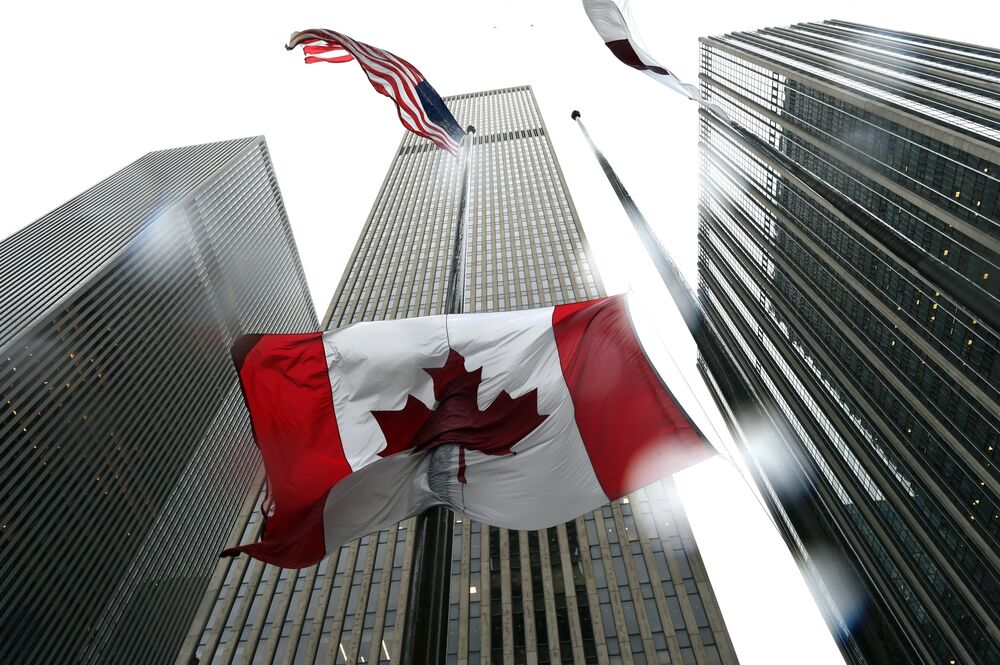
Most Canadians Are Now Better Off Than Most Americans

While the malignant individual in the White House bloviates about "making America great again" and tells his knuckle dragging supporters that he will bring back their economic hopes, a piece in Bloomberg reports that other than America's obscenely rich very wealthy, Canadians are better off economically than their American counterparts (seemingly without factoring the fact that Canadians have a national healthcare system).   Moreover, the piece notes that a number of other advanced nations are seeing their citizens pulling ahead of their American counterparts.  The net take away?  The GOP's version of America's vulture capitalism is serving the very rich but failing the majority of Americans.  Here are article excerpts:

Everybody knows that the U.S. version of capitalism is rougher and tougher than is the norm in other affluent countries. The rich are richer here, the poor poorer and the welfare state less exhaustive. Not surprisingly, the U.S. scores poorly versus other rich nations in terms of health outcomes, education levels and other such metrics.
Defenders of the U.S. approach can point, though, to the fact that per-capita gross domestic product has remained higher in the U.S. than in all but a few small nations with unique characteristics (Qatar, Luxembourg, Singapore, Switzerland, Norway, etc.) — so much higher that even with the less-equal income distribution here, most Americans continue to have higher incomes than their peers in other large, affluent countries.
Times may be changing, though, and international income comparisons are definitely getting more precise. Five years ago, David Leonhardt and Kevin Quealy of the New York Times showed using numbers from the Luxembourg Income Study Database that the median income in Canada had caught up with that of the U.S. as of 2010, and speculated that Canada had probably passed the U.S. since.
Now there’s more evidence. A report released this summer by the Centre for the Study of Living Standards, an Ottawa nonprofit, contends that as of 2016 Canada had in fact pulled ahead of the U.S. in median household income, with a $59,438 to $58,849 advantage in U.S. dollars . . . . The study also compares incomes in every percentile of the income distribution, and finds that up through the 56th percentile Canadians are better off than their U.S. counterparts.
U.S. residents at the top of the income distribution make a lot more than Canadians at the top of the distribution, and Canadians at the bottom make a lot more than their south-of-the-border peers. In the middle of the distribution the income differences are much smaller, but the Canadians have seized the advantage.
Finally, and this is of course totally anecdotal, but I think most Americans who have visited Canada lately would attest that it feels like a more broadly affluent place than the U.S. does. That is, the claim that most Canadians are more prosperous than most Americans is not patently unreasonable.
It’s not just in Canada that those in the middle of the income distribution have been gaining on their American peers. From 1990 through 2018, according to the World Bank, per-capita real gross domestic product grew at the same 1.5% annual rate in the U.S., the European Union and the OECD, which counts 36 affluent democracies on five continents as members. In other words, the rough-and-tough U.S. approach to capitalism hasn’t delivered faster per-capita growth, and istribution, that means Americans in the middle and the bottom have been losing gbecause growth in the U.S. has been concentrated at the very top of the income dround to their counterparts in other countries.
The bottom line: When it comes to improving the lives of the middle class, other rich countries have been doing a better job than the United States.

Thursday, March 08, 2018

Republicans Trash Their Candidate in Pennsylvania Special Election

Democrat candidate Conor Lamb.
Next Tuesday will see a special election in Pennsylvania that, with luck will see the GOP candidate lose and start a trend that will carry through through November, 2018.  What is interesting is that with the election not even yet past, Republicans are trashing their candidate as if setting the stage to throw him under the bus and blame the electoral loss on the individual candidate rather than the toxicity of today's GOP.  One can only hope that the intra-party backbiting and backstabbing continues - indeed, let's hope the phenomenon escalates. True, the Democrats have a telegenic candidate who has raised lots of money.  But the GOP's real problem is that its main message - GOP/Trump tax cuts and opposition to House Minority Leader Nancy Pelosi - doesn't energize voters.  Worse yet, voters who crossed party lines to vote for Trump are seemingly having a major case of buyer's remorse.  A piece in Politico looks at the drama playing out around next week's special election. Here are highlights:
Shortly after the new year, Rep. Steve Stivers, the House GOP campaign chief, delivered a stern message to Rick Saccone, the party's special election candidate in Pennsylvania.  You need to start pulling your weight, Stivers implored Saccone, the mustachioed 60-year-old state legislator who is carrying the weight of the Republican Party in a crucial contest next week.
Stivers’ warning, described by two people familiar with the discussion, was intended to put the candidate on notice. The national GOP would be helping him out substantially, Stivers said. But if Saccone didn’t start upping his fundraising game and getting his sluggish campaign in order, he could lose a race that should be a gimme for the party.
Tuesday’s special election, which is being held in a district President Donald Trump won by 20 percentage points, has emerged as the latest testing ground of whether Republicans are headed for a midterm bloodbath. A loss would be wholly embarrassing, many Republicans privately acknowledge, given that it would take place in a state that Trump made a cornerstone of his 2016 victory. And the themes that the GOP has highlighted in the special election — namely tax cuts and opposition to House Minority Leader Nancy Pelosi — are the centerpieces of the party’s 2018 campaign plan.
But as election day grows closer, the national GOP is increasingly pinning the blame on Saccone. In interviews with nearly two dozen administration officials, senior House Republicans and top party strategists, Saccone was nearly universally panned as a deeply underwhelming candidate who leaned excessively on the national party to execute a massive, multimillion-dollar rescue effort.
They describe a candidate who largely ignored pleas to raise the money he needed, who blindsided the White House and the national party with his choice of a political strategist, and whose amateur-style social media feed included low-quality videos of him at a local bar and yukking it up with Santa. To make matters worse, Saccone is up against a Democratic rival the party could hardly have engineered had it tried: Conor Lamb, an Ivy League-educated 33-year-old Marine veteran and former federal prosecutor.
Lamb has used a nearly $4 million war chest to cast himself as independent of his party, airing slickly produced TV ads underscoring his aversion to Pelosi and his fondness for shooting machine guns. He has a campaign staff of 16 full-time employees, compared with just four for Saccone. . . . .The Saccone campaign declined to comment.
Many Republicans expect that Saccone will ultimately prevail, thanks largely to the conservative nature of the southwestern Pennsylvania district and the national GOP’s effort. Yet three senior party strategists said they’d reviewed internal polling data in recent days pointing to a narrow Lamb lead, raising alarms. And this week, the Republican National Committee conducted a data analysis finding that just 47 percent of voters in the district viewed Saccone favorably, 3 percentage points lower than Trump.
With Trump set to campaign with Saccone on Saturday evening, some White House officials have questioned whether the president should scrap the trip, fearful that a Saccone loss would be seen as even more of a rebuke to the president. But Trump has told aides in recent days he’s going anyway, convinced that he’ll likely be blamed for a defeat regardless.
Capitol Hill Republicans had hoped for another nominee. But late last year, when Pennsylvania Republicans selected their candidate to run in the race, the two prospects favored by House GOP leaders — state Sens. Guy Reschenthaler and Kim Ward — lost to Saccone.
Short on campaign cash of his own, Saccone has relied almost entirely on the national party and outside groups to wage a media blitz on his behalf. Those involved in the effort have been horrified at the candidate’s few attempts at TV advertising, one of which featured him sitting at a kitchen table next to a coffee mug emblazoned with the American flag.
While Saccone has a compelling biography — like Lamb, he served in the military — the outside groups have found that introducing him to voters, rather than having Saccone do it himself, has proven challenging. The telegenic Lamb, meanwhile, has used his extensive campaign bank account to air a series of commercials highlighting his military service.
Even more troubling for Republicans, because Pennsylvania’s congressional map is being redrawn, the special election district will likely no longer exist by the time of the November election. But with so much attention trained on the race, House GOP leaders determined they had little choice but to spend whatever is needed to pull Saccone over the finish line.
Some Republicans say it’s unfair to pin the blame solely on Saccone. They argue that his struggles reflect the broader challenges the party is facing as the midterms approach.
Particularly concerning, they say, is the fact that the millions of dollars Republicans have spent — much of it highlighting the GOP tax cuts and attempting to tie Lamb to Pelosi — has failed to move the needle.
Others note that Lamb has adroitly cast himself as a conservative figure, allowing him to win over the scores of blue-collar Democrats in an area that has voted Republican in recent elections.
“This is a seat that is certainly more competitive than it ought to be,” said Rep. Charlie Dent, a moderate Pennsylvania Republican. “Democrats are very energized both in Pennsylvania and nationally, and that’s really the issue.”
If they come up short on Tuesday, House GOP leaders say it will reinforce that candidates need to pull their weight in such a toxic environment for the party.
“In a tough political environment, candidate quality matters more than ever. In an anti-GOP year — which this is shaping up to be — the Republican candidates will need to run much stronger campaigns or be prepared for the national party to cut them loose,” said Ken Spain, who served as a senior aide at the NRCC during the GOP’s 2010 House takeover.
After Labor Day, Spain added, there would likely be dozens of seats in play. And the national party, he said, would be “unlikely to prop up weak candidates by doling out millions in political welfare like they did in this race.”
I sincerely hope that Lamb wins the election and sends even more Republicans into panic mode - perhaps causing more incumbents to decide on retiring rather than run the risk of electoral defeat.