Monday, January 18, 2016

Putin’s Self-Destructing Economy

Vladimir Putin has sought to distract the Russian populace from the economic misrule of his regime through the Sochi Olympics and various international adventures and, of course, scapegoating gays and pandering to the fossilized leadership of the Russian Orthodox Church.  Meanwhile, the Russian economy has festered and the downturn in oil prices has dealt a further blow to the already struggling Russian economy.  Like so many times in the past, Russia's people are being betrayed by failed national leadership.  Putin likes to see himself as Russia's new Tsar, but seems to have learned nothing from the fall of those he seeks to emulate.  A column in the Washington Post looks at the dismal state of affairs.  Here are highlights:

A little more than a year after “Black Tuesday,” when the ruble lost a quarter of its value in a day, the state of the Russian economy is still uncertain. During the past 12 months, gross domestic product declined 3.9 percent, less than many analysts anticipated a year ago, and the government managed to get inflation below 13 percent. But early official forecasts promising a return to growth by the third quarter of 2015 went unrealized, and subsequent projections of growth resuming later this year also look unrealistic.

Both the international financial institutions and Russia’s economic ministry now agree that the economy will not grow in 2016; . . . Nonetheless, the current consensus is that the economy will resume expanding in 2017. If that indeed happens, one may say that the whole thing was another ordinary economic downturn caused by falling oil prices and Western sanctions. But if growth doesn’t return, then what?

The Russian economy suffers from both the effects of diminishing oil revenue and growing bureaucratic pressure, not to mention the country’s paranoid foreign policy.

Assessing the Russian economy since the early 2000s, one can see two distinct periods. The first runs from 2000 to 2007, when the economy grew by about 7 percent a year, the RTS stock market shot up and average incomes more than tripled. Taxes were lowered and international cooperation increased. Russia rose.

But then came the second period, which now can be called a standstill. Between 2008 and 2015, average annual growth has been close to zero; capital flight has accelerated; foreign investors have been sidelined; the business climate has deteriorated; and dozens of taxes have been newly introduced or increased. Military expenditures doubled as President Vladi­mir Putin launched military operations in Georgia, Ukraine and Syria, and he appears to have completely shifted his interest from economic matters to the geopolitical sphere.

[W]ith the Russian economy now totally subjugated to politics, and the latter becoming more illiberal, there is little hope for recovery, even if sanctions are lifted and oil prices return to more normal levels. Russia has weathered crises before, but neither in 1998 nor in 2008 did so many foreign companies abandon their investments. 

In the past year, more than 20 Western corporations, including Opel, Adobe Systems and Stockmann, have terminated their Russian businesses; around 30 production facilities owned by foreigners have been closed. Net emigration from Russia rose from 35,000 people a year from 2008 to 2010 to more than 400,000, by preliminary estimates, in 2015.

The main reason for this is that in the 1990s and early 2000s, Russia — however chaotic it might have seemed — was a country of hope, and investors were attracted to dynamic and improving domestic conditions. That changed after 2012. Now it is a territory of disillusionment.  

If growth does not resume, it could mean the country has entered a time of economic self-destruction that might mark the third phase of Putin’s reign.  

Donald Trump's Poisonous Use of Religion to Divide


Donald Trump has found a following among poorly educated whites and others feeling threatened by America's changing demographics and society.  While one has to wonder whether Trump has any real religious beliefs - certainly not when it comes to the New Testament's condemnation of divorce - he has nonetheless found religion to be a useful tool in his campaign to endear himself to his targeted audience.  As a column in the New York Times noted, Trump is appealing to religious bigotry to bolster his substance free claims that he will "make America great again."  Here are some column highlights:
IT is no secret that Donald J. Trump’s ruinous rise in the Republican presidential primaries has been powered, in large part, by a naked agenda of religious division and fear-mongering — an agenda that will likely inform his speech today at Liberty University, a conservative Christian college in Lynchburg, Va.

But while his anti-Muslim provocations have rightly drawn the largest share of public outrage, Mr. Trump has in fact been using his bully pulpit throughout this election season to attack religious minorities of all stripes. He deploys this tactic on the campaign trail whenever it suits his political purposes, and his religious digs and dog whistles are often so cartoonishly retro that they sound as if they’re being delivered by a billionaire Archie Bunker.

In the Gospel According to Trump, there is only one blessedly normal, all-American faith: mainline Protestant Christianity. The Presbyterians, the Methodists, the Baptists — those believers who once made up this country’s mid-century religious mainstream — are Mr. Trump’s “chosen ones.” He regards their customs and values as essentially as American as apple pie, while all other faith communities, even other forms of Christianity, seem to rest somewhere on a spectrum from exotic to sinister.

More recently, he tried to blunt Ted Cruz’s surge in the Iowa polls by using the senator’s Cuban heritage to exoticize his Christian faith. “I do like Ted Cruz,” Mr. Trump said at a rally in Des Moines, “but not a lot of evangelicals come out of Cuba.”

There is an absurdity in seeing Donald Trump trying to play the role of 2016 religion referee. This is a man whose sincerest praise for the Bible is to deem it even better than his best-selling book “The Art of the Deal,” a man whose most famous religious experience is having reportedly struck up a romance with his second wife among the pews of a Manhattan church (while he was still married to Ivana).

But Mr. Trump’s religious posturing is not about theology, it’s about branding — and if his religious worldview seems impossibly dated, that’s by design. His entire message, right down to his “Make America Great Again” campaign slogan, is rooted in a gnawing nostalgia and economic anxiety that grips much of the country’s white working class. Mr. Trump’s target demographic is not America’s most devout, but its most anxious and aggrieved, and what he’s selling isn’t salvation, but a bygone era of plentiful factory jobs, robust pension funds and safe, monochromatic suburbs dotted with little white churches that everyone in town attended on Sundays.

By focusing his rhetorical firepower largely on minority faiths that have grown in size and influence in the United States over the past 60 years — displacing the old Protestant monopoly — Mr. Trump is stoking a tribal hostility toward those who worship differently, one that hucksters have seized on throughout history to infect and co-opt America’s faith communities.

It is the same visceral force that animated the witch trials in Salem and set fire to the crosses in front of black churches.
Religion is always a divider and Trump is cynically using religious bigotry to his own end. 

Sunday, January 17, 2016

More Sunday Male Beauty


Is Ted Cruz Trying to Dupe Christofascist Repulicans?

Cruz with wealthy gay donor
Ted Cruz is relentlessly pandering and prostituting himself to the Christofascists in the GOP base, especially in Iowa where he has garnered endorsements from leading anti-gay hate groups.  Meanwhile, he is down playing the Wall Street money that is funding his campaign and his ties to Goldman Sachs, a leading supporter of LGBT equality and gay marriage.  Michelangelo Signorile has a post in Huffington Post that looks at how Cruz may be playing the Christofascists for fools.  Here are excerpts:
Ted Cruz has been attacking "New York values," something he declined to describe at first, saying people across the country would simply "know" what he means, until Thursday night's GOP presidential debate, when pressed to give more detail. He then said, "Everybody understands that the values in New York City are socially liberal and pro-abortion and pro-gay marriage. And focus on money and the media."

That was rich considering how much he and his wife Heidi -- a Goldman Sachs investment manager for several years -- love that New York money, and thus support the very values to which he's pointing. Not only are some of his biggest campaign contributors Wall Street financiers, like the hedge fund operator Robert Mercer, who backed Cruz with $11 million (and who lives on Long Island) but as the New York Times reported yesterday, Cruz and his wife took an undisclosed loan from her employer, Goldman Sachs, to fund his first Senate campaign, in addition to one from New York-based Citibank.

But it gets richer: Just a few months before Cruz took that Goldman Sachs money, Lloyd Blankfein, chairman and CEO of the New York-headquartered investment banking firm, had been given an award by the Human Rights Campaign, because Blankfein and his firm had become leaders on marriage equality. Goldman Sachs wasn't just another "pro-gay" company -- it was one that had been a driving force on influential Wall Street for LGBT equality. Goldman had long provided full benefits for domestic partners, and since 2002 had even paid for gender confirmation surgery for transgender employees.

As commentators have discussed, disclosing the loan also would have sent the wrong message to the tea party at the time when Cruz was running as a tea party darling. Banks were being bailed out, angering tea party activists, and Goldman had been at the forefront of the firms whose reckless actions led to the mortgage crisis.

But what's been less noted is how the religious right, another force behind Cruz, would have responded if it knew at the time that Cruz was taking a loan from a company that had helped make marriage equality a reality in June of 2011 in New York State, less than a year before Cruz took that loan. Much of Cruz's campaign has been based on his supposedly uncompromising evangelical beliefs, including opposition to gay marriage.
Certainly any card-carrying evangelical opposed to marriage equality should have been loudly lambasting Goldman Sachs at that time -- and even now -- and should have been boycotting it rather than taking a loan from it. And let's not forget that Cruz had no problem being hosted at the Manhattan home of two gay hoteliers in New York last year who introduced him to some funders -- until the news got out and Cruz ran for cover.

It would certainly be interesting to know what evangelicals think now of Cruz taking a loan from Goldman Sachs rather than railing against the firm at the time for contributing to what Cruz claims is "the very definition of tyranny." Maybe gay marriage -- and New York values -- are not tyrannical enough to turn money away.

Authoritarianism - The Leading Trait of Trump Supporters

Some have wonder how the thrice married Donald Trump has manage to attract a significant percentage of the Christofascists in the Republican Party base.  A piece in Politico seems to have found the explanation.  Trump is peddling an authoritarian message akin to what Hitler and the Nazi party pushed in Germany in the late 1920's and early 1930's to a Germany reeling from defeat in World War I and the economic whirlwind that hit Germany.   Meanwhile, no one love authority more than Christofascists provided its harshness is aimed at those they don't like: non-whites, immigrants, and non-Christians.  Here are some article highlights:
I’ve found a single statistically significant variable predicts whether a voter supports Trump—and it’s not race, income or education levels: It’s authoritarianism. 

That’s right, Trump’s electoral strength—and his staying power—have been buoyed, above all, by Americans with authoritarian inclinations.

My finding is the result of a national poll I conducted in the last five days of December under the auspices of the University of Massachusetts, Amherst, sampling 1,800 registered voters across the country and the political spectrum. Running a standard statistical analysis, I found that education, income, gender, age, ideology and religiosity had no significant bearing on a Republican voter’s preferred candidate. Only two of the variables I looked at were statistically significant: authoritarianism, followed by fear of terrorism, though the former was far more significant than the latter.

Authoritarianism is not a new, untested concept in the American electorate. Since the rise of Nazi Germany, it has been one of the most widely studied ideas in social science. While its causes are still debated, the political behavior of authoritarians is not. Authoritarians obey. They rally to and follow strong leaders. And they respond aggressively to outsiders, especially when they feel threatened. 
 
From pledging to “make America great again” by building a wall on the border to promising to close mosques and ban Muslims from visiting the United States, Trump is playing directly to authoritarian inclinations.
 
[A]uthoritarians have steadily moved from the Democratic to the Republican Party over time. He hypothesizes that the trend began decades ago, as Democrats embraced civil rights, gay rights, employment protections and other political positions valuing freedom and equality. In my poll results, authoritarianism was not a statistically significant factor in the Democratic primary race, at least not so far, but it does appear to be playing an important role on the Republican side. Indeed, 49 percent of likely Republican primary voters I surveyed score in the top quarter of the authoritarian scale—more than twice as many as Democratic voters.

Trump was the only candidate—Republican or Democrat—whose support among authoritarians was statistically significant.
 So what does this mean for the election? It doesn’t just help us understand what motivates Trump’s backers—it suggests that his support isn’t capped. In a statistical analysis of the polling results, I found that Trump has already captured 43 percent of Republican primary voters who are strong authoritarians, and 37 percent of Republican authoritarians overall.

[T]hose who say a Trump presidency “can’t happen here” should check their conventional wisdom at the door. The candidate has confounded conventional expectations this primary season because those expectations are based on an oversimplified caricature of the electorate in general and his supporters in particular. Conditions are ripe for an authoritarian leader to emerge. Trump is seizing the opportunity. And the institutions—from the Republican Party to the press—that are supposed to guard against what James Madison called “the infection of violent passions” among the people have either been cowed by Trump’s bluster or are asleep on the job. 
 
It is time for those who would appeal to our better angels to take his insurgency seriously and stop dismissing his supporters as a small band of the dispossessed. Trump support is firmly rooted in American authoritarianism and, once awakened, it is a force to be reckoned with.

Sunday Morning Male Beauty


Five Dangerous Saudi Imperial Projects the West has Ignored

With Iran seemingly complying with the terms of the Nuclear containment Agreement and releasing Americans held often without cause, Tehran almost appears to be courting America's favor.  Republicans, of course are outraged and would prefer to bomb Iran.  Meanwhile, as noted in prior post, America's potential larger enemy in the Middle East, Saudi Arabia, is continued to be treated as an ally and its human rights abuses and exporting of Islamic extremism goes sadly ignored.  A piece in Huffington Post looks at dangerous projects backed by Saudi Arabia and/or Saudi funding.  We need to open are eyes quickly - Saudi Arabia is no friend or ally.  Here are article highlights:
Horrified by the news that Saudi Arabia would set a record for beheadings in 2015 while continuing to fund radical Islamic groups across the world, I wrote a column last October arguing that it was time for the United States to reconsider its 70-year relationship with the kingdom in Riyadh. After the piece was posted, one of the friends I heard from was Terence Ward, author of the internationally praised memoir, Searching for Hassan.

As tensions between Iran and Saudi Arabia have rapidly escalated this month over Riyadh's execution of a high-profile Shiite cleric, Terry reached out with a thoughtful perspective on Saudi Arabia and the West. I print it here in full: 
Since 2001, Western leaders have discretely avoided the naked truth--today's Islamic terrorism is deeply rooted in the Saudi Wahhabi faith. First with al-Qaeda's Twin Tower attack and now with the Paris blitz by ISIS, the West's rush for revenge ignores those roots yet again.
Both Al-Qaeda and ISIS needed failed states to create their base: first in Afghanistan, then in northern Iraq and eastern Syria. But to flourish, they needed funding and ideology: all imported from Saudi Arabia.
To be blunt, where is decapitation a public sport? Only in Riyadh and Raqqa. Growing up in Saudi Arabia, I used to witness crowds gather on Friday in "chop-chop square" to watch the medieval spectacle. The recent 47 beheadings remind us again of this uniquely Saudi custom. Now, it has now been exported to Syria where YouTube clips inform the world. But they share more than executions. Few know that as Syrian and Iraqi towns fell to ISIS, Saudi textbooks replaced what was on classroom desks before. So, if any Western leaders seriously want to end the radicalization of young Muslims, they must look no further than the father of the radical faith followed by both terror groups--it lies in the Saudi religious industrial complex. Wahhabism. In Saudi Arabia there is no church, synagogue nor Hindu temple. Wahhabism is not a religion of tolerance. The chilling fact is that in three decades, the Saudis have launched five imperial projects--all sources of today's jihadists.
The first project in Pakistan began when General Zia ul-Haq, after seizing power in 1977, imposed Shari'a law and then gave carte blanche to create countless Saudi-funded Wahhabi madrasas--Islamic schools--across the country to indoctrinate young children and fill the gap of a collapsed education system. Targeting refugee camps of vulnerable Afghans fleeing the Soviet invasion, the Wahhabi movement found its base.
The second project in Afghanistan was born in these Pakistan's refugee camps when a new generation came of age calling themselves "the students" or "Taliban." In 1994, Mullah Omar and 50 madrasa students launched out from Quetta as a fighting force crossing the border, seizing Kandahar, and then taking Kabul in 1996. By 1997, Saudi employees were traveling for free as tourists on government-paid holidays to visit the Islamic Emirate of Afghanistan with their families so they could witness the "true Islam." Mullah Omar was invited on Haj by the Saudi monarch in 1998. He then ordered the Bamiyan Buddhas blown apart in March 2001, in keeping with the iconoclast Saudi vision. The free tourist trips from Riyadh and Al-Hasa ended abruptly on September 11 that same year.

The third project was al-Qaeda's global jihad financed by Wahhabi funders that began with financing foreign fighters in Soviet-occupied Afghanistan and climaxed with the Twin Towers attack. It's enough to remember that 15 of 19 hijackers as well as its founder Bin Laden, all hailed from Saudi Arabia.
The fourth imperial project is termed ISIS, ISIL or DAESH. Its mother was America's Iraq invasion. Its father was Saudi Arabia's eager Wahhabi funders and a defiant ideology that capitalized on the Sunni humiliation in Iraq and Syria (NYT op-ed by Kamel Daoud). Now, the Sunni-Shiite conflagration is tearing apart both countries and the region is ablaze with four civil wars. Of course, Saudis argue this was all started to combat Iran's imperial ambitions but the truth is that only Sunnis have mastered their macabre monopoly on suicide bombings. This is the terror that was exported to Paris.

The fifth imperial project lies in Western Europe--in all madrasas funded with Saudi money and staffed with Wahhabi-trained imams from Paris to Brussels, Antwerp and Rotterdam, from Marseilles to Birmingham. Thousands of mosques and schools have trained a new generation of young Muslims in the rigid and intolerant faith imported from Riyadh, without any local government supervision. And now these seeds planted by Saudi Arabia are bearing fruit under a newly re-named Salafist banner. This Salafi term has been cleverly promoted to disguise any connection to Wahhabism or the Saudi origins, and it has worked. International journalists now use solely the word Salafi as if describing a widespread conservative current in Islam today.

Over forty years ago, Belgium's King Baudoin cut a deal with Saudi Arabia's King Faisal. In exchange for cheap oil, Baudoin gave the Saudis a 99-year lease on the former Oriental Pavilion for the Grande Mosque. At the same time, the Belgians allowed their Saudi friends to train Muslim imams to preach to the growing numbers of Maghrebi immigrants coming into the country. This gave the House of Saud carte blanche to spread the message of Wahhabism in rigid religious schools, setting up tension between the more moderate and largely Moroccan tradition and the Saudi-financed mosques. Now there are 77 mosques in Brussels alone.
From the 2001 assassination of Ahmad Shah Massoud, the anti-Taliban leader in Afghanistan, to the 2004 Madrid train bombings, from the Paris shootings at the magazine Charlie Hebdo, to last year's killings at Brussels' Jewish museum and this summer's foiled shooting spree on a high-speed train, until finally, the Paris massacres, all investigators' lines of inquiry have led to Europe's "ground zero" of terrorism - the Brussels suburb of Molenbeek. This should not be surprising. Only last year, Belgium was riveted by the trial of 46 people who were found guilty of belonging to Sharia4Belgium, a group that recruited volunteers to fight in Syria with ISIS.
The two elements that all five imperial projects share are Saudi financing (private and governmental), and the Wahhabi creed--extremist, fundamentalist, and exclusionist. This creed is surprisingly new to Islam. Only 200 years old, it carries the name of its firebrand founder, Muhammad ibn Abd al-Wahhab. The Christian equivalent would be a union of two groups: the Jehovah Witness and the Ku Klux Klan. The Wahhabi creed views all other Muslims as deviant heretics, deserving no mercy. Moderate Sunnis, Sufis, Shia, Ismailis, Druze, Yazidis, Alawites, even the whirling dervishes are all enemies, fallen Muslims. Of course, non-Muslims fall under the same umbrella of loathing and apostasy. No common humanity exists. There is no dialogue possible. Their Shariah is the only covenant. Non-believers are expendable.

Make no mistake; the Saudi Wahhabis are on a global mission of conversion. Their dream is to change forever a faith that once was tolerant, when Christians, Jews, and Muslims lived side by side in the cosmopolitan Levant's multi-cultural mélange of dialects and faiths from Alexandria to Beirut, from Damascus to Istanbul.
Yet, in the non-Arabic world of Southeast Asia--in Indonesia with over 190 million Muslim faithful--the mood is different. Islam arrived there with Persian and Gujarati merchants who sailed into tropical ports with their mystical Sufi faith. This is why Islam spread so quickly. Had the merchants offered the rigid Wahhabi message instead, there would have been no buyers.
Now, it is only in Indonesia that a repudiation of the Islamic State has surfaced from Indonesia's NU party that numbers 50 million Muslims. Their recent film of ISIS beheadings features the voice-over of former Indonesian president, Abdurrahman Wahid, singing a Javanese mystical poem:
"Many who memorize the Quran and Hadith love to condemn others as infidels while ignoring their own infidelity to God, their hearts and minds still mired in filth."
This campaign for a liberal, pluralistic Islam comes from a country with a rich Hindu and Buddhist past, where Sunnis and Shias live together in harmony. This Islam stresses nonviolence, inclusiveness and acceptance of other religions. All commentators and pundits who ask for a "Reformation in Islam", need look no further. This Islam exists in Indonesia. And it is the antidote to jihadism.
Few know that for 1,000 years the holy city of Mecca was the center of the Sufi universe, where music, dance and ecstatic prayer celebrated the divine and faithful gathered at shrines of saints. When the Wahhabi-backed House of Saud took full control of Hijaz, Mecca and Medina in 1924, the state of Saudi Arabia was established with Wahhabism as its official religion. In less than 100 years, the Saud family and their Wahhabi benefactors erased that rich, mystic past as well as historical sites like the Prophet's house in Mecca and that of his daughter Fatimeh. The homes of the Prophet's wives' are now parking lots. For all those pilgrims on Haj, Mecca has been cleansed of its multi-cultural history.
Virtually every aspect and corner of modern Islam has now been penetrated by Wahhabi influence, thanks to $200 billion spent over the last 30 years in a strategic campaign to promote Wahhabism around the world. Thousands of madrasas -- funded by Saudis - have indoctrinated countless young minds with their "pure Wahhabi Islam" in Belgium, France, Holland, Germany, Bosnia, Kosovo, and the UK as well as the Arab World. At the moment, the economies of the Middle East and North Africa are not creating job opportunities for tens of millions of young students of both sexes who are the ones most easily vulnerable to be converted and recruited.

In turn, Saudi money has strategically silenced virtually all criticism in the international media. Saudi ownership of the largest Arab media outlets (newspapers, magazines, and TV channels) has been crucial in keeping their imperial projects from being discussed openly in the Arab World. And Saudi and Qatari money has bought the deafening silence of Western politicians. Robust sales of military weaponry and prime real estate in major capitals from Rome to Paris and London, has quieted any visible critics. Quite simply, they are not published. With each passing day, the royal house of Saud plays a dangerous double game - posing as allies of the West, while allowing funding to pour into the terrorist networks. This way they keep criticism from zealous Wahhabi clerics at bay. Sicilians pay for "protection" in Palermo the same way. Ironically, ten years ago, on July 13, 2005, US Treasury undersecretary Stuart Levey pointed out that rich Saudi individuals were a "significant source" of global Islamist terror funding. Today, nothing has changed.
The conclusions are chilling. Until the Saudi religious roots in today's crisis are unearthed and examined in the cold light of day, history will only repeat itself from Raqaa to Paris, from Riyadh to Brussels, from Karachi to San Bernardino. As George Soros reminds us, we also live in an "Age of Fallibility." Our assumptions of reality must be re-assessed each day. Turning a blind eye to Saudi Arabia's imperial ambitions since 9/11, has led us to this moment of reflection. Meanwhile, Western leaders should take note of the courageous Indonesians who so profoundly denounce ISIS and Wahhabism. There is indeed a grand difference between Muslims.
Unless the Saudis show tolerance and allow churches, temples and synagogues to be built in Arabia (which is highly unlikely), the EU and the US should take a firm position and legally impose a ban on all Saudi funding--public and private--destined for mosques and Muslim schools. American leaders need to openly speak about Wahhabism (just as they did with Baathism) and end the deafening silence purchased by petro-dollars. From Capital Hill to Foggy Bottom, an oft-whispered claim insists that the royal family is the lesser of two evils. This smacks of irony. The House of Saud has always been Wahhabi. Now, the West must wake to the coming storm. And, we all must pray that no conspiracy is afoot within Pakistan's Intelligence Agency--with its own embedded Wahhabi sympathizers--to offer ISIS their ultimate dream: a nuclear weapon that could become the mother of all suicide bombs.
When the Hell are we going to wake up to who the real enemy is?  

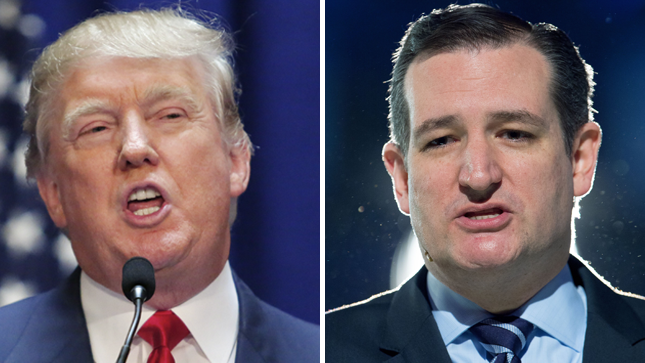
Why We Should Celebrate The Trump-Cruz Ascendancy

Following up on the last post is excerpts from a Washington Monthly piece that argues that sane Americans should welcome, if not, celebrate a Trump Cruz contest and what it may do to the Republican Party.  Additionally, the piece makes the totally accurate case that a Trump or Cruz nomination would drive a wooden stake through the false media driven myth that both the Republican Party and the Democrat Party are equally extreme.  The fact is that the GOP is now fully immersed in lunacy that is irreversible unless and until the Christofascists and white supremacists are driven from the party. The problem is that to rid the party of this cancer, one would likely have to kill the patient.  Sort of a case of having to use Agent Orange to kill weeds in your yard and then finding everything in it is now dead. Here are article highlights:

As we enter the third week of January—just two short weeks away from the Iowa caucuses—it is beginning to dawn even on the most stolid political media figures that Donald Trump is the likeliest bet to win the Republican presidential nomination. It is also becoming apparent even to those most in denial that in the event of Trump’s failure Ted Cruz, the most hated man in Washington and 2nd most unelectable of the GOP candidates in November, will almost certainly become the nominee.

Most of the political and journalistic class see the prospect of a Trump/Cruz nomination as so unthinkable that they have spent months denying its very possibility in the face of overwhelming evidence. That’s understandable for two reasons. First, the history of recent Republican elections strongly suggests that Republican voters flirt with anti-establishment candidates before choosing the traditionally sober candidate. Those who believe that this election represents a realigning paradigm shift—even if, as with the those who predicted the housing bubble calamity, they are ultimately right—are presumed wrong and unserious by default. Second, the mere notion that a majority of the GOP electorate would walk into a voting booth in cold blood and choose Trump or Cruz as their nominee would upend the accepted journalistic narrative in which both parties are presumed equally extreme, and destructive partisan rancor is blamed not on the will of the voters but on the political culture of Washington.

The prospect of either Ted Cruz or Donald Trump actually taking the oath of office is understandably terrifying to many people on both sides of the aisle. Their exclusionary, divisive and even totalitarian-inspired politics show an extreme lack of judgment and poor temperament for the office that should give any reasonable voter pause regardless of their views on the issues of the day. And even though both Trump and Cruz are the least electable of the leading GOP candidates in a general election, the vagaries of campaign gaffes, scandals, and unforeseen events could easily throw the race to a Republican underdog. The danger is therefore quite clear.

Even so, the Trump/Cruz ascendancy on the right is nonetheless a good thing for American politics. There are two principal reasons why:

1) It disempowers the conservative economic and media tycoons who created the malaise that fuels the anger of the GOP base. The American middle class has suffered greatly at the hands of the same corporate leaders who have propped up establishment conservative politics for the last several decades.
[A] rogue’s gallery of conservative tycoons from Koch to Walton to Adelson has been buttressed by the likes of ruthless media figures like Roger Ailes and conscience-free consultants like Karl Rove, and feeds an increasingly dangerous and poisonous electoral monster that cripples the possibility of progressive change, particularly via low-turnout midterm elections. Now that monster has turned on its creators. 

No longer can the Republican party of the Bushes and Romneys count on an attack dog to do their dirty work for them on election day so they can implement policy that benefits only economic elites while keeping a sunny, smiling Reaganesque face. The monster has broken free of its chains and it is demanding at long last to be fed. 

No matter how dangerous the outside possibility of Trump or Cruz winning a general election may be, we should all celebrate the panic and desperation of clueless economic elites . . . . 

If you’re a Republican, the disempowerment of the generation of leaders who left the Republican Party a legacy of failure in economics and foreign policy should be welcome even at the expense of temporary embarrassment. If you’re a Democrat you should fear the dangerous beast that is the Trump-Cruz ascendancy, but watching it gorge on the flesh of the malevolent wizards who created it is not only a source of pleasant schadenfreude, but ultimately good for the country.

2) The Trump-Cruz electorate is shrinking, but the power of concentrated wealth is growing. It’s no secret that even as Republican electoral fortunes depend increasingly on aged whites who constitute a smaller percentage of the total population every year, so too do Cruz and Trump rely particularly heavily on these voters within the GOP coalition. Barring the nightmare scenario of a Trump victory followed by a totalitarian consolidation of authority, the likelihood of a Trump-Cruz power coalition surviving more than a four-year cycle is quite low.
If you believe, as most progressives and even many conservative activists do, that the combination of big business interests and crony-capitalist Washington Consensus lobbyists are the biggest challenges facing the country, then a future led by Rubio/Bush is far more to be feared than one led by Trump/Cruz. A similar dynamic exists on the left in the Democratic nomination fight between Clinton and Sanders. A very large number of Americans feel that the system is so broken that it needs an outsider’s wake-up call from any direction—and there is copious evidence to suggest that they are right.

Is the Trump-Cruz ascendancy in the GOP scary? Of course it is. But we should celebrate and encourage it nonetheless. The country is likely to be better for it in the end.

Has Trump the Bully Hit a Wall?


I view both Donald Trump and Ted Cruz with revulsion.  Both would be an unmitigated disaster for America in the White House.  Trump is in many ways little more than a loud mouthed bully who excels at insults and nasty sound bites, but to date has offered zero in terms of any real substantive policies.  And when it comes to attacking his GOP rivals, he tends to prefer personal insults rather than debate and differences over policies and proposed initiatives.  Like a classic school yard bully, Trump has attracted those who like seeming confidence, especially when pandering to existing prejudices in his audience.  Ted Cruz, to my view, is equally despicable, but as a piece in Politico, Cruz just may be the one who can damage the Trump juggernaut.  Personally, I'd like to see both self-destruct.  Here are article excerpts:

Like all accomplished bullies, Trump understands that the real target is his opponent’s honor. Obeying the maxim that you haven’t gone far enough until you’ve gone too far, Trump slagged Bush’s wife last July, using Twitter to post a quotation from a tweet that said Bush “has to like Mexican Illegals because of his wife.” Trump deleted the tweet, which implied that Columba Bush was not in the country legally. Bush took personal umbrage over the tweet, which was deleted 24 hours after it was posted. “He’s doing this to inflame and incite and to draw attention,” Bush sputtered in the manner of someone whose honor has been wounded. The point of Trump's tweet was to lure Bush into defending Columba, his Spanish-speaking wife and the mother of his three children, thereby boxing him in as conflicted over immigration. It was a brilliant bully move.

When discussing the art of the verbal bully, you really can’t spend too much time on honor. The bully undermines his foes by stripping them of whatever esteem, standing and face they may have acquired. When a man’s mother, wife or daughter is disparaged in most cultures, he must defend her honor or risk losing his manliness. This prompted only more Bush sputtering that Trump must apologize to Columba; Trump’s resopnse (“I won’t apologize, I didn’t do anything wrong”) sliced Bush’s cojones right out of his trousers. 

So how do you beat a verbal bully? We’re actually starting to see it happen. Stanley Elkin sketched a strategy in his 1964 short story, “A Poetics for Bullies.” In it, a young bully named Push torments and leads all the kids in the neighborhood until he is undone by a princely newcomer John Williams, whose accent can’t be mocked, whose skin has no blemish, whose intelligence is impervious to insult. 

Nobody would ever mistake Ted Cruz for John Williams. No Adonis, he looks like a broken-nosed character actor in a film noir. He even whines when he talks. But inside his own head, Cruz is John Williams. He has been polishing the Cruz act for his entire life, making himself a perfectly smooth, unchanging object upon which no New York bully can get a grip. Although Trump may have bested Cruz on several topics in last night’s presidential debate as they fought toe-to-toe for the first time, the mogul seems unable to get under Cruz’s skin the way he has with Bush, Carson, Rand Paul (ridiculing him for being short, just 5’8”!), and the other candidates.

Like Trump, Cruz commands an alpha male’s ego. When towel-snapped, he does not shriek. When denigrated or teased, he does not frown or wince. He does not have to be perfect because he already thinks he’s perfect, which is just one of the reasons why the rest of Congress despises him.

The best way to beat a trash-talking bully is to convincingly pretend you cannot hear him. Donald Trump, you have met your John Williams.
   

Did Hillary Foolishly Underestimate Bernie Sanders?

While the GOP nomination fight has gotten even uglier and more unhinged, on the Democrat side of the process, what some thought would be a coronation for Hillary Clinton more and more seems to becoming a competitive race against Bernie Sanders.  I will concede that I like much of what Sanders has to say.  My number one concern is who can beat the ultimate Republican nominee because I see a Republican in the White House as of January 2017 as nothing short of a disaster.  The Supreme Court hangs in the balance and many policies put in place by Barack Obama through executive orders would likely be rescinded.  A Democrat simply have to win come November 2016.  As a piece in the New York Times reviews, Clinton may have totally under estimated Sanders - at least in the early primary states.  Here are article highlights:
According to Democrats close to the Clintons and involved with her campaign, Mrs. Clinton and the former president are also unnerved by the possibility that Mr. Sanders will foment a large wave of first-time voters and liberals that will derail her in Iowa, not unlike Barack Obama’s success in 2008, which consigned Mrs. Clinton to a third-place finish. They have asked her advisers about the strength of the campaign’s data modeling and turnout assumptions in Iowa, given that her 2008 campaign’s predictions were so inaccurate.
As the Democratic rivals prepare for what is likely to be a contentious televised debate on Sunday night, the Clintons are particularly concerned that her “rational message,” in the words of an aide, is not a fit with a restless Democratic primary electorate. Allies and advisers of the Clintons say Mr. Sanders is clearly connecting with voters through his emotional, inspiring rallying cry that the American economic and political systems are rigged for the wealthy and powerful. By contrast, Mrs. Clinton has laid out an ambitious policy agenda, but more recently has been stressing her electability and questioning the costs of Mr. Sanders’s ideas.

"Hillary is a pragmatic progressive — she’s not an advocate,” said Gov. Peter Shumlin of Vermont, who last week campaigned in Iowa for Mrs. Clinton over his home-state senator Mr. Sanders. “She quietly pulls people together and gets things done. Even though that’s not in vogue right now, I think that’s what voters will want in the end.”

But Mrs. Clinton’s problems are broader than just her message: Opinion polls show that some Democrats and other voters continue to question her trustworthiness and whether she cares about their problems. Recent polls show that her once-formidable lead over Mr. Sanders in Iowa has all but vanished, while he is holding on to a slight lead over her in New Hampshire.

[T]hey were not prepared for Mr. Sanders to become so popular with young people and independents, especially women, whom Mrs. Clinton views as a key part of her base.

Given her many political advantages, like rich donors and widespread support from Democratic Party elites, she is also surprised that Mr. Sanders’s fund-raising has rivaled hers and that her experience — along with her potential to make history as the first woman elected president — has not galvanized more voters.

Several Clinton advisers are also regretting that they did not push for more debates, where Mrs. Clinton excels, to more skillfully marginalize Mr. Sanders over his Senate votes in support of the gun industry and the enormous costs and likely tax increases tied to his big-government agenda.   Instead, Mrs. Clinton, who entered the race as the prohibitive favorite, played it safe, opting for as few debates as possible, which were scheduled at times when viewership was likely to be low — like this Sunday at 9 p.m. on a long holiday weekend.

“In the debates, she has shined, and while conventional wisdom says they offer no upside to a front-runner, she would benefit from more,” said Carter Eskew, a Democratic strategist

Both Mrs. Clinton and her husband believe she can still win the Feb. 1 caucuses in Iowa and the Feb. 9 primary in New Hampshire despite Mr. Sanders’s gaining ground recently and now being virtually tied with her in many polls in those states. But the Clintons also believe she can survive losses in both places because of the strength of her political organization and support in the Feb. 27 primary in South Carolina and in many March 1 Super Tuesday states and other big states to follow.

Yet some Democratic Party officials who remain uncommitted said that after nine months of running, Mrs. Clinton still had not found her voice when it came to inspiring people and making herself broadly likable. While Mrs. Clinton is known for connecting well with people in small settings, she has not shown the same winning touch as consistently at rallies or in television interviews, they said. 

“Her voter base does not seem as gung-ho energetic as Sanders’s base,” Mr. McDonald said. “It may be that they feel like they are waiting for the real race to begin. But an enthusiastic base can make a big difference in the early stages of a presidential nomination campaign, and if Hillary can’t pull away from Sanders fairly early in the season, I suspect he will gain strength rapidly.”