Tuesday, January 21, 2020

Richmond Dodges a Bullet As Smaller Crowd of Extremists Protest

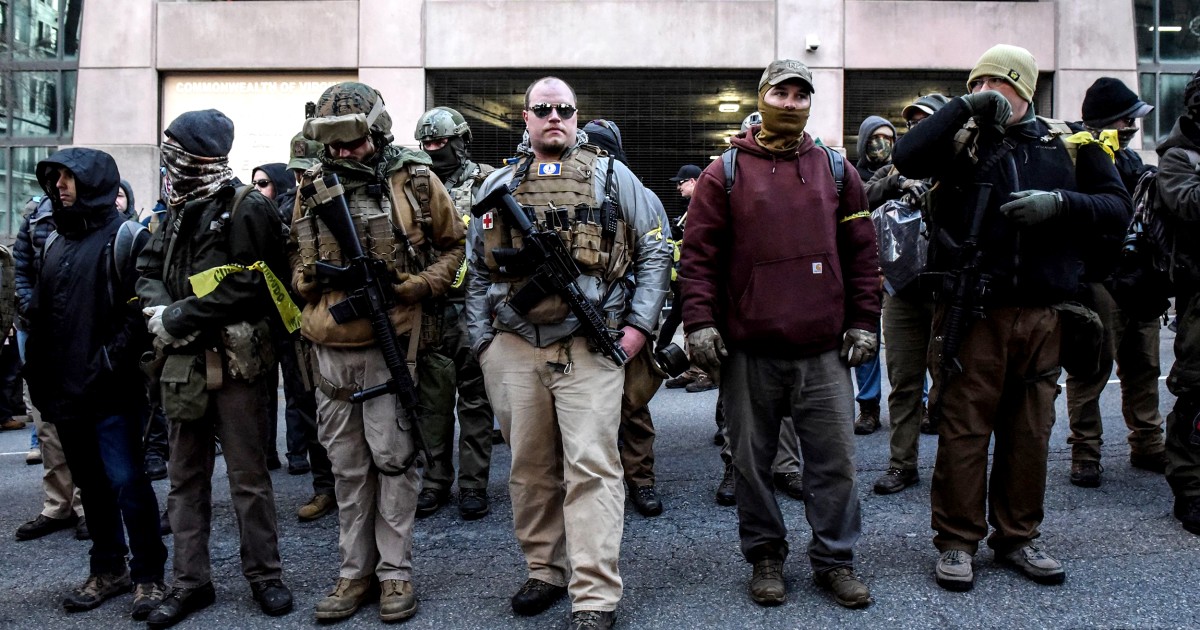
The city of Richmond and the Commonwealth of Virginia dodge a bullet - literally and figuratively - as a much smaller than predicted crowd of gun extremist protesters - many from out side of Virginia - descended on the Virginia Capitol in an effort to intimidate members of the General Assembly.  Promoters had raved about 100,000 pro-gun nuts attending the rally, but police estimates place the crowd at a little over 20% of that number.  Thankfully, no violence occurred, probably largely due to the preemptive action of Governor Northam in banning guns from the Capitol grounds.  Plus, one needs to keep in mind that those who descended on Richmond are an aberration and/or outsiders given that recent polls confirm that the vast majority of Virginians want the gun control measures now before the General Assembly.  As the a column in the Washington Post aptly notes, what today's gun rally really demonstrated was the fear (and I would argue sexual inadequacy) that motivates the attendees who, based on their looks, my late New Orleans southern belle grandmother would have described as "white trash" - the lowest of the low in her book.  Fear of a loss of white privilege.  Fear of a changing world and society. Fear of a loss of white male dominance. They rant about the Second Amendment, but beneath that, something is going on that suggests that something is seriously wrong with these protesters. Here are highlights from the Post column:
Y'all, it smelled like fear out here in Virginia.
Scores of men — plus a handful of women — dressed up in battle rattle and draped themselves with assault weapons, long guns and handguns on Monday. They strapped hunting knives to their thighs and wore body armor and body cameras on their chests, shoulders and helmets. To a rally. A peaceful rally. On city streets in a quiet state capital on a holiday weekend.
That’s a uniform of fear, right there.
Fear of having to pass a background check if they want to buy a gun from a private individual?  Fear of not being able to buy more than one handgun every month?
Fear of not being able to carry an AR-15 across your chest to a county fair that doesn’t want your weapon aboard the Tilt-a-Whirl?
Fear of getting help taking a gun away from your suicidal son?
Because those are all the restrictions on guns that the Virginia [Senate]  passed last week.
The outsized turnout, vigor and rancor in Richmond on Monday — thousands of demonstrators filled the Capitol grounds and surrounding streets — is a reaction based on fear, not fact.
And the fear is all about a loss of power.
“It happened like that,” a man dressed in full camo with a handgun strapped to his hip told his friend, snapping his finger. “We were good for years, then the left took over and they’re going to take our guns away. Virginia is the home of the NRA. They want to run them out, too.”
Most law-abiding, regular old Virginians could still have a weapon — many weapons, even — under the common-sense legislation that the new Democratic majority in Richmond is passing.
Huge assault weapons strapped across chests and backs knocked against each other in the port-a-potty lines. Some walked in a masked phalanx, bookended by German shepherds.
One group pushed through crowds in a conga line of camo and Carhartt, holding on to each other as they muscled through a crush of people. “Racist, white supremacists coming through,” one line leader bellowed, laughing, like everyone should know he really isn’t racist.
All of the men I talked to were also solidly opposed to “red-flag laws,” which allow a concerned family member or the police to ask for the temporary removal of weapons from someone who may be dangerous to themselves or others.
“I can just tell the cops that a guy I hate is dangerous, and they’ll go take all his guns. It can happen to me,” one guy told me.
Nope. That may be what he fears. But the red-flag law requires a state court to be petitioned and a judge to weigh in on whether taking the gun is appropriate.
Let me spell it out: The people who lobby for red-flag laws are usually those who lost a loved one to suicide.
Thirty percent of gun deaths in Virginia, according to the Centers for Disease Control and Prevention, are homicides.
A much larger percentage — 67 percent of all gun deaths in the state — are suicides.
The suicide-by-gun rate — about two a day in Virginia — takes primarily rural, white males over the age of 45, according to numbers compiled by America’s Health Rankings. And veterans are 1.5 times as likely to take their lives in Virginia.
That almost perfectly describes the demographic at the gun rally in Richmond.
Think about it, guys. The biggest thing you have to fear, when it comes to guns, is yourselves, actually.

Sunday, January 19, 2020

More Sunday Male Beauty


Richmond Braces for Invasion of Extremists As Trump Fans Flames

Members of a "Lightfoot Militia" - these are
NOT sportsmen or those focused on self-defense.
The husband and I have a number of friends in Richmond, know a number of members of the Virginia General Assembly, and are friends with Governor Northam and the First Lady of Virginia.  It is with horror that we watch that city braces for a possible invasion by some of the ugliest elements in America.  A piece at NBC News looks at the fear gripping Richmond where businesses will be closed and some are staying in other parts of the city away from the Capitol area. Making maters worse, Donald Trump, a/k/a Der Trumpenführer on this blog, is fanning the flames of hate on the right and then suggesting Republicans will win in Virginia in 2020, suggesting just how delusional Trump is - he is widely hated in Virginia and, if Richmond sees violence tomorrow, rest assured the so-called urban crescent of Virginia will vote even more heavily Democrat.  A piece in Vanity Fair looks at Trump's dangerous and irresponsible behavior:
A tweet from President Donald Trump Friday, one of the sort that Speaker Nancy Pelosi might categorize as “crazy,” drew sharp criticism for seeming to fan the flames of unrest ahead of a gun-rights rally in Richmond, Virginia.
Trump’s social-media eruption warns Virginians that their 2nd Amendment rights are “under attack,” and offers a sarcastic “thank you” to Virginia Democrats who will “take your guns away.”
Sherrilyn Ifill of the NAACP Legal Defense Fund called Trump’s comment “irresponsible and utterly, truly unconscionable.”
 After the deadly events in nearby Charlottesville during the “unite the right” rally in 2017, [Trump] the president was sharply criticized for blaming violence on “both sides.”
Trump seemingly wants violence so he can use further fear mongering with his hideous base of support that increasingly seems to consist of outright racists, white supremacists and evangelical "Christians" (who in general are also racists/white supremacists in my view having followed right wing  "Christian" organization for over 20 years)

As for some of the types of out of state extremists on their way to Richmond, the Washington Post has more information.  Belatedly, Republicans who for years have given a wink and a nod to some of the dangerous extremists in the party base seem to have awoken to the danger these people pose to the public.  Here are artile highlights:

RICHMOND — The convoys and militias are coming, if social media posts are to be believed, headed to Virginia's capital to take a stand for gun rights — or, in the words of some, to fan the flames of a civil war.
“I’ll be rolling into town early. I can’t give you my exact time for security reasons,” said Christian Yingling, head of the Pennsylvania Light Foot Militia and a leader at the “Unite the Right” rally in Charlottesville in 2017.
“I organized a convoy, places we can meet up and drive up together. I’ll be leading it,” said Tammy Lee, a militia activist in Oklahoma.
Both Lee and Yingling were members of groups that signed consent decrees never to return to Charlottesville while armed, part of a lawsuit settlement over the violence there. But there is no restriction against coming to Richmond.
Thousands will join them, they say, for a rally Monday on Capitol Square to protest plans by the new Democratic majority in the General Assembly to pass gun-control laws. State and federal officials were preparing for a volatile mix of weapons, passions and anti-government fervor. Central Richmond was braced for road closures and extensive police presence.
The Federal Aviation Administration has issued temporary flight restrictions for Richmond airspace, making it illegal to fly planes or drones above the city on Monday. Northam has said officials are concerned about threats from weaponized drones.
The pro-gun rally is always the most visible event, but this year it has virtually wiped out everything else. The Virginia Citizens Defense League has appealed for 10,000 supporters to show up unarmed to fill Capitol Square and asked several times that many stand outside with weapons.
One of Richmond’s staunchest gun rights Republicans, who needled Northam over the ban earlier in the week, closed ranks with the governor after a closed-door briefing on the security threats Friday.
“Any group that comes to Richmond to spread white supremacist garbage, or any other form of hate, violence, or civil unrest isn’t welcome here,” House Minority Leader Todd Gilbert (R-Shenandoah) said in a written statement Saturday. “While we and our Democratic colleagues may have differences, we are all Virginians and we will stand united in opposition to any threats of violence or civil unrest from any quarter.”
Gilbert declined to discuss the content of the briefing, but his statement referred to efforts to “infuse” the event with a “twisted or extreme worldview.”
National militia and extremist groups have mobilized, with some making threats against elected officials. Many promise to use Virginia as the place to take a stand against what they see as a rising tide of anti-gun sentiment, invoking language of insurrection and civil war.
Lee, the convoy leader from Oklahoma, has promoted the Richmond rally in Facebook live videos. “I can absolutely not wait,” she said in one. “This may possibly be the first time that almost the entire patriot movement is there.”
But in a video posted Friday, she also expressed dread. “If you’re not apprehensive about going to this event, then I would worry about you and your mental state and your thought process,” she said.
In an interview, Lee said the convoy would kick off in Oklahoma on Saturday morning and swing through 10 states before its scheduled arrival in Richmond on Sunday afternoon. She declined to say how many vehicles or people would be involved.
In a recent video, she indicated that the gun rights movement was fractured over whether the out-of-state militias would help or hinder their cause in Richmond.
“While some don’t want outsiders coming in, it’s too late for that,” she said. “There are so many people woke to what’s happening … that I don’t think you could keep people away if you wanted to.”


I hope sane Virginians are watching and will punish Republicans further at the polls come November, 2020.

Sunday Morning Male Beauty


The New Jim Crow: Mass Incarceration in the Age of Colorblindness

For years now, Republicans have used voter ID laws and purges of voter rolls to minimized the minority vote whenever and where possible.  Its the same mindset from the Jim Crow era when poll taxes kept blacks in the South from voting and it surged in the wake of desegregation when Richard Nixon devised his "Southern Strategy" to recruit Southern whites to the GOP.  The other mechanism  used by Republicans, certainly here in Virginia, was the "war on drugs" and Virginia's draconian marijuana laws (a topic this blog has addressed numerous times) to criminalize minorities, especially blacks. The city of Norfolk, Virginia, is a prime example.  The city is not majority black, yet drug arrests and convictions are disproportionately against young black males (when I go to criminal court in Norfolk, the racial imbalance of those charged continues to be shocking).  Given the ridiculously small amount of marijuana required to make possession a felon, those convicted lose their voting rights permanently (there is no automatic restoration of voting rights once one's sentence is served - again by design). 

As the book "The New Jim Crow: Mass Incarceration in the Age of Colorblindness," a New York Times best seller, lays out, none of this was by accident.  Here in Virginia, we may be on the cusp of change with a drastic overhaul of the state's marijuana laws, plus dramatic change in control gun laws. The reaction from the far right has been apoplectic and could well see violence erupt in Richmond tomorrow.  An op-ed in the New York Times by Michelle Alexander, the author of the reference book, looks at where America now finds itself in the age of Trump who lauds white supremacy.  Here are column highlights:
Ten years have passed since my book, “The New Jim Crow,” was published. I wrote it to challenge our nation to reckon with the recurring cycles of racial reform, retrenchment and rebirth of caste-like systems that have defined our racial history since slavery. It has been an astonishing decade. Everything and nothing has changed.
When I was researching and writing the book, Barack Obama had not yet been elected president of the United States. I was in disbelief that our country would actually elect a black man to be the leader of the so-called free world. As the election approached, I felt an odd sense of hope and dread. I hoped against all reason that we would actually do it. But I also knew that, if we did, there would be a price to pay.
We had recently birthed another caste system — a system of mass incarceration — that locked millions of poor people and people of color in literal and virtual cages.
Our nation’s prison and jail population had quintupled in 30 years, leaving us with the highest incarceration rate in the world. A third of black men had felony records — due in large part to a racially biased, brutal drug war — and were relegated to a permanent second-class status. Tens of millions of people in the United States had been stripped of basic civil and human rights, including the right to vote, the right to serve on juries and the right to be free of legal discrimination in employment, housing, education and basic public benefits.
I was right to worry about the aftermath of Obama’s election. After he was inaugurated, our nation was awash in “post-racialism.” Black History Month events revolved around “how far we’ve come.” Many in the black community and beyond felt that, if Obama could win the presidency, anything was possible. Few people wanted to hear the message I felt desperate to convey: Despite appearances, our nation remains trapped in a cycle of racial reform, backlash and re-formation of systems of racial and social control.
Things have changed since then. Donald Trump is president of the United States. For many, this feels like whiplash. After eight years of Barack Obama — a man who embraced the rhetoric (though not the politics) of the civil rights movement — we now have a president who embraces the rhetoric and the politics of white nationalism. This is a president who openly stokes racial animosity and even racial violence, who praises dictators (and likely aspires to be one), who behaves like a petulant toddler on Twitter, and who has a passionate, devoted following of millions of people who proudly say they want to “make America great again” by taking us back to a time that we’ve left behind.
We are now living in an era not of post-racialism but of unabashed racialism, a time when many white Americans feel free to speak openly of their nostalgia for an age when their cultural, political and economic dominance could be taken for granted — no apologies required. Racial bigotry, fear mongering and scapegoating are no longer subterranean in our political discourse; the dog whistles have been replaced by bullhorns. White nationalist movements are operating openly online and in many of our communities; they’re celebrating mass killings and recruiting thousands into their ranks.
White nationalism has been emboldened by [Trump] our president, who routinely unleashes hostile tirades against black and brown people — calling Mexican migrants criminals, “rapists” and “bad people,” referring to developing African nations as “shithole countries” and smearing a district of the majority-black city of Baltimore as a “disgusting, rat and rodent infested mess.” Millions of Americans are cheering, or at least tolerating, these racial hostilities.
[W]hat our nation is experiencing is not an “aberration.” The politics of “Trumpism” and “fake news” are not new; they are as old as the nation itself. The very same playbook has been used over and over in this country by those who seek to preserve racial hierarchy, or to exploit racial resentments and anxieties for political gain, each time with similar results.
Back in the 1980s and ’90s, Democratic and Republican politicians leaned heavily on the racial stereotypes of “crack heads,” “crack babies,” “superpredators” and “welfare queens” to mobilize public support for the War on Drugs, a get-tough movement and a prison-building boom — a political strategy that was traceable in large part to the desire to appeal to poor and working-class white voters who had defected from the Democratic Party in the wake of the civil rights movement.
[T]he rhetoric has changed, but the game remains the same. Public enemy No. 1 in the 2016 election was a brown-skinned immigrant, an “illegal,” a “terrorist” or an influx of people who want to take your job or rape your daughter.
The fact that Trump’s claims were demonstrably false did not impede his rise, just as facts were largely irrelevant at the outset of the War on Drugs. It didn’t matter back then that studies consistently found that whites were equally likely, if not more likely, than people of color to use and sell illegal drugs. Black people were still labeled the enemy.
Black people charged with possession of crack in inner cities were still punished far more harshly than white people in possession of powder cocaine in the suburbs. And it didn’t matter that African-Americans weren’t actually taking white people’s jobs or college educations in significant numbers through affirmative action programs.
Getting tough on “them” — the racially defined “others” who could easily be used as scapegoats and cast as the enemy — was all that mattered. Facts were treated as largely irrelevant then. As they are now.
Fortunately, a growing number of scholars and activists have begun to connect the dots between mass incarceration and mass deportation in our nation’s history and current politics.
The story of how our “nation of immigrants” came to deport and incarcerate so many for so little, Hernández explains, is a story of race and unfreedom reaching back to the era of emancipation. If we fail to understand the historical relationship between these systems, especially the racial politics that enabled them, we will be unable to build a truly united front that will prevent the continual re-formation of systems of racial and social control.
[T]hose who argue that the systems of mass incarceration and mass deportation simply reflect sincere (but misguided) efforts to address the real harms caused by crime, or the real challenges created by surges in immigration, tend to underestimate the corrupting influence of white supremacy whenever black and brown people are perceived to be the problem.
Once human beings are defined as the problem in the public consciousness, their elimination through deportation, incarceration or even genocide becomes nearly inevitable.
White nationalism, at its core, reflects a belief that our nation’s problems would be solved if only people of color could somehow be gotten rid of, or at least better controlled. In short, mass incarceration and mass deportation have less to do with crime and immigration than the ways we’ve chosen to respond to those issues when black and brown people are framed as the problem.
It is tempting to imagine that electing a Democratic president or more Democratic politicians will fix the crises in our justice systems and our democracy. To be clear, removing Trump from office is necessary and urgent; but simply electing more Democrats to office is no guarantee that our nation will break its habit of birthing enormous systems of racial and social control.
Equally important is the reality that “felons” have families. And “criminals” are often children or teenagers. The notion that, if you’ve ever committed a crime, you’re permanently disposable is the very idea that has rationalized mass incarceration in the United States.
None of this is to minimize the real progress that has occurred on many issues of race and criminal justice during the past decade. . . . . Everything has changed. And yet nothing has.
The politics of white supremacy, which defined our original constitution, have continued unabated — repeatedly and predictably engendering new systems of racial and social control. Just a few decades ago, politicians vowed to build more prison walls. Today, they promise border walls.
The political strategy of divide, demonize and conquer has worked for centuries in the United States — since the days of slavery — to keep poor and working people angry at (and fearful of) one another rather than uniting to challenge unjust political and economic systems. At times, the tactics of white supremacy have led to open warfare. Other times, the divisions and conflicts are less visible, lurking beneath the surface.
The stakes now are as high as they’ve ever been. Nearly everyone seems aware that our democracy is in crisis, yet few seem prepared to reckon with the reality that removing Trump from office will not rid our nation of the social and political dynamics that made his election possible. No issue has proved more vexing to this nation than the issue of race, and yet no question is more pressing than how to overcome the politics of white supremacy — a form of politics that not only led to an actual civil war but that threatens our ability ever to create a truly fair, just and inclusive democracy.
We have a lot of work to do, beginning with removing Trump from office by any means.
Saturday, January 18, 2020

What to Know About the Gun Rally at the Virginia Capitol


Thankfully, the Virginia Supreme Court upheld Governor Ralph Northam's executive order banning all guns from the Virginia Capitol grounds on Monday when gun fanatics and likely unsavory and dangerous "militia" members will descend on Richmond from across the country to try to intimidate legislators into not passing gun control legislation that a majority of Virginians want - perhaps even more now that they have seen the extremism of the gun lobby.  With the FBI's arrest of now seven (7) white supremacist extremists who hoped to ignite a race war at the Capitol, the wisdom of Northam's preemptive strike with his executive order is all the more clear.  As for the whining of the gun nuts, there is no reason they cannot lobby legislators without being armed in what can only be viewed as an attempt at threats and intimidation.  The New York Times has a good overview of what has happened and what is known about some of the bad actors headed to Richmond at the invitation of the misnamed Virginia Citizens Defense League (which to me looks more like a group of all white vigilantes based on photos of the group's meetings) and strongly suggests a peaceful rally was perhaps never the goal. Add to this the reality that most "gun rights" groups receive funding from gun manufacturers who want to maximize sales regardless of the death and mayhem that results and it becomes clear that this gun nuts do not speak for the majority of Virginians.   Here are article highlights:
The rally is being hosted by the Virginia Citizens Defense League, a prominent Second Amendment group that typically holds an annual “Lobby Day” to meet with lawmakers. The group is organizing charter buses, car pools and a sushi dinner the night before the rally in anticipation of what it is calling “the most important Lobby Day Rally that we have ever had.” 
[T]he rally has drawn the attention of militia groups from as far away as Nevada and Oklahoma, including those [hate groups] tracked by the Southern Poverty Law Center and the Anti-Defamation League.
Others vowing to attend include individuals associated with the Light Foot Militia, some of whom were banned from Charlottesville after the “Unite the Right” rally in 2017, which ended in the death of a counterprotester. Richard B. Spencer, a prominent white nationalist who is among 24 defendants in a lawsuit over the rally in Charlottesville, also said he might attend.
Experts on extremism believe the groups want to co-opt the rally in an effort to fuel a race war. For example, extremists are calling Monday’s rally the “boogaloo,” which in the language of white supremacists is an event that will accelerate such a war.
It remains unclear who will actually arrive in Richmond, but it’s possible pre-emptive moves by the authorities could deter some who had vowed to attend.
The authorities on Thursday announced the arrests of three men linked to the Base, an extremist group being tracked by the F.B.I. The three men had obtained weapons and discussed participating in the Richmond rally and were charged with various federal crimes in Maryland, the authorities said.
On Friday, law enforcement announced the arrest of at least four other men also tied to the Base, in separate plots.
The Base is a white extremist, antigovernment group that aims to establish a white “ethno-state.”
The F.B.I. has grown increasingly concerned about the Base as it has worked to recruit more people. The group encourages the onset of anarchy, according to the Counter Extremism Project, an organization that tracks far-right extremists. Experts say that its founder, an American, appears to be living in Russia.
Former law enforcement officials say the Base and a similar group known as Atomwaffen have become priorities for the F.B.I.
In November, the F.B.I. arrested Richard Tobin, a young man in New Jersey, who was accused of recruiting on behalf of the Base and of supporting violence, including the killing of black people with a machete.
In his declaration, Mr. Northam cited the eruption in Charlottesville three years ago as an example of “what can happen when peaceful demonstrations are hijacked by those who come into the Commonwealth and do not value the importance of peaceful assembly.” He added: “We must take all precautions to prevent that from ever happening again.”


Saturday Morning Male Beauty


Can Anyone Save the GOP?

The answer to the question posed in the caption is probably no.  It's the conclusion I came to two decades ago when I left the Republican Party and the situation has become even more dire in the age of Trump with the party base now firmly controlled by evangelical Christian extremists and white supremacists and white nationalists. True, a group of former Republicans will be airing anti-Trump ads on Fox News - during two of Der Trumpenführer's favorite shows - and a few individuals are struggle to mount a primary challenge to Trump, one such individual being Bill Weld, a former Republican Massachusetts governor.  Given the toxic nature of the GOP base and the efforts of state parties in some states to block any challenge to Trump, Weld's effort is an extremely long shot as noted in a column in the New York Times. One can only wish Weld well and meanwhile hope Republican senators in Congress will belatedly put their oaths of office first (don't hold your breath).  Here are column highlights:
Bill Weld, the former Massachusetts governor and current long-shot — make that, loooooooong-shot — candidate for the Republican Party’s presidential nomination, is a keen student of New Hampshire politics. In an interview with me this week, he noted the following fact: Every time an incumbent president of either party faced a significant primary challenge in the Granite State, he failed in his bid for re-election.
It happened to George H.W. Bush in 1992 after Patrick Buchanan took 38 percent of the New Hampshire vote.
It happened to Jimmy Carter in 1980 after Teddy Kennedy took 39 percent.
It happened to Gerald Ford in 1976 after Ronald Reagan took 48 percent.
It happened to Lyndon Johnson in 1968 after Eugene McCarthy took 42 percent.
It happened to Harry Truman in 1952 when Estes Kefauver beat him outright, 55 percent to 44.
So, Weld reasons, why not try to make it happen to Donald J. Trump, too?
That’s the hopeful thought in what otherwise seems to be Weld’s hopeless bid to derail [Trump] a president whose support among Republicans was 89 percent last month, according to Gallup.
But he’s also wise enough to know that losing well can achieve great things, like bringing down a president who, he said, “regards the law as something to be evaded.” Can that be done between now and Feb. 11, the date of the New Hampshire primary? Weld rests his hopes on two things: New England Republicanism, which remains alive and well despite reports of its demise; and Trump’s trial in the Senate, whose result may not yet be a forgone conclusion. On the former, note that Vermont, Massachusetts and New Hampshire all have G.O.P. governors, who, like Weld, are relative moderates compared to the rest of the party. On the latter, Weld knows a lot about the impeachment process, having worked on the House Judiciary Committee’s staff as a young lawyer in 1974 as it considered articles against Richard Nixon. Nixon, Weld recalled, “was essentially forced to withdraw from the presidency because he had been caught lying on television to the American people on one topic” — a foothill of a deception compared to Trump’s Karakoram range.
Weld also knows how quickly things can turn in the course of a trial. “Cases don’t look the same at the end as they do at the beginning,” he noted, recalling his prosecutions of public corruption in the 1980s as United States attorney for the District of Massachusetts, where he won 109 convictions in 111 corruption cases. He believes that if four Republican senators join Democrats in voting to call witnesses — Ohio’s Rob Portman could provide the decisive vote — then anything is possible.
Maybe that’s right, assuming devastating testimony from John Bolton, the former national security adviser; former Rudy Giuliani associate Lev Parnas; and who knows who (or what) else. Not that any kind of testimony is likely to sway the 67 senators needed for a conviction. But it’s not quite out of the question that it might, in the coming weeks, sway a large fraction of New Hampshire Republicans to vote against the president, thereby setting into motion forces that could bring him down. That’s the hope, at any rate. The odds against? I’d say 20 to 1 — which is to say, still worth a shot. If it fails, Weld said he would not run as an independent. Unlike in 2016, when he ran with Gary Johnson on the Libertarian ticket (and won 4.5 million votes) he has no interest in playing the spoiler to anyone in the race except Trump.
The larger question if it fails is what becomes of the G.O.P. Weld compared the party to the late-stage Whigs of the early 1850s, which were riven between the nativist Know Nothing faction and the antislavery wing that would become the Republican Party of Abraham Lincoln. Fortunately, the good side won that time.
And this time? The best conservative case for rooting for a Democrat to win this fall — any Democrat, including Bernie Sanders or Elizabeth Warren — is that it might be the only way to save the Republican Party from itself. That could happen if a critical mass of conservatives repudiates Trumpism or forms a new party on the Lincoln model. Weld calls it the Liberty Party.
Alternatively a Sanders or Warren victory could send the G.O.P. to even further extremes. . . . . Democrats who want to see Republicans recover their center need to protect their own. In the meantime, wish Bill Weld well in his Granite State carom shot.

Probably far to optimistic.  Moral, moderates left the GOP long ago with Trump having accelerated the exodus. That said, one can always hope for a miracle.