Showing posts with label threats and intimidation. Show all posts

Thursday, January 23, 2020

Guns Are No Mere Symbol - They Silence Others

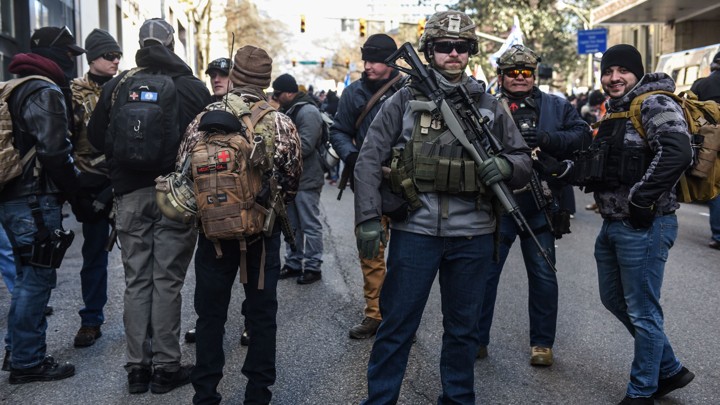
Not to belabor the issue of gun control in Virginia, but a piece in The Atlantic gets to the true agenda of the gun rights fanatics - many from outside of Virginia - who descended on Richmond this past Monday.  Coming fully armed as if going into war was not meant to be an exercise of free speech as alleged but rather had two different goals: (i) threaten and intimidate legislators, and (ii) silence those holding opposing views who did not attend Lobby Day out of fear for the physical safety. To me, it all underscores the reality that the gun lobby and those it manipulates care nothing for the rights of other citizens - much as hunters years ago ignored "posted" signs on my family's property and willfully trespassed on our property.  Their rights superseded our right to be safe on our own property. The mindset on display was all about wanting special rights and trampling on the rights of others. Here are article highlights:
Few places in the United States concentrate as much history in 14 acres as the grounds of the Virginia state capitol. Thomas Jefferson designed the capitol building; Patrick Henry laid its cornerstone; in 1807, Chief Justice John Marshall sat there to preside over the treason trial of former Vice President Aaron Burr. The capitol’s second floor displays a Carrara-marble statue of George Washington made by sculptor Jean-Antoine Houdon, considered the most accurate rendering of its subject. In 1861, a state convention voted there to secede; in 1865, United States Colored Troops re-raised the Stars and Stripes above it as Robert E. Lee’s retreating troops burned the city around them. A few days later, Abraham Lincoln stood at the equestrian statue of George Washington in Capitol Square and—for the first and only time—addressed an audience of freed slaves. In 1990, Lawrence Douglas Wilder, the first African American ever elected governor of a state, was sworn in on the capitol’s north steps. . . . . If there is holy ground in America, Capitol Square is part of it.

On Monday, hundreds of protesters stood outside the designated protest area with the weapons they fear the Virginia General Assembly will limit. Their presence underscores the many contradictions of this strange and ominous event.

To begin with, of course, the celebration of firearms took place on the 35th celebration of the federal Martin Luther King Jr. holiday (within that lies the contradiction that the Commonwealth of Virginia until 2000 tried to use the same day to honor King and the Confederate generals Robert E. Lee and Stonewall Jackson). King’s gift to the national conversation was a commitment to nonviolence, and his life was ended by an assassin with a firearm. Second, the day of the march had come to be known in Virginia as Lobby Day, a day on which citizens could gather in the square and, in the words of the First Amendment, “peaceably assemble, and … petition the government for redress of grievances.”

But note who was not in Capitol Square on Monday. The Coalition to Stop Gun Violence had also planned to assemble and petition for gun-control legislation—as it had done in peaceful competition with gun-rights groups in previous years. This year, because of the threats of armed violence surrounding the gun-rights march, that gun-control demonstration had to be canceled. The delegate from Manassas, Lee Carter, the South’s only socialist legislator, went into hiding because of death threats. Carter had not, in fact, sponsored an anti-gun measure, but gun-rights groups spread disinformation on the internet that he had done so; his life—and his ability to function as a legislator—was endangered.

One group’s politics canceled those of others, in other words. Self-government in a democratic society is supposed to follow a model of openness—different ideas and points of view compete in a “marketplace of ideas” for the support of the people and their representatives. That model doesn’t work when one side kills the other, or even threatens to.

This is the contradiction at the heart of the national dialogue about the Second Amendment. As Justice John Paul Stevens wrote in his 2010 dissent in McDonald v. City of Chicago, the “right to keep and bear arms,” is fundamentally “dissimilar from those [the Supreme Court has] recognized in its capacity to undermine the security of others … Firearms may be used to kill another person.”

Second Amendment activists have, over the years, gone to great lengths to obscure the difference between gun rights and genuine civil liberties, especially the freedom of speech. After Virginia Governor Ralph Northam banned weapons from the square, gun-rights groups rushed to court to seek invalidation of the order. According to news reports, their lawyers “argued that prohibiting rallygoers from carrying guns would violate their Second Amendment right to bear arms and their First Amendment right to free speech” because “carrying guns is a form of symbolic speech.”

This is a potentially deadly confusion. The freedom to buy, own, and carry firearms, whatever its scope, is in no respect like the freedom of speech. Speech consists of words and launches ideas. “Symbolic speech” refers to signs, flags, photographs, and gestures that express those words and ideas. A gun is not merely a symbol; it is not like words or ideas. It is an instrument of violence and death, and its display amid a crowd is a threat.

The right to bear arms in political debate is not the power to speak for oneself; it is, at least implicitly, the power to silence others. It is not the right to persuade; it is the right to terrorize. It is not the right to participate in civil society; it is the power to threaten to disrupt, even to destroy it. As the historian Jill Lepore wrote in The New Yorker in 2012, “When carrying a concealed weapon for self-defense is understood not as a failure of civil society, to be mourned, but as an act of citizenship, to be vaunted, there is little civilian life left.”
Hopefully, the armed fanatics - again, many not even Virginians - will galvanize legislators and the vast majority of Virginians who want gun control to refuse to be threatened and intimidated by those who seek to silence them.

Saturday, January 18, 2020

What to Know About the Gun Rally at the Virginia Capitol


Thankfully, the Virginia Supreme Court upheld Governor Ralph Northam's executive order banning all guns from the Virginia Capitol grounds on Monday when gun fanatics and likely unsavory and dangerous "militia" members will descend on Richmond from across the country to try to intimidate legislators into not passing gun control legislation that a majority of Virginians want - perhaps even more now that they have seen the extremism of the gun lobby.  With the FBI's arrest of now seven (7) white supremacist extremists who hoped to ignite a race war at the Capitol, the wisdom of Northam's preemptive strike with his executive order is all the more clear.  As for the whining of the gun nuts, there is no reason they cannot lobby legislators without being armed in what can only be viewed as an attempt at threats and intimidation.  The New York Times has a good overview of what has happened and what is known about some of the bad actors headed to Richmond at the invitation of the misnamed Virginia Citizens Defense League (which to me looks more like a group of all white vigilantes based on photos of the group's meetings) and strongly suggests a peaceful rally was perhaps never the goal. Add to this the reality that most "gun rights" groups receive funding from gun manufacturers who want to maximize sales regardless of the death and mayhem that results and it becomes clear that this gun nuts do not speak for the majority of Virginians.   Here are article highlights:
The rally is being hosted by the Virginia Citizens Defense League, a prominent Second Amendment group that typically holds an annual “Lobby Day” to meet with lawmakers. The group is organizing charter buses, car pools and a sushi dinner the night before the rally in anticipation of what it is calling “the most important Lobby Day Rally that we have ever had.” 
[T]he rally has drawn the attention of militia groups from as far away as Nevada and Oklahoma, including those [hate groups] tracked by the Southern Poverty Law Center and the Anti-Defamation League.
Others vowing to attend include individuals associated with the Light Foot Militia, some of whom were banned from Charlottesville after the “Unite the Right” rally in 2017, which ended in the death of a counterprotester. Richard B. Spencer, a prominent white nationalist who is among 24 defendants in a lawsuit over the rally in Charlottesville, also said he might attend.
Experts on extremism believe the groups want to co-opt the rally in an effort to fuel a race war. For example, extremists are calling Monday’s rally the “boogaloo,” which in the language of white supremacists is an event that will accelerate such a war.
It remains unclear who will actually arrive in Richmond, but it’s possible pre-emptive moves by the authorities could deter some who had vowed to attend.
The authorities on Thursday announced the arrests of three men linked to the Base, an extremist group being tracked by the F.B.I. The three men had obtained weapons and discussed participating in the Richmond rally and were charged with various federal crimes in Maryland, the authorities said.
On Friday, law enforcement announced the arrest of at least four other men also tied to the Base, in separate plots.
The Base is a white extremist, antigovernment group that aims to establish a white “ethno-state.”
The F.B.I. has grown increasingly concerned about the Base as it has worked to recruit more people. The group encourages the onset of anarchy, according to the Counter Extremism Project, an organization that tracks far-right extremists. Experts say that its founder, an American, appears to be living in Russia.
Former law enforcement officials say the Base and a similar group known as Atomwaffen have become priorities for the F.B.I.
In November, the F.B.I. arrested Richard Tobin, a young man in New Jersey, who was accused of recruiting on behalf of the Base and of supporting violence, including the killing of black people with a machete.
In his declaration, Mr. Northam cited the eruption in Charlottesville three years ago as an example of “what can happen when peaceful demonstrations are hijacked by those who come into the Commonwealth and do not value the importance of peaceful assembly.” He added: “We must take all precautions to prevent that from ever happening again.”


Saturday, July 27, 2019

Liberty University’s "Culture of Fear"

Evangelical Christians - and far right Catholics - talk about "Christian love" and a supposedly loving god, yet the entire premise of their faith construct is one based on fear: fear of eternal damnation and fear of ostracism if one does not conform to medieval dogma.  Knowledge, science and freedom of thought are evil and to be rejected.  And as for loving others, it's the opposite of what one sees in reality where hatred of others is the most defining attribute of "conservative Christians."  In Virginia, two of the leading purveyors of this toxic form of Christianity are CBN/Regent University based in Virginia Beach and Liberty University in Lynchburg. Of the two, perhaps the more toxic and bigger blight on Virginia is Liberty where the reality is the opposite of what the name suggests.  As a lengthy piece in the Washington Post lays out, a climate of fear and censorship reigns under the rule of Jerry Falwell, Jr., a Trump supporter embroiled with his own possible dirty linen involving a young pool boy. Read the entire piece.  Here are highlights which suggest Liberty is the last place one should consider sending their child:

In my first week as editor in chief of the Champion, Liberty University’s student-run weekly, our faculty adviser, Deborah Huff, ordered me to apologize. I’d noticed that our evangelical school’s police department didn’t publish its daily crime log online, as many other private university forces do, so I searched elsewhere for crime information I might use in an article. I called the Virginia Association of Campus Law Enforcement Administrators to find out what the law required Liberty to disclose. But the public affairs worker there told the Liberty University Police Department, which complained to Huff. She called to upbraid me: Apparently, I had endangered our newspaper’s relationship with the LUPD. Huff and Chief Richard Hinkley convened a meeting inside a police department conference room, and Huff sat next to me while I proffered the forced apology to Hinkley — for asking questions. Huff, too, was contrite, assuring the police chief that it wouldn’t happen again, because she’d keep a better eye on me.
This wasn’t exactly a rude awakening. I’d spent the previous three years watching the university administration, led by President Jerry Falwell Jr. (who took a very micromanaging interest), meddle in our coverage, revise controversial op-eds and protect its image by stripping damning facts from our stories. Still, I stuck around. I thought that if I wrote with discretion and kept my head down, I could one day win enough trust from the university to protect the integrity of our journalism.
Instead, when my team took over that fall of 2017, we encountered an “oversight” system — read: a censorship regime — that required us to send every story to Falwell’s assistant for review. Any administrator or professor who appeared in an article had editing authority over any part of the article; they added and deleted whatever they wanted. Falwell called our newsroom on multiple occasions to direct our coverage personally.
Eventually I quit, and the School of Communication decided not to replace me, turning the paper into a faculty-run, student-written organ and seizing complete control of its content. Student journalists must now sign a nondisclosure agreement that forbids them from talking publicly about “editorial or managerial direction, oversight decisions or information designated as privileged or confidential.” The form also states that the students understand they are “privileged” to receive “thoughts, opinions, and other statements” from university administrators.
It was one example of an infrastructure of thought-control that Falwell and his lieutenants have introduced into every aspect of Liberty University life. Faculty, staff and students on the Lynchburg, Va., campus have learned that it’s a sin to challenge the sacrosanct status of the school or its leaders, who mete out punishments for dissenting opinions (from stripping people of their positions to banning them from the school). This “culture of fear,” as it was described by several of the dozen Liberty denizens who talked to me for this story — most of them anonymously, to protect their jobs or their standing — worsened during my four years on campus because of the 2016 presidential election.
[T]he school’s methods became even more aggressive after Falwell endorsed Donald Trump early that year, according to multiple current and former faculty members. “The closer you get to the president’s office,” says former history professor Brian Melton, discussing a chilling effect on campus, “the worse it becomes.” Falwell’s staff now operates masterfully to squash challenges to his views and his rise in national political influence.
The dissent that did exist — from off-message campus speakers, insufficiently sycophantic board members, student activists and our newspaper staff — was ruthlessly neutralized. Liberty, founded on principles of fundamental Christianity, is now a place that has zero tolerance for new questions and ideas. Those who harbor them must remain silent, or leave.
One cause of perpetual insecurity at Liberty is the school’s militant refusal to award tenure to any faculty member (outside the law school, which must offer it for accreditation). Instructors are instead hired on year-to-year contracts; during the spring semester, they find out whether they will be coming back the next fall.
The result is constant, erratic faculty turnover. One recently fired teacher describes the spring as a cycle of stressed-out, fearful professors wandering into each other’s offices to ask if they had their contracts renewed yet. “If you’re a conservative Christian in the academic world, the chances of you getting a job are nil in many areas,” says Melton, who worked at Liberty as an associate professor for 15 years before resigning because of what he described as the school’s surveillance and fear tactics. “The administration knows that, and . . . they wield that very effectively, keeping people quiet.”
Late-notice faculty removals have also become more commonplace, according to Melton, stemming in part from Falwell’s stated desire to tame the teaching corps. . . . This June, a dozen faculty members at Liberty’s School of Divinity were notified that their contracts would not be renewed. By that late in the year, it is too late to find another job in higher education for the fall.
For former faculty members, Liberty’s culture of fear can live on. The school often requires terminated professors to sign a nondisclosure agreement if they want their severance packages, several told me — a practice that is extremely uncommon in higher education, according to Robert Bezemek, a California lawyer who represents labor unions at universities. (As Melton puts it, “They force this NDA on you by leveraging the ability to feed your family against you.”) Even former teachers who hadn’t signed NDAs told me they feared that talking to me on the record would somehow get them blacklisted from jobs elsewhere or imperil their friends who still work at Liberty.
Another onetime instructor declined to use his university-issued laptop because he thought Liberty had equipped it with spyware.
There is no evidence of Liberty firing a faculty member explicitly for his or her political beliefs, but everyone I spoke to believed that the school could easily manufacture some other pretense. “There is zero trust between the administration and faculty,” Melton says. FIRE, a nonprofit that fights for free speech on campus, put Liberty on its 2019 list of the 10 worst colleges for freedom of speech.
Things aren’t much better for the 15,000 students on campus. In 2009, Liberty withdrew funding and recognition for its College Democrats chapter because, as Mark Hine, the senior vice president of student affairs, put it, the national party defends abortion, opposed the Defense of Marriage Act, supported “the ‘LGBT’ agenda, hate crimes, which include sexual orientation and gender identity, socialism, etc.”
Student leaders have consistently helped administrators enforce the culture. After the Charlottesville rally in August 2017, members of Liberty’s Student Government Association drafted a statement expressing solidarity with Heather Heyer, the protester murdered by a neo-Nazi, and all people demonstrating against white nationalism. Then-SGA President Caleb Johnson refused to release the message and send it to university administrators for fear of what Falwell might think. . . . “There’s 100 percent an atmosphere of fear at Liberty,” says Caleb Fitzpatrick, who was then the student government’s speaker of the House and helped draft the statement. “There was a need to avoid being seen as a liberal or progressive, or even being different.”
Guests at the school who deviate from the prescribed philosophy can be targeted, too. . . . . The end finally came for the Champion when a left-leaning faith group, the Red Letter Christians, organized a “Lynchburg Revival” in April 2018 to protest Falwell’s support of Trump and what the group called “toxic evangelicalism.” Two days beforehand, Liberty’s police department notified RLC leader Shane Claiborne that he would be arrested if he set foot on campus.
I graduated last year. Since then, I’ve tried to put Liberty — and the stress and self-doubt that officials there saddled me with — behind me.

Wednesday, January 23, 2019

The Covington Catholic Students - a Calculated Art of Making People Uncomfortable?


At the risk of diving into the debate of what really happened in the confrontation between a group of white Covington Catholic High students and Native Americans, I suspect many individuals will interpret what they saw take place based on their own prejudices and allegiances to Donald Trump or their contempt and animus towards Trump.  Personally, I view wearing a Trump MAGA hat as the nearest thing one can do to donning KKK robes without actually doing so. My Republican "friends" will object, but supporting a vile racist who espouses racist policies, like it or not, makes one a racist or at best a white supremacist sympathizer. Thus, the Covington students wearing MAGA hats to me do not merit the benefit of the doubt.  Moreover, as a column in the Washington Post points out, one can sometimes be intimidating and threatening without violence.  A smug smile or sneer can speak volumes as many in the LGBT know from first hand experience. Given other stories surfacing about the bigotry and homophobia rampant at Covington Catholic, I suspect these students who are now proclaiming their innocence may, in fact, have know precisely what they were doing.  Here are column highlights:
“Rorschach test” already feels like such a weary metaphor for what happened last weekend on the Mall between a Covington Catholic High School student and a Native American elder. But it’s hard to think of another recent incident that’s metastasized so quickly and been interpreted so disparately — an insight into how you see the world and how you understand your place in it.
Meanwhile, the story grows, or maybe it finishes: On Wednesday morning Nick Sandmann, the smiling teenager at the center, sat for an interview on NBC’s “Today” show. “My position is that I was not disrespectful to Mr. Phillips,” he told Savannah Guthrie.
We could quibble about his word choices — is “listening to him and standing there” what really happened? — but that’s the point: We quibble. Conversations unravel. All week long, personal experiences have been unpacked like suitcases and brought forth as evidence.
A man I know who went to an all-boys Catholic school saw only typical adolescence in the videos: a group of kids, already hyped up by an encounter with the profanity-yelling Black Hebrew Israelites, firing off testosterone like careless sparklers.
I floated this with another friend, a woman, who raised an eyebrow. Maybe some of the other students were caught up in a fog of poorly supervised hormones, but Sandmann wasn’t, this friend pointed out. He wasn’t screaming. He was making the conscious decision to stand in Phillips’s path, and to smile.
It's the smile that we've been dissecting all week. Sandmann meant it to defuse the situation, he told Guthrie.
Is provocation a chant and a drum, or is provocation a flat smile and a decision not to move? (“As far as standing there, I had every right to do so,” Sandmann said.) Which one of them is the peaceful act, which one could be misinterpreted?
Here’s where the Rorschach test comes in: As much as we might try to see what happened from Sandmann’s perspective, or from Phillips’s, the perspective we’re ultimately seeing it from is our own.
The most insidious bully in my junior high wasn’t someone who stuffed smaller kids in lockers, but a smaller kid himself: slender, handsome, with a last name that appeared on a big building in town. What he would do, mostly, was stare. Stare and smile, and walk very close to his less-rich, less-handsome targets. Not touching, but close enough to show that he could have touched them if he wanted to.
And it’s funny, how awful “not doing anything” can feel to the person it’s not being done to. How infuriating or unsettling.
It’s funny, what a slender rich kid’s vehement denial can do to your mind-set: Maybe he wasn’t doing anything. Maybe he was just smiling. Maybe he was just smiling even when you made it clear you were trying to pass, and you were on the verge of tears? Maybe he was trying to defuse the situation, and you’re the one who was crazy.
That scene in front of the Lincoln Memorial was a circus . . .That interview with Sandmann was measured, and filled with the right words: “in hindsight,” “respect.”  But I don’t think my friends and I were crazy in junior high. I think our classmate knew exactly where the line was, and how to walk up to it. I think making people uncomfortable wasn’t the point; the point was making sure the uncomfortable people knew there was nothing they could do about it.
The Covington Catholic students were minors who were apparently mature enough to participate in the abortion debate — one of the most complicated issues of our time, and what brought them to Washington — but not mature enough to walk away from hecklers.
Does it matter that they were in MAGA hats? It’s hard for me to imagine anyone wearing them now, in 2019, wouldn’t understand they’re not just a sartorial choice.
It’s hard for me to talk about what happened on the Mall without bringing in every experience I've ever had: the knowledge that people who are used to having power know how to wield it in subtle ways. The knowledge that I’ve been on the receiving end of it, and once or twice, the giving end of it.
Maybe you think Sandmann didn’t do anything and is a victim of an Internet mob.
Or maybe you think, as Guthrie wondered aloud in the interview Wednesday, that standing there was its own act of aggression. The appearance of doing nothing while actually doing something.
It’s hard to imagine anyone’s minds changing by this point, though.
Perhaps my perspective is colored by the bullying I received in high school as a gay kid trying desperately to hide in the closet.  Or perhaps I flash back to the smiling homophobes who forced me from a law firm for being gay. Then again, perhaps I am influenced by the toxicity of Roman Catholicism.  Whatever Sandmann claims, I continue to believe that he knew exactly what he was doing.  The nature of his smile said all I needed to see/hear.

Monday, March 13, 2017

Trump’s Design Style - Dictator Chic


Old money tends to like to be understated since it has no need to prove anything.  The contract, of course is new money - the nouveau riche - where it is all about impressing even if the end result is an impression of bad taste and an air of déclassé.   Stated another way, it's a case of having more money than good taste.  A historian has piece in Politico that looks at Der Trumpenführer's style that puts him not only in the déclassé category, but a style favored by dictators.   The piece reviews dictators of the past - some of whom met violent ends - and compares them to the style favored by Der Trumpenführer.  Here are article excerpts: 
Every good brand needs a theme and an aesthetic, and President Donald Trump has spent decades cultivating both. The theme is success, wealth, winning, and the aesthetic is bright, brassy, loud—or, depending whom you ask, gaudy and fake. . . . . Architecturally, it’s gilt and mirrors, as in his famous marble-and-gold Trump Tower apartment. . . .
Trump’s design aesthetic is fascinatingly out of line with America’s past and present. If you doubt it, note that the interiors of the apartments his company actually sells bear no resemblance to the one he lives in. But that doesn’t mean his taste comes from nowhere. . . . it also has important parallels—not with Italian Renaissance or French baroque, where its flourishes come from, but with something more recent. The best aesthetic descriptor of Trump’s look, I’d argue, is dictator style.
A decade ago, I published a book on exactly that topic: Fascinated by the question of what makes dictators’ houses so recognizably similar . . . . trying to pick out the features they had in common and what those features said about their occupants. I ended up with 16 case studies. . . . most of them, I concluded, obeyed 10 defining “dictator chic” rules.
The first: Go big. Dictators’ building projects are almost always ludicrously overscaled. In the 1980s, the seriously short Nicolae Ceausescu, Romania’s longtime president, and his wife, Elena, started building what was to become one of the largest government buildings in the world. They called it the “People’s Palace,” and they knocked down a good chunk of old Bucharest to make room for it. There was a huge, impressive yet hideous facade and, inside, quite intimidatingly large public rooms. The Ceausescus were executed before the building was finished, and even today, it reportedly is mostly empty—too large for an entire country to fill.
The second rule of the dictator look is all about “repro.” Dictators might work in the grand styles of earlier centuries, but they don’t usually use old materials and furniture. Everything is brand spanking new. Old styles add gravitas, but antiques themselves are too faded and shabby.
This leads to the third rule: Think French. There may never have been an interior style quite as lavish as 18th-century France . . . . Sometimes dictators pull from other places and eras—Roman, Palladian/classical and more—but French can always be counted on to say “money” faster and louder than the subtler English antique look.
Aside from France, dictators often seem to draw from hotels (rule No. 4), perhaps the grandest ones they saw at a young age. . . . I reckon Saddam Hussein saw that early Hilton look as the good-life template for the estimated 65 palaces and other compounds—mostly hideous—he ended up with.
Then, there are the materials—rules 5, 6 and 7. “If I’ve only got one life,” most dictators seem to think, “let me live it surrounded by gold.” When you have all of your country’s resources at your disposal, why not? Gold furniture, gold wall decorations, columns with gold capitals, gold taps.
After gold comes glass—the better to reflect one’s abundant opulence. Shiny surfaces, giant chandeliers with glass droplets and giant mirrors with—you guessed it—more gold in the frames. And after glass is marble—floors, walls, tabletops, every square inch of the bathrooms. New, shiny marble, of course, not the worn, old stuff or the modern architect’s “honed” kind.
Rules No. 8-10 are about decorations and ornaments. When it comes to art, dictators, given a choice, prefer big and bright 19th-century potboilers, or their modern equivalents, to Old Masters (too dark and grim) and to contemporary or abstract art (too ugly and pointless). Dictators also like known-value items—things that people will understand instantly, aka brands. If you’ve got Lamborghinis and Ferraris out front, you want the equivalent inside: Aubusson carpets (new copies, of course), Chinese Ming vases (ditto) and bright Versace-style fabrics. Of course, the cult of personality needs iconography, too, and that means pictures of yourself.
If all of this sounds excessive, even fantastical, remember, these homes don’t exist to express personal collecting passions or evolved tastes. . . . . Dictators can’t understand why anyone would go for the genially scaled-back charm of Western Old Money houses in Cambridge, England, or Cambridge, Massachusetts. Why have old when you can have new, matte when you can have shiny, small when you can have huge? There is no subtlety or understatement, let alone irony.
The whole point is that dictators’ homes aren’t for one’s family, friends or private self; they’re not a refuge from the world or the job. Dictators’ homes, in fact, are the job—a place to do business, harangue people and settle scores, all while one’s entourage stays nearby. They are an architectural and artistic means of establishing the power of the occupants, of intimidating and impressing any visitor.
Why does all of this matter? Domestic interiors reveal how people want to be seen. But they also reveal something about the owners’ inner lives, their cultural reference points and how they relate to other people. With its marble-inlaid dining table, painted ceilings and gold flourishes quite literally everywhere, Trump’s aesthetic puts him more in the visual tradition of Turkmenistan President Saparmurat Niyazov, who erected a massive rotating golden statue of himself in Ashgabat, than the self-effacing gray-suited conventions of Western democratic leaders.
This, of course, is a startlingly un-American idea. The Trump look is miles from the architectural tradition of Washington, D.C., a city kept deliberately low-rise in its center, and whose neoclassical public buildings evoke stability and trustworthiness through their restraint. From the White House to the monuments, the American capital was designed to avoid Europe’s autocratic excesses, projecting a message of simplicity, democracy and egalitarianism—precisely the opposite of the new brand in town.

Monday, December 26, 2016

Pro-Trump Neo-Nazis Plan Armed March Against Jews


Absent Donald Trump's incitements to violence and empowering of alt-right and Neo-Nazi groups does anyone believe an armed march against Jews and those who support them would be in the planning stages for a confrontation before Der Fuhrer's inauguration next month?   Its as if every foul racist, anti-Semitic, homophobic group now feels free to crawl out from under the rocks and social slime they have hidden under for decades.  Just as frightening, silence of any form of condemnation of such behavior coming bot Herr Trump and "good Republicans" is deafening.  To my GOP "friends," if you do not support this type of viciousness and hatred as you claim, why are you silent?  Or am I correct in assuming that you actually support it even if you will not admit so in polite society?  A piece in LawNewz looks at troubling events being planned by Neo-Nazi groups and "news" outlets.  Here are highlights: 
The neo-Nazi website, The Daily Stormer, is advertising an “armed protest” in the city of Whitefish, Montana “against Jews, Jewish businesses and everyone who supports either.”  The event is being organized by the site’s publisher Andrew Anglin as a result of ongoing controversy involving white nationalist Richard Spencer, and his mother who lives in Whitefish.
The announcement, which went up on Friday, says that the march will take place in the second week of January, “just before the inauguration” of President-elect Donald Trump. The post on the Daily Stormer instructs participants not to actually engage in violence, but does call for hundreds of people to walk the streets with guns, citing Montana’s “extremely liberal open carry laws.” People from outside the local community are being called on to join in the armed intimidation tactics, with the announcement saying that they are “busing in skinheads from the Bay Area” to increase their numbers. Anglin has also posted the names and addresses of various individuals, organizations, and businesses to target.
Montana Senator Steve Daines tweeted his opposition to the building anti-Semitic activity in his state.
The Anti-Defamation League said on Friday that they have “been in regular contact with the victim families, as well as relevant law enforcement authorities and other public officials,” including the U.S. Department of Justice.

I find this very frightening and can only imagine how much worse things may get after the inauguration of  Der Fuhrer on January 20, 2017.