History does repeat itself—the first time as tragedy, the second time as farce.
The original Yalta summit took place in a rickety czarist palace on the Crimean Peninsula in February of 1945. Adolf Hitler’s troops were already in retreat when President Franklin D. Roosevelt, Prime Minister Winston Churchill, and the Soviet dictator Joseph Stalin met in cold, drafty rooms to discuss the end of the war.
Eight decades later, the Yalta summit is remembered mostly not for building peace, but for consigning Eastern Europeans, whose leaders were not in the room, to Soviet occupation and repression for the subsequent half century. In the name of ending a war against fascist totalitarianism, in other words, Yalta promoted the spread of communist totalitarianism and planted the seeds of the Cold War.
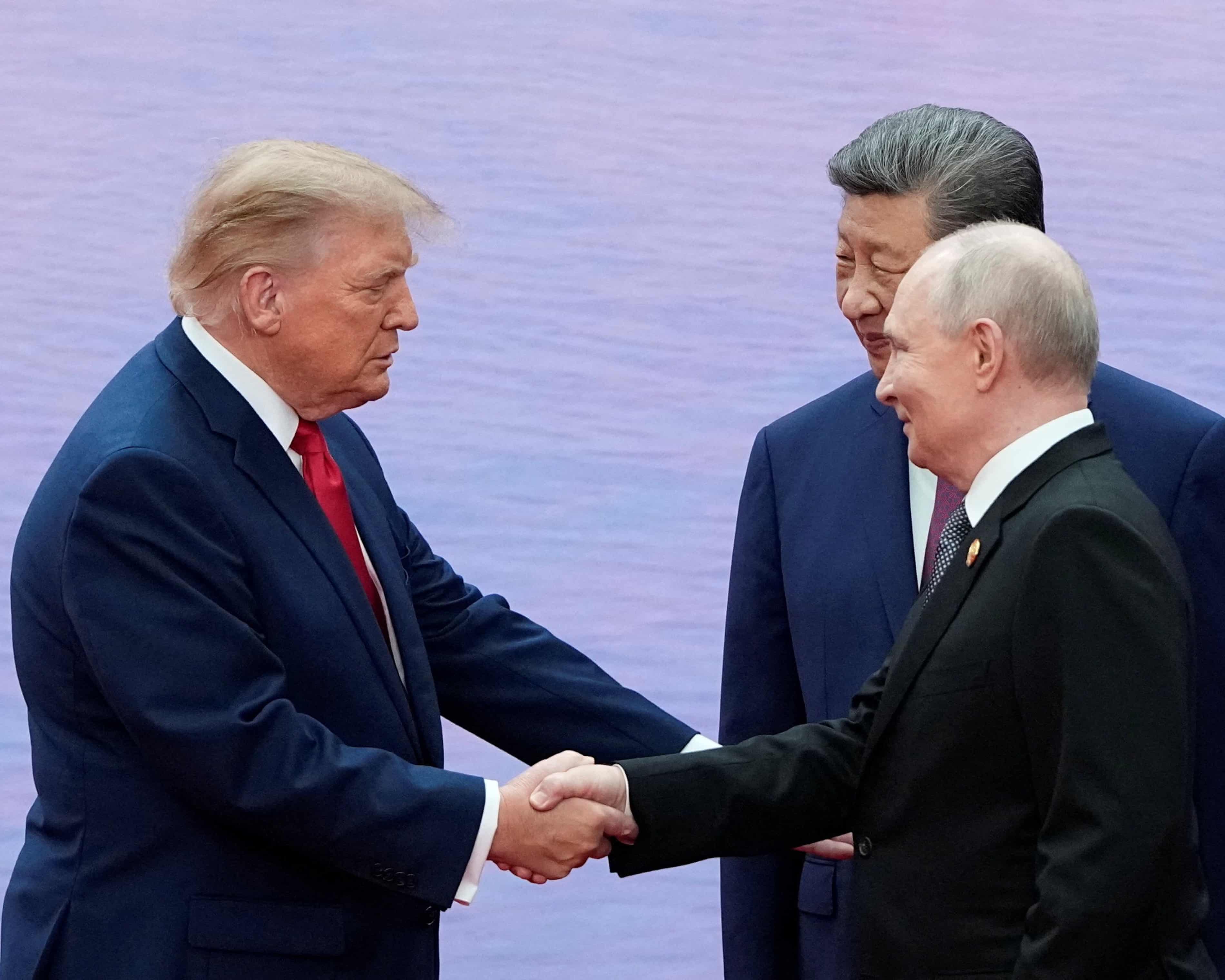
The inconsequential Trump-Putin-Xi summit in Shenzhen, pumped up by the gullible as a “Yalta 2.0,” was an event more suited for our sillier times. No serious agreements were signed. No country’s borders were redrawn on the edge of a paper napkin. . . . . the meeting was brief, almost substance-free, and carefully choreographed for the maximum benefit of the Chinese hosts. Its true purpose was not to end any wars—and certainly not to end Russia’s bloody invasion of Ukraine—but to produce propaganda photographs and video clips that each of the three leaders will now use to mask their political failures.
Certainly this was [the Felon's]
President Trump’smain goal. Before the three leaders met, he actually told Fox News that the most significant moment was already over: “the greeting yesterday, which in the history of China has never happened.” Xi Jinping, aware of how easy it is to manipulate the American president, had met Trump at his airplane, on the tarmac.He[the Felon] also spoke of “the fanfare, the beauty, the pageantry, the thousands of people, the young children, the soldiers, the whole thing,” adding, “That’s a big win for us. It’s a big win for China too.” The White House published a video clip, seemingly created to promote Chinese Communism, showing all of that fanfare and putting Trump at the center of it—a big win for China indeed, and maybe a big win for Trump’s post-midterm ego, although hardly a big win for the United States.
For Vladimir Putin, the meeting also created useful propaganda. Now almost five years into a war he believed he would win in three days, he is coping with 1.5 million war casualties; the loss, as of this week, of half of his country’s oil-refining capacity; and even, in the past few days, the destruction of the Kerch Strait Bridge, which links Russia to Crimea. Putin built that bridge and personally attended the opening ceremony, treating it as a major national event. In recent days, the Ukrainians have struck the bridge three times, totally destroying the road link and at least temporarily halting rail traffic too. Nevertheless, Putin will use the Shenzhen meeting to tell Russians that their country is still a superpower, still allowed to sit in the same room as the Americans and the Chinese, still important on the world stage even as Russian power, influence, and prosperity dramatically shrink.
For Xi, the meeting was useful because he was the host, he set up the photographs, and his propaganda was broadcast around the world. With Trump’s cooperation, he telegraphed American decline, Chinese power, and Russian subservience. Even as the Chinese economy is experiencing a real-estate slump, manufacturing losses, and chronic unemployment, he made China look like the only serious country in the room. The American president was babbling about airport greetings. Russia is bankrupt without Chinese support. But Xi, safe in the knowledge that he has successfully obtained the American chip technology his military and industry need, was the master of ceremonies.
Hidden inside this story of puffery and flattery is some good news. The leaders at the Yalta summit in 1945 really were able to decide the fate of smaller countries over their heads and against their wishes. The three leaders at Shenzhen don’t have that kind of power. Certainly the American president no longer has any cards, to use his own words, in Ukraine, which despite being cut off from all U.S. military and financial aid has continued fighting, with European backing and its own resources.
The world has moved on since 1945—and even since 2022. When the Ukrainians struck the Kerch Bridge, they did so using their own weapons systems, none of which existed at the start of the full-scale Russian invasion. Over the past several months, the Iranians have been able to hit U.S. bases and targets in the Gulf States using Russian drone technology of equally recent vintage. We now live in a world of asymmetric conflicts, where even powers that claim to represent allegedly great civilizations are discovering that they can lose battles to much smaller ones. If the summit in Shenzhen looked anachronistic and obsolete—a failed attempt to re-create the glamour of the Cold War past—that’s because it was.


No comments:
Post a Comment