 |
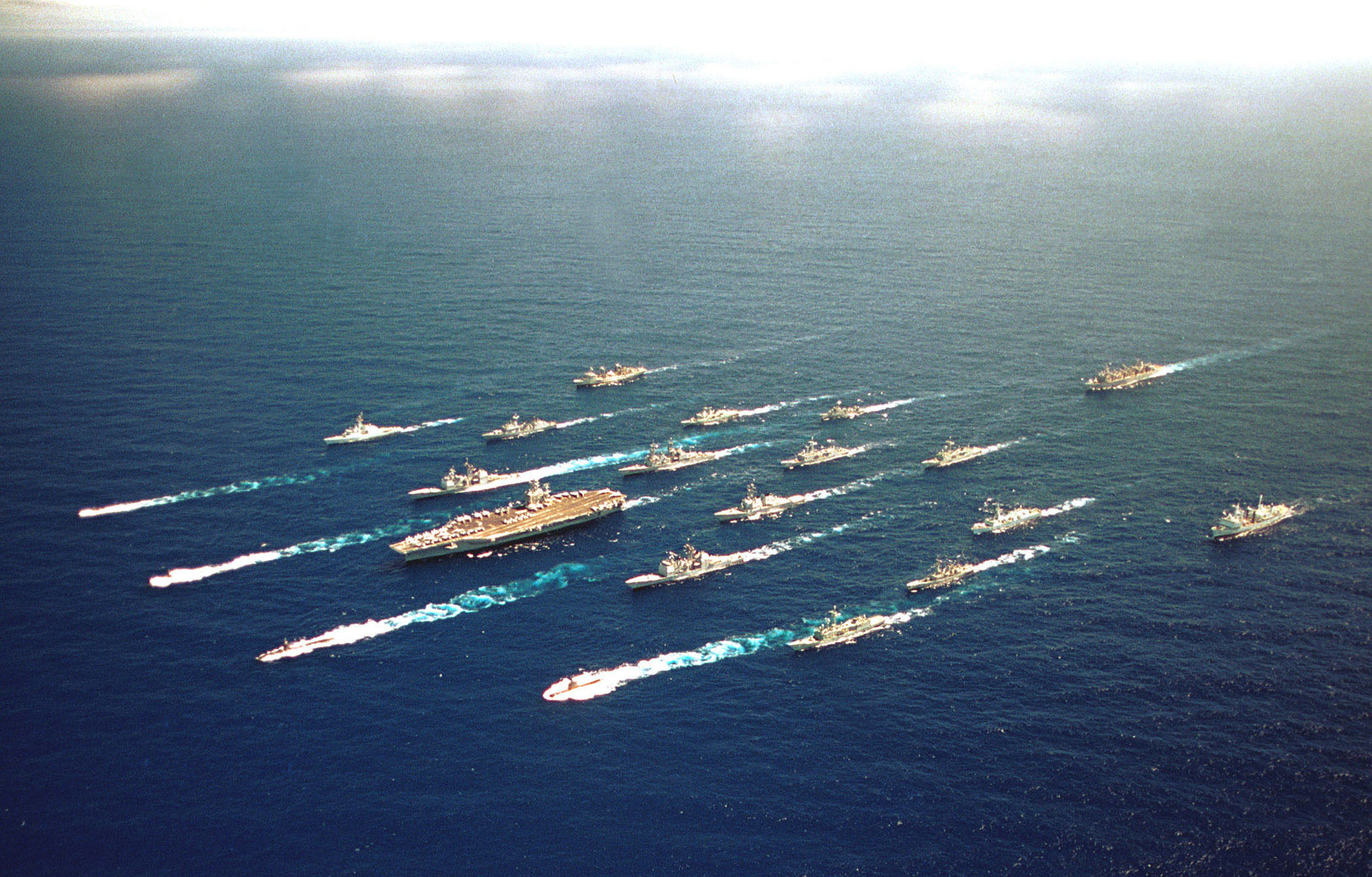
| A carrier battle group. |
One of the books that I am currently reading - I typically read several at a time and rotate what I read based on mood and available time - is "Mortal Republic" which traces the gradual fall of the Roman Republic into a autocracy under emperors. Some of the political parallels to what is happening in America currently are chilling such as the refusal of some factions to compromise (mostly Republicans) and the increasing attacks on political and social policy opponents and efforts to stir hatred and even potential violence against political opponents. The other stark parallel is America's pursuit of global dominance that directed disproportionate funding and resources to never ending wars. Yes, Rome brought back treasure from conquests (often shared only by the wealthy), but over time, the financial drain took a severe toll and pushed the common Roman to no longer feel that the empire offered them anything worthwhile to support. A column in the New York Times looks at America's current financial mismanagement that neglects domestic spending and infrastructure while seeking to maintain a defacto modern day empire (note the amount of Middle East war costs and then think what $6 trillion invested in America's infrastructure and citizens could have done). Here are highlights:
“We have got to put an end to endless war,” declared Mayor Pete Buttigieg of South Bend, Ind., during the Democratic presidential primary debate on Thursday. It was a surefire applause line: Many people consider “endless war” to be the central problem for American foreign policy.But vowing to end America’s interminable military adventures doesn’t make it so. Four years ago, President Barack Obama denounced “the idea of endless war” even as he announced that ground troops would remain in Afghanistan. In his last year in office, the United States dropped an estimated 26,172 bombs on seven countries.
President Trump, despite criticizing Middle East wars, has intensified existing interventions and threatened to start new ones. He has abetted the Saudi-led war in Yemen, in defiance of Congress. He has put America perpetually on the brink with Iran. And he has lavished billions extra on a Pentagon that already outspends the world’s seven next largest militaries combined.
What would it mean to actually bring endless war to a close?
Like the demand to tame the 1 percent, or the insistence that black lives matter, ending endless war sounds commonsensical but its implications are transformational. It requires more than bringing ground troops home from Afghanistan, Iraq and Syria. American war-making will persist so long as the United States continues to seek military dominance across the globe. Dominance, assumed to ensure peace, in fact guarantees war. To get serious about stopping endless war, American leaders must do what they most resist: end America’s commitment to armed supremacy and embrace a world of pluralism and peace.
In theory, armed supremacy could foster peace. Facing overwhelming force, who would dare to defy American wishes? That was the hope of Pentagon planners in 1992; they reacted to the collapse of America’s Cold War adversary not by pulling back but by pursuing even greater military pre-eminence. But the quarter-century that followed showed the opposite to prevail in practice. Freed from one big enemy, the United States found many smaller enemies: It has launched far more military interventions since the Cold War than during the “twilight struggle” itself. Of all its interventions since 1946, roughly 80 percent have taken place after 1991.
The basic cause is America’s infatuation with military force. Its political class imagines that force will advance any aim, limiting debate to what that aim should be. Continued gains by the Taliban, 18 years after the United States initially toppled it, suggest a different principle: The profligate deployment of force creates new and unnecessary objectives more than it realizes existing and worthy ones.
In the Middle East, endless war began when the United States first stationed troops permanently in the region after winning the Persian Gulf war in 1991. A circular logic took hold. The United States created its own dependence on allies that hosted and assisted American forces. It provoked states, terrorists and militias that opposed its presence. Among the results: The United States has bombed Iraq almost every year since 1991 and spent an estimated $6 trillion on post-9/11 wars.
An even deadlier phase may be dawning. Because the United States pursues armed dominance as a self-evident good, the establishment feels threatened by a rising China and an assertive Russia. . . . China’s rise invalidates primacy’s rationale of deterrence, and shows that other powers have ambitions of their own. Addressing the rise of China responsibly will require abandoning nostalgia for the pre-eminence that America enjoyed during the 1990s.
Despite Mr. Trump’s rhetoric about ending endless wars, the president insists that “our military dominance must be unquestioned” — even though no one believes he has a strategy to use power or a theory to bring peace. Armed domination has become an end in itself.
In the 21st century, finally rid of colonial empires and Cold War antagonism, America has the opportunity to practice responsible statecraft, directed toward the promotion of peace. Responsible statecraft will oppose the war-making of others, but it will make sure, first and foremost, that America is not fueling violence.
On its own initiative, the United States can proudly bring home many of its soldiers currently serving in 800 bases ringing the globe, leaving small forces to protect commercial sea lanes. It can reorient its military, prioritizing deterrence and defense over power projection. It can stop the obscenity that America sends more weapons into the world than does any other country. It can reserve armed intervention, and warlike sanctions, for purposes that are essential, legal and rare.
Shrinking the military’s footprint will deprive presidents of the temptation to answer every problem with a violent solution. It will enable genuine engagement in the world, making diplomacy more effective, not less.
Hawks will retort that lowering America’s military profile will plunge the world into a hostile power’s arms. They are projecting, assuming that one rival will covet and attain the kind of armed domination that has served America poorly. Russia, with an economy the size of Italy’s, cannot rule Europe, whatever it desires. China bears watching but has so far focused its military on denying access to its coasts and mainland. It is a long way from undertaking a costly bid for primacy in East Asia, let alone the world.
In any case, local states are likely to step up if the American military pulls back. The world conjured by the Washington establishment is an empty space, a “power vacuum,” waiting passively to be led. The real world is full of people ready to safeguard their freedom. Today a world with less American militarism is likely to have less militarism in general.
After decades of unilateral actions, crowned by the aggressive invasion of Iraq, it is U.S. military power that threatens international law and order. Rules should strengthen through cooperation, not wither through imposition.
In truth, the largest obstacle to ending endless war is self-imposed. Long told that the United States is the world’s “indispensable nation,” the American people have been denied a choice and have almost stopped demanding one. A global superpower — waging endless war — is just “who we are.”
America “goes not abroad in search of monsters to destroy,” Secretary of State John Quincy Adams said in 1821. “She might become the dictatress of the world. She would be no longer the ruler of her own spirit.”
John Quincy Adams was far more prescient than he perhaps ever realized.Two centuries later, in the age of Trump, endless war has come home. Cease this folly, and America can begin to take responsibility in the world and reclaim its civic peace.


