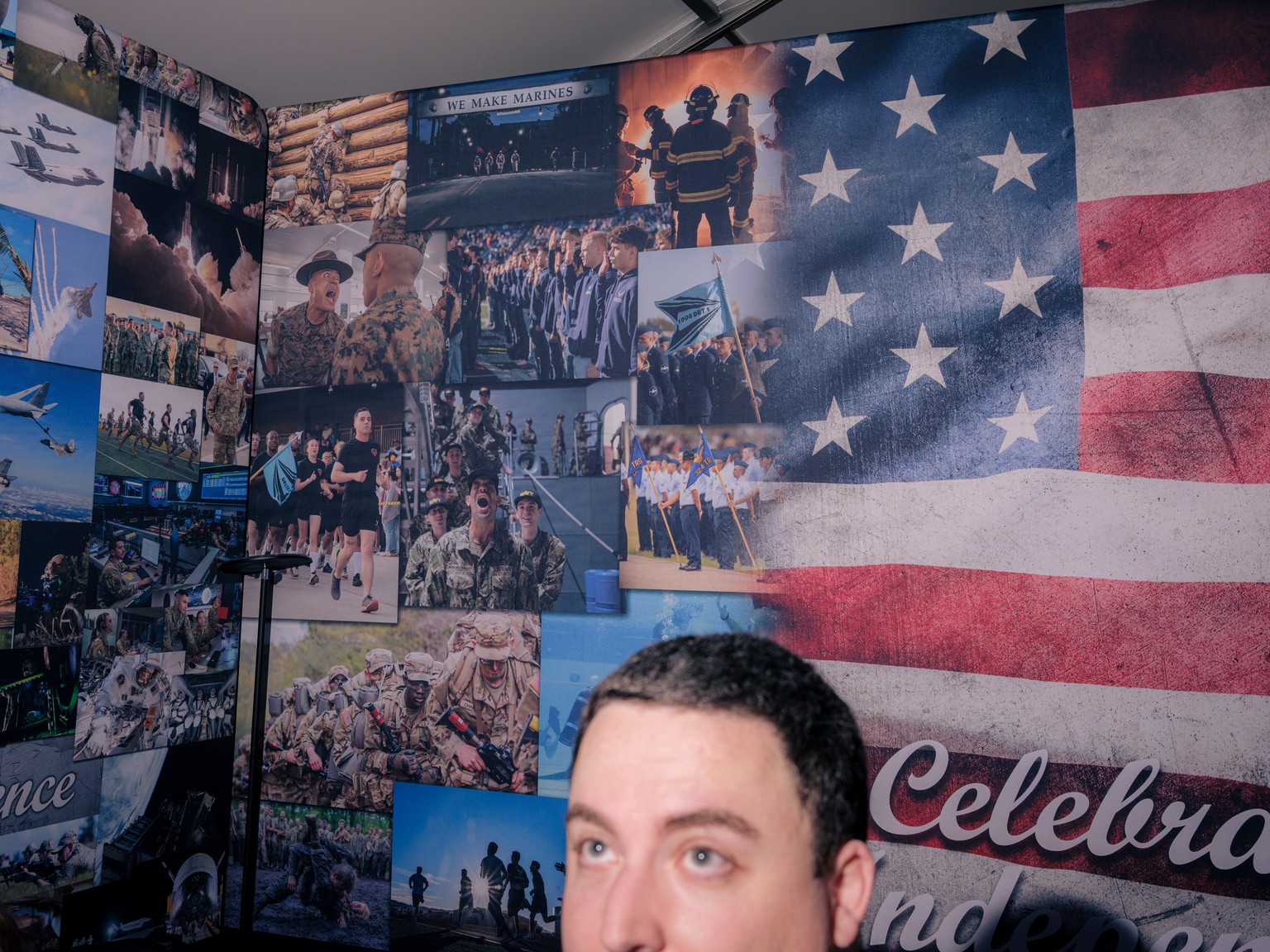
The U.S. capital has been outfitted of late with visual trappings that many associate with authoritarianism, such as banners depicting Donald Trump’s face and featuring his slogans. So perhaps it was only a matter of time before the president erected his own Potemkin village: the Great American State Fair, where almost nothing is what it pretends to be.
Stretching across a large swath of the National Mall, the fair has dozens of pavilions for 56 states and territories and numerous executive-branch departments, in addition to a Ferris wheel, a rodeo, and other displays from companies and organizations, many of them Trump-aligned. It’s advertised by Freedom 250, the White House–created group behind many semiquincentennial events, as a “world-class exposition and modern-day World’s Fair.”
A boxy model of Trump’s proposed triumphal arch in the center of the Mall appears as if it could have been designed in Minecraft and ordered from CVS for same-day pickup.
Perhaps because of this aesthetic of illusions, the earnest state pride evident in some of the pavilions turns out to feel especially delightful. . . . But like any sense of patriotism these days, it’s complicated just as quickly. Right as I was about to crack open a bag of potato chips from Michigan, with “Take Me Home, Country Roads” stuck in my head from a karaoke video game in the West Virginia booth, I wandered into the State Department pavilion, where I was offered a paper replica of the limited-edition Trump passport. . . . Put simply, the [Felon]
presidentis bringing down the mood.Propaganda has a way of being blissfully unconcerned with material reality, and the state fair is no exception. When I arrived Thursday morning, workers were still assembling fencing, and I spotted bits of metal on the floor in Kentucky. North Carolina had no power. At one point in the afternoon, the “Faith & Family” pavilion—where the booths included the Museum of the Bible, Hillsdale College, and an evangelical-Christian stall labeled The Great Awakening—was entirely in the dark.
Several states, including almost all of New England, did not officially show up, citing high costs and, in at least one case, the politicization of the affair, which opened Wednesday night with a Trump rally. Most absentee states received the same treatment: two chairs in front of a photo board showing state highlights, which gave dentist-waiting-room energy. Around midday, a group of disappointed Alaskans emerged from their state’s pavilion with exasperation. A teen named Emily told me that she would have liked to have seen “probably some representation of the nature, because we’re famous for it, and also maybe just, like, something in there, literally anything.”
Some states that declined the invite had other organizations step in on their behalf. The potential perils of this were apparent in Delaware, where a Caesar Rodney impersonator was manning the booth (the Caesar Rodney Institute was the sponsor). A Founding Father who enslaved hundreds, Rodney has become something of a cause célèbre: His statue was pulled down in 2020 in Delaware, only for it to be remounted this year by the Trump administration in Washington, D.C.’s Freedom Plaza.
Trump’s renovation projects have chewed up Washington in recent weeks, but they’ve had the air of a publicity apparatus puttering out. It’s hard to spin a green Reflecting Pool. The fair, with its Trump trinkets and replica arch, is also what you see: a dollar-store version of the grandiosity that Trump hopes will be his legacy.
At its best moments, when the states have space to do their thing, the Great American State Fair feels a little like looking at a brochure inside a strip-mall travel agency: Suddenly, you want to get away to Arizona very badly. But you can’t tell whether it’s because the highly saturated photos are really that persuasive—or whether you’d just rather be anywhere else.
Like so much of what the Felon does, it's a self-absorbed, white trash with money version of what could have been exceptional and historically accurate. Beyond the tackiness and mediocre nature of the Felon's "state fair" the piece at TNR looks at the Felon's efforts to turn MAGA into his own version of the South's "Lost Cause" mythology. Here are highlights:
We’re closing in on July Fourth and the nation’s 250th birthday, and right on time, the all-knowing digital algorithm deposited a memory from 2015 on my screen: That year, burning the Confederate flag on Independence Day was in vogue, sparked by the mass shooting at the Emanuel African Methodist Episcopal Church in South Carolina. . . . we should have fully conquered the Confederacy when we had the chance, instead of allowing them to commemorate their traitorousness.
That’s some food for thought here in 2026, as an ailing, flailing President Donald Trump sets his sight on being the ringmaster of the clown show he has planned for the Fourth. When Trump’s not losing wars or setting the economy on fire, he’s busy turning the nation’s capital into an orgy of self-aggrandizement ahead of next week’s semiquincentennial celebration. At Wednesday’s kick-off event for his “Great American State Fair,” Trump announced that “America is back.” Where had it gone? The president proclaimed that “a short time ago we were a dead country. We were dead. Now we’re the hottest country anywhere in the world. We’re respected by everybody. Nobody’s laughing at us anymore.”
As a thin crowd made for the exits, he also touched on the matter of state that’s consumed most of his time lately: “The Reflecting Pool that you’ve heard so much about, which is so incredible, it’s been gruesomely vandalized by thugs, bad people, but soon will be looking as beautiful as it looked just two weeks ago,” Trump said.
All of this is definitely a product of ego, but it’s also highly reminiscent of Confederate kitsch. Trump’s drive to commemorate himself, which has even run afoul of some of his fellow Republicans, is animated by the same idea as the Lost Cause: to lend legitimacy to a period of betrayal and to ensure this malevolent force lives on. Allowing the Confederacy to commemorate itself was a profound failure on our part, and it seeded the earth for the weakening of our democracy. As Trump plans to sully the District of Columbia’s skyline with his triumphal arch (now with more fist!), I can see history repeating: Trumpism as the new Lost Cause.
I am hardly the first to evoke this comparison. As The Atlantic’s David Graham wrote back in 2020, Trump spent his Independence Day marinating in a variety of Lost Cause grievances: the decision to remove the Confederate iconography from the Mississippi state flag and NASCAR events, the renaming of the Washington Redskins and Cleveland Indians, along with the usual suspects (“the radical left, the Marxists, the anarchists, the agitators, the looters, and people who, in many instances, have absolutely no clue what they are doing”).
Trump’s Lost Cause fetish was his campaign schtick, the red meat he used to rally his base. In 2020, that playbook failed, in no small part because the Covid-19 pandemic was foremost on the minds of voters. But Trump played the same game in 2024 and won back the White House. And as the Southern Poverty Law Center’s Rivka Maizlish wrote last year, the “unrelenting propaganda of the Lost Cause” returned with a vengeance. The names of Confederacy luminaries stricken from U.S. military bases were restored, there was a renewed push to whitewash the sins of slavery, and the Civil War era’s insurrectionists were conflated with the nations’ Founders. It’s no accident that Trump believes our latter-day insurrectionists should be the ones to get government reparations.
As Maizlish noted, ’twas ever thus: Lost Cause mythology is central to Trump’s movement. He romanticizes the gender and racial hierarchies of the Old South, valorizes Confederate leaders and symbols, and demonizes those who would remove Confederate memorials as “angry mobs” trying to “wipe out our history.” The Confederate anthem “Dixie” played at Trump’s Madison Square Garden rally on Oct. 27, 2024, an event filled with racist harangues and ridicule.
Trump is now deep into his dotage (and perhaps his inexorable decline). He has no campaigns left to run and no further need to worry about uniting the American people to build some kind of sustainable electoral coalition. These days, the president is motivated entirely by thoughts of his legacy. But the Lost Cause schtick remains the same . . . The possibility that he might not be remembered seems to vex Trump, . . . .
Every lasting monument to Trump is really a monument to accommodating his misrule, celebrating his corruption, and a signal to the public that it’s OK to forget his criminal legacy and accept the Trump era as legitimate. “It will be much easier to arrest the normal process of forgetting,” writes Beutler, “if Democrats embrace the goal of Trump humiliation now. If peeling Trump’s name off the Kennedy Center is just a taste of what’s to come.”
[W]e should look to future Democratic presidential candidates to follow in the footsteps of Beatty and commit to a cosmetic de-Trumpification. It would send a strong signal that the party will brook no attempts to commemorate a discredited president—and that it has the stomach for the civic deworming this nation needs to kick off its next century.


No comments:
Post a Comment