
Sunday, November 09, 2025


Saturday, November 08, 2025

188+ Christian & Republican Leaders Charged With of Child Sex Abuse this Year

I first got involved in LGBT activism back in 2003 when I worked with Mike Rogers to "out" former Congressman Ed Shrock who had the second most anti-LGBT voting record in Congress at the time yet was trolling for gay trysts. Shrock made the mistake of trying to hookup with someone I knew who told me of the encounter. Then, as now, one of the things that motivated me was the rank hypocrisy displayed by Schrock whom I had known back in my days as a Republican activist (when I came out, to say I was not treated kindly by former colleagues would be an understatement). Nowadays, we see the same hypocrisy on the part of anti-LGBT Republicans and anti-LGBT pastors who demonizes members of the LGBT community and describe us as "groomers" and a threat to children. Meanwhile, in reality there are almost no instances where drag queens or gays have molested children. The same cannot be said about "Christian" and Republican leaders. A piece in LBGTQ Nation looks at data compiled by Evan Hurst - a FB friend of mine and fellow activist - that details how at least 188 Christian and Republican leaders have been charged with sexual abuse of children or child pornography so far this year alone. The number in all likelihood is even higher (several organizations have newsletters filled with the misdeeds of pastors and youth pastors). The sad truth is that for minors of both genders, church is often the most dangerous place when it comes to sexual predators. Here are article highlights:
Anti-LGBTQ+ conservatives have long crowed about how queer adults, drag queens, and their allies have been “grooming” and “sexualizing” children for abuse. Notably, these concern-trolls ignore all the child abuse scandals regularly coming out of the Republican party and the Christian church.
But journalist Evan Hurst — managing editor of the catty and left-leaning political website, Wonkette — has been keeping an ongoing list of Christian and Republican leaders who have been caught, accused, sued, or convicted for abusing and/or exploiting kids. Hurst has identified 188 Christian and Republican leaders this year, so far, stating, “If MAGA is so upset about Epstein, they should hear about Baptists!”
Hurst’s lists — which can be viewed here, here, and here — all link to local reports of church and GOP leaders being accused of abusing kids. His most recent update, published on Halloween, featured 49 new names of accused child abusers and pedophiles.
In fact, Hurst is having such a hard time keeping up with updates that he has asked for donors and subscribers to aid in his continuing efforts.
“Conservative Christian leaders are such prolific groomers and abusers of kids, the news is so full of these stories, they are published in such a rapid-fire manner, that if you let it go ANY MORE THAN A MONTH, then it will take you hours and hours and hours and days and weeks to compile an update,” Hurst wrote in his most recent update.
“If you are tracking drag queens or trans people or just LGBTQ+ people abusing children, you can take sabbaticals to Europe as often as you f**kin’ want,” Hurst added, “because those stories just don’t happen much, despite the lies vile MAGA Christians tell.”
Hurst notes that, according to Trump’s new National Security Directive (NSPM-7) for “countering domestic terrorism and organized political violence,” both “anti-Christianity” and “hostility towards those who hold traditional American views on religion” are listed as sentiments that can indicate one’s inclination to become a full-fledged “antifa” terrorist.
As such, Hurst wondered, “Is it ‘anti-Christian extremism’ or ‘hostility to traditional American values’ … to tell the truth about who is really sexually abusing children in this country, and how more often than not it’s conservative Christian religious leaders?”

None of Tuesday's Results Are Good for Republicans

President Trump’s[The Felon's] Halloween party at Mar-a-Lago, set to the theme of “The Great Gatsby,” reenacted the decadence of that story’s licentious era: befeathered flappers shimmying in the crowd; gilded and onyx décor; scantily clad women posing in an enormous champagne coupe. The revelatory moment says so much about where we stand today — and what we could be lurching into next.Published a century ago, F. Scott Fitzgerald’s “The Great Gatsby” captured the culture of an overheated economy on the brink of demise. Just as Jay Gatsby fell from the height of fortune to an ignominious death, the 1920s roared with financial overindulgence until the markets drowned in the Wall Street crash of 1929. The Great Depression followed, and the consequences for the global economy proved calamitous.
Today we find ourselves again dancing toward new highs in the stock market. Speculative money is once more pouring into risky investment schemes, with staggering sums of money being thrown at artificial intelligence and cryptocurrencies. But rather than heed a century of hard-won lessons, the Trump administration’s financial regulators are embracing dissolute policies to keep the punch flowing. The parallels between the 1920s and the 2020s are numerous — and ominous.
Again, the total disconnect of most Republicans and most certainly the Felon is shocking. Equally bad is the refusal of most Republicans to admit that the Felon is viewed as toxic by growing numbers of Americans - including those who swung Republican in 2024 only to see the Felon's campaign promise on the economy being broken and unfulfilled. As another column in the Times notes:
The scale of the Democratic wins should be a flashing warning sign to the Republican Party. Not just that the national environment is very favorable to Democrats, but that voters have ceased making distinctions between Trump and other Republicans. They’re treating other Republicans like they would treat Trump. And that is the nightmare scenario. It makes it much more difficult for incumbents next year to distance themselves from the president.
Yet, seemingly most Republicans continue to fear the Felon's wrath or the hint of a primary challenge by MAGA cultist more than a potential general election wipe out. A piece in The Atlantic continues this theme and how the Felon and the self-prostituting members of the GOP are ignoring the flashing warning signs. Here are column highlights:
President Donald Trump’s[The Felon's] gerrymandering war has never looked riskier for his party.Prodded by Trump, Republicans earlier this year launched an audacious plan to entrench their congressional majority by redrawing House-district maps to squeeze out Democrats—anywhere and everywhere they could. The gambit was an exercise in political power and, coming outside of the traditional decennial redistricting process, without precedent in modern history.
Yet if Democrats feared not long ago that they would be locked out of a House majority, their decisive victories across the country last night have made them, arguably, the favorites heading into next year’s midterm elections.
In California, an overwhelming majority voted to redistrict, essentially canceling out the five House seats that Republicans had thought they gained through redistricting in Texas over the summer. The GOP’s steep losses farther east cast even more doubt on the wisdom of its redistricting push. Voters repudiated Republicans virtually across the board, handing Democrats convincing victories for the governorships of New Jersey and Virginia, important judicial and legislative races in Pennsylvania, and, for the first time in two decades, a pair of statewide elections in Georgia. In Virginia, the breadth of the Democrats’ win gave them their largest majority in the state House of Delegates since 1989.
For Democrats, the results were reminiscent of—and in many cases stronger than—the victories they posted during the 2017 elections, in Trump’s first term, which presaged the wave that delivered them the House majority a year later. Even if the GOP’s gerrymandering advantage nets the party a few additional seats, Democrats will have a narrower gap to overcome next year than they did eight years ago.
Among the constituencies that swung the hardest toward Democrats yesterday were Latinos, who helped power Trump’s presidential win last year and were key to the GOP’s redrawn congressional map in Texas. The Republicans’ chances of flipping five additional House seats there rest in part on their holding Trump’s gains among Latino voters. That was a questionable assumption from the start, the longtime GOP strategist Mike Madrid told me. It appears even shakier in light of Tuesday’s election results . . .
“None of this is good for Republicans. It’s all their own doing, though,” Madrid said. Latinos in Texas border towns may vote differently in 2026 than Latinos in New Jersey did this year. But the anti-GOP shift in this week’s elections could boost the Democrats’ chances of winning two and possibly three of the five Texas seats that Republicans redrew in their favor, Madrid told me. It could also open up even more opportunities for Democrats, because to create the additional red-leaning seats, Republicans had to cut into previously safe GOP districts.
Yesterday’s election results could complicate both parties’ plans to escalate their gerrymandering tit-for-tat across the country. In addition to their Texas effort, Republicans have enacted newly drawn congressional maps in Missouri and North Carolina that could yield them an additional House seat in each state. . . . . Internal opposition, however, has slowed the GOP’s drive elsewhere. Ohio Republicans cut a deal with Democrats on revised districts that are more favorable for the GOP but not nearly as aggressive as some party leaders had advocated for. In Indiana, Republicans remain short of the votes they would need in the state legislature to gerrymander both of its House Democrats out of their seats, despite an intense pressure campaign from the White House. And just as polls were closing in eastern states last night, Kansas Republicans announced that they lacked support to call a special legislative session to redraw the House seat of Representative Sharice Davids, the lone Democrat in the state’s congressional delegation.
Some Democrats, meanwhile, were emboldened by the success of California’s Proposition 50, the ballot measure devised by Governor Gavin Newsom that temporarily redraws the state congressional map to target five Republican-held House seats and strengthen five additional swing districts represented by Democrats. With 75 percent of precincts reporting today, the referendum was leading by more than 25 points. . . . . The GOP’s “biggest strategy for trying to steal the 2026 election is falling apart before their eyes,” Ken Martin, the chair of the Democratic National Committee, told reporters on a conference call trumpeting the party’s electoral wins.
Even before Democrats swept Virginia’s elections last night, the party’s state legislative majorities began a two-year process to gerrymander two or three Republicans out of their House seats in the 2026 elections. House Minority Leader Hakeem Jeffries has pushed Democratic leaders in Illinois and Maryland to similarly redraw their state’s congressional maps. But the effort has met resistance from some Democratic lawmakers.
Martin said he hoped Tuesday’s election results, and especially the Prop 50 vote in California, would “send a chilling effect to Republicans” who are trying to gerrymander more states. “It’s not going to net you enough seats to guarantee that you’re going to control the U.S. House next year,” he said. “So knock it off now.”
There was no signal from Republicans that they planned to abandon their efforts. Although Trump voiced disappointment in the election results, other party leaders dismissed them. . . . . One GOP strategist, who was granted anonymity to candidly assess the party’s performance, told me that yesterday’s results were “a wake-up call.” But the strategist said Republicans remained “full-steam ahead” on their redistricting push in Florida.
Madrid said the elections should send each party a message on redistricting. Republicans should “pause and stop and contemplate. Say, ‘Wait a second. Maybe we made a mistake here.’” At the same time, Democrats should understand, he said, that they can win elections at the ballot box without sacrificing the moral high ground on gerrymandering. Madrid wasn’t optimistic, however: “There’s a lesson for both parties in this, and neither one of them will learn it.”

Friday, November 07, 2025

Marjorie Taylor Greene's Calculated Break With Trump
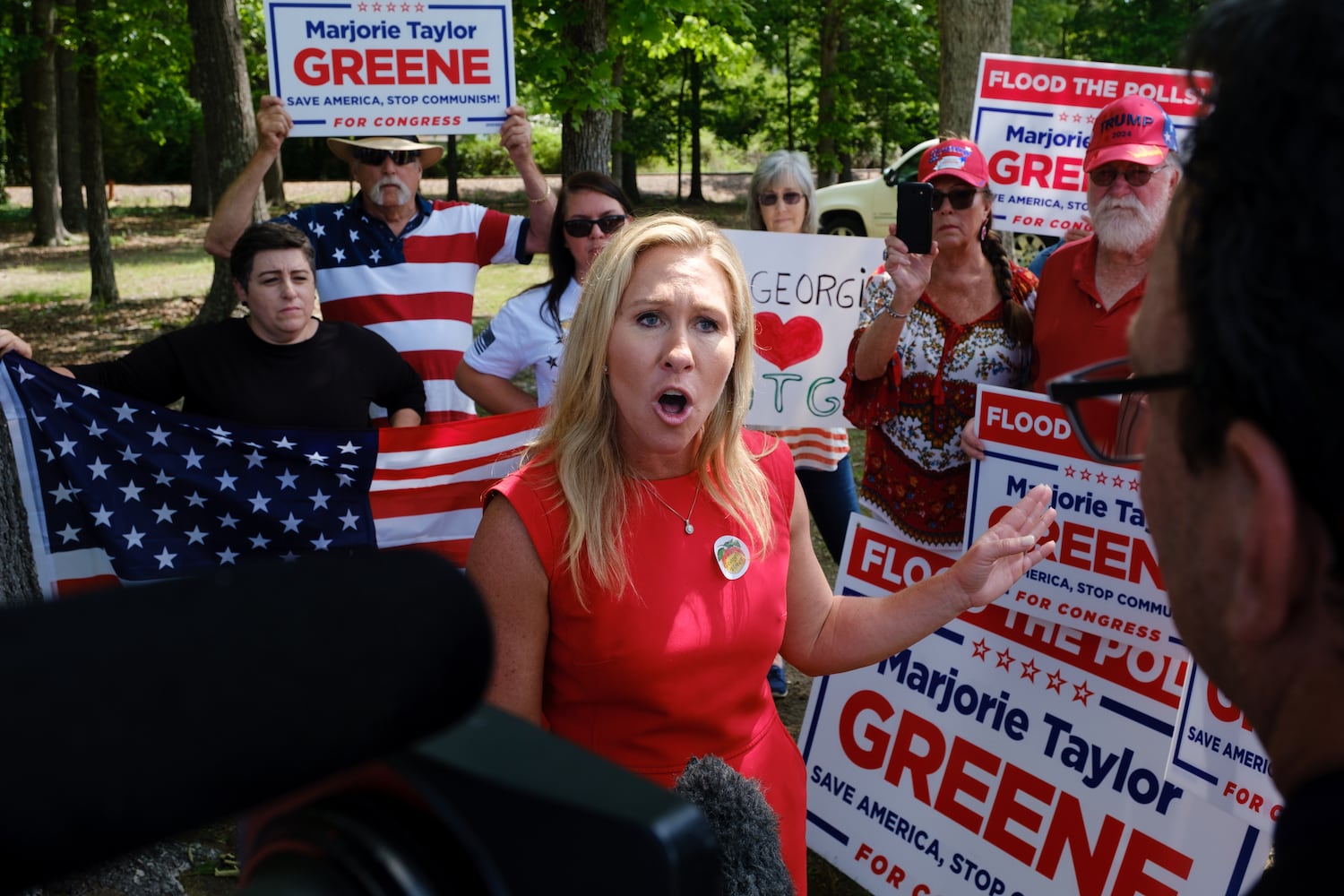
Representative Marjorie Taylor Greene has been bucking the Republican party line with increasing frequency—standing with Democrats to demand that the Justice Department release the Epstein files, decrying the spike in health-care premiums, and holding love-ins with the hosts of The View. Many people are trying to get their heads around the fact that the “Jewish space lasers” lady is now a leading voice of heterodoxy and, at least intermittently, common sense.
The prevailing theory for this bout of independence is that Greene is angry at the Felon
President Donald Trumpfor foiling her plans to run for Senate. “Here’s some tea for you,” explained Representative Alexandria Ocasio-Cortez, a longtime Greene antagonist, on social media this week: “The White House and Trumpland shut down Marjorie Taylor Greene’s personal ambitions to run for Senate, and she has been on a revenge tour ever since.” The journalist Tara Palmeri suggested in her newsletter, “As much as I’d like to believe Greene’s recent critiques are born of sudden enlightenment—that it was just fearing that her adult sons will have to pay higher Obamacare premiums that changed her mind on health care or that she’s suddenly opposed to mass deportations—the simpler, messier truth is often personal.”Having initially judged Greene to be a wildly uninformed conspiracy theorist, I was similarly predisposed to dismiss her evolution as a kind of revenge for being slighted. But having listened closely to her commentary of late, I’ve concluded that she is up to something more interesting and strategic. Greene seems to have recognized that the president has broken faith with his own followers. That realization may also now be dawning on other Republicans after Tuesday’s electoral mini-rout, but Greene not only saw it happening sooner; she began planning her future around it. She may be planning for a day when the MAGA movement is not led by Trump, or even by a member of his administration, but by a leader who can speak on behalf of its disgruntled base. Somebody like her.
When Greene announced in May that she wouldn’t seek her party’s nomination for Senate in Georgia next year, she insisted that Trump had not pressured her to stay out of the race. But Greene’s rebellion against him began around the same time. It takes a lot for Trump to disqualify a loyal candidate, but Greene’s history of conspiratorial claims—such as that 9/11 was an inside job, and that the Parkland and Sandy Hook shootings were staged—yielded polls that had her reportedly trailing incumbent Democratic Senator Jon Ossoff by double digits. Although Greene may have been diverted from her path to the Senate, she seems to have found an even bigger opportunity.
Her first major break with the administration came on the Epstein files. Right-wing activists devoted years to building up Jeffrey Epstein as not only a deviant and a monster but the beating heart of a nexus of dark power. It was odd, then, for Trump to suddenly declare the entire issue too boring even to merit discussion, let alone a full public disclosure.
Most of Trump’s supporters eventually, if reluctantly, came around to his position. After initially demanding more information, Charlie Kirk announced in July, “Honestly, I’m done talking about Epstein for the time being. I’m going to trust my friends in the administration. I’m going to trust my friends in the government to do what needs to be done.” Greene seemed to recognize that “trust my friends in the government” was not the most satisfying resolution to the saga that had gripped MAGA devotees, so she pounded the table for the files to come out.
Greene has also positioned herself as a vocal critic of Israel who has been willing to flirt with anti-Semitic conspiracy theories. She has voted to cut aid to Israel, including missile defense, and to protect the Boycott, Divestment, and Sanctions (BDS) movement from a ban backed by fellow Republicans.
Greene’s stances on these issues may be motivated by bigotry, but her views are consistent: She denounces most foreign aid, including to Israel, Ukraine, and Argentina, which is getting a $40 billion bailout from Trump. She has noticed that the party’s base remains attached to “America First” nationalism, some of which is inflected with anti-Semitism. Trump stoked these sentiments and rode them to victory, but in office has straddled the divide between MAGA ideals and standard conservative policy goals, such as lower taxes for the rich and a muscular foreign policy.
The representative’s most surprising act of deviation has come on health care. Democrats shut down the government to force Republicans to extend subsidies, without which premiums for health insurance bought through the Affordable Care Act marketplace will spike for millions of people. Republicans, still gripped by a dogmatic opposition to universal health care, have adamantly refused. Greene, however, has identified herself with the cause of constituents whose health insurance is suddenly unaffordable. “I’m absolutely disgusted that health insurance premiums will DOUBLE if the tax credits expire this year,” she wrote on X in early October, but swiftly added, “Also, I think health insurance and all insurance is a scam, just be clear!” (Greene’s views on the value of modern medicine are, well, idiosyncratic.)
Greene is essentially doing to Trump what Trump did to the Republican Party of George W. Bush: She is recognizing the gaping void between the values of the party’s leaders and those of its followers, and ruthlessly exploiting it.
When Trump ran for president a decade ago, he grasped that, although conservative voters loyally followed the party’s culture wars, they had little interest in the priorities of their leaders, such as a hawkish foreign policy and deep cuts to social welfare.
Greene seems to have stumbled onto the insight that Trump, despite his almost-theological hold on the base, has nonetheless betrayed it. Republican voters may not say they oppose aspects of Trump’s agenda, or even admit it to themselves. But Trump has used their loyalty to advance a series of causes—a regressive tax cut, slashes to Medicaid and food stamps, a bailout for Argentina—that his voters, at best, are willing to abide or, at worst, quietly resent.
Greene’s most shocking apostasy is her almost casual admission that Trump has not ended inflation and revived prosperity, as he routinely claims. “Prices have not come down at all,” she told the podcaster Tim Dillon in October. “The job market is still extremely difficult. Wages have not gone up. Health-insurance premiums are going to go up. Car insurance goes up every year.” . . . . they reflect public sentiment, which is the reason that Trump’s approval ratings have sagged, and that Democrats were able to run successfully everywhere on affordability in this week’s elections.
Imagine a Republican presidential primary three years from now. If the economy is booming, the party’s voters will probably crave the continuity promised by J. D. Vance. If inflation remains stubbornly high and the job market is still soft, or if the economy has plunged into outright recession, then matters will look different. The aperture will widen for a new populist MAGA leader who will carry out the promises Trump failed to fulfill. Greene appears to be making a bet on inheriting control of MAGA after a failed Trump presidency.
Greene has reportedly confided in colleagues that she has designs on the top office, apparently firm in the belief that she is “real MAGA and that the others have strayed.” Yet when Dillon asked whether she wished to run for president in 2028, Greene demurred. “Do I know what that means two years down the road or four years down the road?” she mused. “I don’t know what that means.”
Perhaps she doesn’t. But for a politician who may or may not know what she is doing, Greene is positioning herself for a future that, not long ago, would have appeared as absurd as a Trump presidency once did.
If Greene can cause the GOP to engage in a circular firing squad, I say kudos to her.

Thursday, November 06, 2025

Subscribe to:
Posts (Atom)