
Saturday, December 09, 2023


The Electoral College: Tyranny of the Minority

Arlando Monk is an increasingly rare find in presidential politics: a voter whose choices matter.
The Black entrepreneur lives in Wisconsin, one of seven expected battlegrounds in the 2024 presidential race. He is registered to vote but not sure he will bother. He has not decided between former president Donald Trump or President Biden, if those are the major-party options.
If U.S. presidents were selected through the principle of “one person, one vote” that governs legislative races, the ballots of undecided swing-state citizens such as Monk would be worth just as much as the other 150 million or so Americans who are expected to vote next year.
But that is not the system handed down from the nation’s founding fathers, who opted for multiple winner-take-all contests that give greater power to smaller states. The electoral college was supposed to moderate the passions of what Alexander Hamilton called the “general mass,” which he worried could fall prey to candidates with “talents for low intrigue and the little arts of popularity.”
[T]he system increasingly distorts the democratic process as partisan divisions grow along geographic lines.
Advances in technology, meanwhile, allow campaigns to calibrate their outreach to only the most persuadable voters. The upshot is that a tiny segment of the population will get an outsize say in who leads the United States. And the will of the majority may not even prevail.
Once rare, the frequency with which the electoral college has skewed the overall result has increased: The “general mass” — now called the popular vote — has been won in two of the past six contests by someone who lost the White House. In both cases, the Republican candidate benefited.
At the same time, the count of swingable states has narrowed. The 2024 presidential campaign is likely to target a smaller share of Americans than at any point in the modern era, despite massive increases in spending due to online fundraising, a Washington Post analysis found.
During the last election, just 10 states and two congressional districts were targeted by Republican or Democratic nominees’ campaigns. It was a precipitous drop from the 26 states on average that were targeted each year between 1952 and 1980
The Washington Post’s analysis found that just 1 in 4 Americans lived in such areas in 2020, down from roughly 3 in 4 in the earlier period. If the major parties do not contest Florida in 2024, as is widely expected, only 18 percent of Americans would live in battlegrounds.
The targeted voters in the decisive states should expect a barrage of communications . . . . . The rest of the country’s citizens will find themselves on the sidelines, watching the news or the occasional live candidate event with a diminished voice in their own futures. Their vote will still count but is unlikely to decide anything.
“It’s now getting to the point where you are probably talking about 400,000 people in three or four states. That is what it is getting down to,” said Joe Trippi, a Democratic strategist who has worked on presidential campaigns since 1980. “It does mean that more and more people feel that they don’t have a say.”
The geographic sorting of Americans along partisan lines helps explain why. Most of the country resides in red or blue states where the outcome in a two-party race is not in doubt. If a candidate wins California by one vote or 1 million votes, the electoral college outcome is the same, giving candidates no incentive to campaign in places where the outcome can be predicted. Thirty-three states — including giants such as California, New York and Texas — have voted for the same party in each presidential election dating back to 2000.
“Instead of using increased spending to target a broader swath of voters, you have more and more money focused on specific voters that campaigns think will be decisive in the electoral college.”
“It is pretty clear that not all voters are equal,” said Shaw, the political scientist, whose book “Battleground: Electoral College Strategies, Execution, and Impact in the Modern Era” is due out next year. “It’s not just the system. It is the system and the voters it is operating on.”
The vast majority of the ad and organizing dollars is focused on media markets and outlets where the voters who will decide the election reside, as campaigns seek to infiltrate the communities, households or iPhones where the few identified swing voters such as Monk spend their time.
At the Biden campaign, the early betting is that the outcome of next year’s election will again be very close, with a margin once again hinging on tens of thousands of votes in a few states. Former secretary of state Hillary Clinton, who won the 2016 popular vote by 2.9 million votes, or 2 percent, could have won the electoral college if about 80,000 people in Michigan, Pennsylvania and Wisconsin had voted differently.
In 2020, about 45,000 votes in Georgia, Arizona and Wisconsin could have changed the outcome of that race, even though Joe Biden won the popular vote by more than 7 million.
Before 2000, the outcome of the electoral vote had matched the popular vote in every election for more than a century. But in recent years the aberrations have become more common, with mismatches in 2000 and 2016 that enabled the popular vote loser to claim the White House.
In the past two elections, Republicans have had a distinct electoral college advantage. That’s because the tipping-point states that won the election were more Republican-leaning than the country as a whole. In 2020, Wisconsin, the tipping-point state, was 3.5 points more Republican than the country, the highest advantage since 1948.
The shifts have only magnified the need for campaigns to ignore the bigger blue states where Democrats tend to rack up large margins.
Persuading people to participate in the election at all may prove more important than winning them over from the other side. That means campaigns are likely to focus on voters who are among the least politically engaged.
“The people who will decide this election don’t want to participate in it,” said one Democrat who requested anonymity to describe planning for next year.
At the root of this dynamic is the antiquated assumption at the heart of U.S. presidential politics — that regular people cannot be trusted to directly select America’s leader. Enslaved people, Native Americans and women had no vote in the original U.S. Constitution. The White, landowning men who did were seen as susceptible to their own passions and selfish interest. Electors, by contrast, were expected to be enlightened and above the fray.
“The people choose the electors,” James Madison, a drafter of the U.S. Constitution, said during the debate. “This can be done with ease and convenience, and will render the choice more judicious.”
The electoral college system came with tricky ramifications, including a built-in bias toward smaller states. The population of California, the most populous state, is more than 67 times the population of Wyoming, the least inhabited. But California only gets 18 times the representation in the electoral college of Wyoming. Put another way, the vote of Wyoming residents is worth 3.7 times more than Californians in presidential contests.
The overall effect has been to give the GOP an edge. University of Texas political scientists found that in a 50-50 popular vote election, the Republican had a 65 percent chance of winning in recent elections.
Polling data has consistently shown that a majority of Americans oppose the electoral college, and in a 2019 Gallup survey one of the most common concerns among those opposed was that “the winner of the popular vote doesn’t always win the election.”
Abraham Lincoln won 40 percent of the popular vote in 1860 when he ran against Stephen Douglas and two other candidates. He got 59 percent of the electoral college votes. Bill Clinton won 69 percent of the electoral college votes in 1992 against two rivals, while winning only 43 percent of the vote.

Friday, December 08, 2023

Liz Cheney Reminds Us of the Stakes in 2024

No wonder MAGA Republicans hate Liz Cheney. No Republican is as articulate, persuasive and passionate as the former Wyoming congresswoman in describing the threat four-time-indicted former president Donald Trump and her own party as currently constituted pose to the future of American democracy and international security.
Her new book “Oath and Honor” has plenty of bombshells — the congressman who derided Trump as “orange Jesus”; Rep. Kevin McCarthy’s pathetic excuse that he had to visit Trump at Mar-a-Lago because the former president was depressed and not eating. But the jaw-dropping tidbits should not distract from her overarching message, one that Republicans and the media alike need to embrace.
In her characteristically blunt, unvarnished way, she told CBS’s John Dickerson in an interview aired Sunday: “He’s told us what he will do. It’s very easy to see the steps that he will take. … People who say ‘Well, if he’s elected, it’s not that dangerous because we have all of these checks and balances’ don’t fully understand the extent to which the Republicans in Congress today have been co-opted.” She stressed, “One of the things that we see happening today is a sort of a sleepwalking into dictatorship in the United States.”
Without citing No Labels directly, she cautioned that in facing an existential crisis, we cannot have “a situation where the election that might be thrown into the House of Representatives is overseen by a Republican majority.” (No Labels has let on that throwing the election to the House rather than achieving an outright victory for its candidate might be its desired scheme.)
Moreover, she made no bones about the unfitness of her own party to hold power in Congress. “If you look at what Donald Trump is trying to do, he can’t do it by himself. He has to have collaborators,” she said. “And the story of [House Speaker] Mike Johnson is a story of a collaborator and of someone who knew then — and knows now — that what he’s doing and saying is wrong, but he’s willing to do it in an effort to please Donald Trump. And that’s what makes it dangerous.”
Asked directly whether we would be better off with a Democratic House majority, she did not mince words. “I believe very strongly in those principles and ideals that have defined the Republican Party, but the Republican Party of today has made a choice and they haven’t chosen the Constitution,” she said. “And so I do think it presents a threat if the Republicans are in the majority in January 2025.”
In a subsequent interview with Rachel Maddow, Cheney added another caution. Trump “would take those people who are the most radical, the most dangerous, who had the proposals that were the most dangerous, and he will put them in positions of supreme power,” she said. “That’s a risk that we simply can’t take.”
Her remarkable interviews and ongoing campaign to prevent the United States from “sleepwalking into dictatorship” should be a wake-up call to the remaining anti-MAGA Republican still deluding themselves that a second Trump term wouldn’t be all that bad. (As she told Maddow, “When you have a president who is willing to go to war with the rule of law, to ignore the rulings of the courts if he doesn’t agree with them, that has the potential to unravel everything.”)
[H]er message might resonate with “soft” Republicans, independents and even left-wing Democrats in a snit about President Biden’s handling of the Israel-Gaza war and who vow not to support Biden.
How she will make her case in 2024 remains to be seen. Though she has not ruled out a third-party run, she might carry far more weight if she and pro-democracy Republicans such as Sen. Mitt Romney of Utah and former congressman Adam Kinzinger of Illinois endorse Biden and warn voters against enabling Trump by voting for one of the other candidates.
Cheney can also play another critical role: keeping the media focused on “not the odds, but the stakes” as media critic Jay Rosen put it. It has not been easy to get mainstream media to emphasize the stakes — the survival of our democracy — rather the horserace and premature, meaningless polls.
It is not enough to run a story once every month or so. Unless the campaign is covered as a battle between democracy and authoritarianism, the real threat Trump poses will be concealed. Given Cheney’s extraordinary communications skills and ratings draw, her constant presence in print, online and TV coverage — and her willingness to dismiss efforts to normalize Trump and to assign Biden artificial demerits — might prove invaluable.
Cheney, long an ardent critic of Democrats, can provide one more service. After years of criticizing Nancy Pelosi (D-Calif.) and House Democrats, she worked with them on the Jan. 6 committee, attesting to Pelosi’s willingness to put aside past barbs and Cheney’s fellow committee members’ fidelity to the Constitution. Cheney is a valuable character witness to debunk the demonization of Democrats that has driven Republicans to favor the grotesquely unfit Trump over a center-left, competent Democratic president.
No single voice can determine the outcome of the election. But few have as powerful or effective a voice as Cheney. If she wields her influence adroitly, she will earn her share of the credit for beating back the most serious threat to democracy in our history.

The Implosion of "Moms for Liberty"
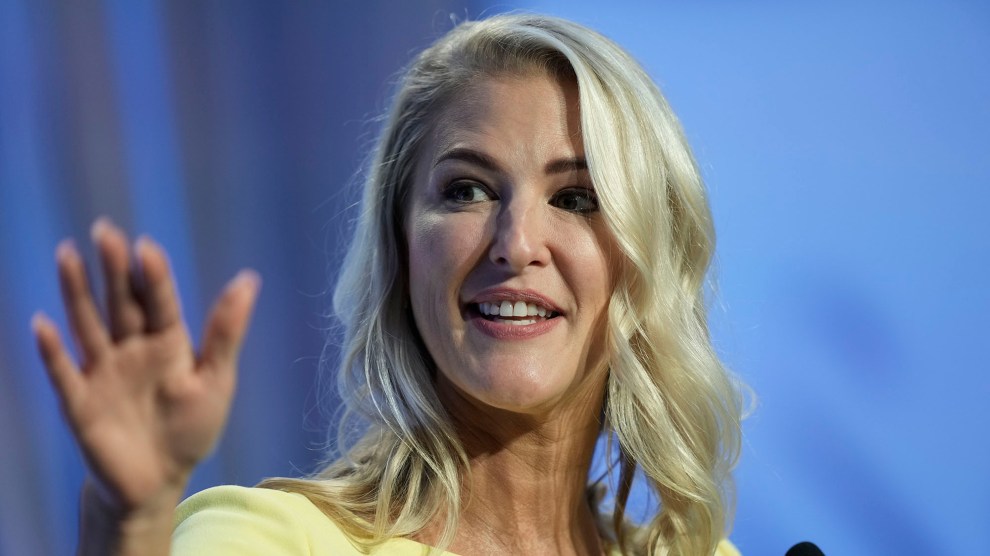
She is a nationally known conservative culture warrior, a Sarasota County School Board member and a co-founder of the book-banning Moms for Liberty, which denounces all things LGBTQ. She is also a DeSantis appointee to the Disney World oversight board. . . . Her virulent hatred for all things LGBTQ in public while conducting a bisexual tryst in private is damning only in the court of public opinion.
But the Zieglers show contempt for public opinion and for the Republican political machine that enriched them and made them prominent public figures. They should retire discreetly to private life while the criminal investigation proceeds.
There is a certain deliciousness in seeing liars and hypocrites exposed. But Bridget Ziegler is only one of Moms for Liberty's problems. In the recent November, 2023, elections some 70% of Moms for Liberty backed school board candidates went down to defeat. Plus, other sexual impropriety and hypocrisy have made headlines. A piece at Salon looks at the welcomed collapse of Moms for Liberty. Here are highlights:
At first, there was little that was surprising about a report that Christian Ziegler, the husband of Moms for Liberty co-founder Bridget Ziegler, is under police investigation in Sarasota, FL following a rape allegation. The modus operandi of Moms for Liberty and their allies is implying, often outright falsely accusing, everyone from drag queens to school librarians of being sexual predators. Lurid finger-pointing from conservatives is often, as most folks have figured out by now, a form of psychological projection. It hasn't even been two weeks since the release of a similar story outing a Philadelphia organizer for Moms of Liberty for his 2012 conviction of sexual abuse of a 14-year-old boy.
Just as predictable were the details dug up by local reporters for the Florida Trident that "both the woman and Bridget Ziegler independently told police they had engaged with Christian Ziegler in a three-way sexual encounter more than a year before the incident, according to a search warrant in the case released late Friday." According to police, the woman had been alone with Christian Ziegler, who is also the chair of the Florida GOP, the night of the alleged rape. Time and again, we have seen this story play out: The self-appointed guardians of everyone else's sexual morality often have rather exotic sex lives of their own. Just ask Jerry Falwell Jr.
But what is genuinely startling — downright shocking, even — is there are signs that these revelations could result in bona fide political consequences for the Zieglers. Gov. Ron DeSantis, whose support of Moms for Liberty played a huge role in the group's skyrocketing to national prominence, didn't mince words when asked about the allegations Thursday night. He called on Ziegler to resign, saying, "He’s innocent till proven guilty, but we just can’t have a party chair that is under that type of scrutiny."
DeSantis isn't alone in this, either. The Zieglers don't seem to have a lot of defenders. The Republican Party of Sarasota released a statement saying they were "shocked and disappointed" by the allegations. While Moms for Liberty claims they "stand with" Bridget Ziegler, they also closed replies on Twitter and put out a statement emphasizing that "she stepped back from the organization’s board in 2021." As confirmed by the Washington Post, however, Zieglers remains on the group's advisory board.
The speed with which the Zieglers are being tossed overboard is fascinating because it wasn't that long ago that the couple were some of the biggest rising stars in the GOP, especially in Florida. DeSantis aligned himself so firmly with Moms for Liberty that they seemed all but an official part of his presidential campaign. He gave a keynote address at the Moms for Liberty conference in Philadelphia in July. He also did innumerable events highlighting the group's work in banning books in school, terrorizing teachers for being LGBTQ or allies, and intimidating educators out of teaching facts about history that conservatives would rather keep hidden.
Bridget Ziegler played a strong hand in writing Florida's "don't say gay" law. DeSantis even appointed her to the tourism board he constructed to harass Disney for daring to speak out against his anti-LGBTQ agenda.
We can rule out sincere concerns about sexual violence as the reason the Zieglers are looking friendless this week. Republicans do not hold rape allegations, no matter how credible, against their leaders. After all, a court found Donald Trump responsible for sexually assaulting E. Jean Carroll just this year, which comports with Trump's previous bragging about how he likes to "grab them by the pussy." Yet he is still sailing to the Republican nomination. DeSantis, who is supposedly challenging Trump for the nomination, hasn't even tried to make Trump's history of sexual assault an issue. Neither he nor the voters he's speaking to give a single fig about sexual violence. If anything, rape charges just burnish one's reputation in MAGA circles, which have made a virtue out of toxic masculinity.
Ziegler has reasons to think he can survive this. The GOP is a party that has made Trump, a thrice-married chronic adulterer, the avatar of their "Christian" messaging. They don't hide any longer that their sexual rules exist mainly as an excuse to harass marginalized people, while those inside their tribe are permitted all sexual adventures they like. If the GOP establishment wanted to rally the troops to defend the Zieglers, we'd probably already be hearing on Fox News how threesomes are simply a Christ-approved way to keep your marriage healthy.
Maybe it will still happen, but this looks like a proper political defenestration with DeSantis hitting the eject button. It's not hard to guess why: Moms for Liberty has bad mojo. The group's political agenda of banning books and bullying LGBTQ students and teachers turned out to be politically unpopular. Being publicly linked to Moms for Liberty hurt Republicans in the midterms. This was most evident in school board races, where Democrats won big in swing districts that Moms for Liberty had targeted for takeovers.
It wasn't that long ago that Moms for Liberty were the belles of the Republican ball. When Virginia's Republican Gov. Glenn Youngkin won in 2021 on a campaign demonizing teachers under the guise of "parents rights," the GOP pinned their electoral hopes on the theory that they could woo swing voters by drumming up fears that LGBTQ acceptance and naughty words in books are a danger to kids. It swiftly became popular on the right to accuse all liberals, but especially those employed in education, of being "groomers," i.e. the equivalent of pedophiles.
What they didn't count on was how this outrageous and falsified moral panic would create a backlash, especially once the book banning frenzy started to affect the quality of education kids could get in school. As I reported in October, parents in suburban Pennsylvania really began to rise up when Moms for Liberty-aligned politicians started to rewrite social studies curricula away from historical facts to peddle right-wing propaganda. People don't like hearing false accusations that beloved teachers are "groomers." They especially don't like it when that's used as an excuse to deprive kids of lessons they need to get into good colleges and get good jobs in an increasingly diverse country.
Few people did more than the Zieglers to convince the larger GOP that it was a smart move to bet it all on this whole "Moms for Liberty" thing. And no one was more gung-ho about the Zieglers than DeSantis. That he's dropping them like a hot potato suggests that even he sees the writing on the wall: Moms for Liberty is a political loser — and the GOP cannot drop them fast enough.
One can only hope this vile group continues to sink and go down in flames.

Thursday, December 07, 2023

A Trump Second Term Could Outlaw Abortion Everywhere
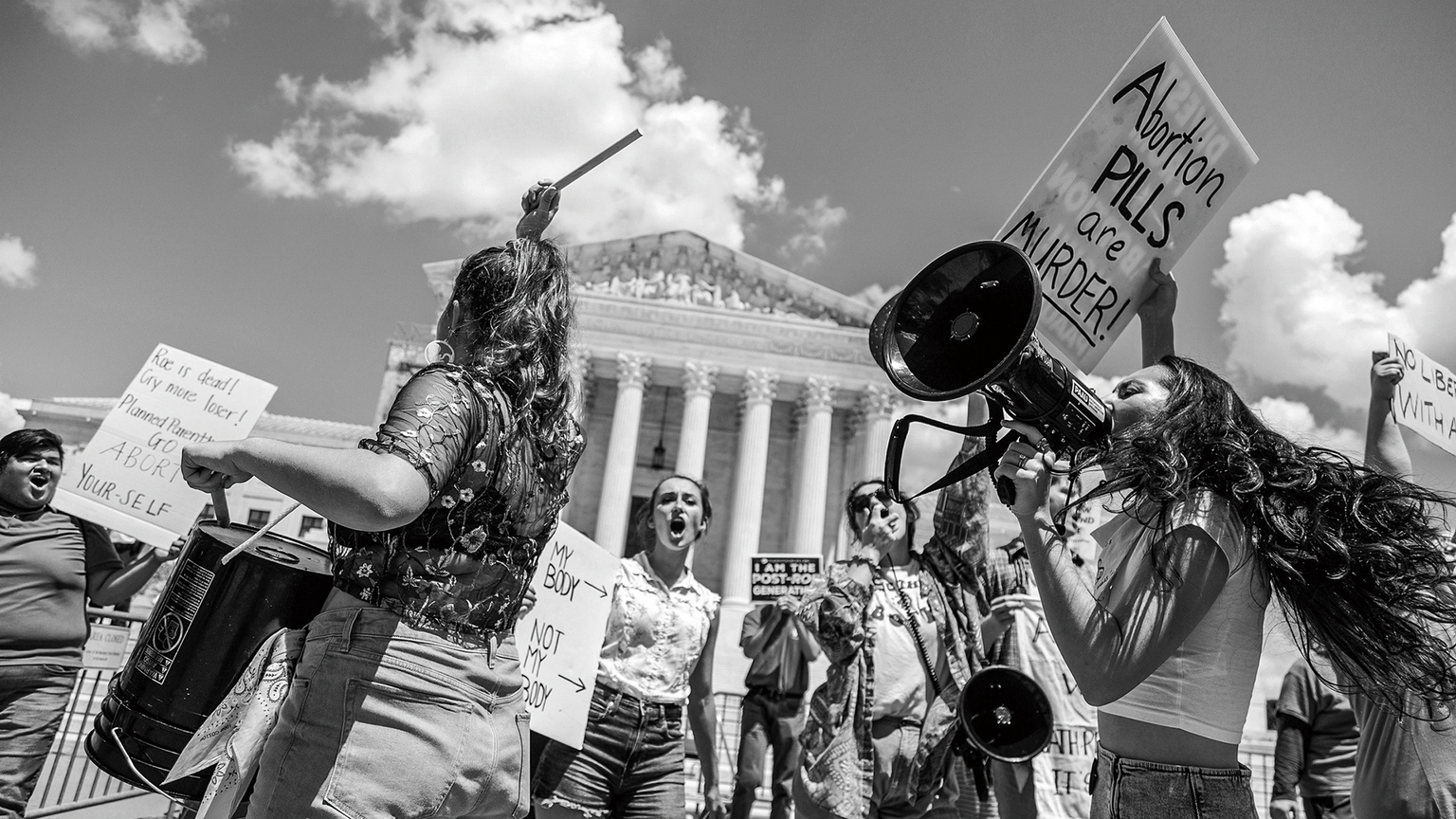
The year 2022 was a triumphant one for the anti-abortion movement. After half a century, the Supreme Court did what had once seemed impossible when it overturned Roe v. Wade, stripping Americans of the constitutional right to terminate a pregnancy. Now movement activists are feeling bolder than ever: Their next goal will be ending legal abortion in America once and for all. A federal ban, which would require 60 votes in the Senate, is unlikely. But some activists believe there’s a simpler way: the enforcement by a Trump Justice Department of a 150-year-old obscenity law.
The Comstock Act, originally passed in 1873 to combat vice and debauchery, prohibits the mailing of any “article or thing” that is “designed, adapted, or intended for producing abortion, or for any indecent or immoral use.” In the law’s first 100 years, a series of court cases narrowed its scope, and in 1971, Congress removed most of its restrictions on contraception. But the rest of the Comstock Act has remained on the books. The law has sat dormant, considered virtually unenforceable, since the Roe v. Wade ruling in 1973.
Following the Supreme Court’s Dobbs v. Jackson Women’s Health Organization decision in 2022, the United States Postal Service asked the Justice Department for clarification: Could its workers legally transport abortion-inducing medications to states with bans? The DOJ replied by issuing a memo stipulating that abortion pills can be legally mailed as long as the sender does not intend for the drugs to be used unlawfully.
If Donald Trump is reelected president, many prominent opponents of abortion rights will demand that his DOJ issue its own memo, reinterpreting the law to mean the exact opposite: that Comstock is a de facto ban on shipping medication that could end a pregnancy, regardless of its intended use (this would apply to the USPS and to private carriers like UPS and FedEx).
“The language is black-and-white. It should be enforced,” Steven H. Aden, the general counsel at Americans United for Life, told me. A broader interpretation of the Comstock Act might also mean that a person receiving abortion pills would be committing a federal crime and, if prosecuted, could face prison time. Federal prosecutors could bring charges against abortion-pill manufacturers, providers receiving pills in the mail, or even individuals.
The hopes of some activists go further. Their ultimate aim in reviving the Comstock Act is to use it to shut down every abortion facility “in all 50 states,” Mark Lee Dickson, a Texas pastor and anti-abortion advocate, told me. Taken literally, Comstock could be applied to prevent the transport of all supplies related to medical and surgical abortions, making it illegal to ship necessary tools and medications to hospitals and clinics, with no exceptions for other medical uses, such as miscarriage care. Conditions that are easily treatable with modern medicine could, without access to these supplies, become life-threatening.
Legal experts say that the activists’ strategy could, in theory, succeed—at least in bringing the issue to court. “It’s not hypothetical anymore,” Mary Ziegler, a law professor at the UC Davis School of Law, told me. “Because it’s already on the books, and it’s not ridiculous to interpret it this way, [the possibility] is not far-fetched at all.”
Eventually, the Supreme Court would likely face pressure to weigh in. Even though a majority of the Court’s justices have supported abortion restrictions and ruled to overturn Roe, it’s unclear how they’d rule on this particular case. If they were to uphold the broadest interpretation of the Comstock Act, doctors even in states without bans could struggle to legally obtain the supplies they need to provide abortions and perform other procedures.
This is what activists want. The question is whether Trump would accede to their demands. After years of championing the anti-abortion cause, the former president seemed to pivot when he blamed anti-abortion Republicans’ extremism for the party’s poor performance in the 2022 midterm elections (only a small fraction of Americans favors a complete abortion ban).
As president, Trump might choose not to enforce Comstock at all. Or he could order his DOJ to enforce it with discretion, promising to go after drug manufacturers and Planned Parenthood instead of individuals. It’s hard to be certain of any outcome: Trump has always been more interested in appeasing his base than reaching Americans in the ideological middle. He might well be in favor of aggressively enforcing the Comstock Act, in order to continue bragging, as he has in the past, that he is “the most pro-life president in American history.”
The best way to stop this is vote Democrat at every level in 2024 and beyond.
Subscribe to:
Posts (Atom)