
Saturday, August 26, 2023


Youngkin Scrambles as Schools Reject His Anti-Trans and Anti-LGBT Policies
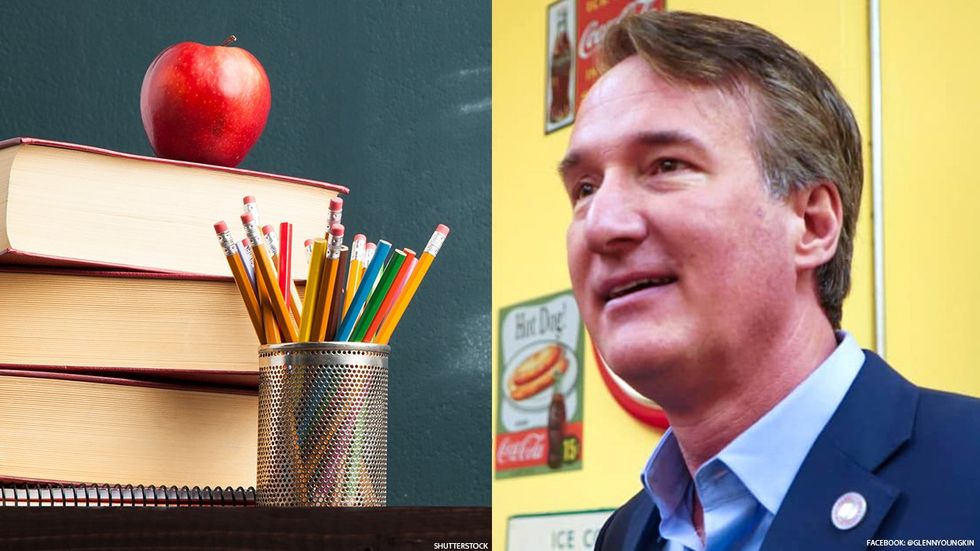
As the school year begins anew in Virginia, many districts around the state are rejecting Republican Gov. Glenn Youngkin’s new school policies that advocates say discriminate against transgender students. His administration is scrambling to find ways to compel school districts to adopt these controversial new policies.
During a Fox News interview on Monday, Youngkin criticized schools that aren’t adopting his administration’s controversial “Model Policies on Ensuring Privacy, Dignity, and Respect for All Students and Parents in Virginia’s Public Schools” for transgender students, stating that “it is the law and they don’t have a choice.”
Appearing on “The Story with Martha MacCallum,” Youngkin griped how many districts around the commonwealth are considering or have chosen to forego implementing the 2023 policies that have been in the works since last September and were finalized in July.
The policies require students to use bathrooms and locker rooms according to their assigned sex at birth. They also require that all parents provide written permission to the school if a student wishes to use a name or pronoun that differs from their official records. Furthermore, schools must disclose to parents if students share information regarding their sexual orientation or gender identity with school staff.
The Advocate spoke with Niko, a transgender teen who goes to school in Arlington.
Niko made headlines for calling out Gov. Youngkin on his transgender model policies for trans students at a CNN town hall event in March. Youngkin appeared stumped when Niko asked which bathroom Youngkin thought the teen should use.
“I think it shows that he’s grasping at straws,” Niko said. “Youngkin doesn’t have a lot to stand on right now. I think that this is a topic that is firing people up right now, and so it’s something that he’s able to rely on.”
The district where Niko goes to school has rejected Younkin’s new policies.
Superintendent of Arlington Public Schools, Francisco Durán, toldThe Advocate recently that he believes that his district’s current policies align with Virginia law and that he would not implement the governor’s discriminatory new guidelines.
“It’s very important for me to make the statement because when the model policies came out, many of our families, our staff, and our students were very concerned with what they meant for them,” he said. “As the superintendent of all students, regardless of their background, it’s my responsibility to ensure we provide a welcoming, safe environment for them.”
On Thursday, Virginia Attorney General Jason Miyares gave his opinion regarding new guidelines the Virginia Department of Education set forth regarding transgender and nonbinary students.
As part of a release issued by the attorney general’s office on Thursday, Miyares said the new guidance “complies with federal and state nondiscrimination laws,” adding that “the model policies comply with the Equal Protection Clause, Title IX, and the Virginia Human Rights Act,” noting “local school boards are required to adopt policies that are consistent with them.”
An opinion on the guidelines was released “at the request of Governor Glenn Youngkin,” who expressed support for the guidelines, saying that children should “trust your parents,” Miyares said.
The opinion stated that under the First and Fourteenth Amendments, parents have “a fundamental right to direct the upbringing and education of their children.”
Virginia voters need to vote against Republican candidates and realize that if the GOP gains control of the General Assembly, Virginia will quickly become a carbon copy of DeSantis' Florida with abortion banned, black history erased, and LGBT individuals subject to a Christofascist jihad. . Virginians deserve better than that.

Palin’s Civil War Threat Underscores MAGA World's Insanity

As a phenomenon in itself, Sarah Palin’s pithy comments about Donald Trump’s arrest in Atlanta this week were neither surprising nor terribly significant. Her rant and rave, as the Daily Beast reported, were characteristically over the top:
Sarah Palin responded to Donald Trump’s arrest in Georgia on Thursday night by talking up the possibility of civil war. Speaking to Eric Bolling as the former president was booked at the Fulton County Jail on election interference charges, Palin slammed “those who are conducting this travesty and creating this two-tier system of justice.” “I want to ask them: What the heck?” the former Alaska governor said. “Do you want us to be in civil war? Because that’s what’s going to happen. . . . .
It’s unlikely that the perpetually overrated pol last seen losing two congressional races in Alaska to a Democrat last year is going to lead the kind of violent insurrection she is not-so-subtly threatening. But it’s a sign that the many, many, many attention-starved MAGA straphangers in or at the periphery of national politics are going to have a new mantra going forward. Having burned through more conventional measures to “take our country back” via normal electoral or legislative activity, Trump’s surrogates are embracing their leader’s increasingly incendiary talk about past, present, and future setbacks that must be avenged or prevented by any means necessary.
Jack Smith’s federal indictment of Trump sparked a lot of fiery rhetoric, as Insider reported in June:
Right-wing Trump supporters are indignant and using “violent rhetoric” online after a federal grand jury brought criminal charges against former President Donald Trump. “We have now reached a war phase,” Republican congressman Andy Biggs menacingly tweeted on Friday. “Eye for an eye,” said the Arizona Rep.
More recently, the threats have been more specifically aimed at the alleged persecutors, notes Time:
Trump has repeatedly been warned by federal officials to refrain from rhetoric that could “incite violence or civil unrest.” Yet as he faces a fourth criminal indictment within a matter of months, he is only stepping up his attacks on prosecutors and judges. And within minutes of his attacks, his acolytes respond.
Here’s the scary thing that ensures this rhetoric will only escalate: By labeling his multiple indictments “election interference” (the very crime of which he is charged by both federal and state prosecutors), Trump has now made his “rigged election” claim for 2024 well over a year in advance.
In the view from the MAGA fever swamps, it’s now impossible for Trump to have a fair shot at regaining the presidency. If he wins despite the massive “election interference” he faces, he is fully justified in unleashing the vengeance that is so prominent a part of his 2024 message. If he seems to lose … it’s clearly grounds for whatever extra-constitutional redress he and his supporters choose.
But with this terrible miscarriage of justice underway before our eyes each day in Washington and Manhattan and Florida and Georgia, why wait for the preemptive theft of the presidency to be consummated? Why not demand it stop right now on pain of nation-rending violence (or as some hard-core conservatives like to put it, a “Second Amendment Solution”)?
Trump’s 2024 campaign is already infused with the smell of gunpowder and the clamor of insurrection. More conventional thinkers may believe his endless misconduct and his ever-more-relentless extremism will convince Republican primary voters to dump him in favor of some safer substitute who doesn’t terrify half the electorate. But the MAGA take on the nomination contest is that doing anything other than sending Trump back out into battle represents complicity in a “rigged election” that happened in 2020 and that is already fully underway for 2024. That makes the rhetoric of civil war, and at some point a significant risk of something worse than rhetoric, not only inevitable, but certain to get worse and worse as the various legal proceedings against Trump run their course.
Be very afraid of what these insane people are capable of doing. January 6, 2021, may prove to be a mere dress rehearsal.

Friday, August 25, 2023

Yevgeny Prigozhin May Yet Have the Last Laugh

Initial reports suggest that Yevgeny Prigozhin, the ruthless mercenary leader of the Wagner Group, has been killed. Although confirmed details are scant, his private plane has allegedly crashed or been shot down, an event that many have interpreted as an assassination. Prigozhin probably knew to stay away from windows in high buildings, so it seems plausible that Vladimir Putin took him out at 28,000 feet instead.
Coup plotters rarely die of old age. Prigozhin sealed his fate in June when he launched a failed mutiny against Putin, which fizzled hours after it began. No dictator can afford to tolerate that kind of disloyalty: Every moment that Prigozhin lived made Putin look weaker, a dictator seemingly forced to accommodate a man who had directly challenged him, simply because Russia needed the Wagner Group for its disastrous war of attrition in Ukraine.
Putin likely knew that letting Prigozhin live risked emboldening enemies within to mount additional threats. In an interview earlier this year, Putin said that leaders must be able to forgive, but that not everything can be forgiven. When the interviewer asked him “What can’t be forgiven?,” Putin’s answer was immediate: “Betrayal.”
And so Prigozhin has apparently gone down in his private plane. The Kremlin could easily have staged a less conspicuous death that would be more likely to dupe outsiders into wondering whether Prigozhin had died of natural causes. But dictators don’t usually want plausible deniability. When they use deadly force against their enemies, they want everyone to know—a shot across the bow to other would-be plotters—which is why Russia’s enemies abroad have been killed with highly controlled radioactive substances that point directly to the Kremlin. If you’re going to send a message, make sure everyone knows who sent it.
Prigozhin’s death, if confirmed, is very likely Putin’s calculated method of trying to reassert his strength. But if so, Putin has made the classic error that all dictators make: wrongly conflating ruthless violence with strength. True strength—and lasting power—comes from regimes that are resilient. The apparent death of Yevgeny Prighozin instead reveals a brittle dictatorship with cracks and divisions that will continue to grow over time.
Today’s events are almost certain to have unintended consequences, as Putin falls further into what I call “the dictator trap”: In authoritarian regimes, every act comes with a trade-off, and those intended to shore up power nearly always wind up undermining it. Short-term displays of brutal strength ensure long-term weakness. In the immediate future, loyalists will fear Putin more—and they will understand that betraying him comes with the ultimate price tag. But in the medium to long term, two fresh threats will likely emerge.
First, senior loyalists in Russia’s regime will now rightly wonder whether they could be next. When dictators start to kill top-level insiders—even those who have challenged the dictator’s authority directly—an intensified paranoia sets in. And who could blame those in Putin’s inner circle for worrying after all of the “mysterious” deaths over the past two decades of Putin’s reign of terror? Some might contemplate whether they’d be better off living in a Russia without Putin, so long as they could define its terms. If insiders fear for their own safety, a palace coup becomes more likely. In that way, getting rid of Prigozhin just shifts and delays the threat. Eventually, every dictator meets his end.
Second, the quality of Putin’s information pipeline is about to get considerably worse, which could lead him to make avoidable errors, because he’s not being told hard truths. That pipeline was likely already compromised after two decades of brutal rule, in which Putin—like all dictators—purged honest advisers who upset him and promoted fawning lackeys who told him what he wanted to hear. Many advisers learn that the best survival strategy when working for a ruthless autocrat is to be a bobblehead. Putin, in one of the biggest blunders in modern history, listened to the bobbleheads who told him he’d capture Kyiv in a few days. That venture has blown up in his face.
But when a dictator assassinates a senior official and not just journalists, opposition candidates, and dissidents, well, then the fear impulse goes into overdrive. Trusted advisers who used to speak honestly but cautiously soon start to bite their tongue or provide overly optimistic assessments, which creates a vicious cycle of bad information and bad decisions. Over time, catastrophic miscalculations become more likely—and, eventually, one of them triggers the end of the regime.
None of this is to say that Putin’s murderous regime is now in its death throes. But once the long-term costs of today’s apparent assassination have been accounted for, the late Yevgeny Prigozhin may yet have the last laugh from beyond the grave.

Thursday, August 24, 2023

America Is Losing Religious Faith

While much of the rest of the industrialized world has become more secular over the last half-century, the United States has appeared to be an exception.
Politicians still end their speeches with “God bless America.” At least until recently, more Americans believed in the virgin birth of Jesus (66 percent) than in evolution (54 percent).
Yet evidence is growing that Americans are becoming significantly less religious. They are drifting away from churches, they are praying less and they are less likely to say religion is very important in their lives. For the first time in Gallup polling, only a minority of adults in the United States belong to a church, synagogue or mosque. (Most of the research is on Christians because they account for roughly 90 percent of believers in the United States.)
“We are currently experiencing the largest and fastest religious shift in the history of our country,” Jim Davis and Michael Graham write in a book published this week, “The Great Dechurching.”
The big religious shifts of the past were the periodic “Great Awakenings” that beginning in the mid-1700s led to surges in religious attendance. This is the opposite: Some 40 million American adults once went to church but have stopped going, mostly in the last quarter-century.
“More people have left the church in the last 25 years than all the new people who became Christians from the First Great Awakening, Second Great Awakening and Billy Graham crusades combined,” Davis and Graham write.
This “dechurching,” as they call it, is apparent in most denominations, reducing the numbers of Presbyterians and Episcopalians and also of evangelicals like Southern Baptists. White and Black congregants have left churches in similar percentages, but Hispanic religious attendance has dipped less.
Pew reports that 63 percent of American adults identify as Christian — but that’s down from 78 percent in 2007. And in that same period the percentage of adults who say they have no religion has risen to 29 percent from 16 percent.
If this trend continues at the same pace, by the mid-2030s fewer than half of Americans may identify as Christian.
There are various theories for what is behind the struggles of Christianity, and multiple factors are probably at work. One noted by Davis and Graham is that to many people the church hasn’t seemed very Christian.
When the Rev. Jerry Falwell dismissed AIDS as God’s lethal judgment on promiscuity, he conveyed a sanctimoniousness that in the 1980s and 1990s allowed much of the religious right to turn a cold shoulder to the suffering of people with the virus.
Jesse Helms, a leader of the religious right in the Senate, even suggested in 1995 that funds for fighting AIDS should be reduced because gay men contract the virus through “deliberate, disgusting, revolting conduct.” In retrospect, the most immoral conduct in America in the late 20th century was not taking place in gay bathhouses but in conservative churches where blowhards preached homophobia, embraced bigots like Helms and resisted efforts to counter AIDS — allowing millions of people, gay and straight alike, to die around the world. That is not morally inspiring.
Then in 2001, Falwell and the Rev. Pat Robertson suggested that the Sept. 11 terror attacks were God’s punishment for the behavior of feminists, gay people and secularists.
The embrace of Donald Trump by many Christian leaders, even as he boasted about assaulting women, separated children from parents at the border and backed an insurrection, was for some a final indication of moral decay.
The loss of religious community has far-reaching implications. Congregations are a crucial part of America’s social capital, providing companionship, food pantries and a pillar of community life. There’s also some evidence that religious faith is associated with increased happiness and better physical and mental health.
One of the most thoughtful contemporary religious commentators, Russell Moore, an evangelical who is now editor of Christianity Today, bluntly acknowledges the challenges ahead.
“American Christianity is in crisis,” Moore writes in his new book, “Losing Our Religion.” “The church is a scandal in all the worst ways.”
Moore is deeply critical of the way many evangelical leaders embraced Trump, and he is pained by church sex abuse scandals. In his own ministry, Moore said that he increasingly has heard from committed young Christians who are upset that their parents have been politically radicalized: “I was less likely to hear about wayward children going out into ‘the real world’ and losing their faith as I was to hear about wayward parents retreating into an imaginary world and losing their minds.”
Moore cites data suggesting that the reason people leave churches is not that they lose their belief in God so much as that they lose confidence in religious leaders and in the church’s moral leadership. He thinks faith can still recover; I’m not so sure.
Religious charlatans like Falwell may have meant to usher in a new Great Awakening, but in fact they taught millions of Americans to be wary of preening ventriloquists who claim to speak for God.
The last paragraph sums up the force behind the phenomenon well.
Subscribe to:
Posts (Atom)