
Saturday, April 02, 2022


Democracies Must Stand Up to Autocrats
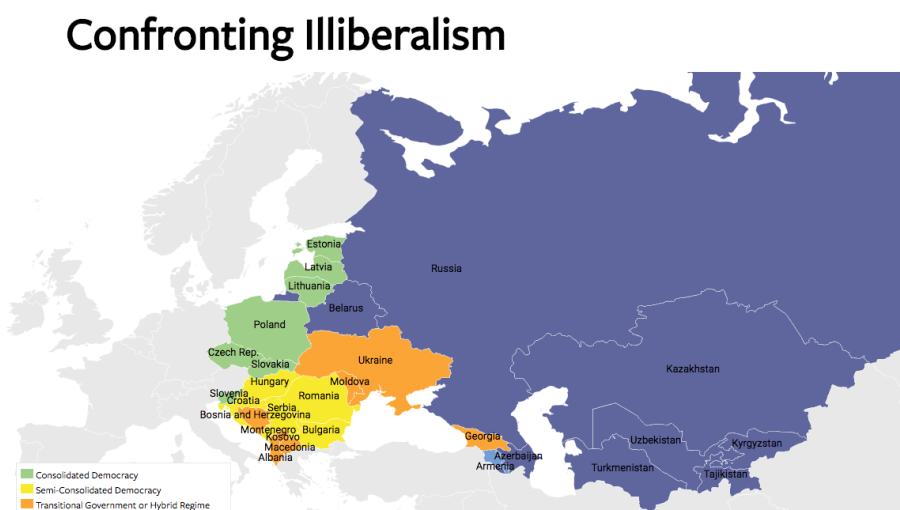
In February 1994, in the grand ballroom of the town hall in Hamburg, Germany, the president of Estonia gave a remarkable speech. Standing before an audience in evening dress, Lennart Meri praised the values of the democratic world that Estonia then aspired to join. “The freedom of every individual, the freedom of the economy and trade, as well as the freedom of the mind, of culture and science, are inseparably interconnected,” he told the burghers of Hamburg. “They form the prerequisite of a viable democracy.” His country, having regained its independence from the Soviet Union three years earlier, believed in these values: “The Estonian people never abandoned their faith in this freedom during the decades of totalitarian oppression.”
But Meri had also come to deliver a warning: Freedom in Estonia, and in Europe, could soon be under threat. Russian President Boris Yeltsin and the circles around him were returning to the language of imperialism, speaking of Russia as primus inter pares—the first among equals—in the former Soviet empire. In 1994, Moscow was already seething with the language of resentment, aggression, and imperial nostalgia; the Russian state was developing an illiberal vision of the world, and even then was preparing to enforce it. Meri called on the democratic world to push back: The West should “make it emphatically clear to the Russian leadership that another imperialist expansion will not stand a chance.”
At that, the deputy mayor of St. Petersburg, Vladimir Putin, got up and walked out of the hall.
Meri’s fears were at that time shared in all of the formerly captive nations of Central and Eastern Europe, and they were strong enough to persuade governments in Estonia, Poland, and elsewhere to campaign for admission to NATO. They succeeded because nobody in Washington, London, or Berlin believed that the new members mattered.
Nobody else anywhere in the Western world felt any threat at all. For 30 years, Western oil and gas companies piled into Russia, partnering with Russian oligarchs who had openly stolen the assets they controlled. Western financial institutions did lucrative business in Russia too, setting up systems to allow those same Russian kleptocrats to export their stolen money and keep it parked, anonymously, in Western property and banks. We convinced ourselves that there was no harm in enriching dictators and their cronies. Trade, we imagined, would transform our trading partners. Wealth would bring liberalism. Capitalism would bring democracy—and democracy would bring peace.
Because of Europe’s metamorphosis—and especially because of the extraordinary transformation of Germany from a Nazi dictatorship into the engine of the continent’s integration and prosperity—Europeans and Americans alike believed that they had created a set of rules that would preserve peace not only on their own continents, but eventually in the whole world.
This liberal world order relied on the mantra of “Never again.” Never again would there be genocide. Never again would large nations erase smaller nations from the map. Never again would we be taken in by dictators who used the language of mass murder. At least in Europe, we would know how to react when we heard it.
But while we were happily living under the illusion that “Never again” meant something real, the leaders of Russia, owners of the world’s largest nuclear arsenal, were reconstructing an army and a propaganda machine designed to facilitate mass murder, as well as a mafia state controlled by a tiny number of men and bearing no resemblance to Western capitalism. For a long time—too long—the custodians of the liberal world order refused to understand these changes.
Even when the Russians, having grown rich on the kleptocracy we facilitated, bought Western politicians, funded far-right extremist movements, and ran disinformation campaigns during American and European democratic elections, the leaders of America and Europe still refused to take them seriously. It was just some posts on Facebook; so what? We didn’t believe that we were at war with Russia. We believed, instead, that we were safe and free, protected by treaties, by border guarantees, and by the norms and rules of the liberal world order.
With the third, more brutal invasion of Ukraine, the vacuity of those beliefs was revealed. . . . His [Putin’s] policies aimed to create refugees so as to destabilize Western Europe. “Never again” was exposed as an empty slogan while a genocidal plan took shape in front of our eyes, right along the European Union’s eastern border. Other autocracies watched to see what we would do about it, for Russia is not the only nation in the world that covets its neighbors’ territory, that seeks to destroy entire populations, that has no qualms about the use of mass violence. North Korea can attack South Korea at any time, and has nuclear weapons that can hit Japan. China seeks to eliminate the Uyghurs as a distinct ethnic group, and has imperial designs on Taiwan.
We can’t turn the clock back to 1994, to see what would have happened had we heeded Lennart Meri’s warning. But we can face the future with honesty. We can name the challenges and prepare to meet them.
There is no natural liberal world order, and there are no rules without someone to enforce them. Unless democracies defend themselves together, the forces of autocracy will destroy them. I am using the word forces, in the plural, deliberately. Many American politicians would understandably prefer to focus on the long-term competition with China. But as long as Russia is ruled by Putin, then Russia is at war with us too. So are Belarus, North Korea, Venezuela, Iran, Nicaragua, Hungary, and potentially many others.
This fight is not theoretical. It requires armies, strategies, weapons, and long-term plans. It requires much closer allied cooperation, not only in Europe but in the Pacific, Africa, and Latin America. NATO can no longer operate as if it might someday be required to defend itself; it needs to start operating as it did during the Cold War, on the assumption that an invasion could happen at any time. Germany’s decision to raise defense spending by 100 billion euros is a good start; so is Denmark’s declaration that it too will boost defense spending. But deeper military and intelligence coordination might require new institutions—perhaps a voluntary European Legion, connected to the European Union, or a Baltic alliance that includes Sweden and Finland—and different thinking about where and how we invest in European and Pacific defense.
Much as we assembled the Department of Homeland Security out of disparate agencies after 9/11, we now need to pull together the disparate parts of the U.S. government that think about communication, not to do propaganda but to reach more people around the world with better information and to stop autocracies from distorting that knowledge. Why haven’t we built a Russian-language television station to compete with Putin’s propaganda? Why can’t we produce more programming in Mandarin—or Uyghur? Our foreign-language broadcasters—Radio Free Europe/Radio Liberty, Radio Free Asia, Radio Martí in Cuba—need not only money for programming but a major investment in research.
Trading with autocrats promotes autocracy, not democracy. Congress has made some progress in recent months in the fight against global kleptocracy, and the Biden administration was right to put the fight against corruption at the heart of its political strategy. But we can go much further, because there is no reason for any company, property, or trust ever to be held anonymously. Every U.S. state, and every democratic country, should immediately make all ownership transparent. Tax havens should be illegal. The only people who need to keep their houses, businesses, and income secret are crooks and tax cheats.
We need a dramatic and profound shift in our energy consumption, and not only because of climate change. The billions of dollars we have sent to Russia, Iran, Venezuela, and Saudi Arabia have promoted some of the worst and most corrupt dictators in the world. The transition from oil and gas to other energy sources needs to happen with far greater speed and decisiveness. Every dollar spent on Russian oil helps fund the artillery that fires on Ukrainian civilians.
Take democracy seriously. Teach it, debate it, improve it, defend it. Maybe there is no natural liberal world order, but there are liberal societies, open and free countries that offer a better chance for people to live useful lives than closed dictatorships do. They are hardly perfect; our own has deep flaws, profound divisions, terrible historical scars. But that’s all the more reason to defend and protect them. Few of them have existed across human history; many have existed for a time and then failed. They can be destroyed from the outside, but from the inside, too, by divisions and demagogues.
Perhaps, in the aftermath of this crisis, we can learn something from the Ukrainians. For decades now, we’ve been fighting a culture war between liberal values on the one hand and muscular forms of patriotism on the other. The Ukrainians are showing us a way to have both. . . . They demonstrated that it is possible to be a patriot and a believer in an open society, that a democracy can be stronger and fiercer than its opponents. Precisely because there is no liberal world order, no norms and no rules, we must fight ferociously for the values and the hopes of liberalism if we want our open societies to continue to exist.
Friday, April 01, 2022

DeSantis/GOP Use Children As Pawns In Cruel Political Game
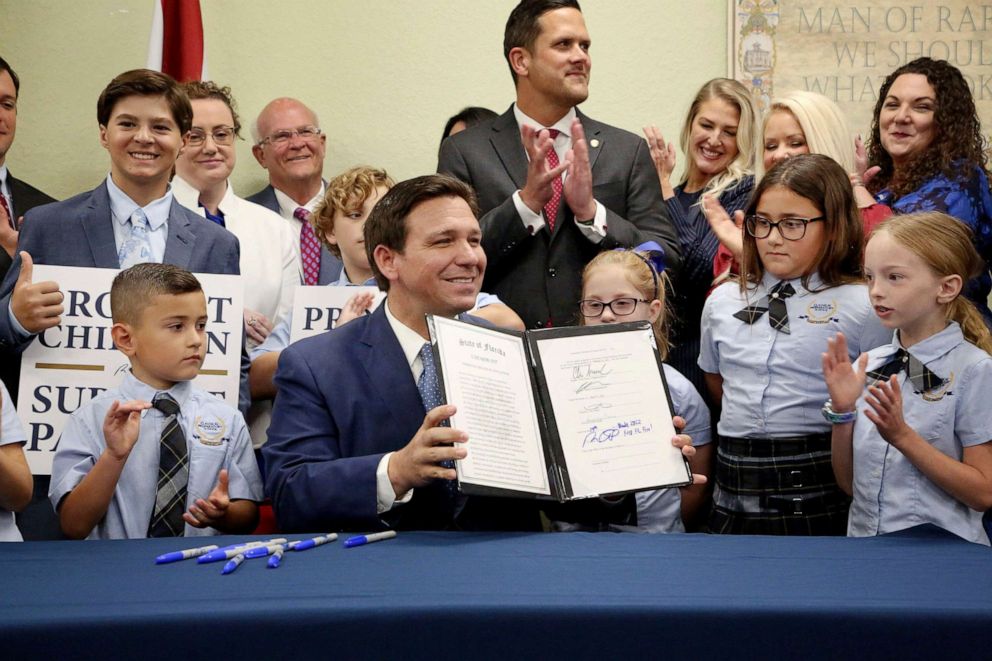
Gov. Ron DeSantis signed HB 1557 — the so-called “Don’t Say Gay” legislation that’s been nationally castigated as cruel, divisive and potentially hazardous to the mental and physical wellbeing of Florida students. The signing ceremony was staged at a Spring Hill charter school founded by the wife of DeSantis’ top education official, where boys are required to keep their hair short and only girls are allowed to wear earrings.
It was a safe space for the governor. He laughed and handed the markers he was using to the children clustered around him.
But you have to wonder about those children: How many of them will remember this event? How many will come to realize that, as they fidgeted and stared at the dark-haired man with the markers, he was enacting a law meant to intimidate teachers who might offer support to LGBTQ+ students and convince those students their voices should be silenced? Not because the students, or the teachers, were doing anything wrong. But because it was politically advantageous for Florida lawmakers and the governor to wield vicious lies, spinning false visions of child predators and erasing the identities of students who don’t conform with heterosexual norms.
So much has been said about the wreckage that this new law will create. There’s the immeasurable, but seemingly inevitable economic damage as companies remove Florida from their lists for potential expansion or relocation. The move put many of Florida’s biggest corporations in the crosshairs of controversy and many — including Disney, which recently trumpeted inclusion as one of its keys to guest relations — added to the trauma by not speaking out in a timely and decisive fashion. These companies stayed silent when they should have been demanding the return of campaign contributions from politicians who chose to capitalize on hate.
The new law allows parents to sue school boards over any teacher-led discussions of gender identity or sexual orientation in kindergarten through third grade. Those discussions aren’t taking place, Florida educational leaders have said. However, the bill goes on to ban any discussions with older students that are not “age-appropriate or developmentally appropriate” – a highly subjective standard.
The new law was stripped of its most corrosive language, which could have required school officials to “out” students who identify as LGBTQ+ at school. But it does force schools to notify parents if a student needs additional services for “mental, emotional, or physical health or well-being” — ignoring the fact that family strife, including anger or denial over a child’s sexuality, is a heartbreakingly common cause of depression or suicidal thoughts.
And that goes to the heart of the anguish that will be caused by this bill. It is aimed directly at students who are suffering because of their sexuality. Lawmakers might have been offended by outspoken students like Winter Park High School student Maddie Zornek, who helped stage that school’s protest walkout and said in a letter to the Orlando Sentinel “This bill is a direct target of the LGBTQ+ community. It is riddled in homophobia and bigotry and it has no place in our schools.”
They certainly overlooked the outspoken trepidation of Ellie Zucker, an eighth grade student in Broward County, who told the Sun Sentinel: “This law being passed basically says we are not allowed to speak to teachers in class who can help me find my way when I’m really lost and really sad about being myself. I feel like my rights are being taken away as a human being.”
Prior to signing this bill, DeSantis didn’t meet with any of the courageous students leading the protests. He didn’t talk to mental-health professionals about why gender-divergent youth are at such high risk for suicide. He didn’t visit shelters for LGBTQ+ students who have been thrown away by their parents. He didn’t even curb the scurrilous dishonesty of his chief spokeswoman, who repeatedly connected non-heterosexual orientation to pedophilia.
Instead, this governor — who has often said how much he despises political theater — sat down in front of students holding signs that said “Protect Children.” And signed legislation that actively, knowingly, purposefully puts children in danger.
The children at Monday’s bill signing, used as scene-setting pawns in a war they didn’t understand, may someday feel shame. We doubt DeSantis will. But he should.
Sadly, Glenn Youngkin and most Virginia Republicans are no better than DeSantis. Come 2023, Republicans in the General Assembly need to be punished and voted from office.

Thursday, March 31, 2022

Signs of a Housing Bubble are Brewing

US home prices have soared to new heights and they keep on climbing, and some researchers and economists say they have seen signs of a housing bubble brewing.
Home prices are rising faster than market forces would indicate they should and are becoming "unhinged from fundamentals," according to a new blog post written by researchers and economists at the Federal Reserve Bank of Dallas.
Until recently, the possibility of a bubble wasn't widely supported. But after looking at housing markets across the US, the Fed researchers said new evidence is emerging.
"Our evidence points to abnormal US housing market behavior for the first time since the boom of the early 2000s," the researchers wrote. "Reasons for concern are clear in certain economic indicators ... which show signs that 2021 house prices appear increasingly out of step with fundamentals."
Many Americans are still scarred by the last housing crash in 2007, which was fueled by cheap credit and lax lending standards that resulted in millions of homeowners owing more on their homes than they were worth.
But this time, the economists said they are worried about a different scenario.
Just because home prices are rising wildly does not always mean housing is in a bubble. And there are lots of reasons why home prices have risen steadily over the past decade and shot up even more significantly in the past two years, including supply and demand imbalances in the market, rising labor and construction costs and how high or low the interest rates are for a mortgage, the researchers pointed out.
But they said prices may be rising to a point they call "exuberance," in which prices become increasingly out of sync with the economic fundamentals underpinning the market.
One possible reason, they suggested, is that buyers may believe prices will continue to climb and fear they will miss out on snagging a lower price on a home now and get stuck paying more later.
This fear of missing out, or FOMO, effect can drive up prices and heighten expectations of higher prices ahead. That can create a self-fulfilling prophecy, researchers said, in which price growth can become exponential.
The consequences of housing market exuberance can include overpriced homes, investments based on distorted expectations of returns and reduced economic growth and employment.
The cycle is interrupted when policymakers intervene, spurring investors to become cautious and causing the flow of money into housing to dry up. This could cause a housing correction or possibly even a bust, according to the blog post.
The researchers recommended policy makers and market participants closely watch local markets for booms in prices in order to better respond, "before misalignments become so severe that subsequent corrections produce economic upheaval."
The behavior of homebuyers and sellers over the past two years has been anything but normal, the researchers pointed out. Prices are at record highs and continue to move higher because there has been record low inventory. Still, homebuyers keep buying. Interest rates fell to record lows during the pandemic, but that does not alone explain the housing market frenzy, they wrote.
Fed researchers also looked at the relationship between home prices and rents. They found that since 2020, the home price-to-rent ratio has rapidly skyrocketed beyond what market fundamentals can explain and began showing signs of exuberance in 2021.
Another indicator the researchers examined was the ratio of home prices to disposable income, which is closely tied to affordability. This home price-to-income ratio is increasing quickly, but not yet exuberant, the researchers said.
A lot was learned from the last housing crash, which has led to better early detection and warning indicators of housing bubbles, the researchers wrote. If these concerning trends continue, banks, policymakers and regulators ought to be better equipped to quickly react to avoid the most severe, negative consequences of a correction.
In addition, they wrote, there is no reason to expect any resulting correction would impact homeowners or the economy as significantly as the last housing crash. Americans are generally in better financial shape, homeowners have stronger equity positions and excessive borrowing is not as rampant as it was in the mid-2000s.
Wednesday, March 30, 2022


Subscribe to:
Posts (Atom)