
Wednesday, January 22, 2025


Tuesday, January 21, 2025

Trump and the New Gilded Age
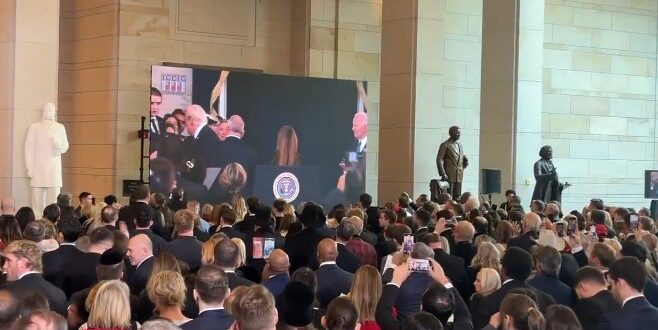
Eight years ago, with his “American carnage” speech, Donald Trump delivered what was likely the darkest inaugural address in U.S. history. During his second inaugural, he tried for a slightly more uplifting message. . . . . “The golden age of America,” he declared, “begins right now.”
Perhaps it would be more aptly called a Gilded Age. Trump was joined in the Capitol Rotunda by many of the nation’s richest and most powerful men, including Elon Musk, Jeff Bezos, Tim Cook, and Mark Zuckerberg. The attendance of the business titans was rendered conspicuous by the small space. . . . . Their presence also added a strange dimension to Trump’s complaint that “for many years, the radical and corrupt establishment has extracted power and wealth from our citizens.”
This was the first time since Grover Cleveland’s second inauguration, in 1893—during America’s first Gilded Age—that a president was sworn in for a nonconsecutive second term. And many of the policies and ideas in the speech evoked the late 1800s more than any recent presidency.
The speech was saturated with 19th-century imperialism. Trump announced that he would order the name of America’s highest peak to be changed from Denali back to its old name, Mount McKinley, and he extolled the 25th president’s use of tariffs. . . . . Trump also said he would rename the Gulf of Mexico “the Gulf of America,” and he promised to “pursue our Manifest Destiny into the stars,” invoking the controversial slogan of expansionism. Picking up an idea he had voiced in recent weeks, he also vowed to seize the Panama Canal from Panama.
Senator Amy Klobuchar, the chair of the Inaugural Ceremony Committee, heralded America’s “peaceful transfer of power” in the same building where it was disrupted on January 6, 2021. A few minutes later, Trump stood face-to-face with Chief Justice John Roberts, who granted him broad immunity in a ruling last summer, and took the same oath of office that he flagrantly broke at the end of his first term. His mood was not only celebratory, but messianic.
Historically, presidents have used their inaugural addresses to pivot from the blue-sky promises of the campaign trail to the more sober language of governing. Rather than dwell on campaign vows they may struggle to keep, they reach for gauzy and unifying language. This, however, is not Trump’s forte.
Nor did Trump make much effort to reach out to or reconcile with the voters who don’t support him, although he promised that “national unity is returning to America.” He boasted about his (very narrow) margin in the popular vote and victories in seven swing states. “My recent election is a mandate to completely and totally reverse a horrible betrayal and all of these many betrayals that have taken place and to give the people back their faith, their wealth, their democracy, and indeed their freedom,” he said.
Instead, Trump delivered something akin to his stump speech: a meandering laundry list of policy promises of varying degrees of plausibility. He called for a huge expansion of oil and gas extraction. “We will drill, baby, drill,” he said. He promised to impose major tariffs. He said he would deploy U.S. troops to the Mexican border, expand immigration enforcement inside the country, and declare drug cartels foreign terrorist organizations. He also signaled an executive order that will continue the attacks on people who don’t conform to traditional gender norms.
[M]uch of the speech was devoted to things that are almost certainly never going to happen. He vowed to beat inflation but didn’t say how. He said he’d establish an External Revenue Service to handle the money he claimed tariffs would bring in, but this would require an act of Congress, as would the Department of Government Efficiency he claims he’ll create. . . . This was all a warm-up for Trump’s most audacious promise. “Our power will stop all wars and bring a new spirit of unity to a world that has been angry, violent, and totally unpredictable,” he said.
But the world already knows what four years of a Trump presidency looks like. Serenity, peace, and predictability were not the hallmarks of his first term, and they are unlikely to describe the second any better.

Monday, January 20, 2025

Turn the Channel on the Inauguration

[J]ust know that you are under no obligation to watch the second inauguration of You-Know-Who. You’ve undoubtedly heard insistences from well-meaning crusaders like The Lincoln Project’s Ryan Williams, who rang the shame bell for all to hear last Monday. . . . Williams posted on Bluesky. “Don't you dare turn your eyes away from history, even the awful, scary parts. If you don't watch it with your own eyes, you rely on others to tell you what you saw. We must all bear witness to what's coming.”
Do we, though? We’re about to be flooded in four years of covfefe, if not more. Withstanding the onslaught will require us to protect our energy whenever we can. So instead of donating your attention to a man who thrives off ratings, use those hours to fortify yourself with knowledge or rest.
Monday is also Martin Luther King, Jr. Day, don’t forget. . . . . If you subscribe to Paramount+, you can watch “Selma” for no additional cost. Also highly recommended are “I Am Not Your Negro” on Hulu; “Rustin” or “Amend: The Fight for America” on Netflix; and a trove of options from Henry Louis Gates, Jr. via PBS.org or one of its apps. “Reconstruction: America After the Civil War” is stunning and might wake people up to the truth that America’s been here before. It’s available via the PBS Documentaries app on Prime Video.

Sunday, January 19, 2025

What’s Really Behind the GOP Anti -Trans Jihad

What did people care about in the lead-up to the 2024 Presidential election? Last fall, Gallup ran a poll and asked. The economy was first on the list; most voters rated it as “extremely important.” Majorities of respondents also named a slew of other issues as either “extremely important” or “very important” to their vote: democracy in the U.S., terrorism and national security, picks for Supreme Court Justices, immigration, health care, gun policy, taxes, abortion, crime, income and wealth distribution, the federal budget deficit, foreign affairs, energy policy, race relations, and so on. In fact, only two issues on the list were not considered at least “very important” by a majority of voters. One was climate change, which half of those surveyed voted as “somewhat important” or “not important.” The other was transgender rights, which came last.
Perhaps it’s unsurprising that transgender issues seemed less salient than the other topics. (As for climate change, tell that to a melting Greenland.) Only around one per cent of American adults identify as transgender, Gallup reported last year. . . . . “How many transgender athletes are you aware of?” Durbin continued. “Less than ten,” Baker said. That’s less than .002 per cent.
But the drive to ban transgender athletes from sports has never been about numbers. In 2023, Ohio’s House of Representatives passed a bill banning trans girls from competing in girls’ sports as early as kindergarten. It was called the Save Women’s Sports Act, conjuring an image of barbarians at the gate. But, when the journalist Pablo Torre went looking for these girls who were, purportedly, breaking all the records and stealing all the opportunities, he found that, when the efforts of the measure began, there was one trans varsity athlete in Ohio: a backup catcher. (She wasn’t very good.) When the governor of Mississippi signed a bill in 2021 barring trans athletes from competing in sports according to their gender, supporters of the bill didn’t present evidence of trans athletes at public schools in the state. . . . no one could cite any problematic instances of transgender participation. Many of the bills’ biggest advocates did not know whether there were any transgender athletes in their states at all.
And yet, as the election neared, Donald Trump’s campaign doubled down on attacking transgender rights and trans athletes. He started talking about them all the time, even when there was, in reality, not much to talk about. . . . ads for the Ohio Senate race that mentioned transgender issues in sports were aired almost twenty-seven thousand times by Election Day. Trump’s campaign went even further. AdImpact found that his campaign spent more than nineteen million dollars last fall on two television ads alone that centered on transgender-rights issues, and that the ads aired nearly fifty-five thousand times in a span of two weeks or so.
Given how vanishingly few transgender athletes there are, and how many voters pointed to other policy issues as greater priorities, a rational person might have been confused. . . . The ads were zero-sum, too—them versus you.
There are people who want to “save” women’s sports who don’t like women’s sports. A new study in the Sociology of Sport Journal reviewed survey data collected between 2018-19—before the issue was highly politicized—and found that opposition to transgender participation in sports was correlated with idealized views of female attractiveness and traditional gender norms. . . . But there are also people who want to narrowly define women’s sports on a natalist basis who care very much about women’s sports. Some of them are, or were, élite athletes themselves. They see the gains of women’s sports as hard-won and dependent on biological differences—differences that are real, however difficult to define.
But all these bills are not really about fairness. They do not distinguish between dodgeball and ice hockey, between Ultimate Frisbee and Division I shot put. They target kindergartners as well as Olympians. . . . people are tribal. We define ourselves in terms of our groups—the allegiances we are born into, and the allegiances we choose. Sports fandom can be a powerful experience of belonging to a group, and of loathing other groups, too.
It's all about fanning hatred and loathing and causing division.

Subscribe to:
Posts (Atom)