
Friday, November 24, 2023


Book: Trump Called Evangelicals "Pieces of Shit"
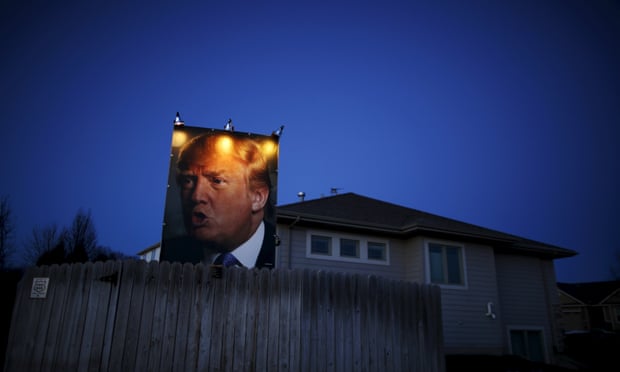
In the heat of the Republican primary of 2016, Donald Trump called evangelical supporters of his rival Ted Cruz “so-called Christians” and “real pieces of shit”, a new book says.
The news lands as the 2024 Republican primary heats up, two months out from the Iowa caucus and a day after Trump’s closest rival this time, the hard-right Florida governor, Ron DeSantis, was endorsed by Bob Vander Plaats, an influential evangelical leader in Iowa.
The new book, The Kingdom, the Power, and the Glory: American Evangelicals in an Age of Extremism, by Tim Alberta, an influential reporter and staff writer for the Atlantic, will be published on 5 December. The Guardian obtained a copy.
Early in the book, Alberta describes fallout from an event at Liberty University, the evangelical college in Virginia, shortly before the Iowa vote in January 2016.
As candidates jockeyed for support from evangelicals, a powerful bloc in any Republican election, Trump was asked to name his favourite Bible verse.
Attempting to follow the advice of Tony Perkins, president of the Family Research Council, the thrice-married, not noticeably church-going New York billionaire and reality TV star introduced it as “Two Corinthians”, rather than “Second Corinthians”, as would have been correct.
“The laughter and ridicule were embarrassing enough for Trump,” Alberta writes. “But the news of Perkins endorsing Ted Cruz, just a few days later, sent him into a spiral. . . . “When Cruz’s allies began using the ‘Two Corinthians’ line to attack him in the final days before the Iowa caucuses, Trump told one Iowa Republican official, ‘You know, these so-called Christians hanging around with Ted are some real pieces of shit.’”
Alberta adds that “in private over the coming years”, Trump “would use even more colourful language to describe the evangelical community”.
Pursuing the lie that his defeat was the result of electoral fraud, Trump refused to concede defeat. He has continued to dominate Republican politics, now as the clear frontrunner to be the nominee again.
Trump has maintained that status despite having been impeached twice (the second for inciting the deadly January 6 attack on Congress) and despite facing 91 criminal charges (34 for hush-money payments to a porn star) and civil threats including a case arising from a rape allegation a judge called “substantially true”.
Evangelicals remain the dominant bloc in Iowa, 55% of respondents to an NBC News/Des Moines Register poll in August identifying as “devoutly religious”. But despite his lengthy rap sheet, Trump’s hold on such voters appears to remain strong.
In October, the Register put him at 43% support overall in Iowa, with DeSantis and the former South Carolina governor Nikki Haley 27 points behind. The same poll said 44% of evangelicals planned to make Trump their first choice, with DeSantis at 22% and Haley seven points back.
Speaking to Fox News, Vander Plaats said: “I don’t think America is going to elect [Trump] president again. I think America would be well served to have a choice, and I really believe Ron DeSantis should be that guy. And I think Iowa is tailor-made for him to win this.”
Trump’s rivals may yet take encouragement from Register polling, should evangelicals begin to doubt Trump. In the October poll, 76% of Iowa evangelicals said they had a positive view of DeSantis, while 62% said they liked Haley.

Thursday, November 23, 2023

Florida GOP Seeks to Expand “Don’t Say Gay Ban” to Workplaces

A new bill just introduced in Florida aims to expand “Don’t Say Gay Or Trans” provisions to a broad range of workplaces. Targeting government employees, contractors, and nonprofits, the bill sets forth restrictions and bans on policies relating to pronouns, gender identity, and sexuality.
Specifically, it would prohibit state and local government employees as well as any contractors engaged with the government from changing their pronouns or honorifics if they do not match their assigned sex at birth. It would also bar them from instructing on gender identity or sexuality, similar to “Don’t Say Gay Or Trans” laws already active in the state education system. The legislation would establish “biological” pronouns as official state policy.
The bill also would establish protections for what it calls “deeply held biology-based beliefs.” It may even prevent all nonprofits in the state from mandating any “training, instruction, or other activity on sexual orientation, gender identity, or gender expression,” a clause that could destroy LGBTQ+ nonprofits across Florida.
The bill, HB599, was introduced by Representative Ryan Chamberlin, a Republican. The bill is split into two sections, with the first section applying to government employees and contractors, which it defines as “an individual, partnership, corporation, or business entity” that “enters or attempts to enter into a contract for services” with any state, county, municipality, or special district of Florida.
These definitions encompass a huge number of businesses, such as stadiums, convention centers, major hospitals, insurance agencies, and more. For these businesses, as well as for all government workers, the bill would declare that it is the state’s policy that “a person’s sex is an immutable biological trait and that it is false to ascribe to a person a pronoun that does not correspond to such person’s sex.” It then would bar covered employees from sharing pronouns that “do not correspond to that person’s sex,” effectively banning social transition at work for these employees.
The bill also would enshrine a new phrase into law: protections for employees “deeply held religious or biology-based beliefs.” The phrase “deeply held religious beliefs” has longstanding precedent in constitutional law and is used to overturn laws judged to be violating someone’s freedom of religion.
Deeply held “biology-based” beliefs, however, are not something that has ever been a part of any law. It would appear that this line is meant to provide religious-based protections to people who assert that their misgendering of transgender people and using transgender people’s old names is part of their “biology-based” rights.
The bill is not limited in its application to government employees and contractors, however. A separate section of the bill would apply to “nonprofit organizations or an employer who receives funding from the state.” In the most broad reading of this section, separating “nonprofit organizations” from “employers who receive funding from the state,” it would bar all such organizations from mandating “training, instruction, or other activity on sexual orientation, gender identity, or gender expression.”
This provision is severe in its potential impact. Virtually every LGBTQ+ organization would be radically affected by it and would likely have to shut down. It would be nearly impossible for an LGBTQ+ organization to run without providing instruction, training, and “other activity” around gender identity or sexuality. It would be a blatant power grab by the state targeting organizations critical to the government and would further drive LGBTQ+ activism and organizing underground in the state. If enforced broadly, this section could have a similar impact to laws in Russia designed to shut down LGBTQ+ organizations there.
This section would have impacts far beyond LGBTQ+ organizations as well. The provisions would apply to “any organization that is exempt from taxation” including “s. 501” organizations. This would include, for instance, 501c4s, which are crucial during election cycles and could be used to target left-leaning organizations running election ads. Many of these organizations have LGBTQ+ employees and provide instruction and accommodations for their employees, which would be barred by the state if this gets passed into law.
It could also have impacts on medical organizations that do business with state and local governments. Planned Parenthood, a 501c3, heavily provides care for LGBTQ+ people, and such a law could be used to target the organization statewide. Likewise, many state hospital systems that do business with the government often must educate employees and patients on HIV and AIDs, which is impossible to divorce from LGBTQ+ issues. Community health clinics would, similarly, have to contend with these provisions.
This legislation represents an early move in what promises to be a challenging year for anti-LGBTQ+ legislation in 2024. Historically, Florida has often been the breeding ground for new laws aimed at the LGBTQ+ community. This bill might well serve as a precursor to the next “model policy” that could be replicated in multiple states, and bears close watching.

Wednesday, November 22, 2023

Be Very Afraid of Speaker Mike Johnson

Mike Johnson, the new speaker of the House, voiced support for revisiting Supreme Court decisions that struck down restrictions on the use of contraception, barred bans on gay sex and legalized same sex marriages, according to a CNN review of his prior public statements.
On a conservative talk radio show the day the Supreme Court struck down Roe v. Wade in June 2022, Johnson underscored Justice Clarence Thomas’s concurring opinion that the high court should reconsider those other landmark rulings.
Johnson, citing his years as an attorney against “activist courts,” defended Thomas’ view, insisting that what Thomas was calling for was, “not radical. In fact, it’s the opposite of that.”
When asked about Johnson’s post-Roe comments, a spokesman for the congressman told CNN that Johnson “views the cases as settled law.”
Still, CNN’s review of more than 100 of Johnson’s interviews, speeches and public commentary spanning his decades-long career as a lawmaker and attorney paints a picture of his governing ideals: Imprisoning doctors who perform abortions after six weeks; the Ten Commandments prominently displayed in public buildings; an elimination of anti-hate-crime laws; Bible study in public schools.
From endorsing hard labor prison sentences for abortion providers to supporting the criminalization of gay sex, his staunchly conservative rhetoric is rooted in an era of “biblical morality,” that he says was washed away with the counterculture in the 1960s.
His vision has been well received as a congressman in his deeply conservative district in western Louisiana. But his surprising rise to the speakership has brought his particularly subtle brand of fire-and-brimstone to second in line to the presidency — delivering him a national platform from which to shape and influence laws.
Johnson’s endorsement of Thomas’ opinion, legal experts say, positioned him significantly outside the mainstream.
“Speaker Johnson embraces a view that is not only outside of the mainstream but is so radical in terms of his endorsement of the Thomas position, that even the extremely conservative Supreme Court majority isn’t willing to go there,” said Norm Eisen, a senior fellow at the Brookings Institute and a CNN legal analyst. “It would take the country back more than a half-century.”
CNN unearthed more than two dozen radio interviews from Johnson’s time as an attorney at the socially conservative legal advocacy group Alliance Defense Fund (ADF) where Johnson litigated and voiced support for what he sometimes described as a battle for the country between the forces of good and evil.
“The arrows in the culture war are particularly directed at our youth, where the Enemy often has the greatest effect,” read the 2005 webpage for “God & Country,” a Christian local radio show co-hosted by Johnson. “We cannot lose our children to the forces of darkness. Be aware and get active in your kids’ schools.”
Topics discussed on the show included “creation science” in public schools; how to “fight the porn industry”; God’s “design for government”; and “the true meaning of ‘separation of church and state.’”
As an attorney at ADF, Johnson repeatedly battled two organizations in his fight to keep religion in the public square: The American Civil Liberties Union, which he called “the most dangerous organization in America,” and Americans United for Separation of Church and State.
Johnson’s rhetoric has tapped into a “persecution complex” for evangelicals as American culture leans increasingly left on social issues, said Ryan Burge, a political scientist at Eastern Illinois University and a Baptist pastor.
“They want to feel embattled. They want to fight the culture war,” Burge told CNN.
“When he talks about Griswold and Lawrence, evangelicals know that what he really is saying to them is: ‘Our way of life is under attack and liberalism is on the march. Stand firm in our convictions,’” added Burge, referring to the landmark cases that legalized gay sex and contraception use.
Johnson “doesn’t understand the problem with a government compelling its citizens to follow not just religion, but a particular religion,” said Katherine Lewis Parker, the former legal director for the ACLU of North Carolina, who opposed Johnson in a lawsuit related to prayer at official meetings.
Homosexuality was a frequent topic for Johnson, which he has called “inherently unnatural” and a “dangerous lifestyle.” In addition to suggesting he hopes the Supreme Court will reverse its decision allowing same-sex marriage, he also wrote in support of Texas’ anti-sodomy laws, which said gay men caught having sex could be fined [in Virginia it was a felony involve jail time].
In 2015, transitioning from his role at ADF to a member of the Louisiana House of Representatives, Johnson sparked national controversy with the “Marriage and Conscience Act.” The bill aimed to protect individuals objecting to same-sex marriage on religious grounds but faced opposition from Johnson’s hometown editorial board, business leaders and even Republicans in the state legislature.
Critics argued it could enable discrimination against LGBTQ individuals by businesses. Following backlash, the bill never reached a vote. . . . In Congress, Johnson signed on to some of the toughest anti-abortion bills, such as a 2021 so-called “heartbeat bill,” which would essentially outlaw abortion after six weeks. He has repeatedly called states that allow abortion “pro-death” states.
Johnson also supported plans to change Medicare and Social Security benefits while increasing the retirement age, emphasizing urgency in addressing escalating entitlement.
Following Trump’s 2020 reelection defeat, Johnson played a pivotal role in efforts to overturn the election – urging his colleagues to sign onto the Texas Attorney General’s longshot lawsuit aiming to throw out the results in key swing states.
“It was rejected by a bipartisan majority of the Supreme Court,” Eisen told CNN, but Johnson was willing to “perpetuate the loser as the winner and to twist the law and the facts to support that.”
Johnson also endorsed some fringe conspiracies, including the unsubstantiated belief that voting software machines were manipulated.
During a church service in 2022, reflecting on the conclusion of Roe v. Wade, Johnson remarked that much of the credit belonged to Trump.

Has Anyone Noticed That Trump Is Really Old?

Donald Trump is an old man.
He’s 77 years old. When Trump was born, Harry S. Truman was president and Perry Como topped the year’s pop charts. Betty White hadn’t yet started her career in film. Israel and Pakistan didn’t exist. Korea was a unified country, and Vietnam was not. The pioneering computer ENIAC was just four months old.
Trump’s cultural references are dated, and only getting more so. . . . The same goes for his political touchstones. His view of immigration, in which foreign countries dispatch their undesirables en masse, seems to be shaped largely by the 1980 Mariel boatlift. His trade policy is steeped in ’80s-era fears of Japan. He rails against “Communists” and “Marxists” like a Cold Warrior of yore (only with a peculiar affection for the Russians, rather than enmity).
Trump’s older sister died recently—at the age of 86. His younger brother died in 2020; another brother died in 1981. . . . . And these days, Trump sure seems to struggle with mental acuity. At a rally in Iowa, he confused Sioux City with Sioux Falls, a city in South Dakota, and had to be corrected by a state senator. He said that Kim Jong Un rules a nation of 1.4 billion, appearing to confuse the North Korean leader he so admires with China’s Xi Jinping. He has on multiple occasions mixed up his past election opponents, confusing Barack Obama for Hillary Clinton and Joe Biden, and Jeb Bush and George W. Bush. (The campaign of Governor Ron DeSantis put together a long thread of such mix-ups.)
All of this might seem blazingly obvious, or else just mean-spirited and ageist. But these signs of decrepitude are relevant because of an odd dynamic of the presidential race, which is headed inexorably to a Trump-Biden rematch that most Americans don’t want. Biden’s age has received intense, and well-deserved, scrutiny; he’s already the oldest president in American history . . .
Yet Trump’s own aging has not received nearly so much attention in the press or from the public. Next to Biden, Trump just doesn’t seem as old. But he is elderly—less than four years younger than Biden. To the extent that old age is an issue for a presidential contender, it should be an issue for both.
Why has Trump managed to get a pass? Long attuned to the power of appearances, Trump has focused on how he looks. He is often mocked for his heavy orange makeup, his hair dye, and the elaborate nest of hair he constructs atop his head, but those embellishments have also done their job, making him look less old than he might otherwise.
He has also been lucky in his opponents. Biden’s campaign has no interest in talking about age, given the polling about the president (though his aides surely don’t mind coverage of Trump’s gaffes). And Trump’s ostensible rivals for the Republican nomination were until recently hesitant to attack him, which meant they were unlikely to question his robustness, though now DeSantis is starting to emphasize the issue.
Trump’s tendency to bluster has probably also helped hide his aging. Biden’s tone of voice is soft and sometimes slow; he sounds old, in a simple aural sense. If you look at what Trump is saying, especially written out, much of it is unintelligible. But it’s barked out in that familiar overbearing voice, papering over the disturbing substance.
Finally, detecting a decline in Trump may be challenging because his language and reasoning skills started at such a low place. His pronouncements in the 2016 campaign and throughout his presidency could be baffling or nonsensical. Asked at a recent event whether Trump was losing it, former Attorney General Bill Barr said, “His verbal skills are limited.” The audience chuckled, but Barr seemed entirely serious.
But what Barr didn’t say was that Trump was slipping, perhaps because this is who Trump has long been. In that sense, a discussion of time’s ravages on Trump seems misplaced. During his years in the White House, a few incidents of physical struggles—lifting a glass, walking down a ramp—raised just the sorts of doubts that are being raised about Biden now.
I argued at the time, during the 2020 presidential campaign, that the discussion missed the point: “There is extensive evidence that Trump is unfit to serve as president for reasons that have nothing to do with his physical health.”
This has not changed. The idea that Trump has the stamina for the presidency but Biden does not has little evidence to back it up—and even if he did, that would be no reason to risk another round of his administration.
Subscribe to:
Posts (Atom)