Saturday, September 09, 2023

Is the The China Model Dead

By any measure China is a main competitor of the United States and the so-called West both economically and increasingly militarily.  Yet China's economy is facing major problems which are a reminder that a state controlled economy is not free from economic forces - something the former Soviet Union discovered the hard way. With unemployment soaring among young college graduates, a declining real estate industry with falling prices and a huge number of empty properties, and a heavy debt burden, the so-called "China Model" is running into a harsh reality check.  Political and economic reforms could lessen the problems but the Chinese leadership seems unwilling to let go of personal power and control thus setting the stage for slower economic growth.  Hopefully, economic problems will not push China's dictator to opt for military adventures to distract the populace from the failings of the government controlled economy. A long piece in The Atlantic looks at China's economic woes and the challenges China will continue to present to America and the West.  Here are highlights:

China’s jobless college graduates have become an embarrassment to Chinese leader Xi Jinping. The unemployment rate among the country’s youth has reached an all-time high, putting the country’s severe economic troubles on display at home and abroad. In August, Xi’s administration decided to act: Its statistics bureau stopped releasing the data.

But Xi can’t hide China’s economic woes—or hide from them. The problems are not just a post-pandemic malaise, or some soon-to-be-forgotten detour in China’s march to superpower stature. The vaunted China model—the mix of liberalization and state control that generated the country’s hypersonic growth—has entered its death throes.

The news should not come as a surprise. Economists and even Chinese policy makers have warned for years that the China model was fundamentally flawed and would inevitably break down. But Xi was too consumed with shoring up his own power to undertake the necessary reforms to fix it. Now the problems run so deep, and the repairs would be so costly, that the time for a turnaround may have passed.

Contrary to the assumptions of many commentators in recent years, China may never overtake the United States as the world’s dominant economy if current trends continue. In fact, it’s already falling behind.

The demise of the China model is in many ways a function of its tremendous success. When China’s free-market reforms were just getting under way in 1980, the country was poorer, per capita, than Ghana or Pakistan. Today, China has an $18 trillion economy capable of devising 5G telecom networks and electric vehicles.

The motor of the China model is investment, and lots of it—into factories, highways, airports, shopping malls, apartment towers, you name it. China was destitute at the outset of its reforms, and much of the new infrastructure was necessary. Better transport systems helped to boost economic efficiency; new housing sheltered families migrating from farms to cities in search of opportunity. The investments turned China into the world’s factory floor and produced eye-popping rates of growth.

The growth rate stayed high, but now the economy was generating wasteful excess that undermined its health. Logan Wright, a partner at the research firm Rhodium Group, estimates that China has 23 million to 26 million unsold apartments. That’s enough to house the entire population of Italy. Many of these apartments will never be purchased, Wright conjectures, because they were constructed in towns with declining populations. China’s automobile industry, figures Bill Russo, the founder of the consulting firm Automobility in Shanghai, has enough unused factory capacity to make more than 10 million cars (sufficient to supply the entire Japanese car market—twice). Beijing boasts about its extensive network of high-speed railways, already the world’s largest—but the state-owned company that operates it has racked up more than $800 billion in debt and posts substantial losses.

The Chinese “continue to invest beyond what they can actually absorb,” Alicia Garcia-Herrero, a senior fellow and specialist in Asian economies at the think tank Bruegel, told me. “This is why their model went wrong.”

As a result of all this unproductive investment—much of it financed by borrowing—China’s debt has expanded much faster than its economy. A decade ago, China’s total debt was about twice the size of the country’s economy; now it’s three times as large.

Politics have exacerbated the debt problem. The Communist Party has trumpeted high growth rates as proof of its legitimacy and competence, so when growth rates have slipped below targets, authorities unleashed credit to pump them back up. The International Monetary Fund estimates that China’s local governments have amassed $9 trillion in debt in the name of financing infrastructure projects.

China’s leadership has long known that its investment strategy carried risks. Back in 2007, Wen Jiabao, then China’s premier, said, “There are structural problems in China’s economy which cause unsteady, unbalanced, uncoordinated and unsustainable development.” And Chinese policy makers knew exactly how to repair these problems: China had to “rebalance,” as economists say, meaning that it needed to decrease its reliance on investment and foster new engines of growth, especially domestic consumption, which is abysmally low compared with that of other major economies. For that, economists agreed, China would need to liberalize its financial sector and relax the hand of the state on private enterprise.

Early in his tenure, Xi seemed to accept these imperatives. . . . But the reforms never happened. Enacting them would have diminished the power of the state—and thus Xi’s own power. China’s leader was unwilling to trade political control for economic growth.

The more power Xi has commanded, the heavier the state’s hand in the economy has become. Xi has relied on state industrial policy to drive innovation, and he has imposed intrusive regulations on important sectors, such as technology and education. As a result, China’s private sector is in retreat.

Now rebuilding the private sector’s confidence is perhaps the most urgent task facing China’s economic policy makers, the Cornell economist Eswar Prasad told me: “And on that score they don’t seem fully cognizant of what needs to be done, or maybe they’re just not willing to do it, and that I think has some fairly serious repercussions for China’s growth.” Prasad added that the chances of policy makers correcting course are “pretty slim” because they consider private enterprise a “necessary but not really ideal avenue of generating more growth.”

At a time when China sorely needed to juice domestic consumption, Xi’s draconian pandemic lockdowns delivered a devastating blow to incomes. The China model has cracked under the pressure: So little demand drives the economy that it has slipped into deflation, which, if it persists, could further discourage the investment and consumer spending that the economy needs to revive. The Peking University professor Zhang Dandan recently estimated that the unemployment rate among youth ages 16 to 24 could be close to 50 percent, more than twice the official figure. Real estate was once a major contributor to economic growth and a store of middle-class wealth. Now investment, sales, and prices in that sector are falling. The largest private developer, Country Garden, is teetering on the brink of default as its Hong Kong–listed shares have lost two-thirds of their value since the beginning of the year.

China’s economy isn’t beyond repair, but fixing it will be costly and painful. The government will have to write off bad debts, close up zombie companies, and introduce sweeping market reforms of a nature that policy makers have so far avoided. Taking these steps would reboot the economy for a new phase of growth—not at the lofty rates of the past, but at a pace that could sustain the country’s economic progress.

The Chinese government has shown no interest in adopting these reforms, however. Various authorities have issued multiple-point plans to support the economy that amount to little more than administrative tweaks and vague pronouncements. Xi’s confidence-inspiring message to the public is, essentially, “suck it up”

Xi Jinping has spent the past decade amassing personal power. Now the yuan has to stop with him. In theory, the economy’s troubles should prod him into a rapprochement with the United States, to stop economic relations with the West from further deteriorating and keep foreign technology and capital flowing to aid the country’s development. But Xi is taking China in a different direction.

The country remains relatively poor, with per capita income of $12,700—one-sixth that of the United States. It may not have the resources to support the continued expansion of its military capabilities, or to underwrite initiatives meant to bolster its influence abroad. State banks have already significantly scaled back development lending to low-income countries, for example.

The slowdown of China’s economy may undercut Xi’s ideological assault on the world order. By example, China has sought to demonstrate to the Global South that democracy and development are not inseparable, and that autocrats can have wealth, international respect, and political power. Those claims are harder to make with a faltering economy. If anything, China’s economic troubles suggest that authoritarian regimes cannot both tighten control and sustain economic progress—that, ultimately, political reform must accompany economic reform.

Xi is unlikely to embrace this inconvenient truth. Rather, he will pursue his anti-West agenda with even greater urgency. . . . For this reason, economic weakness could make China’s leaders all the more dangerous—more prone to champion nationalist causes and stumble into foreign adventures, such as a military grab for Taiwan. One can only hope that Xi will look to history and realize that a nation’s power can be projected only as far as its economic strength allows.


Saturday Morning Male Beauty


Friday, September 08, 2023

More Friday Male Beauty


Americans' Disconnect on the State of the Economy

A number of surveys and polls show Americans claiming the American economy is doing badly even though most say they are doing alright themselves.   Yet when one looks at the objective data (something one never does if one is on the political right nowadays) , the reality is that the American economy has had a "soft landing" and our economic grow is considerably higher than in our European peer nations.  Yes, interest rates have made securing a new mortgage much more costly - although my law firm continues to do a high volume of residential real estate closings - and the same has occurred with the interest rates on auto loans. But otherwise inflation is way down from where it was a year ago, unemployment remains low and overall wages are up.  Why the confounding disconnect?  Likely at least two reasons: (i) endless Republican and Fox News lies about the actual state of the economy, and (ii) a mainstream media that seemingly always prefers to report on the negative rather than the positive.  For Democrats the disconnect is maddening and the task before them both in Virginia's 2023 elections and the federal elections in 2024 is finding a way to get Americans to look at objective facts and data in what the political right has made a fact free political world.  A column in the New York Times by a Pulitzer prize winning economist looks at reality compared to the public perception.  Here are highlights:  

If President Biden loses his bid for re-election, a key factor will be the widespread perception that the economy is doing badly on his watch. Poll after poll shows Americans rating economic conditions as very bad and giving Biden very low approval for his economic management.

The strange thing is that these bad ratings are persisting even as the economy, by any normal measure, has been doing extremely well. Indeed, we’ve just experienced what Goldman Sachs is calling the “soft landing summer.” Inflation is down by almost two-thirds since its peak in June 2022, and this has happened without the recession and huge job losses many economists insisted would be necessary. Real wages, especially for nonsupervisory workers, are significantly higher than they were before the pandemic.

Oh, and to correct a widespread misconception: No, these figures don’t exclude food and energy prices. The government does calculate measures of “core” inflation excluding those prices, but those are only for analytical and policy purposes.

So why are people so negative about an economy that by all standard measures is doing very well?

When I first began writing about the disconnect between public economic perceptions and what appeared to be economic reality, I got a lot of pushback, of two distinct kinds.

First, there was the argument that there were real economic problems that justified public negativity. People really hate inflation, even if their incomes are keeping up, and a year ago real wages were still somewhat depressed. But at this point inflation is way down and real wages are up.

Second, there was the argument that, in effect, the customer is always right: If people feel that they’re doing badly, you should figure out why, not lecture them that they should be feeling better.

But here’s the funny thing: There’s substantial evidence that people don’t feel that they personally are doing badly. Both surveys and consumer behavior suggest, on the contrary, that while most Americans feel that they’re doing OK, they believe that the economy is doing badly, where “the economy” presumably means other people.

Let me run through some of this evidence.

The Federal Reserve conducts an annual survey of the economic well-being of households. At the end of 2022, 73 percent of households said that they were “at least doing OK financially,” down from the previous year (presumably because of the end of many pandemic aid programs) but not significantly below the number in 2019. In 2019, however, half the population said that the national economy was good or excellent; in 2022 that number was down to just 18 percent.

Are people still doing OK? Well, consumer spending has been strong, suggesting that American families aren’t too worried about their financial situation.

What about inflation? According to a recent poll by The Wall Street Journal, 74 percent of Americans say that inflation has moved in the wrong direction over the past year — a result stunningly at odds with the data, which shows inflation plunging. But are people really experiencing rising inflation?

As it happens, several organizations regularly survey consumers to ask how much inflation they expect, and these expectations have come way down, which is completely at odds with claims that inflation is getting worse.

Even better, I’d argue, are surveys that ask businesses not about the national economy but about their own prices or costs.

The National Federation of Independent Business asks small-business owners whether they have increased or reduced prices over the past three months. More businesses are raising than are lowering prices, but the difference is much smaller than it was last year. The Federal Reserve Bank of Atlanta asks businesses how much they expect their costs to rise over the next year; their median answer is 2.5 percent, down from 3.8 percent last year.

[W]hen people are asked about their own experiences, not “the economy,” what they say about inflation is consistent with official data showing rapid improvement.

The bottom line is that there is a real disconnect between what Americans say about the economy and reality — not just official data, but even their own experiences. It’s silly to deny that this disconnect exists.

What explains negativity about a good economy? Partisanship is surely a factor: Republicans’ assessment of the current economy roughly matches what it was in June 1980, when unemployment was twice as high and inflation four times as high as they are now. Beyond that, the events of the past few years — not just inflation and higher interest rates but also the disruption Covid caused to everyone’s lives, and perhaps the sense that America is coming apart politically — may have engendered a sourness, an unwillingness to acknowledge good news even when it happens.

Now Biden administration officials are trying hard to sell their economic accomplishments, as they should — if they don’t, who will? But will public opinion turn around? Nobody knows. We’re living in a world in which what people believe may have little to do with facts, including the facts of their own lives.

Friday Morning Male Beauty


Thursday, September 07, 2023

More Thursday Male Beauty


Trump Remains a Malignancy That Must Be Prosecuted

Donald Trump - and by extension his Republican enablers - are a cancer on America.   Were he an actual disease, chemotherapy or some other harsh medial regime would be employed to hopefully destroy the disease and restore the nation's health - or at least halt the metastasizing of the disease.  In a democracy where the rule of law is supposed to apply to all and hopefully prevail, prosecuting Trump is the equivalent of chemotherapy and must be utilized regardless of how messy the process may become.  To do otherwise would be to gut the justice system and usher in authoritarianism.  Even under numerous indictments Trump continues to display his contempt for the rule of law and is utilizing a playbook of lies and threats reminiscent of some of the worlds most heinous dictators.  He must be stopped and, if he continues to attack judges and prosecutors, need to be jailed as literally any other defendant engaging in such behavior would be placed behind bars pending trial.  Republicans promoting Trump's lies and falling on their fainting sofas over the prospect of Trump's much deserved prosecution and hopefully his conviction need to be ignored, or better yet voted out of office.  A piece in The Atlantic argues why Trump must be prosecuted.  Here are excerpts:

With four separate criminal cases moving forward against Donald Trump, the rule of law in America appears both commanding and startlingly fragile. Small scenes at courthouses from Florida to New York underline the ever-present threat of violence. In Fulton County, Georgia, officials set up bright-orange security barriers around the courthouse in advance of Trump’s indictment there. In Washington, D.C., fences and yellow tape surrounded the U.S. district court. Judge Tanya Chutkan, who will oversee the federal case against Trump for his efforts to overturn the election, has received increased protection from U.S. marshals—and perhaps not a moment too soon, as a Texas woman was recently arrested for calling in death threats against the judge. Trump, meanwhile, has been busy attacking Chutkan and other judges on social media, smearing the prosecutors bringing the cases against him as a “fraud squad” doing the bidding of President Joe Biden, and promising to turn the Justice Department against his foes should he win a second term.

It’s a grim picture. “The next 18 months could further undermine confidence in democracy and the rule of law,” The Washington Post warned in June. Some commentators, largely on the right, have cautioned that the investigations and prosecutions of Trump might widen cracks in the already-unstable foundations of the American public sphere.

As the threats of violence and attacks on the justice system show, these concerns are not unfounded—far from it. But worrying about the dangers of prosecuting Trump is a bit like focusing on the risk that chemotherapy poses to a cancer patient’s health. The reasoning isn’t exactly wrong; it just begins the analysis in the wrong place. The chemotherapy might be ugly, but it isn’t the source of the problem. It’s the treatment for the underlying disease.

During Watergate, Richard Nixon’s White House Counsel, John Dean, famously told the president that the scandal had become a “cancer growing on the presidency.” Trump’s presence in American politics is similarly malignant. He has made the country meaner, uglier, and more violent. During his first term, he ate away at the protections guarding the U.S. system from authoritarianism, insisting on his own right to absolute power. For prosecutors to have ignored Trump’s provocations would have been to allow the cancer to progress—to acquiesce to his vision of a fundamentally corrupt politics in which the only constraint on power is the threat of vengeance.

Still, that doesn’t mean the prosecutions will be a pleasant experience. Even under the best of circumstances, the country’s first trial of a former president—especially a former president once again seeking office—would have been a high-stakes test of the ability of American political institutions to hold the powerful to account. Trump, though, seems dead set on making the experience as grueling as possible. Already, he may be headed for confrontations with the three separate judges who have cautioned him against using incendiary language and threatening witnesses—which hasn’t stopped him from attacking the prosecutors and complaining on Truth Social that Judge Chutkan is “VERY BIASED & UNFAIR.”

Even so, the notion of the body politic has persisted for a reason. What would happen if the current disease were to go untreated? What might unfold if Trump continues to push the boundaries of what he can get away with—deciding, for example, to skip out on appearing at his trials? The judges and prosecutors would have to decide whether to hold Trump to the standards they would use for any other defendant and reprimand him for his insouciance—potentially, as incredible as it seems, by jailing him. A decision to hold Trump in custody before a conviction would be a bitter and contentious choice: Trump would be sure to complain about the terrible injustice and persecution he faces, eating away at public confidence in the legal system.

Likewise, there’s been a recent surge of interest in the notion that Trump may be barred from returning to the presidency under Section 3 of the Fourteenth Amendment, a post–Civil War provision that disqualifies onetime government officials who have “engaged in insurrection or rebellion” from returning to office. Any effort to block Trump’s candidacy on these grounds would surely involve a prolonged legal battle—and raise uncomfortable questions about the wisdom, in a democracy, of ruling out by judicial fiat a serious contender for the presidency. It would make for harsh medicine.

Yet this harsh medicine wouldn’t be necessary if Trump hadn’t brought this challenge to American democracy in the first place. And letting the challenge go unanswered would have far more destructive effects. The idea of the body politic, and the risks of its decay, is a very old one. Trump’s actions are the source of its current illness, and though the treatment may seem extreme—and have unpleasant side effects—it’s what’s needed to stop the disease from taking over.


Thursday Morning Male Beauty


Wednesday, September 06, 2023

More Wednesday Male Beauty


Call Out Alabama’s Defiant Racism

I lived in Alabama decades ago and I am continually shocked at how the state has regressed and now seems run by open white supremacists and "Christian" extremists.  When I lived there the racism that did exist was more subtle and politicians at least acted in a manner that did not broadcast to the world that the state was a hot bed of racists and misogynists' in general.  Fast forward to today and the majority of the Republican members of the Alabama legislature might just as well don their Klan robs before entering the Capitol.  A case in point is the state legislature's refusal to abide a U.S. Supreme Court ruling that directed the states congressional maps be redrawn to include two majority black districts in recognition of the reality that 27% of the population is black.  Now, for a second time the gerrymandered congressional map has been struck down by a three panel federal court - two judges are Trump appointees - and the court assigned court-appointed experts to draw three potential maps that each include two districts where Black voters have a realistic opportunity of electing their preferred candidate.  A piece at CNN looks at the racism rampant in Alabama (sadly, there are elements in Virginia - e.g., The Family Foundation that descends from those backing Massive Resistance - that would happily follow Alabama's extremism).  Here are highlights:

The current US Supreme Court, stacked with right-wing justices, has in recent years dismantled many of the core civil rights programs of the past 50 years, from voting rights to affirmative action to anti-discrimination law. So it came as a surprise — and for many, a relief — when the court handed down a 5-4 decision in June, declining to gut the remaining provisions of the Voting Rights Act of 1965. Instead, the court found that Alabama’s new redistricting plan discriminated against Black voters and ordered the state legislature to redraw it.

Their new map is out, and it makes clear that the Republican-controlled legislature in Alabama has flouted the court order. Republican Gov. Kay Ivey seemed content to ignore it as well when she signed the redistricting bill (which must now go to a federal court for approval). “The Legislature knows our state, our people and our districts better than the federal courts or activist groups,” she said in a statement.

This defiance of the court by Alabama Republicans is notable not because their objection to the ruling is unique or surprising  — there has been widespread frustration with the Supreme Court’s other recent rulings as well as calls to question this court’s legitimacy — but rather what they are defying. They are rejecting an order to stop discriminating against Black people. Understood in that historical vein, the action of Alabama Republicans fits into a long, sordid backstory.

For much of the Supreme Court’s history, the justices were firmly on the side of discrimination. In the years preceding the Civil War, the court decided in Dred Scott v. Sandford that no Black person could be a citizen of the United States, regardless of whether they were enslaved or free. In 1883, it struck down the federal Civil Rights Act of 1875 that had “affirmed the equality of all persons in the enjoyment of transportation facilities, in hotels and inns, and in theaters and places of public amusement.”  In the 1896 case Plessy v. Ferguson, the court legally sanctioned the segregation regimes emerging across the South.

That started to change in 1938, when the court began to lay the groundwork for the civil rights jurisprudence of the mid- 20th century. . . . Justice Harlan Stone suggested in his majority opinion that, while the court presumed the constitutionality of many laws, there was an exception: Should the court be asked to evaluate laws that discriminated against “discrete and insular minorities,” it would apply a higher standard of judicial review. That notion of “strict scrutiny” would inform a number of the court’s rulings against racial discrimination in the years that followed, most notably in the unanimous Brown v. Board of Education decision in 1954 ordering desegregation of schools.

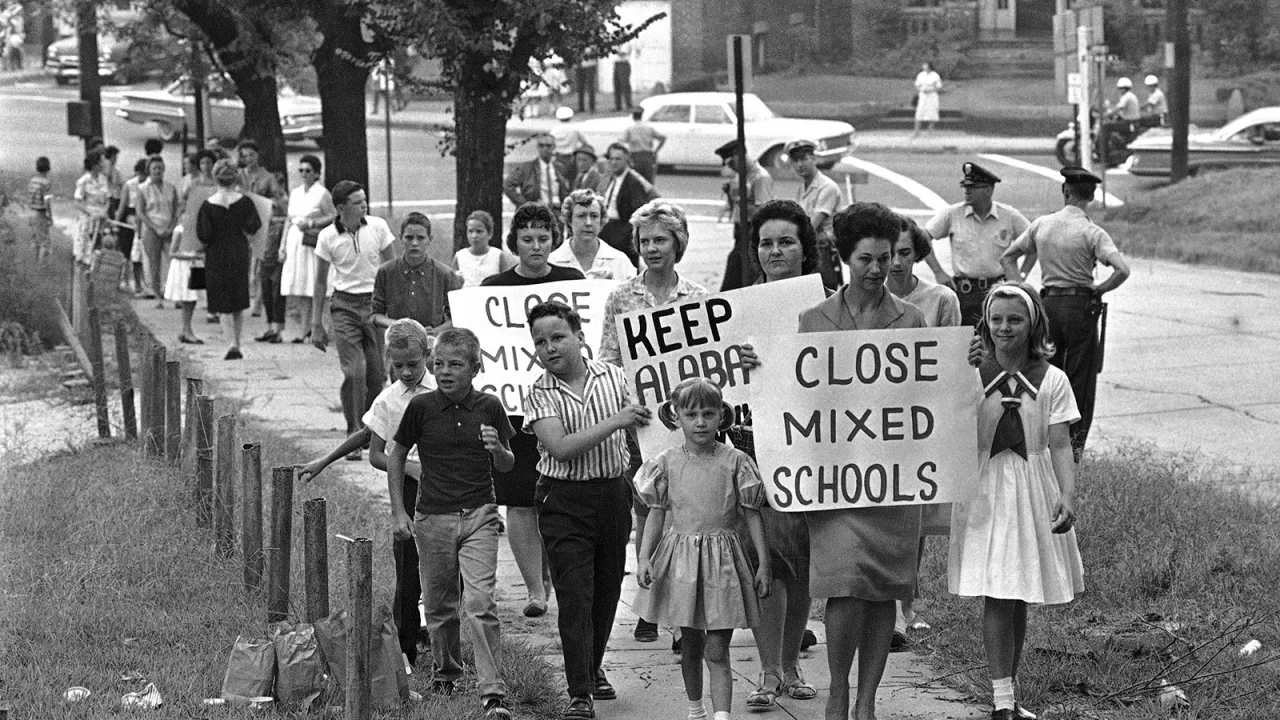
As the court came to embrace civil rights, racial conservatives began to defy it. Though the right found itself at odds with the court on a number of fronts in the mid-20th century, including on issues like school prayer and abortion, it was on issues of desegregation that they were the most actively in defiance of the court. Massive resistance, the sustained refusal of White Americans to comply with desegregation orders, fueled a generation of activists. By 1963, nearly a decade after the Brown decision, only 1% of Black students in the South went to school with White students. It would take federal troops and the National Guard to enforce desegregation orders in the South, and still, White legislators and parents often opted to close schools entirely rather than desegregate.

The courts historically have faced White resistance whenever they have sided with Black civil rights. The Alabama ruling is no exception. Even in an era when the court is rapidly rolling back anti-discrimination jurisprudence — weakening the Voting Rights Act, greenlighting discrimination against LGBTQ consumers, ending affirmative action — even the mildest move to retain existing protections sparks resistance. That tells us less about the court and more about the political power — and impunity — still wielded by pro-discrimination forces, decades after the Civil Rights Movement.

Republicans’ defiance in Alabama is wrong not only because it violates a court order but also because it seeks to dilute Black voting in the state, part of a century-long effort to deny Black voters equal rights. As the fight over the state’s redistricting efforts continues to play out, that denial, rather than the Republicans’ defiance, should be the central focus.