
Sunday, August 20, 2023


Saturday, August 19, 2023

What Trump’s Debate Stunt Says to GOP Voters

It’s hard to think of a more childishly on-brand stunt than Donald Trump’s effort to sabotage the first Republican debate of the 2024 presidential race.
The MAGA king refusing to put on his big-boy pants and share the stage with his opponents is one thing. But counterprogramming some sad sideshow to siphon attention away from the first major candidate forum of the cycle — and with Tucker Carlson, no less? That’s a whole different level of petulant and needy, and it speaks to his staggering disregard for voters and their right to accurately assess the field. The electorate, especially Trump-skeptical Republicans, should demand better.
I get why Mr. Trump isn’t eager to climb into this sandbox. Debating is hard, and he is out of practice. He participated in only two debates during the 2020 cycle, the first of which was the stuff of campaign legend — but in a bad way. (Proud boys, stand back and stand by!) At some point during Wednesday’s two-hour event he would need to talk about something other than his grievances. He hates doing that, and has always been kind of lousy at it. Much of the primary field he is now facing is younger, sharper, hungrier and actually cares about policy and governance. And while few people have Mr. Trump’s razzle-dazzle, at least a couple of his opponents have solid media chops.
Mr. Trump may well be correct to assume he has more to lose than gain from these matchups. But it bears remembering that debates aren’t supposed to be primarily for the benefit of the candidates strutting and fretting upon the stage. They are meant to provide voters with a meaty opportunity to judge their options side-by-side, to listen to them field tough questions, to compare their policies and priorities and visions of leadership. The point is to help the electorate make an informed choice.
This is the case for every presidential hopeful. It is all the truer for Mr. Trump, who is dominating the Republican herd. Sure, he’s done the job before. But his performance was … well, unsettling enough that he lost re-election — and then handled the loss rather poorly. Some Republican voters, especially all those suburban women he needs to win back, might care to hear why he thinks they should give him another chance, especially now that he is up to his comb-over in legal trouble. His high-handed decision to skip this debate risks underscoring to these voters how unserious he is about winning their support and expanding his base even a whit, versus staying comfortably focused on his MAGA fans.
Mr. Trump’s participation would reveal much about the other candidates as well. How would the field handle it when he started spewing his conspiracy nonsense? Who would call him out? (If these debate strategy memos are any indication, not Pudding Fingers DeSantis.) Would anyone be able to wrest the spotlight from him?
Even with Mr. Trump missing, there will be much awkward talk of him. (Or so Fox News’s debate moderators promise.) You would think that, if he were in fighting form, he would want to be on hand to keep the pretenders to his throne in line — or, more precisely, to humiliate his critics face-to-face. I mean, lobbing fat jokes at Chris Christie from afar can provide Mr. Trump only so much satisfaction, particularly since Mr. Christie has been calling him a liar, a coward, and a con artist of late.
Instead, the former president is taking the cheap and entitled way out, fulfilling at least one of Mr. Christie’s critiques. After weeks of being tiresomely coy about his debate-night plans, he has decided to sit down with the disgraced pundit Tucker Carlson, The Times reported on Friday. The man is notoriously fickle, so who knows when — or even if — this will actually happen. Let’s hope it doesn’t. I’m sorry, but we already watched Mr. Carlson give Mr. Trump a thorough bootlicking back in April, not long before Fox News gave Mr. Carlson the boot, in fact, and it was sad.
The Republican debaters, meanwhile, will be left to struggle with the thorny challenge of how to prevent Mr. Trump from hijacking the event in absentia. His antidemocratic inclinations and parade of indictments will have to be addressed. But then everyone really should move on to other issues, leaving the attention-thirsty former president in the shadows. If a Trumpless debate winds up being all about Mr. Trump anyway, he is the winner.
This election cycle is still young, and there will be other debates. The next one, in fact, was announced just last week. (Mark your calendars for Sept. 27!) Republican voters who are feeling even slightly ambivalent about a Trump nomination/coronation should make clear that they expect him to start showing up — and soon, before the field has been whittled way down.
Sure, the MAGA faithful don’t care about such niceties as accountability. But they do not constitute the majority of the Republican Party. The non-MAGA masses can take this primary in another direction if they choose. Many of those voters have reservations about Mr. Trump’s fitness for office — or at least about his electability. (The guy has been responsible for an awful lot of losing since 2016.) They deserve to take his measure directly against the field’s alternatives. And they are in a position to punish him if he cannot be bothered to even try.

Thursday, August 17, 2023


Wednesday, August 16, 2023
Ron DeSantis' Shriveling Campaign
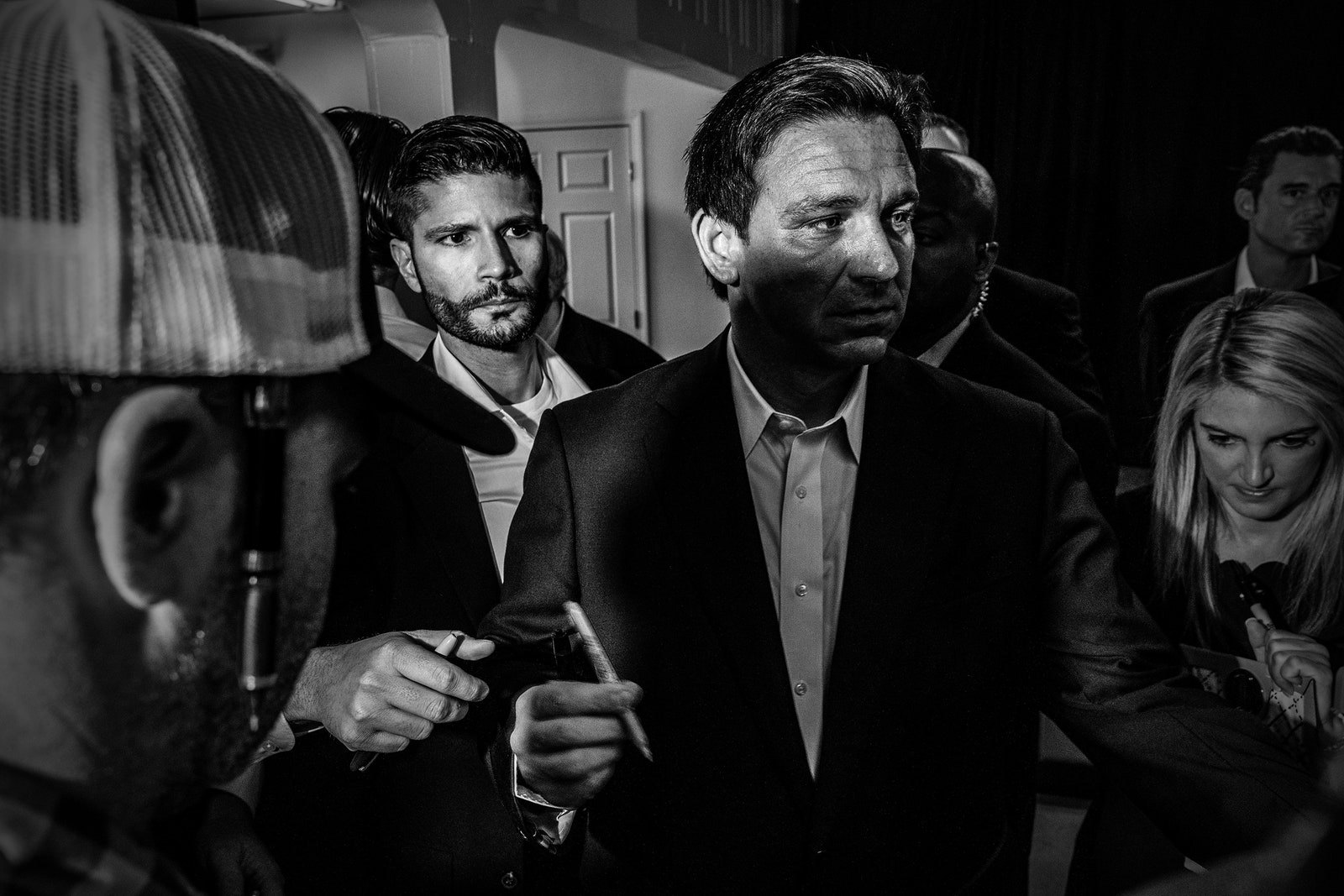
Go to YouTube, and you can still find the Ron DeSantis who got Republican donors and media so excited, just a year ago. A source familiar with the campaign described clips of DeSantis, usually at press conferences he gave as governor of Florida, that went viral in Republican circles. . . . The questions were often about DeSantis’s COVID policies, and also sometimes about his aggressive stances against the teaching of race and gender topics in public schools or his perplexing war on Disney. In response, DeSantis generally took an impatient tone—the press, he seemed to suggest, was once again wasting everyone’s time.
It wasn’t surprising that this kind of figure would appeal most keenly to conservative élites: his gubernatorial campaign last year, effectively a COVID victory lap, drew an astonishing two hundred million dollars in contributions from donors, and, in a four-month period just after the 2020 election, Fox News producers asked DeSantis to appear on the network more than a hundred and ten times. By the end of 2022, after DeSantis romped to reëlection in a midterm cycle in which Republicans underperformed and some of Trump’s preferred candidates flamed out, it seemed to G.O.P. pollsters that the DeSantis phenomenon was no longer just top-down.
Since the 2020 election, Sarah Longwell, a Republican pollster closely affiliated with the Never Trump movement, has been conducting frequent focus groups with Republicans who voted twice for Trump. This past winter, Longwell told me, “We started having to screen groups for Trump favorability to find people who even wanted Trump to run again. I can’t tell you how dominant DeSantis was in that moment, and how clear people were that it was time to move on.” Former Trump voters, Longwell said, “were very DeSantis curious. They just thought Trump had too much baggage.
One theory circulating among politicos right now is that DeSantis simply waited too long to enter the race. . . . But, whatever the reasons for the delay, it was also the case that DeSantis and his advisers had not solved a fundamental problem for the campaign: how to run against Trump. Within two months of DeSantis’s announcement, his campaign laid off a third of its staff; last week, he fired his campaign manager. In a recent Times/Siena poll, he trailed Trump 54–17 among national Republican primary voters.
At the outset of his campaign, DeSantis had a strong base of support among more moderate, college-educated voters. But this base alone is not big enough to win the Republican primaries. “Early on in the race, DeSantis was gonna have to make a decision,” a leading G.O.P. consultant working with a rival candidate told me. One path, he said, would have been to run as a moderate, pull all the anti-Trump people into his camp, and then go to work on the conservatives by arguing that he was younger than Trump, more competent at governing, and likelier to win. The other path was to try to run from the right, even if that cost him the support of his natural base, on the theory that it would be impossible to beat Trump without denting his conservative support and that eventually the moderates would come home because, as the consultant put it, “Where the fuck else are they gonna go?”
In truth, a conservative run was a more natural fit for DeSantis. As DeSantis built his national brand, he had leaned heavily into a hard form of culture war: attacking Disney and pushing laws that curtailed the teaching of gender- and race-related topics. It would have been tricky for even the most adept politician to pivot from this to a moderate pitch of good governance and policy. The DeSantis campaign also seemed to lack Trump’s appeal to what the source familiar with the campaign called the “deep base instincts” of the Republican Party. Perhaps to compensate for this and to channel the right-wing id, the campaign associated itself with some envelope-pushing young activists and journalists. This backfired.
But, from the start of this year, DeSantis has struggled to identify issues that might appeal to very conservative voters. In February, DeSantis criticized the U.S.’s support of the Ukraine war, but he was forced to reverse his position after some prominent donors threw a fit. In April, as much of the political world was coming to terms with Democrats’ electoral advantage after the Supreme Court’s reversal of Roe v. Wade, DeSantis signed a bill outlawing abortion after six weeks.
For several years now, it’s been common to hear Republican consultants and pollsters say that Trump dominates among the Party’s conservative base because he is seen as a “fighter.” More than anyone else in the G.O.P. primary, DeSantis has a reputation for political aggression and a track record of conservative efficacy, but that doesn’t seem to have helped him. Perhaps this characterization of Trump is misleading. Is he really a fighter? He is a yeller, certainly, an expresser, a maker of big threats. He also wanders away from the fights he has started.
On August 4th, a verdict of a sort was delivered on DeSantis’s effort to pry the conservative base from Trump. The hotel magnate Robert Bigelow, the largest individual donor to the DeSantis super PAC, Never Back Down, to which he’d given twenty million dollars, told Reuters that he would not give any more money to the campaign unless it adopts a more moderate approach, saying that DeSantis “does need to shift to get moderates.” When I spoke with Sarah Longwell a few days later, she told me that, in her last two focus groups of two-time Trump voters, not a single participant had said that they wanted DeSantis to win the nomination . . .
The qualities that recommended DeSantis six months ago are intact; Trump is in a strong poll position but a perilous legal one. When I followed DeSantis on the Iowa trail last week, at least, the challenge seemed to be the fundamental political matter of what, exactly, he was trying to say. . . . He did not mention his conflict with Disney; the riff on “parental rights in education” was reserved for his wife, who took the mike after him. Was he abandoning the culture-war hard line? It was difficult to tell. I had the impression that he was hedging.
If the DeSantis campaign is changing, it isn’t yet obvious how. The source familiar with the campaign told me, “If you’re seeking to understand why this entire operation has been such a disaster, the problem has more to do with the fact that there isn’t any unifying theory of the case and certainly no unifying, coherent message—it’s a schizophrenic campaign with a schizophrenic message.” DeSantis, the source went on, had put himself in the impossible position of trying to be “more moderate than Trump and more conservative than him simultaneously.”
In recent weeks, the campaign had taken note of an anti-Trump message that seemed likely to have some traction with Republican voters: a sixty-second spot, “John,” cut by a PAC. In it, a middle-aged man, seated on the steps of a suburban home and speaking calmly to the camera, says that he loves Donald Trump and saw him as a “breath of fresh air,” but that this got him disinvited from his sister’s for Thanksgiving. “The drama . . . he’s got so many distractions, the constant fighting, there’s something every day,” John says. “And I’m not sure he can focus on moving the country forward.” The country is heading in the wrong direction, he adds, “and we definitely need somebody that can freakin’ win. I think you probably lose that bet if you voted for Trump.”
But if this was the sort of message that DeSantis’s supporters hoped might dent Trump’s standing, there was an obvious problem: it did not so much as mention DeSantis. The first debate is on August 23rd, and the best message that the DeSantis campaign has found is not about the Florida governor himself.


Republicans Defend Trump at Their Own Risk

Republican leaders rushed to defend Donald Trump after a Georgia grand jury levied charges against the former president for his scheme to interfere in the state’s 2020 presidential election. House Speaker Kevin McCarthy described the indictment as a “desperate sham.” Rep. Jim Jordan, chair of the House Judiciary Committee, said it was a “WITCH HUNT” and that Trump “did nothing wrong.”
That reaction is unsurprising, but it’s troubling nonetheless. Yes, the legal theories deployed against Trump might be questionable. And yes, there is no doubt that Trump’s prosecution is politically motivated. (That is, unfortunately, a fact of life.) But Republicans minimize Trump’s awful scheme to overturn his defeat at their own risk.
The indictment lists in excruciating detail how Trump and his band worked to undermine the election. The effort was at times shambolic and comical (remember what looked like hair dye dripping down Rudy Giuliani’s face at a news conference?), but nevertheless, it was a serious plot to ensure Trump stayed in the Oval Office against the voters’ will.
Trump’s defenders contend the Georgia indictment is an attempt to criminalize the former president’s political speech. . . . But this ignores the sheer audacity of Trump’s acts and willful ignorance of the facts. Gore had reason to believe that an honest recounting of the votes might award him Florida’s electoral votes. And Clinton did not spend months manufacturing phony controversies in multiple states to provide then-Vice President Joe Biden a pretext to reject electoral votes on the House floor. Trump did, even though he had no rational reason to think he was the fair winner of the election.
Trump flagrantly disregarded the truth from the moment the polls closed. He said, for example, that Milwaukee’s release of its absentee ballots on the morning after Election Day was proof those votes were fraudulent. But, as it was widely reported at the time, those votes would be released in the early hours because Wisconsin law did not allow election officials to begin processing mail ballots until 7 a.m. on Election Day. Facts simply didn’t matter to Trump and his squad.
[T]he prosecution should spend considerable time at trial documenting the rampant disregard for the facts that Trump and his co-conspirators consistently displayed. This wasn’t a case of hardball politics as usual; it was an unusual case of a desperate man pulling every lever of power he could to stay in office despite the facts and the law. Even if doing so does not result in conviction, it would do a service for the public.
The Senate’s Watergate hearings helped sway public opinion against President Richard M. Nixon because they patiently and prudently unraveled his defenses. . . . That could happen again during Trump’s trial. Many Republican voters who back Trump believe his false claims of election fraud, but no one with the resources that Trump’s prosecutors have has ever attempted to systematically undermine those claims.
Prosecutors have a chance to correct that. If they do, do not be surprised if Trump’s GOP backing erodes as his own supporters realize he played them for chumps.
This is why the rush to defend Trump rests on such shaky ground. Ultimately, Republicans who do so are implicitly condoning his heinous behavior. That could prove to be politically unwise.
People will forgive partisan witch hunts if the facts prove the defendant is, in fact, a witch. Republicans should thus think twice before they risk drowning in Trump’s cauldron of deceit.
Subscribe to:
Posts (Atom)