
Wednesday, November 09, 2022


Seemingly the Vaunted GOP Red Wave Failed

Control of the Senate hung Wednesday on Nevada and Arizona, where victories for Democrats could secure their party a majority in Congress’s upper chamber even if the tight Senate contest in Georgia moves to a December runoff.
Democrats defied all predictions of a midterm electoral drubbing on Tuesday, winning dozens of key House, Senate and governors’ races across the country and handing a stunning rebuke to Republicans who had promised that a “red wave” would end one of the most consequential midterm campaigns in recent memory.
Locally, Elaine Luria lost to utter whack job Jen Kiggans which demonstrated again that Virginia Beach remains a far right enclave where going forward I will spend as little time and money as humanly possible. The big hope remains that Democrats will win in the still undecided U.S. Senate races which would hobble Republicans if they control the House of Representatives. Why the GOP failure to experience a wave election? The pundits will dream up all kinds of rationales. Personally, I suspect that the result was a public recognition of the extremism of today's GOP, a backlash against the Supreme Court in Dobbs, and a lack of any GOP plan to deal with the economy and inflation in particular. A column in the Washington Post looks at the results so far:
In the closing days of the 2022 campaign, Republicans were in a bullish mood. They believed that after a difficult summer, the momentum of the midterm elections had swung decisively in their direction.
Election night proved to be more problematic. The vaunted red wave never hit the shore.
Republicans remained confident that when all the results were tallied, they would control the House, though likely by a margin that would fall short of their projections. The Senate, meanwhile, was turning out as predicted, with control in the balance and a handful of seats not called and not likely to be for days.
The pattern for the night was set relatively early, as seats Republicans thought they would flip were agonizingly close and some went against their expectations. One was in Virginia, where Rep. Abigail Spanberger (D) was reelected; another was in Rhode Island, where Seth Magaziner (D) prevailed. Other races Republicans had expressed confidence in winning were turning out to be more competitive than thought.
Candidate quality also appeared to be a problem for Republicans. In the Georgia Senate race, Democratic incumbent Raphael G. Warnock and Republican Herschel Walker were in a virtual tie all evening. Walker, whose troubled past had dogged him throughout the election, was running several points behind Gov. Brian Kemp (R), who easily won his reelection over Democrat Stacey Abrams. And in Pennsylvania, Lt. Gov. John Fetterman (D) was projected to win a hard-fought race for an open Senate seat.
Midterm elections are always a referendum on the president. Try as Biden did to make it a choice between his leadership and that of former president Donald Trump and what he labeled the “MAGA Republicans,” it was in fact more of a referendum on the incumbent administration than anything else. But this has been an unusual election year, one in which some of the normal rules have not applied. If it was a referendum on Biden, it was also a referendum on the Republicans and America itself.
It was the first balloting since rioters attacked the Capitol on Jan. 6, 2021, in an attempt to aid Trump in his quest to overturn the 2020 election results and remain in power. It also was the first election since the Supreme Court overturned Roe v. Wade, ending the constitutional right to an abortion that had stood for half a century. And it was the first campaign in which the label “election deniers” was applied to hundreds of candidates around the country — all of them running as Republicans.
As the first waves of votes were coming in from states around the country, nothing appeared likely to change the prevailing pattern of constant change — in this case putting Republicans on a path to claim a majority in the House, which the odds have favored that outcome all year. The real suspense as the night went on was whether those gains would be big or not so big — and here, Republicans were forced to wait for more results before knowing what the future House would look like.
By early Wednesday, the balance of power in the Senate depended on the outcome of competitive contests in a handful of states. With late poll closings out West and expected slow counting of mail-in ballots in some places, a definitive answer to the question of who would be in the majority may not be forthcoming for days or perhaps longer.
By 2 a.m. Wednesday, the only Senate seat to switch party control was in Pennsylvania, where Fetterman was projected to defeat Republican Mehmet Oz to succeed the retiring Sen. Pat Toomey (R). Meanwhile, Democrats retained Sen. Maggie Hassan’s seat in New Hampshire, one that Republicans saw as a potential pickup that would signal a banner night for the party.
For Republicans, with power comes the obligation to govern — and to avoid the voters’ wrath two years hence. The last time they were in control of the presidency, the House and the Senate, which was after Trump was elected president in 2016, they stumbled badly on a pledge to eliminate the Affordable Care Act, squabbled among themselves and were saddled with unhappiness over Trump’s conduct in office. In 2018 they lost the House, and in 2020 the Senate.
Republicans tried to take advantage of prevailing public sentiment about inflation and crime and Biden’s low approval ratings. Republican candidates said they can bring down the cost of living, deal with crime and secure the southern border, but they have provided only scant policy details. Voters have shown time and again that they have limited patience awaiting results.
In June, the Supreme Court overturned Roe, throwing open a long-brewing debate. The decision caused an immediate shift in election calculations, as many women and some men responded with anger and determination to use the ballot box to express their dismay.
Exit polls showed that about 3 in 10 voters cited abortion as the most important issue in their vote. That was smaller than the number who named inflation, but not by a huge margin. About 6 in 10 said they were angry or dissatisfied with the court’s decision.
Trump and democracy were similarly elevated as issues during the same stretch of summer months, thanks principally to public hearings from the House committee investigating the Jan. 6 attack. Biden especially picked up the theme, delivering two speeches on the topic, including one in the closing days of the campaign. “Democracy is on the ballot” became a rallying cry for some Democrats.
A question heading into Election Day was whether the two issues buoying Democrats would be enough to truly blunt the winds at the backs of Republican candidates.
As the returns continued to come in Wednesday morning, that question remained unanswered, though it was not the night Republican leaders had anticipated.

Tuesday, November 08, 2022
A Political Nightmare 2 Years in the Making
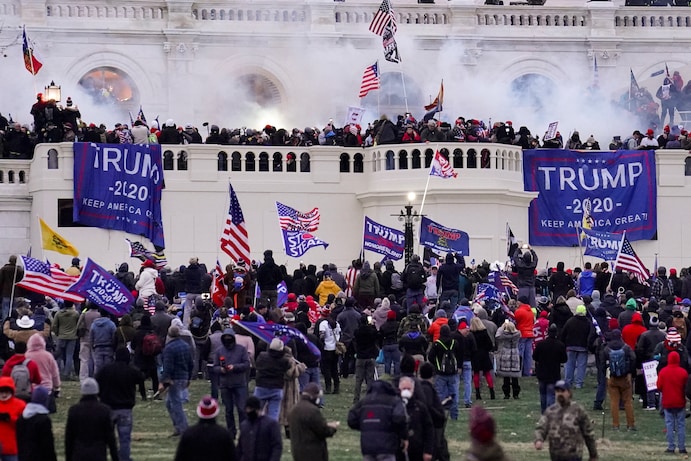
I have been wary of political predictions ever since I co-authored a book 50 years ago that explained how John Lindsay would be elected president in 1972.
But it took no predictive gifts two years ago to warn that while the 2020 presidential election ended by affirming the legitimate winner, it raised unsettling questions about what might happen the next time. Would American democracy be on firmer ground by 2024 — or in an even more perilous state? After the midterm votes are counted, it’s almost certain to be the latter. The warnings of the growing threat to our very system of government are likely to be validated, with potentially disastrous consequences.
In late November 2020, after the states had certified their electoral votes, but well before the Jan. 6 Capitol riot, I wrote in this space:
“It takes no great leap into speculation to show that Trump has taught his would-be successors very powerful lessons in just how to steal an election. Indeed, he’s shown that there’s already political and judicial structure in place that will make it far easier to pull off in elections to come, at least for Republicans, who hold most of the reins in state legislatures. Like the German military who saw the Spanish Civil War as a testing ground for the Luftwaffe, the GOP may come to see 2020 as the election that illuminated the path to seizing power over the will of American voters.” That path involved several theoretical steps that have steadily become more real, with anti-democratic forces now poised to gain ground across the country.
First: Convince your voters that the election has been stolen from them.
That’s been the GOP’s approach almost from the moment Donald Trump declared, falsely in 2020, that: “Frankly, we did win.” A significant majority of self-identified Republicans believe Joe Biden is an illegitimate president. Even more significant, large numbers of Republican officials and candidates have amplified this delusion or lie.
Second: Make sure local and state officials are loyal.
This has been a uniquely successful effort on the part of the Trumpists. As soon as key Republican officials in Michigan, Pennsylvania, Georgia and Arizona rejected efforts to overturn the verdict of the voters in 2020, the strategy for the next campaign was born. The capacity to gum up the machinery of counting and validating votes, maybe even nudge it the other direction, would increase dramatically. If nothing else, Republicans — who control a majority of statehouses in the U.S. — now know precisely where to exert political muscle to ensure that loyalists hold those jobs.
Primary campaigns have already taken out key players who protected the 2020 vote, like half a dozen House Republicans and the Arizona House speaker who was seeking a state Senate seat. In state after state, Republicans have labeled the Jan. 6 insurrection as a “peaceful exercise of First Amendment rights.” More important, some GOP-controlled legislatures have ensured that voting will be more difficult, and that the process of counting of the votes — prohibiting early and mail-in votes from being tallied until late in the process — will only fuel further claims of “another stolen election!”
Third: Open the door to state legislatures deciding the vote.
It caused some heads to turn when Wisconsin GOP gubernatorial candidate Tim Michels told supporters that if he is elected, his party “will never lose another election” in the state. While he claimed later to mean only his policies would be hugely popular, the implication was unmistakable. Ever since taking control of the Legislature in 2010, Wisconsin Republicans have worked to give the Legislature significant power over the counting of votes. . . . . The ability of courts to thwart the power of legislatures, which has proven effective in Pennsylvania and North Carolina, may in turn be severely weakened if the U.S. Supreme Court adopts the radical “Independent State Legislature” theory.
Fourth: Bend the last guardrail — the U.S. Congress.
Should the GOP win control of either the House or Senate, the chances for a voting right bill to curtail the power of state legislatures are non-existent (though Democrats couldn’t even pass one while they had majorities, thanks to Joe Manchin and Kyrsten Sinema’s opposition to gutting the Senate filibuster). And if both houses come under Republican control, the GOP’s ability to contest and reject the certified votes of states in 2024 will be vastly strengthened.
And as for the consequences of allowing election denialism to sink deep into the roots of our politics? I sketched them out nearly two years ago: “Republicans learned in the 2020 election that the ancient machinery of conducting elections is rusted, frail and highly vulnerable. They have seen exactly where the stress points of the system are. … There is every reason to believe they will seek to collapse that system the next chance they get.”
The midterm results look likely to ensure we’ll test that theory out in 2024. I’ll be a lot happier if I’m dead wrong.

A MAGA America Would Be Ugly

If you aren’t feeling a sense of dread on the eve of the midterm elections, you haven’t been paying attention.
We can talk about the conventional stakes of these elections — their implications for economic policy, major social programs, environmental policy, civil liberties and reproductive rights. And it’s not wrong to have these discussions: Life will go on whatever happens on the political scene, and government policies will continue to have a big impact on people’s lives.
But I, at least, always feel at least a bit guilty when writing about inflation or the fate of Medicare. Yes, these are my specialties. Focusing on them, however, feels a bit like denial, or at least evasion, when the fundamental stakes right now are so existential.
Ten or 20 years ago, those of us who warned that the Republican Party was becoming increasingly extremist and anti-democracy were often dismissed as alarmists. But the alarmists have been vindicated every step of the way, from the selling of the Iraq war on false pretenses to the Jan. 6 insurrection.
[I]t’s almost conventional wisdom that the G.O.P. will, if it can, turn America into something like Viktor Orban’s Hungary: a democracy on paper, but an ethnonationalist, authoritarian one-party state in practice. After all, U.S. conservatives have made no secret about viewing Hungary as a role model; they have feted Orban and featured him at their conferences.
At this point, however, I believe that even this conventional wisdom is wrong. If America descends into one-party rule, it will be much worse, much uglier, than what we see in today’s Hungary.
If Democrats lose one or both houses of Congress, there will be a loud chorus of recriminations, much of it asserting that they should have focused on kitchen table issues and not talked at all about threats to democracy.
I don’t claim any expertise here, but I would note that an incumbent president’s party almost always loses seats in the midterms. The only exception to that rule this century was in 2002, when George W. Bush was able to deflect attention from a jobless recovery by posing as America’s defender against terrorism. That record suggests, if anything, that Democrats should have talked even more about issues beyond economics.
[E]ven voters who are more worried about paychecks and living costs than about democracy should nonetheless be very concerned about the G.O.P.’s rejection of democratic norms.
For one thing, Republicans have been open about their plan to use the threat of economic chaos to extract concessions they couldn’t win through the normal legislative process.
[T]hey should understand that this time, voting Republican doesn’t just mean giving someone else a chance at the wheel; it may be a big step toward handing the G.O.P. permanent control, with no chance for voters to revisit that decision if they don’t like the results.
Which brings me to the question of what a one-party America would look like.
As I said, it’s now almost conventional wisdom that Republicans are trying to turn us into Hungary. Indeed, Hungary provides a case study in how democracies can die in the 21st century.
But what strikes me, reading about Orban’s rule, is that while his regime is deeply repressive, the repression is relatively subtle. It is, as one perceptive article put it, “soft fascism,” which makes dissidents powerless via its control of the economy and the news media without beating them up or putting them in jail.
Do you think a MAGA regime, with or without Donald Trump, would be equally subtle? Listen to the speeches at any Trump rally. They’re full of vindictiveness, of promises to imprison and punish anyone — including technocrats like Anthony Fauci — the movement dislikes.
In short, if MAGA wins, we’ll probably find ourselves wishing its rule was as tolerant, relatively benign and relatively nonviolent as Orban’s.
Now, this catastrophe doesn’t have to happen. Even if Republicans win big in the midterms, it won’t be the end for democracy, although it will be a big blow. And nothing in politics, not even a full descent into authoritarianism, is permanent.
On the other hand, even if we get a reprieve this week, the fact remains that democracy is in deep danger from the authoritarian right. America as we know it is not yet lost, but it’s on the edge.

Monday, November 07, 2022
A GOP Congress Could Roll Back Nationwide Freedoms

If Republicans win control of one or both congressional chambers this week, they will likely begin a project that could reshape the nation’s political and legal landscape: imposing on blue states the rollback of civil rights and liberties that has rapidly advanced through red states since 2021.
Over the past two years, the 23 states where Republicans hold unified control of the governorship and state legislature have approved the most aggressive wave of socially conservative legislation in modern times. In highly polarizing battles across the country, GOP-controlled states have passed laws imposing new restrictions on voting, banning or limiting access to abortion, retrenching LGBTQ rights, removing licensing and training requirements for concealed carry of firearms, and censoring how public-school teachers (and in some cases university professors and even private employers) can talk about race, gender, and sexual orientation.
Republicans in the U.S. House and Senate have introduced legislation to write each of these red-state initiatives into federal law. The practical effect of these proposals would be to require blue states to live under the restrictive social policies that have burned through red states since President Joe Biden’s victory in 2020.
None of the proposals to nationalize the red-state social agenda could become law any time soon. Even if Republicans were to win both congressional chambers, they would not have the votes to overcome the inevitable Biden vetoes. Nor would Republicans, even if they controlled both chambers, have any incentive to consider repealing the Senate filibuster to pass this agenda until they know they have a president who would sign the resulting bills into law—something they can’t achieve before the 2024 election.
But if Republicans triumph this week, the next two years could nonetheless become a crucial period in formulating a strategy to nationalize the red-state social-policy revolution. . . . And the 2024 Republican presidential candidates are also likely to test GOP primary voters’ appetite for writing conservative social priorities into national law. Embracing such initiatives “may prove irresistible for a lot of folks trying to capture” the party’s socially conservative wing, Patrick Brown, a fellow at the conservative Ethics and Public Policy Center, told me.
It starts with abortion. Senator Lindsey Graham of South Carolina in September introduced a bill that would ban the procedure nationwide after 15 weeks of pregnancy. In the House, 167 Republicans have co-sponsored the “Life Begins at Conception Act,” which many legal analysts say would effectively ban all abortions nationwide.
In elections, Senator Rick Scott of Florida has proposed legislation that would impose for federal elections nationwide many of the voting restrictions that have rapidly diffused across red states . . .
In education, Senator Tom Cotton of Arkansas has proposed to federalize restrictions on how teachers can talk about race by barring any K–12 school that receives federal money from using “critical race theory” in instruction. Several Republicans (including Senator Josh Hawley of Missouri) have introduced a “Parents’ Bill of Rights,” which would mandate parental access to school curriculum and library materials nationwide—a step toward building pressure for the kind of book bans spreading through conservative states and school districts.
Representative Mike Johnson of Louisiana, along with several dozen co-sponsors, recently introduced a federal version of the “Don’t Say Gay” legislation that Governor Ron DeSantis of Florida pushed into law. Johnson’s bill is especially sweeping in its scope. It bars discussion of “sexually-oriented material,” including sexual orientation, with children 10 and younger, not only in educational settings, but in any program funded by the federal government, including through public libraries, hospitals, and national parks. . . . . Johnson’s bill is only one of several Republican proposals to nationalize red-state actions on LGBTQ issues.
Meanwhile, Senator Steve Daines and Representative Richard Hudson of North Carolina have introduced legislation requiring every state to accept a concealed-carry gun permit issued in any state—a mechanism for overriding blue-state limits on these permits. . . . Ambler told me he expects that the NRA and congressional Republicans will eventually seek not only to preempt blue states and city limits on who can carry guns, but also to invalidate their restrictions on where they can do so, such as the New York State law, now facing legal challenge, barring guns from the subway.
[W]e’ve seen again and again in the states is that when they can, they have moved in these directions. Even when you take a look at more moderate states, when they have the power to do these things, they move these things forward.” That precedent eventually may apply not just to LGBTQ issues, but to all the red-state initiatives some Republicans want to inscribe into national law.
[T]he red states have moved to reverse that long trajectory toward a stronger national floor of rights by setting their own rules on abortion, voting, LGBTQ issues, classroom censorship, and book bans, among other issues. In that cause, they have been crucially abetted by the Republican-appointed Supreme Court majority, which has struck down or weakened previously nationally guaranteed rights (including abortion and voting access).
But the proliferation of these congressional-Republican proposals to write the red-state rules into federal law suggests that this reassertion of states’ rights was just a way station toward restoring common national standards of civil rights and liberties—only in a much more restrictive and conservative direction.
Like many students of the red-state social-policy eruption, Tillery believes that Republicans and social conservatives feel enormous urgency to write their cultural priorities into law before liberal-leaning Millennials and Generation Z become the electorate’s dominant force later this decade. “The future ain’t bright for them looking at young people, so they are acting in a much more muscular and authoritarian way now,” he said.
Be very afraid.

Dancing Near the Edge of a Lost Democracy

One of the most sobering statements from President Biden’s speech last week on protecting democracy was one that might well have gone unnoticed by many who heard it or read about it.
In the speech, Biden pointed out, “The remarkable thing about American democracy is this: Just enough of us, on just enough occasions, have chosen not to dismantle democracy but to preserve democracy.”
The sentence is damning. The dismantling of our democracy is just one apathetic electorate, one slate of voter suppression laws or one barrage of misinformation away.
Modern presidential elections don’t often end in landslides. In fact, no president has won by a margin of the popular vote greater than 10 percentage points since Ronald Reagan in 1984. Biden’s margin of victory over Donald Trump was only four percentage points.
These slim margins are obscured by the flaws and peculiarities of our electoral process, how small states are overrepresented and most states award electors on a winner-take-all basis.
[T]hat same [Electoral College] fluke means that the country’s last two Republican presidents were able to win the Electoral College while losing the popular vote — George Bush in 2000 and Trump in 2016.
This is all to say that we are always a cat’s whisker away from calamity.
And that doesn’t go only for presidential elections. The same dilemma has plagued this year’s midterms as control of Congress hangs in the balance, with the antidemocracy barbarians at the door.
It is widely believed that Republicans will retake control of the House of Representatives, the only question being by what margin. But the control of the Senate is very much in play, with some of the most hotly contested races playing out in states that often swing presidential elections, like Georgia, Pennsylvania, Arizona and Wisconsin.
In each of these states, the Republican candidates for the Senate have at one time either openly denied the results of the 2020 election or pushed false claims of fraud about that election.
Those candidates have a chance to win, but even if they don’t, the damage their election denialism has done will linger. We are witnessing a generational curse being cast.
Republicans have turned doubt about the 2020 election — and about the legitimacy of any elections they lose — into a test of faith. It is the crucible through which one must pass to be a modern Republican in good standing. You are true only if you swallow the lie.
Many elected officials and operatives are simply being opportunists, using the lie to excite voters or to benefit from the zealotry the lie has spawned. But for many Trump followers, the lie is gospel. It is being welded not only to the psyche but also to the soul.
This mass delusion will not be easy to dislodge.
But this is a problem for our democracy. The people fighting to save democracy are doing so with fact, but the people willing and working to destroy it are operating on a feeling. The former is relying on data and the latter on dogma.
The antidemocracy faithful cannot and will not be dissuaded by facts. Faith, which doesn’t require evidence, can be fed and affirmed by things that aren’t true. And that is precisely what is happening.
That faith doesn’t even allow for the notion that destroying democracy would be bad, or markedly worse than present conditions. So people may even believe that they will benefit from democracy’s demise.
This is Trump’s twisted legacy, something that will endure, no matter what happens during these midterms and whether he runs once more for president. The damage he has done and continues to do will, in the end, be far bigger than he ever was.
[T]he country is perilously close to installing officials who want to undo it and remake it, who want a partial democracy or none at all. America is one bad election away from being a memory.
Subscribe to:
Posts (Atom)