
Tuesday, August 03, 2021


11th Circuit Upholds Megachurch Hate Group Designation

Fortunately, the hate group designation has restricted Coral Ridge's ability to utilize fundraising platforms such as the AmazonSmile Foundation. As a result, Coral Ridge sued Amazon, the AmazonSmile Foundation and the SPLC. A three judge panel of the 11th Circuit Court of Appeals (all three judges are Republican appointees) upheld the dismissal of Coral Ridge suit and by extension upheld the hate group designation. Courthouse News Service looks at the ruling:
The 11th Circuit on Wednesday struck down a Florida evangelical Christian ministry’s claim that it was discriminated against and defamed after the Southern Poverty Law Center labeled it a hate group, causing Amazon to deny its application to fundraise through the online retailing giant’s charitable website.
A unanimous three-judge panel of the Atlanta-based appeals court upheld an Alabama federal judge's September 2019 decision to dismiss the lawsuit brought by Fort Lauderdale-based Coral Ridge Ministries Media (also known as D. James Kennedy Ministries) against Amazon, the AmazonSmile Foundation and the SPLC.
In a 15-page opinion, the panel found that Coral Ridge’s defamation claim against the Alabama-based SPLC fails because it did not show that the organization “acted with actual malice” when it listed the ministry on its “hate map" as an anti-LGBTQ hate group.
“Coral Ridge did not sufficiently plead facts that give rise to a reasonable inference that SPLC ‘actually entertained serious doubts as to the veracity' of its hate group definition and that definition’s application to Coral Ridge, or that SPLC was ‘highly aware’ that the definition and its application was ‘probably false’,” U.S. Circuit Judge Charles Wilson, a Bill Clinton appointee, wrote on behalf of the panel.
The SPLC’s designation of Coral Ridge as a hate group led Amazon to deny the ministry's application to fundraise as a charitable organization through AmazonSmile.
The AmazonSmile program gives eligible charities 0.5% of a customer’s purchase price if the customer shops on smile.amazon.com and picks the charity as a recipient. Eligible charity organizations must be registered and in good standing with the IRS as a nonprofit. They also cannot engage in or support violence, illegal activities or intolerance.
Coral Ridge admitted in its lawsuit that it opposes same-sex marriage and the "homosexual agenda" based on its religious beliefs.
The panel also ruled Wednesday that Coral Ridge’s religious discrimination claim under Title II of the Civil Rights Act was a non-starter.
Title II ensures equal access to services and public accommodations — including hotels, restaurants and places of entertainment — and prohibits discrimination or segregation on the basis of race, color, religion or national origin.
But Coral Ridge's interpretation of Title II runs up against Amazon's First Amendment rights, the panel found.
Amazon is engaging in expressive conduct under the First Amendment when it decides which charities to support, the ruling stated. Coral Ridge’s reading of the law would therefore violate the retailer's rights by “essentially forcing Amazon to donate to organizations it does not support."
Wilson was joined on the panel by U.S. Circuit Judge Britt Grant, a Donald Trump appointee, and Senior U.S. Circuit Judge Gerald Tjoflat, a Gerald Ford appointee.

‘Freedom,’ Florida and the Delta Variant Disaster
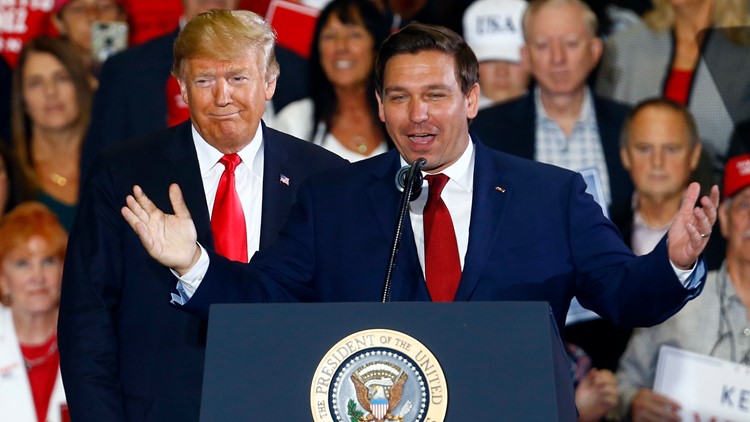
Ron DeSantis, governor of Florida, isn’t stupid. He is, however, ambitious and supremely cynical. So when he says things that sound stupid it’s worth asking why. And his recent statements on Covid-19 help us understand why so many Americans are still dying or getting severely ill from the disease.
The background here is Florida’s unfolding public health catastrophe.
We now have highly effective vaccines freely available to every American who is at least 12 years old. There has been a lot of hype about “breakthrough” infections associated with the Delta variant, but they remain rare, and serious illness among the vaccinated is rarer still. There is no good reason we should still be suffering severely from this pandemic.
But Florida is in the grip of a Covid surge worse than it experienced before the vaccines. More than 10,000 Floridians are hospitalized, around 10 times the number in New York, which has about as many residents; an average of 58 Florida residents are dying each day, compared with six in New York. And the Florida hospital system is under extreme stress.
There’s no mystery about why this has happened. At every stage of the pandemic DeSantis has effectively acted as an ally of the coronavirus, for example by issuing orders blocking businesses from requiring that their patrons show proof of vaccination and schools from requiring masks. More generally, he has helped create a state of mind in which vaccine skepticism flourishes and refusal to take precautions is normalized.
One technical note: Florida’s vaccination rate is well below the rates in the Northeast, but closely matches the national average. But seniors are much more likely to be vaccinated than younger Americans, in Florida as elsewhere; and Florida, of course, has an unusually high number of seniors. Among younger groups the state lags behind the nation as a whole, and even further behind blue states.
So, given these grim developments, one might have expected or at least hoped that DeSantis would reconsider his position. In fact, he has been making excuses — it’s all about the air-conditioning! He has been claiming that any new restrictions would have unacceptable costs for the economy — although Florida’s recent performance looks terrible if you place any value on human life.
Above all, he has been playing the liberal-conspiracy-theory card, with fund-raising letters declaring that the “radical left” is “coming for your freedom.”
So let’s talk about what the right means when it talks about “freedom.” Since the pandemic began, many conservatives have insisted that actions to limit the death toll — social distancing, wearing a mask and now getting vaccinated — should be matters of personal choice. Does that position make any sense?
[D]riving drunk is also a personal choice. But almost everyone understands that it’s a personal choice that endangers others; 97 percent of the public considers driving while impaired by alcohol a serious problem. Why don’t we have the same kind of unanimity on refusing to get vaccinated, a choice that helps perpetuate the pandemic and puts others at risk?
[T]he link between vaccine refusal and Covid deaths is every bit as real as the link between D.U.I. and traffic deaths, but is less obvious to the naked eye. But why are people on the right so receptive to misinformation on this subject, and so angry about efforts to set the record straight?
My answer is that when people on the right talk about “freedom” what they actually mean is closer to “defense of privilege” — specifically the right of certain people (generally white male Christians) to do whatever they want.
Not incidentally, if you go back to the roots of modern conservatism, you find people like Barry Goldwater defending the right of businesses to discriminate against Black Americans. In the name of freedom, of course. A lot, though not all, of the recent panic about “cancel culture” is about protecting the right of powerful men to mistreat women. And so on.
Once you understand that the rhetoric of freedom is actually about privilege, things that look on the surface like gross inconsistency and hypocrisy start to make sense.
Why, for example, are conservatives so insistent on the right of businesses to make their own decisions, free from regulation — but quick to stop them from denying service to customers who refuse to wear masks or show proof of vaccination? Why is the autonomy of local school districts a fundamental principle — unless they want to require masks or teach America’s racial history? It’s all about whose privilege is being protected.
The reality of what the right means by freedom also, I think, explains the special rage induced by rules that impose some slight inconvenience in the name of the public interest . . . After all, only poor people and minority groups are supposed to be asked to make sacrifices.
[A]s you watch DeSantis invoke “freedom” to escape responsibility for his Covid catastrophe, remember, when he says it, that word does not mean what you think it means.
What is truly scary is that Desantis, foul as he is, is considered a "rising star" within the GOP even as the death toll from his malfeasance in governing grows.
Monday, August 02, 2021

Diocese of Albany Engaged in Decades-Long Cover-Up of Sexual Abuse

Members of the U.S. Conference of Catholic Bishops are obsessing over barring Joe Biden from receiving communion due to Biden's support for reasonable abortion rights. Meanwhile, these same individuals continue efforts to avoid accountability for decades of sexual abuse of minors and youths by Catholic clergy and concerted efforts to cover up such abuse. A story out of Albany, New York, provides a view of the lies, deception, and utter indifference to the victims of abuse that characterized the Albany diocese and which sadly was replicated in dioceses all over America and the world. Having been raised Catholic - all of my family has left the Catholic Church at this point - I continue to be struck by the hypocrisy and moral bankruptcy of bishops, cardinals and popes who lectured others on morality and, of coursed, demonized LGBT individuals. Here are highlights from a piece in the Times Union:
The Roman Catholic Diocese of Albany engaged in a decades-long cover-up of chronic child sexual abuse committed by its priests by employing practices described in a recent statement from former Bishop Howard J. Hubbard, who ran the diocese from 1977 to 2014.
Hubbard’s statement, issued through his attorney in response to a series of questions from the Times Union, confirmed that the diocese shielded priests and others facing sexual abuse allegations — sending them into private treatment programs rather than contacting law enforcement officials or alerting parishioners. Some of those priests allegedly emerged from treatment and committed more crimes.
Hubbard's response comes as he is facing multiple allegations of sexually abusing a minor, and is named in dozens of additional court cases in which he stands accused of covering up abuse by others.
The bishop's acknowledgement comes as there have been roughly 300 Child Victims Act lawsuits filed against the Albany diocese, providing an unprecedented window into the organization's documented history of abuse, as well as the actions of Hubbard.
The cases name hundreds of predators and describe decades of abuse allegedly committed by priests and others who preyed on the children in their care, while using their positions to evade accountability.
For this story, the Times Union reviewed thousands of pages of court records, including once-secret documents kept by the diocese, and interviewed attorneys, survivors and experts on child abuse.
One such case unfolded around 1983, when Eileen Thompson received a tearful phone call from her teenaged nephew.
He said he'd been molested by Gerald Miller, a priest from Altamont, and didn’t know what to do. He’d confided with another adult at his school, but that person had told him, “Well, after what happened to you, you’re never going to be a real man.”
He couldn’t stop crying during the phone call, Thompson recalled.
“I have to go. I'll call you," she remembered him saying before he hung up. She expected him to call back to finish their conversation, or maybe drop by her home to see her, which he did frequently.
Instead, the next day he went to his uncle’s house in Rensselaerville and killed himself with a shotgun.
An attorney who has handled thousands of abuse cases against the church nationally said that the body of evidence suggests Albany was a "problem diocese," as both Hubbard and his former second in command, Edward Pratt, both stand accused of abuse.
Thompson was "almost hysterical" at her nephew's funeral service. She heard someone mention in passing that Miller was supposed to officiate, since he was so close with the deceased, but ultimately hadn't for some reason. A few weeks later, Thompson called the Roman Catholic Diocese of Albany and asked to speak with the bishop.
“Father Gerry is being sent to New Mexico where they have more respect for priests,” Thompson said Hubbard told her. New Mexico is the home of a now-infamous treatment site where abusive priests from around the country were sent.
Jeff Anderson, an attorney with one of the largest abuse firms in the country, compared Hubbard to former Cardinal Theodore McCarrick. A former powerful figure in the American Catholic church, McCarrick was defrocked due to allegations of child abuse, and on Friday was charged with sex crimes against a 16-year-old boy in the 1970s.
Hubbard "was able to protect himself and all of his priests at the same time, doing the same things that McCarrick did. As an offender and also as someone who was in complete control over all the clerics," Anderson said. "He was able to protect himself without accountability to anybody, to protect so many offenders. So many kids and so many months, years and decades.”
Attorneys for many of the alleged victims said they are seeking to prove that the diocese’s practices enabled abuse. They're seeking personnel files from all accused priests, not just the ones who allegedly abused their clients; the diocese is fighting that request in court. But an appellate judge recently ruled that the diocese must turn over the records in the coming weeks.
Given the Catholic Church's continued refusal to accept a full accounting for the abuse it allowed and in some ways fostered, I find it difficult to comprehend how moral individuals can remain members of the Church..

Youngkin’s "Economic Plan" Would Harm Virginia

As Virginia Democrats have run the table in every statewide election since 2009, Republican gubernatorial aspirants have reverted to the same failed three-step playbook:
- Declare the state’s economy is in a tailspin.
- Promise to jump-start it by drastically slashing taxes, while insisting no harm would result to critical state services.
- Pledge to shrink public spending by eliminating unidentified waste, fraud and abuse.
Now comes Glenn Youngkin, Virginia’s current Republican gubernatorial nominee — a slicker, wealthier version of past GOP hopefuls who poses as a new kind of candidate while peddling much the same nonsense.
Mr. Youngkin, who made a fortune in private equity, says Virginia’s economy is “in the ditch” — an assertion flatly contradicted by a tsunami of evidence to the contrary. And, like his predecessors, he claims lower tax bills are the elixir that would cure what ails the commonwealth.
That very baloney was also peddled by Republicans Ed Gillespie, who lost the governor’s race in 2017; Corey Stewart, who narrowly lost the GOP primary that year to Mr. Gillespie; and former state attorney general Ken Cuccinelli, who lost in 2013. In each case, the conceit was that cutting taxes would attract new businesses to Virginia and help them grow faster. But what businesses, and which employees, would flock to a state that would decimate its tax base, thereby starving schools, roads, health care, parks, prisons and police of resources?
Here are the facts. Virginia’s individual income tax — the target of Mr. Youngkin’s fever dream — accounts for 72 percent of the state’s $43.5 billion of revenue in the current two-year general fund budget. (Most of the rest comes from sales, corporate and other taxes.) Take an ax to the income tax, and funding for vital services is decimated.
That’s not theory; it’s been tried, recently — in Kansas and Louisiana, in both cases by Republican governors who promised that cutting taxes would generate higher growth. In fact, the predictable result was that revenue shriveled, and so did state support for services Democrats and Republicans alike care about. In fact, eliminating Virginia’s income tax is a perfect recipe for defunding the police, the very policy Mr. Youngkin (falsely) accuses Virginia Democrats of favoring.
The GOP tax-cutting experiments in Kansas and Louisiana were disasters. In both cases, the damage was severe, and the tax cuts were rolled back.
What makes Mr. Youngkin’s proposal even more preposterous is that Virginia’s economy is robust. Unemployment is significantly below the national average. Residents’ tax burden is squarely in the middle of the nationwide pack. The state government is running a $2 billion budget surplus, boasts a AAA bond rating (putting it in the top dozen states nationally) and is regularly ranked among the best states for business.
If Virginians want to see an economy run “into the ditch,” Mr. Youngkin’s plan would do the trick.
Youngkin must be defeated in November. We do not need a reprise of failed GOP policies that did extreme harm to schools and necessary public services.
Sunday, August 01, 2021

The Insurrection Was Just Part of the Plot

For raw emotional content, [last] Tuesday’s hearing of the new House select committee to investigate the January 6 insurrection was nonpareil. Four police officers who fought to hold back armed hordes seeking to disrupt Congress told stories of physical injury, racist abuse, and post-traumatic distress. Even for Americans who paid close attention to the crisis, these stories added new texture and horror.
But the House Oversight Committee shed more light this week on just how and why January 6 happened, releasing handwritten notes by Richard Donoghue, a top Justice Department official in the waning days of the Trump administration. The violence of the day has taken center stage, but these notes help put it in context: The angry crowd was just one part of President Donald Trump’s long-running effort to overturn the results of the election in the House of Representatives.
Trump’s effort to call the election results into doubt began long before the votes were cast, but it accelerated immediately after the election. As I wrote on January 26, Trump’s coup attempt started not on January 6 but in the wee hours of November 4, when Trump said at the White House, “This is a fraud on the American public. This is an embarrassment to our country. We were getting ready to win this election.” He added: “Frankly, we did win this election.” (He did not, and was not being frank.)
In November and early December, the focus of Trump’s efforts was pressuring state officials in places such as Arizona and Georgia to decline to certify results in favor of Biden, and pressing Attorney General William Barr to cast doubt on the results. But Barr declined, breaking with Trump, and so did pivotal Republicans including Georgia Secretary of State Brad Raffensperger and Arizona Governor Doug Ducey. Once Barr was pushed aside, The Washington Post reported this week, Trump began a daily campaign to pressure Acting Attorney General Jeffrey Rosen into doing what Barr would not . . . . Unbeknownst to Rosen, Trump was also orchestrating a plan to topple him.
What Trump hoped to achieve from these efforts has always been a little hazy. The Justice Department doesn’t certify elections, and at most could have pursued fraud claims in court—had there been any credible ones, which there were not. The new releases by the House Oversight Committee, first reported by The New York Times, connect the dots. Donoghue explained to Trump that the DOJ couldn’t overturn the result, but the president was unruffled.
“Don’t expect you to do that, just say that the election was corrupt + leave the rest to me and the R[epublican] Congressmen” is how Donoghue recorded Trump’s response in handwritten notes.
All Trump wanted was some semi-independent arbiter to declare the election fraudulent—whether that was the governor of Arizona, the Georgia secretary of state, or the U.S. Justice Department. This much was clear even then, but Trump’s endgame was not. . . . . he didn’t need any of these officials to set aside the results on their own. He just needed enough ammunition, no matter how tenuous, that he could derail certification of the election in Congress.
If the election couldn’t be decided based on the results, then it would go to the House of Representatives. Though Democrats held a majority there, the presidency would have been decided by state delegations, of which Republicans controlled more.
The Justice Department refused to say the election was stolen, of course. Ahead of January 6, Trump tried his last two options. First, he pressured Vice President Mike Pence, both publicly and privately, to refuse to certify the results, but Pence concluded that he had no constitutional authority to do so. Trump also summoned a crowd to Washington and demanded they fight. They did, but it didn’t work. Despite the assault on the Capitol, the election was certified, and Biden was inaugurated 14 days later.
The violence has taken center stage recently. General Mark Milley, the chairman of the Joint Chiefs of Staff, reportedly feared that Trump was contemplating a military coup, and took measures to ensure he couldn’t misuse troops.
What is becoming clear is that the violence, though abhorrent, was simply a part of the bigger and more dangerous plot, not the culmination of it. Although Trump clearly had no problem with the riot, there is no evidence that Trump envisioned a violent coup, and as the attack on the Capitol unfolded, he watched, bemused, from the White House, neither calling off the attackers nor doing anything more to spur them on.
Could Trump’s plan to toss the election to the House have worked, if only Barr or Raffensperger or Rosen or Donoghue or Pence had been willing to go along? The answer is ultimately unknowable, but depends in part on how you define success.
Yet even if the House gambit had failed, a public decree of a corrupt election by the Justice Department or the vice president would have been catastrophic in its own right. Trump had his finger on the pulse of his backers. (“You guys may not be following the internet the way I do,” the extremely online president told DOJ officials, and he was almost certainly right.) Despite the lack of evidence of fraud tainting the 2020 results, huge numbers of Republicans tell pollsters they don’t trust the election system. If Trump had managed to twist some other authority into giving the claims of fraud its imprimatur, the damage to faith in elections would be deeper.
If the country is to reckon with what happened on January 6, the focus will need to be less on the tactical movements—whether by police or by Oath Keepers—around the Capitol, and more on the strategic choices that Trump was making further up Pennsylvania Avenue throughout the postelection period.
What is frightening is that Republicans across the country are working to replace moral individuals who refused to yield to Trump's pressure with either Trump cultists and/or spineless individuals who will do the bidding of a would be autocrat.
Subscribe to:
Posts (Atom)