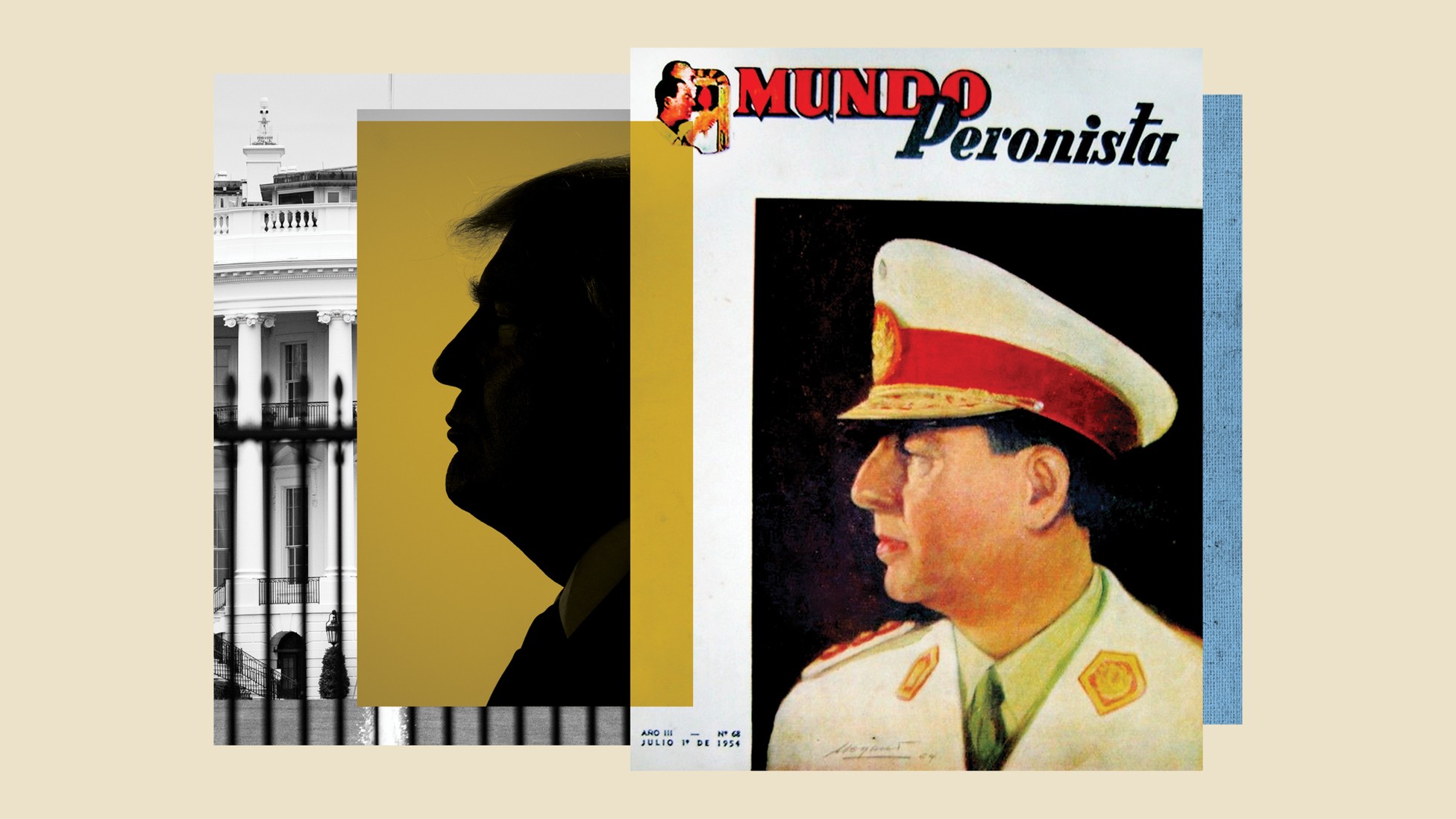
When the populist strongman Juan Perón ran Argentina’s economy from his presidential palace in the mid-20th century—personally deciding which companies received favors, which industries got nationalized or protected, and which businessmen profited from state largesse—economists warned that the experiment would end badly. They were right. Over decades of rule by Perón and his successors, a country that had once been among the world’s wealthiest nations devolved into a global laughingstock, with uncontrollable inflation, routine fiscal crises, rampant corruption, and crippling poverty. Peronism became a cautionary tale of how not to manage an economy.
President Donald Trump[The Felon] seems to have misunderstood the lesson. His second term has begun to follow the Peronist playbook of import substitution, emergency declarations, personal dealmaking, fiscal and monetary recklessness, and unprecedented government control over private enterprise. And, as with Argentina’s Peronism, much of U.S. economic policy making runs directly through the president himself.Trump’s tendency toward Peronist policy is strongest on trade. Central to Perón’s economic vision was an “import substitution industrialization” strategy, or ISI, that used tariffs, quotas, subsidies, localization mandates, and similar policies to push Argentines to produce domestically what they’d previously imported more cheaply from abroad. The approach was intended to fuel domestic growth, but it instead created insular and uncompetitive manufacturing industries saddled with high production costs, bloated finances, and rampant cronyism. Perversely, it also crushed Argentina’s globally competitive agricultural sector by diverting resources away from it and toward protected industries. Argentinian consumers suffered from higher prices, unavailable products, and lower overall living standards.
One of the most notorious examples of ISI’s failure was when the government of the Peronist President Cristina Kirchner attempted to incubate a local electronics industry through steep restrictions on imported televisions and smartphones. The result was disastrous: Modest increases in low-value domestic-assembly operations were more than offset by a market that featured substandard products priced at double what consumers were paying in neighboring Chile.
Trump’s second term is following the ISI playbook in several respects, in some cases even more so than Argentina did. According to the World Bank, for example, Argentina’s average tariff rate has hovered between 10 and 16 percent since 1992, while the Yale Budget Lab estimates that the United States’ now exceeds 18 percent and could go higher in the months ahead. “National security” tariffs for Trump’s preferred industries—including steel, aluminum, copper, and automotive goods—top out at 50 percent, well above the 35 percent duty that Argentina once applied to smartphones.
Trump’s Peronist tactics extend well beyond import substitution. Perón, for example, nationalized entire industries—railways, airlines, telecommunications, utilities—creating chronically loss-making state enterprises that endured for decades. Trump hasn’t gone nearly that far, but is exerting an astonishing degree of government control over private companies’ commercial operations. The Trump administration forced Japan’s Nippon Steel to give the U.S. president a “golden share” in U.S. Steel in order to acquire it, and required the U.S. semiconductor firms AMD and Nvidia to give the government a 15 percent cut of their China sales in exchange for export approvals. The administration also took a 15 percent stake in the rare-earth miner MP Materials and a 10 percent stake in Intel, in each case making Uncle Sam the company’s largest shareholder.
These aren’t temporary crisis measures, such as the U.S. bank and auto bailouts or wartime acquisitions of decades past. They’re permanent arrangements that give the state substantial influence over private transactions and decisions. And various administration officials, as well as Trump himself, have promised more of these deals in tech, defense, and other industries.
Trump has also flirted with Peronism in fiscal and monetary policy. Perón took control of Argentina’s central bank and used expansionary monetary policy to finance massive government spending and deficits, which led to chronic inflation. Trump, for his part, has already added trillions of dollars in new U.S. debt via the One Big Beautiful Bill Act, while also seeking to smash the independence of the Federal Reserve in order to adopt expansionary U.S. monetary policy in the face of still-warm inflation.
Perhaps the president’s most Peronist trait is the way in which he enacts his policies. Peronists, for example, acquired and then routinely deployed broad “emergency” powers to implement their statist economic policies quickly and unilaterally. Trump has similarly declared multiple national emergencies to justify his rapid imposition of global tariffs, as well as extra penalties for China, India, and Brazil, under the International Emergency Economic Powers Act. Should the Supreme Court decide that those “emergency” moves are lawful, Trump will have effectively unlimited power over tariffs and trade—a startling expansion of executive authority and a departure from our Constitution’s separation of powers.
Perón didn’t just set broad economic policy—he personally decided which companies succeeded or failed, which sectors received government support, who got access to foreign currency, and more. Trump’s second term features a similar approach, with Trump’s own preferences, interests, and personal connections driving U.S. policy making.
Trump’s first term featured a trade regime that was at least open and transparent. This time around, deals are being made behind closed doors, and special treatment is being earned from political connections and power. Those without the president’s ear don’t stand a chance. The centralization of economic decision making is decidedly Peronist: rewarding friends and punishing enemies through state power.
Trumpism isn’t full-blown Peronism yet. . . . . But each emergency declaration, Oval Office favor, and presidential intervention into private enterprise moves us closer to the Argentine model, and will make reversing course more difficult.
Peronism created vested interests—companies, cronies, unions, government officials, and more—that became dependent on the state and successfully resisted systemic reforms for decades. Trump is creating a similar dynamic today.
When a nation’s economic policy depends on personal whims and relationships rather than consistent rules applied equally to everyone, it has abandoned market capitalism. Argentina took almost 80 years to begin moving back. Let’s hope the United States moves sooner.


No comments:
Post a Comment