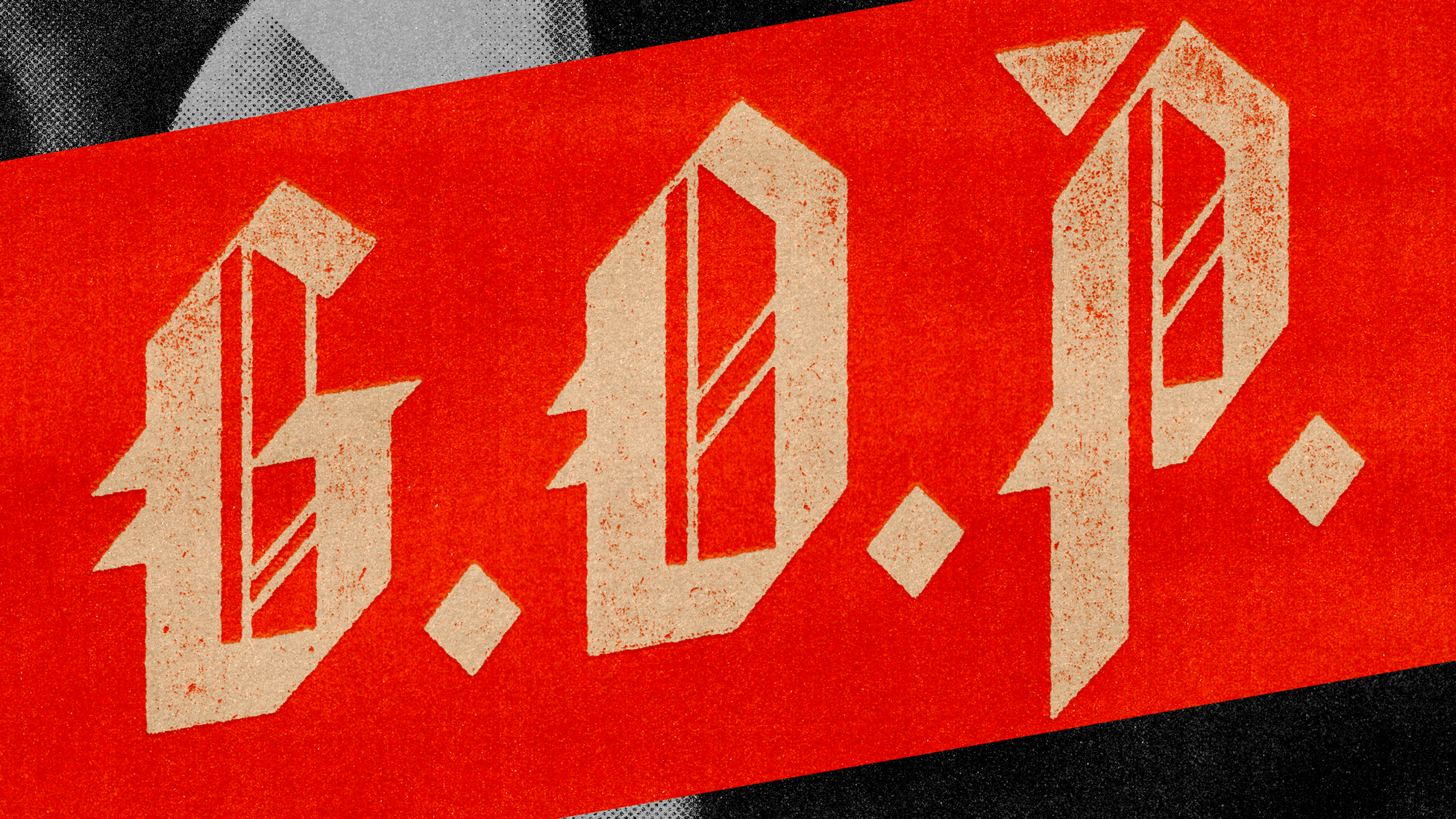
Over the past few months, during his agency’s chaotic crackdowns in Chicago and Minneapolis, the U.S. Border Patrol chief Greg Bovino has worn an unusual uniform: a wide-lapel greatcoat with brass buttons and stars along one sleeve. It looks like it was taken right off the shoulders of a Wehrmacht officer in the 1930s. Bovino’s choice of garment is more than tough-guy cosplay (German media noted the aesthetic immediately). The coat symbolizes a trend: The Republicans, it seems, have a bit of a Nazi problem.
By this, I mean that some Republicans are deploying Nazi imagery and rhetoric, and espouse ideas associated with the Nazi Party during its rise to power in the early 1930s. A few recent examples: An ICE lawyer linked to a white-supremacist social-media account that praised Hitler was apparently allowed to return to federal court. Members of the national Young Republicans organization were caught in a group chat laughing about their love for Hitler. Vice President J. D. Vance shrugged off that controversy, instead of condemning the growing influence of anti-Semites in his party.
Even federal agencies are modeling Nazi phrasing. The Department of Homeland Security used an anthem beloved by neo-Nazi groups, “By God We’ll Have Our Home Again,” in a recruitment ad. The Labor Department hung a giant banner of Donald Trump’s face from its headquarters, as if Washington were Berlin in 1936, and posted expressions on social media such as “America is for Americans”—an obvious riff on the Nazi slogan “Germany for the Germans”—and “Americanism Will Prevail,” in a font reminiscent of Third Reich documents.
Trump, of course, openly pines to be a dictator. In his first term, he reportedly told his chief of staff, General John Kelly, that he wished he had generals who were as loyal as Hitler’s military leaders. (The president was perhaps unaware of how often the führer’s officers tried to kill him.) More recently, the White House’s official X account supported Trump’s pursuit of Greenland by posting a meme with the caption “Which way, Greenland man?” That is not merely a clunky turn of phrase; it’s an echo of Which Way Western Man?, the title of a 1978 book by the American neo-Nazi William Gayley Simpson, a former Presbyterian minister who called for America to expel its Jewish citizens.
The people pushing such trash are offended by the accusation that they are pantomiming Nazis. . . . But when even Laura Loomer—conspiracy theorist and ardent Trump supporter—says on social media that “the GOP has a Nazi problem,” then perhaps the GOP has a Nazi problem.
As a former Republican, I’m aware that the American conservative movement has spent generations fighting off intrusions from the far right, including the John Birchers and the Ku Klux Klan. But I am still surprised and aggrieved by how quickly 21st-century Nazism has found a home in the party of Lincoln. . . . Today, Trump and his party haven’t bothered to even pretend to be appalled by the degenerates gathering under the GOP aegis.
So how did a major American political party become a safe space for such people? When I first joined the GOP, in 1979, the party around me did not seem hospitable to Nazis. . . . I was, like many people then, a resolute ticket-splitter, voting often for local Democrats but always for Republican presidents, because I believed the national GOP was a moderate institution. Ronald Reagan, for example, disappointed the far right and his evangelical base by reducing nuclear weapons, leaving abortion rights largely untouched, and granting mass amnesty to undocumented immigrants . . . .
I first encountered the fringe elements of the conservative base in 1990, when I went to work in the U.S. Senate for John Heinz of Pennsylvania. I remember fielding an angry phone call from a constituent who grilled me about whether the senator was part of a globalist one-world-government conspiracy.
The country and the GOP were in the hands of Bush, the ultimate moderate, but extremists were making inroads to power. The populist demagogue Pat Buchanan, crusading against modernity and multiculturalism, challenged Bush in 1992 and garnered 23 percent of the Republican-primary vote. Bush, in turn, gave him the stage at the Republican National Convention in Houston. Buchanan’s speech, which envisioned a “religious war” for the country, shocked many Americans.
A few years later, Representative Newt Gingrich of Georgia carried Buchanan’s culture war into the House speakership. For Gingrich, politics was solely about winning; his scorched-earth approach treated opponents as enemies and compromise as treason. He wanted votes, and wasn’t concerned about who was animated by his viciousness.
Later Republican presidential nominees—good men such as John McCain and Mitt Romney—represented the moderate coalition that had brought people like me into the party. As they stood in the center of the GOP tent, they began to see who was now lurking in the back. In 2008, the nation saw too, when McCain had to defend Barack Obama as a “decent family man” to a delusional town-hall participant who had obviously imbibed racist right-wing propaganda.
By the time Romney was running against Obama, in 2012, Trump had launched his political career by pushing the “birther” lie, which capitalized on racial animus toward the 44th president. Rather than try to push Trump out of the tent, Romney accepted his endorsement. McCain came to be viewed as a traitor by the Republican base; Trump made that permissible by mocking his war-hero status.
In his third run for office, Trump expanded his vote share despite embracing fascist themes of xenophobia, nationalism, and glorification of violence. I didn’t want to see what was happening to the Republican Party, until the durability of Donald Trump made it impossible to ignore.
[R]acism is the original sin of the modern Republican Party. White voters were alienated by the passage of the Civil Rights Act in 1964 and the violence around the 1968 Democratic primaries. As Black voters deserted Republicans, the segregationist George Wallace proved with his ’68 presidential run that white southerners were up for grabs. Richard Nixon made a cunning and cynical calculation to sweep up those disaffected white voters, using appeals to “law and order” to stoke racial anxiety. By the 1970s, the GOP was the de facto white party in the United States. . . . years of racial pandering had created a too-big tent, enlarged in the name of electoral expediency, that offered dark corners for despicable ideologies.
Political realignment also made the GOP vulnerable to extremism. Democrats became appealing to wealthy suburbanites. Republicans, whose voters were now less educated and more working-class, gained among white voters in rural areas and the Rust Belt. Gerrymandering helped turn red districts redder and blue districts bluer. Democrats’ more diverse constituencies were a built-in trip wire against politicians who cozied up to extremists, while Republican-primary candidates—influenced by the rise of talk radio, Fox News, and the Tea Party—were not subjected to serious moderate challengers. Unprincipled and bizarre candidates could now thread a path to victory in ruby-red districts.
Critics of the GOP have long argued that something like the Trump movement, and the emergence of a new American Nazism, was inevitable—that conservatism, as a belief system, inevitably decays into fascism. . . . . Without Reagan, the Reaganite coalition began to dissolve in the face of Buchanan’s angry populism and Gingrich’s cold opportunism. The Republican Party, as an institution, weakened over time, until it could be hijacked by an aspiring dictator. Republican leaders who warned against Trump in 2016—senators such as Ted Cruz, Lindsey Graham, and Mike Lee—soon discarded conservative principles to protect their jobs. Their eager amorality has allowed extreme elements to use the GOP as a vehicle for bigotry and rage. Racism and hate are now structural parts of the Republican Party, replacing consensus, compassion, and compromise. Trump started his second presidency by pardoning the insurrectionists who’d wanted to unlawfully extend his first. Little wonder that fascists and other miscreants feel welcome.
Some Republicans lament these developments and still hold fast to conservative principles and policy ideas. But their party has laid out a welcome mat for an ideology that Americans once had to defeat in combat, at the cost of millions of lives. If wannabe Nazis now confidently roam the halls of power—and the streets of American cities—it is because Republican leaders have made them feel at home.
What can Americans do in the face of moral rot in a major political party? The only short-term answers are shaming, shunning, and mockery—and punishment at the polls. Decent citizens must ostracize those among them who toy with Hitlerism. Americans—especially journalists—should resist becoming inured to fascist rhetoric. No one should rely on euphemisms about “extreme” comments or “fiery” speeches. Call it what it is: Nazi-like behavior.
When a Gen Z Republican focus group has 20-somethings talking about how Hitler “was a great leader,” even if “what he was going for was terrible,” something is amiss not only in the Republican Party but also in America’s homes, schools, and neighborhoods.
Whatever their intentions, some Americans are expressing or abetting ancient hatreds, smirking at the mention of Hitler, and plastering public spaces with images that Allied soldiers once tore from the walls of destroyed German cities. Political leaders who encourage or tolerate such scoundrels should be driven from office.
The Republicans have a Nazi problem, yes. But this means that the United States also has a Nazi problem. The responsibility for defeating it in the 21st century falls, as it did in the 20th, to everyone—of any party or creed—who still believes in the American idea.


1 comment:
It was clear Nazism with the Proud Boys and those tiki torches....
The Repugs welcomed them. Cankles said there were 'good people' in their ranks. The writing was on the wall. But the United States has always had that ugly underbelly. These men are exactly the opposite of their great grandfathers: they have no moral compass and are blinded by ideology. We are fucked.
XOXO
Post a Comment