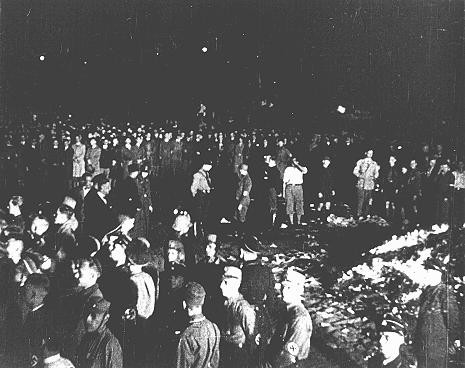
The warlords who sacked Rome did not intend to doom Western Europe to centuries of ignorance. It was not a foreseeable consequence of their actions. The same cannot be said of the sweeping attack on human knowledge and progress that the Trump administration is now undertaking—a deliberate destruction of education, science, and history, conducted with a fanaticism that recalls the Dark Ages that followed Rome’s fall.
Every week brings fresh examples. The administration is threatening colleges and universities with the loss of federal funding if they do not submit to its demands, or even if they do. The engines of American scientific inquiry and ingenuity, such as the National Science Foundation and the National Institutes of Health, are under sustained attack. Historical institutions such as the Smithsonian and artistic ones like the Kennedy Center are being converted into homes for MAGA ideology rather than historical fact and free expression. Libraries are losing funding, government-employed scientists are being dismissed from their jobs, educators are being cowed into silence, and researchers are being warned not to broach forbidden subjects. Entire databases of public-health information collected over decades are at risk of vanishing. Any facts that contradict the gospel of Trumpism are treated as heretical.
The Trump administration has launched a comprehensive attack on knowledge itself, a war against culture, history, and science. If this assault is successful, it will undermine Americans’ ability to comprehend the world around us. Like the inquisitors of old, who persecuted Galileo for daring to notice that the sun did not, in fact, revolve around the Earth, they believe that truth-seeking imperils their hold on power.
By destroying knowledge, Trumpists seek to make the country more amenable to their political domination, and to prevent meaningful democratic checks on their behavior. Their victory, though, would do much more than that. It would annihilate some of the most effective systems for aggregating, accumulating, and applying human knowledge that have ever existed.
Perhaps the most prominent targets of the attack on knowledge have been America’s institutions of higher education. Elite colleges and universities have lost billions of dollars in federal funding. . . . . In some cases, the administration has made specific demands that institutions adhere to Trumpist ideology in what they teach and whom they hire, or face a loss of funding.
The Trump administration’s purge of forbidden texts and ideas at West Point offers a glimpse of what its ideal university might look like. At the military academy, The New York Times reported, leadership .“initiated a schoolwide push to remove any readings that focused on race, gender or the darker moments of American history.” A professor who “leads a course on genocide was instructed not to mention atrocities committed against Native Americans, according to several academy officials. The English department purged works by well-known Black authors, . . . .
The right-wing activist Chris Rufo recently told The New York Times that in addition to using funding to force universities to teach or adhere to conservative dogma, he would like to “reduce the size of the sector itself.” Students will have fewer opportunities. Research in many fields will be put on indefinite pause. America will make fewer scientific breakthroughs. The Trump administration’s attack on knowledge is not limited to academia, however. Across the government, workers whose job is to research, investigate, or analyze have lost funding or been fired. These are people who do the crucial work of informing Americans about and protecting them from diseases, natural disasters, and other threats to their health.
The most devastating cuts may be those to the government’s scientific-research agencies, such as the NIH and NSF. According to CBS News, since January, more than $2 billion has been cut from NIH and 1,300 employees have been fired. One former NIH employee told CBS that “work on child cancer therapies, dementia, and stroke slowed or stopped because critical lab and support staff were let go.”
Also gone are years’ worth of public-health data, which, as my colleague Katherine J. Wu has reported, have been removed as part of the “ongoing attempt to scrub federal agencies of any mention of gender, DEI, and accessibility.” This includes both previously published research and works in progress. . . . Secretary Robert F. Kennedy Jr. appears to have eliminated more than a dozen “data-gathering programs that track deaths and disease,” which, perhaps not coincidentally, will make evaluating his destructive tenure more difficult.
Trump has sought to justify these cuts by exploiting Americans’ bigotry or ignorance . . . . the clear purpose of such misleading descriptions is to hide the gravity of what is being stolen from the American people by pretending that it has no value.
The first-order effects of the attack on knowledge will be the diminution of American science and, with it, a decline in the sorts of technological achievements that have improved lives over the past century. Modern agriculture and medicine were built on the foundation of federally funded research.
For the past century, state-funded advances have been the rule rather than the exception. Private-sector innovation can take off after an invention becomes profitable, but the research that leads to that invention tends to be a costly gamble—for this reason, the government often takes on the initial risk that private firms cannot.
But a massive technological stall is only the most apparent aspect of the coming damage. The attack on knowledge also threatens the country’s ability to address subtler social problems, such as racial and economic inequalities in health, opportunity, and civil rights. Research into these disparities is being cut across government and civil society in the name of defeating so-called wokeness. Invoked as a general criticism of left-wing excess, the fight against “wokeness” is destroying huge swaths of scholarship and research, for fear the results might make the case for racial or gender equality, the redistribution of wealth, or the regulation of industry. . . . . this stems from the administration’s ideological discomfort with the facts of this world, and the conclusions scholars draw from them. “It turns out that when you pay close attention to these issues, you don’t end up where they end up,” he added. “So they’ve had to manufacture their own facts, and they’re attacking the places that have the facts on the ground and the reality of history.”
The Trumpist campaign against American history in schools and museums reflects the same impulse. The administration issued an executive order to coerce K–12 public schools into teaching a distorted, one-sided view of American history that excludes or whitewashes its darker episodes.
A Black-history museum in Boston—located in a meetinghouse where the abolitionists Frederick Douglass and William Lloyd Garrison once lectured—is in danger now that its federal grant was terminated on the grounds that it “no longer align[s] with the White House policies.” Trump has also threatened the Smithsonian over descriptions of exhibitions that contradict right-wing dogma, including one at the American Art Museum that stated, “Race is not a biological reality but a social construct.” That race is a malleable social construct and not a biological reality is a matter of genetic science, but one that contradicts the Trump administration’s implicit belief that social inequalities stem from the inherent capabilities of different groups rather than discrimination or public policy.
Further destruction is still coming. Of particular concern is the risk that the administration will manipulate economic data to hide the disastrous effects of Trump’s policies. . . . . Objective economic data have become even more important given Trump’s ruinous attempt to replace the income tax—a windfall for the rich—with tariffs. Trump reversed course on some of his recent tariffs last month once bond yields began to rise steeply, an indication of impending catastrophe. Avoiding such a catastrophe requires unimpeachable data, but should one occur, the Trump administration may decide that political survival requires lying. Such lies are more effective without the data to contest them.
The reasons for this wholesale destruction are as ideological as they are short-sighted. Conservatives have made no secret of their hostility toward higher education and academia. In 2021, as my colleague Yair Rosenberg recently noted, J. D. Vance, then a Senate candidate, gave an address in which he quoted Richard Nixon saying, “The professors are the enemy,” and laid out his belief that colleges and universities “make it impossible for conservative ideas to ultimately carry the day.”
The Trump administration wants fewer highly educated workers, and it wants them as a group to be whiter and from wealthier families. . . . . Trump and his allies see highly educated people, in the aggregate, as a kind of class enemy of the MAGA project. Highly educated voters have trended leftward in recent elections, a phenomenon that has not-so-coincidentally appeared alongside the conservative movement’s growing conviction that higher education must be brought under right-wing political control. In short, destroying American universities will also limit the growth of a Democratic-trending constituency—fewer educated voters will translate to fewer Democrats in office.
Many of Trump’s supporters have come to see knowledge-producing institutions and the people who work for them as sources of liberal indoctrination that must be brought to heel or destroyed, and they do not want Americans trusting any sources of authority that are not Trump-aligned.
Trump’s attack on knowledge will harm not just the so-called elites he and his allies are punishing. The long-term price of solidifying their power in this way will be high—perhaps even higher than Trumpism’s wealthy benefactors expect. One obvious cost is the damage to technological, scientific, and social advancement. Another will be the impossibility of self-governance, because a public denied access to empirical reality cannot engage in self-determination as the Founders imagined.
A population dependent on whatever engagement-seeking nonsense is fed to them on a manipulated social-media network is one that is much easier to exploit and control. By destroying knowledge, including the very scholarship that would study the effects of the administration’s policies on society, the Trump administration and its allies can ensure that their looting of the federal government and public goods can never be fully rectified or punished.


1 comment:
It’s almost inconceivable that people do not find this alarming.
But people in the US tend to not worry about things that do not affect them until it does. And then it’s going to be too late.
XOXO
Post a Comment